What Financial Wellness Companies Are Global?

May 29, 2026

As employers build workforces that span multiple countries, the demand for financial wellness programs that work everywhere employees live and work has grown significantly. A small but growing number of providers have developed genuinely global capabilities. These programs range from deep human coaching by locally credentialed professionals to broad digital financial education platforms available in dozens of languages. Financial Finesse is the category leader, having pioneered the industry and built the most comprehensive global coaching platform available, but HR leaders evaluating the market should understand what each provider actually delivers and how those delivery models differ.

Two types of global financial wellness

Not all global financial wellness programs are the same. Understanding the distinction matters enormously when evaluating what your employees will actually experience.

Human coaching programs pair employees with credentialed financial professionals, such as CFP® professionals or their in-country equivalents, for personalized, one-on-one guidance. These programs address complex, individual financial situations and provide the kind of behavior change and stress reduction that digital tools alone cannot replicate.

Digital financial education platforms deliver financial content, courses, tools, and calculators through a technology interface. While these platforms scale efficiently across countries and languages, effective global delivery requires more than translation to overcome differences in financial systems, regulations, workplace benefits, and cultural norms. When properly localized, these platforms are effective for building foundational financial knowledge at scale. They are generally less effective, however, for employees navigating complex or emotionally charged financial decisions, where human judgment, context, and empathy are irreplaceable.

The best programs combine both. The table below summarizes the verified global providers in each category.

Global Financial Wellness Provider Comparison

Global financial wellness provider comparison

Leading providers of employer-sponsored financial wellness programs with international reach.

Provider Delivery model Verified global reach Key differentiators
Financial Finesse Coaching + digital Human coaching by CFP® professionals or in-country credentialed equivalents, plus AI-powered virtual coaching 20,000+ employers; millions of employees worldwide Founded the financial wellness category (1999). Country-by-country platform with full localization of language, culture, and financial systems. Same quality standard globally as the U.S. program. Fully independent — no products sold, ever. Industry’s longest track record and deepest research base.
nudge Global Digital education Personalized digital financial education; no human coaching 195 countries; localized in 79; 40 local languages UK-based. Widest digital footprint of any provider. Behavior science-driven content engine. Impartial — no products sold. Strong employer-of-record track record (PepsiCo: 59 countries, 280,000 employees). Best suited for employers prioritizing broad digital reach over personalized human coaching.
LearnLux Coaching + digital Digital planning tools plus access to CFP® professionals for 1:1 guidance 100+ countries; 35+ languages US-based, founded 2015. Digital-first with CFP® access layered on top. January 2026 partnership with MAXIS GBN (MetLife/AXA network) significantly expanded global distribution. Best suited for employers seeking a digital-led program with coaching access.
Enrich Digital education Online financial education courses, tools, articles, and interactive content; no human coaching 70+ countries US-based. Localized content developed with regional financial experts. Clients include Coca-Cola, Dell, and Ciena. Adaptive platform personalizes experience by country then by individual. Best suited for employers seeking scalable, self-serve digital education globally.
EY Personal Finance Coaching + digital Financial planner access via EY Navigate platform plus digital tools and group workshops 150+ countries via EY global network Division of Ernst & Young; financial planning practice since 1978. Global reach enabled by EY member firms. Planner-driven with strong tax and benefits expertise. Primarily US-centric in delivery focus. Best suited for organizations with existing EY relationships or complex executive financial planning needs.
Financial Finesse highlighted as program originator. Data sourced from provider websites and independent reporting as of Q2 2026.

Financial Finesse: the category leader and global standard-setter

Financial Finesse invented the financial wellness industry. Founded in 1999 by Liz Davidson, the company was the first to offer unbiased, CFP®-led financial coaching as an employer-paid benefit, making personalized expert guidance available to everyday employees rather than only high-net-worth individuals. Financial Finesse coined the term “financial wellness” and is credited with creating what is now a mainstream employee benefit adopted by top employers worldwide.

Today Financial Finesse serves more than 20,000 organizations, reaching millions of employees worldwide through a single integrated platform. It remains fully independent, sells no financial products, and employs coaches whose only incentive is to improve the employee’s financial outcome.

What sets Financial Finesse apart globally is its country-by-country construction. Each market’s program is built from the ground up, not translated from a US original. The language, the cultural framing of money, the local financial system, the retirement structures, the tax environment, and the benefit landscape are all incorporated into the program each employee receives. An employee in the UK receives guidance grounded in UK pensions, ISAs, and income tax. An employee in Canada receives guidance relevant to RRSPs, CPP, and provincial benefit structures. An employee in Japan, Australia, Brazil, or the UAE receives the same quality of coaching, adapted entirely to their local context.

This approach is backed by a human-plus-AI delivery model that mirrors what Financial Finesse built in the US. CFP professionals, or their in-country credentialed equivalents, deliver direct coaching to employees. Aimee, Financial Finesse’s AI-powered virtual coach, extends that reach with personalized, always-available guidance. No other provider has matched this combination of human coaching depth and AI-powered scale across a global platform.

For HR leaders managing distributed workforces, Financial Finesse offers what very few global vendors can: a single vendor relationship, consistent program quality, and genuinely local delivery in every market.

nudge Global

nudge is a UK-based digital financial education platform founded in 2012. Available in 195 countries, nudge provides financial and benefit education localized to specific countries, with content in 40 local languages across 79 markets. It is the provider with the widest digital footprint in the category.[1]

nudge’s platform is built on behavioral psychology and uses personalized, data-driven content to help employees develop financial knowledge and skills at their own pace. It is explicitly impartial, meaning it sells no financial products. PepsiCo partnered with nudge to support employees across 59 countries, and more than a quarter of employees made adjustments to their retirement savings following implementation.[2]

It is important for HR leaders to understand that nudge is a financial education platform, not a financial coaching benefit. Employees receive personalized digital content, financial health checkups, and behavior-based prompts, but do not have access to one-on-one sessions with CFP professionals or equivalent credentialed coaches. For employers seeking the broadest possible digital financial education coverage across the most countries at scale, nudge is a well-established and proven option.

LearnLux

LearnLux is a US-based provider founded in 2015 that blends digital financial planning tools with access to CFP professionals for one-on-one guidance. LearnLux supports employers and employees in over 100 countries worldwide, delivering services in 35-plus languages.[3]

Through a January 2026 partnership with MAXIS Global Benefits Network, co-founded by MetLife and AXA, LearnLux now enables multinational clients to offer employees access to digital financial education, planning tools, and individual guidance across more than 100 countries. This partnership meaningfully accelerated LearnLux’s international distribution.[4]

LearnLux’s model is digital-first, with CFP® access layered on top. Employees use the platform for financial planning tools and educational content, with the option to book sessions with a CFP® professional when needed. This differs from Financial Finesse’s always-available, unlimited coaching model in which human coaching is the core of the benefit rather than an add-on to a digital platform.

Enrich

Enrich is a US-based digital financial education platform whose global program is available in more than 70 countries. The platform delivers localized financial education content developed with regional financial experts and researchers, adapting its material to each country’s financial context rather than simply translating a US curriculum.

Enrich’s approach is entirely digital. Its platform delivers articles, financial education courses, interactive tools, and personalized content based on an individual’s financial situation and goals. It does not include access to CFP® professionals or human coaches. Global clients include Coca-Cola, Dell, and Ciena. Enrich is well suited for employers seeking scalable, self-serve digital financial education that reaches employees cost-effectively across many countries.[5]

EY Personal Finance

EY Personal Finance is the financial wellness division of Ernst and Young, with a financial planning practice dating to 1978. EY Personal Finance is a suite of planner-driven, digitally-enabled financial wellness offerings covering financial planning, benefits guidance, and tax compliance, delivered through the EY Navigate platform. Its global reach is enabled by EY member firms operating in more than 150 countries.[6]

EY planners do not sell financial products, offering objective guidance on topics from debt management to retirement planning. The delivery model is more formal and advisor-centric than coaching-centric, reflecting EY’s professional services DNA. EY Personal Finance is best suited for employers with existing EY relationships or those managing high-complexity employee populations with significant tax and financial planning needs alongside a global footprint.

What HR leaders should ask any global provider

The global financial wellness market is still maturing, and many providers overstate their international capabilities. Before selecting a vendor, HR leaders should ask each provider these questions directly:

  • Is your program built for each country, or adapted from a US or UK original?
  • In which specific countries do you have locally credentialed human coaches delivering one-on-one guidance?
  • What languages does your platform support natively, and can you demonstrate content examples in each?
  • How is your program updated when local tax law, retirement rules, or benefit structures change?
  • Can you provide global client references from the specific countries where our employees are located?

These questions will quickly reveal the difference between providers with genuine global infrastructure and those with global presence on paper only.

FAQs:

What financial wellness companies are global?

The providers with verified global reach as of 2026 are Financial Finesse, nudge Global, LearnLux, Enrich, and EY Personal Finance. They differ significantly in delivery model, with some offering human coaching by credentialed professionals and others delivering digital financial education only.

Which global financial wellness provider offers human coaching?

Financial Finesse, LearnLux, and EY Personal Finance all offer access to credentialed human professionals. Financial Finesse provides the most comprehensive coaching model globally, with CFP® professionals or in-country credentialed equivalents delivering unlimited direct coaching as the core of the benefit, not as an optional add-on.

What is the difference between a financial coaching program and a financial education platform globally?

A financial coaching program connects employees with credentialed financial professionals for personalized, one-on-one guidance on their specific financial situation. A digital financial education platform delivers content, courses, and tools employees navigate independently. Coaching programs tend to produce deeper behavior change. Education platforms tend to offer broader reach at lower cost. The strongest global programs combine both.

Is Financial Finesse available outside the United States?

Yes. Financial Finesse extends the company’s US program internationally through a country-by-country platform. Each market’s program is adapted to its specific language, culture, local financial system, and benefit landscape, delivered to the same quality standard as the US program.


Financial Finesse is the leading independent global provider of unbiased financial coaching as an employee benefit, driving measurable improvements in employee financial wellness and proven employer ROI. Employees receive unlimited access to CFP® professionals and AI-powered guidance that expands reach and personalization with trusted human oversight at every step.


[1] https://nudge-global.com/campaigns/financial-wellness-employee-benefit/

[2] https://www.benefitnews.com/news/benefit-managers-prioritize-financial-wellness-offerings

[3] https://www.prnewswire.com/news-releases/maxis-gbn-partners-with-learnlux-to-provide-global-financial-wellbeing-support-302665543.html

[4] https://www.global-benefits-vision.com/financial-wellbeing-maxis-gbn-partners-with-learnlux/

[5] https://enrich.org/insights/1389/the-newest-international-employee-benefit-financial-wellness

[6] https://www.ey.com/en_us/services/tax/ey-personal-finance
How Do Employers Measure ROI on Financial Wellness Programs?

May 29, 2026

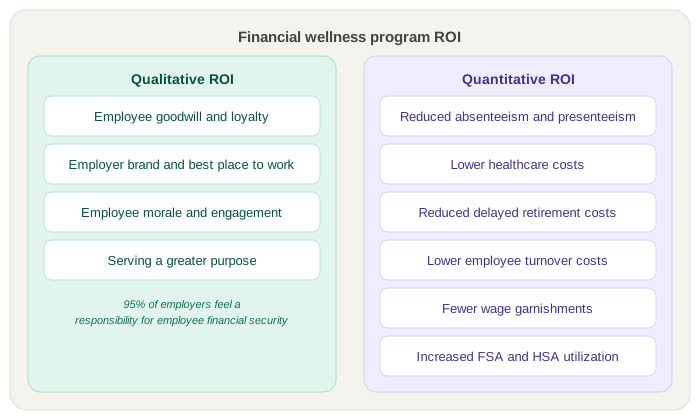
Employers measure the return on investment of a financial wellness program in two ways: qualitatively, through the human and cultural value the benefit creates, and quantitatively, through measurable reductions in direct costs like absenteeism, healthcare expenses, delayed retirement, turnover, wage garnishments, and underutilization of tax-preferred benefits. Together, these two lenses tell the complete story of what a financial wellness program is worth.

Why measuring ROI matters

Financial wellness programs represent a meaningful employer investment. Benefits leaders who can connect that investment to measurable outcomes are better positioned to justify the budget, expand the program, and demonstrate its value to leadership and finance teams.

The good news is that the data exists. Research consistently shows that financially stressed employees cost employers real money in ways that show up in the numbers that CFOs and CHROs already track. A strong financial wellness program moves those numbers in the right direction.

The qualitative case: why employers say it is simply the right thing to do

Not every return on a benefit shows up in a spreadsheet, and leaders at the world’s top employer brands understand this. According to the Employee Benefit Research Institute’s 2025 Financial Wellbeing Employer Survey, 95 percent of employer respondents believe their company has a responsibility to ensure employees are financially secure and well. That belief reflects a broader shift in how leading organizations think about their role in employees’ lives.

The qualitative ROI of a financial wellness program includes several dimensions that are harder to quantify but no less real.

Offering financial coaching signals to employees that the company cares about their lives outside of work, not just their productivity inside it. This sense of goodwill builds loyalty that is difficult to manufacture through compensation alone. Employees who feel genuinely supported by their employer are more engaged, more likely to stay, and more likely to serve as advocates for the organization.

Financial wellness benefits also reinforce an employer’s brand as a best place to work. Recognition from organizations like Fortune, Glassdoor, and industry-specific awards increasingly weighs whether employees report low financial stress and feel their employer supports their total wellbeing. A strong financial wellness program contributes directly to the factors those surveys measure.

There is also the matter of purpose. Many HR leaders describe the decision to offer financial coaching with a phrase that resonates beyond cost calculations: it is the right thing to do. Employees bring their whole selves to work. When financial stress consumes a significant portion of their mental energy, the impact spills over into every dimension of their performance and health. An employer who helps reduce that stress is doing something genuinely meaningful.

The quantitative case: where the numbers show up

The financial impact of a well-designed financial wellness program shows up across several measurable cost categories. Research from Financial Finesse’s Financial Wellness Think Tank™, including an independent case study of employees conducted by the Personal Finance Employee Education Foundation (PFEEF), provides clear evidence that employees who participate in financial education programs generate meaningfully better outcomes across each of these dimensions.

Absenteeism and presenteeism

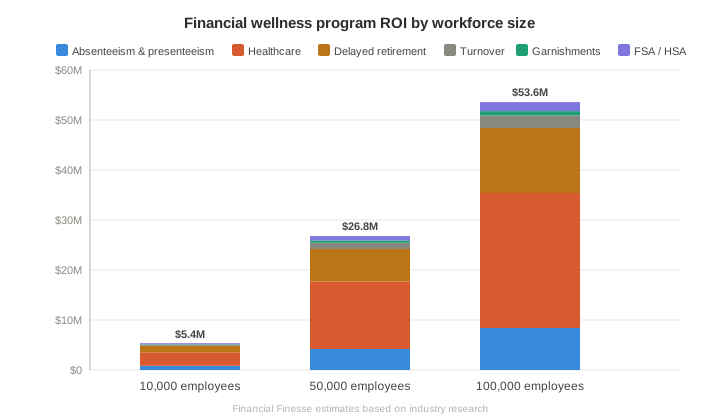
Financial stress is one of the leading drivers of unplanned absences. Employees who are worried about money are more likely to miss work and less productive when they are present, a phenomenon known as presenteeism. In the PFEEF case study, financial education program participants averaged 11 unscheduled absence days compared to 16 days for non-participants. Based on a proprietary predictive model developed by Financial Finesse’s Financial Wellness Think Tank™, moving a workforce’s median financial wellness score from a 4 to a 6 on a 10-point scale could save a 50,000-employee organization more than $4.2 million annually in reduced unplanned absences alone.

Healthcare costs

Financial stress manifests physically. A study of a Fortune 100 healthcare company found that employer healthcare costs for employees who used the company’s financial wellness program actually decreased by 4.5 percent, while costs for non-users increased by 19.4 percent over the same period. That difference translated to a net savings of $271.50 per employee. For a 50,000-employee organization, that is a potential annual healthcare cost reduction of more than $13.5 million.

Delayed retirement

When employees cannot afford to retire, they often stay in the workforce past their intended retirement date. This creates a cascading cost problem for employers: higher compensation costs, reduced mobility for career advancement among younger employees, and challenges with workforce planning. Research from Financial Finesse’s Financial Wellness Think Tank™ found that employees who engaged repeatedly with their employer’s financial wellness program increased their likelihood of being on track for retirement from 34 percent to 47 percent. For a 50,000-employee organization, that 13-point improvement translates to an estimated $6.5 million in annual cost reduction related to delayed retirement.

Employee turnover

Replacing an employee is expensive. Direct replacement costs can range from 50 to 60 percent of an employee’s annual salary, with total costs including lost productivity and retraining ranging from 90 to 200 percent. A financial wellness program that helps employees feel more secure and more valued reduces voluntary turnover. Even a one percent reduction in turnover at a 50,000-employee organization could save more than $1.25 million annually.

Wage garnishments

Wage garnishments create administrative burden and cost for employers. Processing a single garnishment costs an employer an estimated $300 per year. Research from Financial Finesse’s Financial Wellness Think Tank™ found that improving a workforce’s financial wellness score from a 4 to a 6 reduces the likelihood of garnishment from 4.8 percent to 1.8 percent. In one case study, garnishment rates were 5 percent for program participants versus 8 percent for non-participants. For a 50,000-employee organization, the reduction in garnishment processing costs alone can exceed $440,000 annually.

FSA and HSA utilization

Flexible spending accounts and health savings accounts reduce taxable payroll for both employees and employers. When employees do not understand or use these benefits, both parties leave money on the table. Financial wellness coaching increases FSA and HSA participation rates. In the case study, program participants contributed significantly more to both health FSAs and dependent care FSAs than non-participants. Research from Financial Finesse’s Financial Wellness Think Tank™ found that improving financial wellness from a score of 4 to 6 increased average combined FSA and HSA contributions from $905 to $1,137 per employee, generating nearly $900,000 in annual FICA tax savings for a 50,000-employee organization.

The chart below shows how these quantitative savings stack up across employer sizes based on Financial Finesse’s predictive model.

What an independent ROI study found

The PFEEF case study is one of the most rigorous independent analyses of financial wellness program ROI available. Based on data from 8,233 program participants and an equal-sized control group of non-participants, the study calculated a return-on-investment ratio of 5.50 to 1 under conservative assumptions. That means for every dollar invested in the Financial Finesse program, the company received $5.50 in net benefits. Under more optimistic but still realistic assumptions about program impact, the ROI ratios reached 9.76 to 1 and 15.07 to 1.

The study measured outcomes across unscheduled absences, wage garnishments, FSA contributions for both health and dependent care, retirement plan contribution rates, and job performance. Participants outperformed non-participants on every measurable metric.

How to build your own ROI case

HR leaders do not need to wait for a third-party study to make the case for a financial wellness program. A practical ROI analysis can be built using data that most organizations already collect or can reasonably estimate.

Start by establishing a baseline. What is the organization’s current rate of unplanned absences? What are annual healthcare cost trends? What percentage of employees are on track for retirement? What is the voluntary turnover rate and the estimated cost to replace an employee? What percentage of eligible employees are participating in FSA and HSA programs?

Then model the potential improvement. Financial Finesse’s predictive model uses a 10-point financial wellness scale to project the cost impact of incremental improvements in workforce financial wellness. Even modest improvements, moving the median workforce score from a 4 to a 6, generate savings that dwarf the cost of the program itself.

Finally, track outcomes over time. Financial wellness program ROI is best demonstrated through longitudinal measurement, comparing employee cohorts who engage with the program against those who do not, and tracking how behaviors change as employees progress in their financial wellness journey.

FAQs:

What metrics do employers use to measure financial wellness ROI?

The most common quantitative metrics are reductions in unplanned absenteeism, lower healthcare costs, reduced delayed retirement costs, lower turnover, fewer wage garnishments, and increased FSA and HSA utilization. Qualitative measures include employee engagement, employer brand perception, and workforce morale.

What ROI can employers expect from a financial wellness program?

An independent study of a Fortune 500 healthcare company’s Financial Finesse program calculated a return of $5.50 for every $1 invested under conservative assumptions. Financial Finesse’s own predictive model estimates that moving a 50,000-employee workforce’s median financial wellness score from a 4 to a 6 could generate more than $26 million in annual cost savings across six measurable categories.

How long does it take to see ROI from a financial wellness program?

Some benefits, such as increased FSA enrollment and reduced garnishment processing, can appear within the first year. Larger savings categories like healthcare cost trends and delayed retirement impacts typically emerge over a two-to-five year horizon as employee financial wellness improves and behaviors change.

Does financial wellness ROI only apply to large employers?

No. The cost drivers are present at every employer size. While the absolute dollar savings are larger for larger organizations, the return-on-investment ratio, dollars saved per dollar invested, is comparable regardless of workforce size.


Financial Finesse is the leading independent global provider of unbiased financial coaching as an employee benefit, driving measurable improvements in employee financial wellness and proven employer ROI. Employees receive unlimited access to CFP® professionals and AI-powered guidance that expands reach and personalization with trusted human oversight at every step.

What Is the Difference Between a Financial Coach and a Financial Advisor?

May 29, 2026

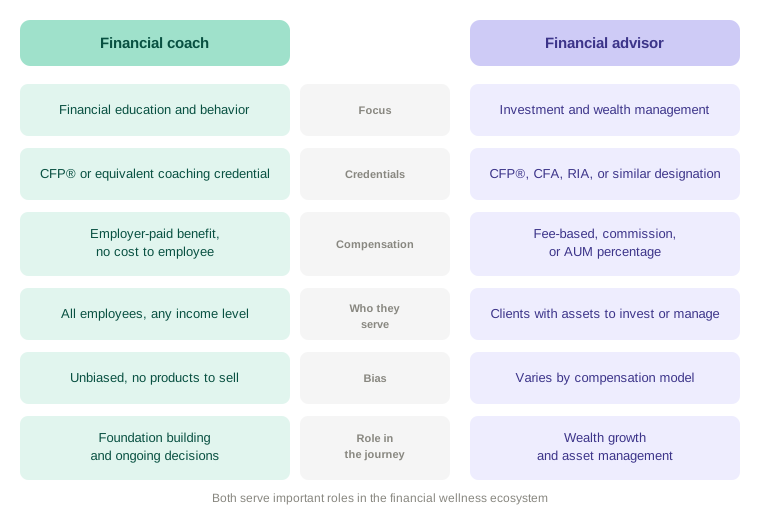
A financial coach helps people understand their finances, build better money habits, and make informed decisions across all areas of their financial life. A financial advisor typically manages investments and builds wealth strategies for people who already have assets to grow. Both serve important roles, but they operate at different stages of the financial journey and are often most powerful when they work together as part of a broader financial wellness ecosystem.

Why HR leaders should understand this distinction

When evaluating financial wellness benefits, the coach versus advisor question comes up often. Many employees have never worked with either. Others assume these roles are interchangeable. HR leaders who can articulate the difference clearly are better positioned to match the right benefit to the right employee need, and to explain the business value of financial coaching to leadership and benefits committees.

The short version: financial coaching is a benefit designed for everyone. Financial advice is typically offered as a service for those already managing significant wealth.

What a financial coach does

A financial coach helps employees navigate the full range of financial questions and decisions they face throughout their lives. This includes understanding how to build a budget, pay down debt, establish an emergency fund, make sense of employee benefits, plan for retirement, and protect their family with the right insurance coverage.

The coaching relationship is educational and empowering by design. A coach does not make decisions for the employee. Instead, the coach helps the employee understand their options, build financial confidence, and develop the habits and knowledge to make sound decisions on their own over time.

In a workplace financial wellness benefit, coaches are typically CERTIFIED FINANCIAL PLANNER® (CFP®) professionals or their in-country equivalents. CFP professionals hold one of the most rigorous and respected credentials in financial services, covering financial planning, tax, insurance, retirement, and estate planning. At Financial Finesse, for example, every coach is a CFP® professional (or in-country equivalent), meaning employees receive expert guidance regardless of their income level, financial situation, or the complexity of their situation.

Critically, financial coaches are an employer-paid benefit, have no products to sell, and no commissions to earn. Their only job is to help the employee. This makes financial coaching one of the only truly unbiased sources of financial guidance most employees will ever have access to.

What a financial advisor does

A financial advisor focuses primarily on managing and growing wealth. This typically involves creating an investment strategy, managing a portfolio, and helping clients plan for major wealth-related milestones such as retirement drawdown, estate planning, and tax optimization on investments.

Financial advisors operate under a range of compensation models. Some charge a flat fee for their services. Some earn commissions on financial products they recommend. Others charge a percentage of the assets they manage, often referred to as an AUM (assets under management) fee. Understanding how an advisor is compensated matters because it can influence the recommendations they make.

Financial advisors are well suited for people who have accumulated meaningful assets and need ongoing investment management and sophisticated planning. Most financial advisors also have minimum asset thresholds, which can make their services inaccessible to employees who are still building their financial foundation.

Why they are not competing, but complementary

The most important thing for HR leaders to understand is that financial coaches and financial advisors serve different needs at different stages of an employee’s financial life, and the strongest financial wellness ecosystems include both.

Think of it as a progression. Financial coaching meets employees where they are, often before they have significant assets to manage. A coach helps an employee get their cash flow under control, build emergency savings, pay off high-interest debt, and start saving for retirement. Over time, as that employee builds wealth, they may reach a point where a financial advisor makes sense.

In this way, a financial wellness benefit that includes strong coaching does not compete with financial advisors. It creates better clients for them. Employees who arrive at a financial advisor already financially literate, with no high-interest debt and a clear sense of their goals, are in a far stronger position than those who arrive without that foundation.

What this means for benefits design

When an HR leader is evaluating financial wellness programs, the key question is not “should we offer coaching or advisory services?” The better question is: “What does the majority of our workforce actually need right now?”

For most employee populations, the answer is financial coaching. Research consistently shows that financial stress is widespread across all income levels, and that most employees lack basic financial literacy, emergency savings, and confidence in their financial decisions. Financial coaching addresses this directly, at scale, and at no cost to the employee.

For higher-income segments of the workforce, such as executives or senior professionals with complex compensation, an advisor referral network or supplemental advisory benefit may also be appropriate.

The gold standard is a benefit that provides every employee with access to a credentialed financial coach as a starting point, with a pathway to connect with more specialized resources, including financial advisors, when the employee’s needs evolve.


FAQs

Is a financial coach the same as a financial advisor?

No. A financial coach focuses on education, financial decision-making, and building a strong financial foundation. A financial advisor focuses on managing investments and growing wealth. Both serve important roles, but they operate at different stages of the financial journey.

Do financial coaches manage money or investments?

No. Financial coaches provide guidance and education to help employees make their own informed financial decisions. They do not manage portfolios or direct investments on behalf of clients.

Are financial coaches unbiased?

When coaching is delivered as an employer-paid benefit, yes. Coaches in a financial wellness program like Financial Finesse have no products to sell and no commissions to earn, which makes their guidance genuinely objective.

Do employees need a certain income level to work with a financial coach?

No. Financial coaching as an employee benefit is available to all employees regardless of income, savings level, or financial situation. This is one of the most significant differences from traditional financial advisory services, which often require minimum asset thresholds.

Can an employee work with both a financial coach and a financial advisor?

Yes, and for many employees this is the ideal approach. A coach helps build the financial foundation. As wealth grows, an advisor can take on investment management and sophisticated planning. The two roles complement each other.


Financial Finesse is the leading independent global provider of unbiased financial coaching as an employee benefit, driving measurable improvements in employee financial wellness and proven employer ROI. Employees receive unlimited access to CFP® professionals and AI-powered guidance that expands reach and personalization with trusted human oversight at every step.

What Do Financial Wellness Programs Include?

May 29, 2026

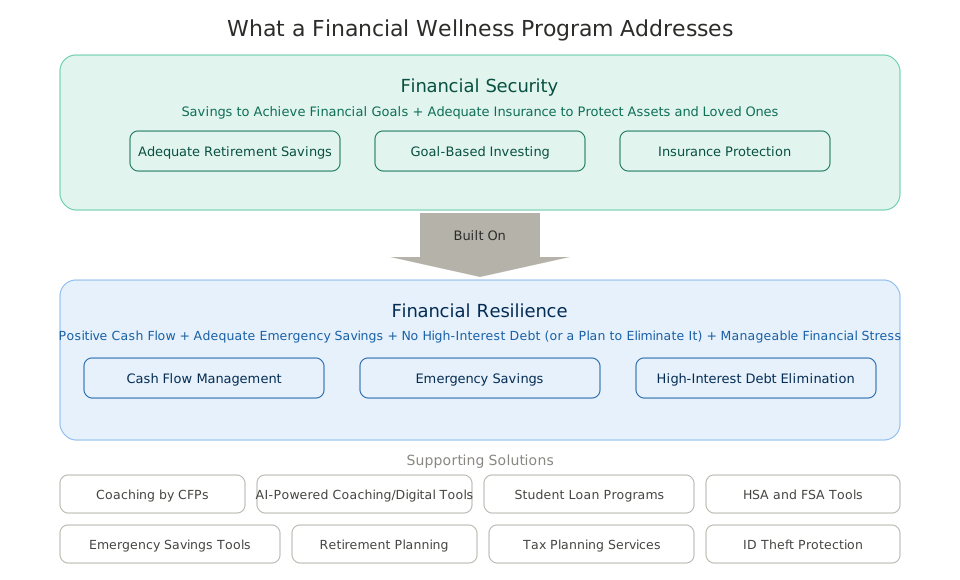
A financial wellness program helps employees build a stable financial foundation, reach long-term financial goals, and maximize the value of their compensation and benefits. At its core, it provides access to credentialed financial coaches, personalized guidance for real-life financial decisions, and practical tools—often including AI-powered coaching, financial calculators, and trusted educational content—to help employees take action. The most effective programs address both financial resilience, which is the ability to absorb financial shocks, and financial security, which is the ability to grow and thrive financially over time.

The two goals of a financial wellness program

A well-designed financial wellness program works on two levels simultaneously: helping employees withstand financial setbacks and helping them build toward lasting security.


Financial resilience: the foundation

Financial resilience means an employee can absorb unexpected financial shocks without falling into a crisis. Financially resilient employees have positive cash flow, a meaningful emergency savings cushion, either no high-interest debt or a clear plan to eliminate it, and manageable levels of financial stress.

Without this foundation in place, longer-term financial goals are nearly impossible to pursue. A coaching program that skips this layer and jumps straight to investment planning is putting the cart before the horse.

Financial security: the next level

Once resilience is established, the program shifts focus to financial security. This means having adequate savings to reach meaningful financial goals and appropriate insurance coverage to protect assets and loved ones.

Financial security looks different for every employee. For one person it means funding a child’s education. For another it means retiring at 62. For another it means buying a home. A strong program meets employees where they are rather than applying a one-size-fits-all approach.

What guidance looks like inside a financial wellness program

The guidance component of a financial wellness program answers the financial questions employees are actually asking. Questions like:

  • “How much should I have in an emergency fund?”
  • “Should I pay off debt or invest in my 401(k) first?”
  • “Am I taking advantage of all the benefits my employer offers?”
  • “When can I realistically retire?”

This guidance should come from credentialed coaches, such as Certified Financial Planner® (CFP®) professionals, who are trained to help employees understand their options and feel confident acting on them. When available and appropriate, live coaching should be coupled with well‑vetted AI‑powered coaching. Programs offered through Financial Finesse, for example, provide unlimited access to unbiased CFP® professional financial coaches (or in‑country equivalents) who combine financial expertise with emotional intelligence, as well as Aimee, a safe AI‑powered coach.

What solutions a financial wellness program includes

Guidance alone is not enough. Employees need resources to act on the coaching they receive. The solutions layer of a financial wellness program connects employees to tools and programs that help them execute. These solutions typically span several categories:

  • Cash and debt management: Resources for budgeting, managing cash flow, credit counseling, and structured plans for eliminating high-interest debt, including credit card debt and personal loans.
  • Savings programs: Emergency savings tools designed to help employees build a financial cushion, often integrated directly with payroll for automated contributions.
  • Student loan assistance: Programs that help employees navigate repayment options, refinancing decisions, and employer-sponsored student loan contribution benefits.
  • Retirement planning: Support for maximizing 401(k) contributions, understanding employer match structures, and planning for a sustainable retirement income.
  • Healthcare savings: Guidance on Health Savings Accounts (HSAs), Flexible Spending Accounts (FSAs), and how to use these tools to reduce out-of-pocket healthcare costs.
  • Insurance and protection: Help evaluating life, disability, and supplemental insurance coverage to ensure employees are adequately protected, along with identity theft protection resources.
  • Tax planning: Year-round guidance on tax-smart financial decisions, not just tax filing support.
  • Family and housing support: Resources covering dependent care benefits, childcare savings accounts, and guidance on major decisions like homebuying.

These solutions are not a checklist. What matters most is that employees receive guidance from a credentialed coach who helps them understand which solutions apply to their specific situation, and then connects them to the right tools to take action.

How the program is delivered matters

The most effective financial wellness programs are employer-paid benefits, meaning there is no cost to the employee at the point of use. When employees have to pay out of pocket to access financial coaching, utilization drops sharply, and the employees who need help most are often the ones least likely to reach out.

Delivery should be flexible. Employees need to access coaching on their schedule, through their preferred channel, whether that is a phone call, chat, or digital self-service. Multilingual and global delivery matters for employers with distributed workforces.

AI-powered tools are increasingly part of well-designed programs, helping scale access and personalization. Financial Finesse pairs AI-powered guidance with certified human coaches, so employees benefit from both the empathy, motivation, and judgment of a credentialed professional and the reach of technology.

FAQs:

What is the main goal of a financial wellness program?

To help employees build financial resilience, meaning the ability to handle financial shocks, and financial security, meaning the ability to reach long-term financial goals.

Who delivers the guidance in a financial wellness program?

Guidance should come from unbiased credentialed professionals such as CFP® professionals who have expertise in both financial planning and the emotional dimensions of financial stress and, when available and appropriate, well‑vetted AI‑powered coaching tools.

Is a financial wellness program just about retirement savings?

No. While retirement planning is an important component, a comprehensive program also addresses emergency savings, debt management, insurance, tax planning, healthcare savings, and other financial priorities employees face at every life stage.

How is a financial wellness benefit different from a financial advisor?

A financial advisor typically manages investments on behalf of clients and may have minimum asset requirements. A financial wellness benefit is an employer-paid resource available to all employees, focused on unbiased coaching and guidance across a broad range of financial topics rather than investment management.


Financial Finesse is the leading independent global provider of unbiased financial coaching as an employee benefit, driving measurable improvements in employee financial wellness and proven employer ROI. Employees receive unlimited access to CFP® professionals and AI-powered guidance that expands reach and personalization with trusted human oversight at every step.

August 2020 Engagement Study

March 15, 2021

Learn how financial coaching influenced coronavirus related distributions in this study conducted by Financial Finesse on behalf of a large, midwestern building supply manufacturer.

What’s it really like to work with a financial coach?

March 11, 2021

Until they’ve tried it, your employees will never know; and not knowing may be keeping them from engaging with a benefit that could literally change their lives. 

Nearly 2 in 3 adults (64%) say that money is a significant source of stress in their life

We know that Americans are dealing with significant levels of financial stress, in many cases exacerbated by COVID-19. According to the American Psychological Association, “Nearly 2 in 3 adults (64%) say that money is a significant source of stress in their life, and around half of adults (52%) say they have experienced negative financial impacts due to the pandemic.”[1]

We also know that talking with a financial coach can improve financial stress levels considerably. For example, the percentage of financially suffering employees (i.e., those with an initial financial wellness score of less than 3.0) with high or overwhelming levels of financial stress fell from 70% to 41% after talking with a financial coach as part of their financial wellness benefit.

So how can we get employees ‘over the hump’ of not knowing and get them comfortable enough to call a coach? I asked our coaching team which myths or misconceptions they believe may be holding employees back. Allow me to bust them.

Myth #1 – A financial coach will try to sell me something.
While many financial professionals are compensated for selling financial products, this is not the case at Financial Finesse. Our company is independent and not affiliated with any other financial institution and our coaches do not sell or manage any financial assets.

Myth #2 – A financial coach will judge me or talk over my head.
Fear of judgment is universal, which is why we seek coaches that have first-hand experience with common financial challenges and screen for empathy and emotional intelligence (EQ).

Fear of judgment is universal

Our coaches are motivated by helping employees make progress, no matter what their starting point. In every conversation, they aim to make financial concepts easier to understand and to build rapport. To get a sense of who is on the other end of the line, employees can “meet” our coaches here

Myth #3 – A financial coach is not trained to deal with my problems.
Some may think their issues are too simple to merit a call or too complex for us to help. Our coaches address the full range—from fundamentals to complex topics—every day. If an employee needs advice (we provide coaching only), for example on taxes or investing, we can help them find someone through objective screening—we do not have a referral network or any affiliation with any providers.

Myth #4 – A financial coach expects me to have my finances in order before we speak.
Our coaches are happy to help employees get started—no prep work required. We hope the first call is not the last. That’s why we encourage employees to reach out to get the ball rolling.

Myth #5 – A financial coach will share my information with my employer.
This one simply isn’t true. Our coaches adhere to a strict code of confidentiality and never share any information with employers as it relates to their employees’ financial health.

Myth #6 – A financial coach can only discuss benefits offered by my employer.
While our coaches often help employees get the most out of their benefits, they are by no means limited to benefits-related questions. They can help with any financial concern.

We know that the more employees interact with our coaches the more their financial wellbeing improves, but getting first-time users started can be a challenge. By understanding their concerns, you can develop a communication strategy to address them head-on, encouraging engagement and changing lives—a win-win for any organization.

[1] https://www.apa.org/news/press/releases/stress/2020/report-october