What Happens To Your Work Life Insurance When You Leave?

April 30, 2019

People often find that the most cost-effective way to buy life insurance is to buy the supplemental life insurance that many employers offer – it’s typically offered as part of a group policy, meaning that the risks are spread among more people, which usually makes it a lot cheaper than similar coverage would be for just you on the open market.

Guaranteed issue

This is an especially helpful benefit for people with health conditions that make buying insurance on the open market difficult – if you sign up at the same time you’re initially enrolling in benefits, most policies are “guaranteed issue,” meaning that there are no health evaluations necessary. Forgoing that early opportunity often means forgoing that guarantee of coverage, so it’s something you’ll want to think carefully about.

Tied to your job

One of the downsides we often discuss is the fact that it is, obviously, tied to your job. That can cause some people to forgo the coverage altogether, but before you do that, it’s a good idea to understand what the options would be if you do end up leaving. Here’s what you’ll want to look into if that’s a concern that you have:

Consider whether you’ll still need the same amount of insurance

The first step in deciding what to do with an insurance policy (or whether to buy any at all) is to decide how much insurance you need. A great resource to do this are the calculators on lifehappens.org.

Remember that what you need today may not be what you’ll need in the future, so for example, many people are comfortable leaving supplemental policies at work when they retire, as the need for insurance is no longer there due to children having grown along with adequate retirement savings to support any surviving dependents.

If you’ve determined that it is a good idea to purchase the insurance, here’s what you’ll want to know about whether you can take it with you should you leave:

  • Is it portable? Portable means exactly what it sounds like: can you take it with you? Typically that means you would have to pay the cost of insurance, which may be higher than the group rate you’ll pay while working there. There may be some requirements (tenure, age, health, etc.) that you must meet. If it is portable and you exercise that option, you basically end up with a new insurance policy that is considered an individual yearly renewable term policy.
  • Is it convertible? This means you can change from a term policy to a whole life insurance policy or universal life insurance policy without showing evidence of insurability (that means you don’t have to go through underwriting and can be really important if you’ve experienced any health issues such as cancer, diabetes, arthritis, etc.) Many people choose this option when available in order to cover their final expenses (such as insurance for medical bills, funeral costs, etc.), which allows them to pass along any remaining retirement savings to their heirs.

If you have a health condition that would make you uninsurable, using the portability and convertibility option may be your only way to maintain life insurance. If you are insurable but only at higher premium rates, the portability and convertibility option may allow you to keep life insurance at a lower rate.

If, at the time you’re leaving a job, you are healthy, you may be able to buy a new insurance policy for a lower premium than you’d pay by continuing your group policy. If you’re moving to another employer that also offers supplemental insurance, then you could purchase coverage through your new employer if they offer it or you could buy your own policy. 

Like much of financial planning, figuring out the best thing to do here involves a bit of predicting the future. But knowing what the options are can help you at least run worst-case scenarios as you decide.
What Should You Do With An Old Life Insurance Policy?

April 17, 2019

If you have an old life insurance policy and you no longer need the life insurance, don’t just stop paying the premiums and let it lapse – it may be worth something. Many people are surprised to learn that there are several options available, depending on the type of insurance. Before you get rid of any policy, you do want to make sure you’ve determined how much life insurance you need. To figure this out, we really like the calculators on LifeHappens.org.

Once you’ve decided you really don’t need a life insurance policy anymore, then you’ll need to determine the type of policy to figure out your options. Most life insurance can be classified as either term or permanent.

Term insurance

Term insurance is designed to cover you for a period of time (like 20 years) and typically has a fixed premium for that period. At the end of that period, it will typically convert into yearly renewable term and become dramatically more expensive. 

Your options when your term is up

  • If you don’t need the insurance, drop it – there is no value there to recoup.
  • If you need the insurance, see if your policy allows you to convert all or part of the death benefit to a whole life policy – this can help you keep some in place without having to pay the higher premiums.

Permanent insurance

Permanent insurance can mean a Whole Life policy or a Universal Life policy – both are designed to cover you permanently (aka for your lifetime) as long as you keep the policy in force. In the earlier years of these policies, keeping it in force typically means paying the premiums, although there are ways a policy can be fully paid-up or begin paying for itself.

That’s because these policies also build up a cash value over time and that can provide you some options if you no longer need the insurance in place. If you own a Whole Life or Universal Life policy and find that you can no longer afford the premiums or you simply don’t have a need for life insurance anymore, before you let the policy lapse, make sure you explore your options.

Your options for a permanent policy

  • You can surrender the policy – Also sometimes called “cashing out,” this is when you ask the insurance company to pay you whatever the cash value is, then the policy is canceled. The difference between what you paid in premiums and the cash value (aka if you made money over the years) is subject to income tax.
  • You borrow against the policy – This is a key feature that many insurance salespeople use to sell policies – this is a way to get at the cash value of your policy without taxes and while keeping the policy in force. The main downside of this is it may result in a taxable event if the policy lapses and what you paid in premiums is less that the amount you borrowed.
  • You can do a 1035 exchange to an annuity – The phrase “1035 exchange” references the tax code that allows for this. You basically use the cash value of your policy to buy an annuity that will pay out to you during your lifetime, rather than waiting until you pass for the policy to pay out. There are no tax implications to do the exchange and your cost basis (premiums paid) carries over. Your distributions from the annuity, whether an immediate income annuity or a deferred annuity, are taxable as they come out.
  • You can do a viatical settlement – That is where the owner of the policy (usually you), sells the policy to someone else (either a person or a business) for an amount less than the insurance face value. For example, if the new owner changes the beneficiary to themselves, then they get the death benefit when you die. You would pay income tax on the difference between what you paid in premiums and what they paid you for the policy. (You may qualify for tax-free income if the insured person has less than 24 months to live.)

The bottom line is don’t treat 30 year-old insurance policies like 30 year-old ties. Old life insurance policies may have some value left and can be a way to access money you didn’t even realize you had.

How To Have The Money Talk With Your Spouse Without Slamming Doors

April 04, 2019

Have you ever had “The Talk” with your partner and it ends in hurt feelings and a slammed door? This is a financial blog so of course I mean the “Money Talk.”

If you haven’t, well then congratulations – can you tell me how it’s done? For the rest of us, you’re not alone. In an almost 30 year career as a financial planner and 26 year “career” as a spouse, I have had the money talk end in a slammed door and talked with people about how to have the money talk quite a few times.

What I’ve learned over the years is that there’s no perfect way to avoid it, but with practice and patience, you can decrease the door slamming and money stress in your relationship. Here are some guidelines that have worked for me:

1. Set reasonable expectations

  • Not a one-time deal. Unless you’re in Hollywood, the Money Talk is probably not going to have a romcom ending – you’re not going to be able to just have a 30 minute talk and then live happily ever after without ever having to bring it up again. Getting and staying on the same page as a couple takes work and repetition.
  • Judgement free zone. Start off with the expectation that there will not be a slammed door. This is where I failed miserably for a long time. In order to accomplish that, the talk must be judgement free – it is not an opportunity to blame each other over who spent too much last month.
  • Don’t be a jerk. This is also an opportunity for you to use your big boy words and not sound like a CFP® with an MBA who does this for a living. Sounding like a lecturing jerk is a major cause of doors getting slammed. (don’t ask me how I know)
  • Give each other grace. If your partner is trying his best not to sound like a jerk, grade him on a curve (he is a guy after all).

2. Remember that this is a planning discussion

  • Break it down into shorter milestones. I get overwhelmed if I try to think of the next 30 years. If this is you or your partner, narrow your timeframe. I suggest you start by discussing the next 4 paychecks (if you’re paid twice a month) or the next 2 paychecks (if you’re paid monthly).
  • Have a common starting point. To frame your discussion, you need to find some way of seeing where your money has gone (How to Find a Spending Plan that is Right for You). This is not the focus of the meeting, it is just where you start.
  • Stick with the next month or 2. Adopt the mindset of “What do I want to spend the next 2 (or 4) paychecks on?” Think of it as planning a vacation – you don’t have the time or money to do everything, so the task is figuring out what matters to you, then focus your time and money on that.
  • Work to limit the ‘must-spend’ items. There are some things like electricity that you must spend money on. Focus on figuring out how to spend the least amount on these items, so you can free up money to save or spend on what is important to you.
  • Follow your debt-payoff plan. Run a DebtBlaster to see how to pay off your debts sooner.
  • Take a look at retirement progress. Run a Retirement Estimator to make sure you are on pace to be OK in retirement.
  • Keep the focus on what you can change. Make sure your Money Talk is a forward-looking talk – if you’re talking about the past, doors will be slammed.

3. Think about the best time to have “The Talk”

  • When are you at your best? I am a morning person, which is another way of saying I am slightly less than perky at night. Some would say I am grumpy at night. The best time for me to have the Money Talk with my spouse would be at 6:30 on Saturday mornings. Unfortunately, my proposed time was met with a surprising lack of enthusiasm. We compromised and decided that 10:30 every other Saturday morning was a better time.
  • When can you talk uninterrupted? Find a time when both of your energy levels are high and you can have a relatively quiet 30 minutes.
  • Schedule it. Put this on your calendars, and if something comes up, you can make a note on your appointment to discuss it then. This is a lot better than having the talk when you are both rushing off to work.

4. Make a plan for all the money you’ll save on doors

One huge benefit to planning a regular Money Talk is that you will save a lot on door repairs. What will you do with that money instead?

Should You Do A Rollover From Your IRA To Your HSA?

March 20, 2019

Did you know that if you have money in an IRA that you want to use for healthcare expenses tax-free, you may be able to roll it over to your HSA? As more people realize the power of the health savings account, we are getting more questions about this strategy. Here are the ins and outs of what to consider.

Who qualifies

You are able to do a one-time tax-free rollover from a pre-tax/traditional IRA to an HSA if you meet the following conditions:

  • You are enrolled in a high deductible healthcare plan (HDHP) when you make the transfer and continue to be enrolled in a HDHP until the last day of the 12th month after you make the transfer.
  • You can only contribute up to the maximum HSA contribution for that year. In 2019, that is $3,500 single, $7,000 family and if you are 55 or older a $1,000 catch up.
  • The distribution must be a direct transfer from your IRA custodian to your HSA custodian – it can’t be indirect.

When it makes sense

Some reasons why you would want to do rollover from an IRA to an HSA:

  • Save on taxes in retirement: Withdrawals from a traditional IRA are taxable, even after age 59 ½, and a common thing that retirees spend their IRA money on is for healthcare. If you spend money in an HSA for qualified medical expenses, it is tax free, so doing this transfer can save on taxes in the future for medical expenses.
  • It’s risk-free: After age 65, you are able to spend HSA funds on non-medical expenses if you want. If you do, you would have to pay income tax just like an IRA. In other words, if you roll money from your IRA to HSA then end up NOT needing it for medical expenses, you’ll still have access after age 65. In essence, your HSA becomes like an IRA with a healthcare tax benefit.
  • Good at any age: Many people don’t realize that you only have to be enrolled in a HDHP when you contribute to your HSA, but you can spend that money at any point after, even years later. You are able to spend money that is in an HSA on qualified medical expenses at any age.
  • Lower your RMDs: With a traditional IRA, you’ll be required to start taking a minimum amount out each year once you turn age 70 1/2. For some people that’s not an issue – they need the money anyway. But for people who may be trying to preserve their IRA for later years, rolling some of the money from your IRA to your HSA during your working years can lower the amount you’ll eventually have to withdraw in your 70’s. (keep in mind that once you’re on Medicare, you can no longer contribute to your HSA, so this strategy must be done prior to your enrollment in Medicare, so you have to plan ahead)

When it doesn’t make sense

Some reasons why you wouldn’t want to do this:

  • Your money is in a Roth IRA: If your money is in a Roth IRA and has been for at least 5 years, once you reach age 59 ½, the money that is in your Roth IRA can be used for any expenses without paying income taxes. You have more flexibility with Roth IRA distributions.
  • You’d be missing out on a tax deduction: You get a tax deduction if you contribute to your HSA from non-IRA money. You do not get a tax deduction for a rollover from your IRA to your HSA. If you have the money to max out your HSA with non-IRA dollars, it usually makes more sense to go that route first.

An example of someone who rolled money from their IRA to their HSA

This is a real-world example of when it might make sense to do a rollover from an IRA to an HSA:

  • Someone is 55, recently laid off and working part-time as an Uber/Lyft driver while looking for a new job.
  • A substantial portion of their savings is in IRAs and 401(k)s. Very little is in taxable accounts (individual or joint), meaning there isn’t much money available to spend penalty-free before age 59 1/2.
  • They are making enough income this year to cover their essential expenses but cannot contribute to an HSA.
  • They have an HDHP and anticipate having a HDHP in the future.
  • They think it may take them a year to find another position (the 1 month for every $10,000 of monthly income rule).
  • They think they will eventually use the money ($7,000 + $1,000 catchup) for qualified health expenses.

Like most financial decisions, your individual situation determines whether it makes sense to do a rollover from your IRA to your HSA, but in the right situation it can be a really great idea.


Here’s How Your Income Tax Withholdings Work

March 04, 2019

I was recently given the opportunity to explain tax forms to a bunch of 17-year olds with part time jobs. They were eating pizza in my house when one of the guys asked me to explain how they will pay their taxes when they are adults. I was pleased to hear that one of them was not planning on living with me forever. Here’s how I explained it.

Paying your taxes through work

When you get a job, you fill out something called a W-4, usually on your very first day. This form tells your employer how much money to withhold from each paycheck and your employer sends it to the IRS. At the end of the year you get another form, called a W-2, which shows how much was withheld over the course of the year, along with how much you were paid and some other numbers as well.

I went on to tell them that you will use your W-2 to fill out your IRS Form 1040, which is what you use to file your taxes. At this point I realized that in 15 seconds I had referred to 3 separate tax forms – I was losing them fast and had to change tactics.

An example of how withholding taxes work

I started over, saying, “Let’s say you earn $10 an hour and work 10 hours a week. What would your weekly income be?” They correctly said $100 (with a little eye rolling). I went on: Now suppose you worked 50 weeks a year, what would your annual income be? Proving they have some math acumen, they said $5,000, which seemed like a lot of money to them (to be young again!).

The W-4 is what would tell your employer to keep $5 from your paycheck and send it to the IRS, then they would pay you the other $95 (keeping it simple here). At the end of the year, you would have sent $250 to the IRS.

After the end of the year, you get your W-2, which confirms this information – you earned a total of $5,000 and pre-paid $250 of what you owe to the IRS through your employer. You use that to fill out a tax form called a 1040, where you calculate what your actual taxes due on your income should be.

How you end up owing taxes or getting a refund

If you didn’t have enough withheld, aka your taxes for the year are more than $250, you have to pay the balance by the April 15th deadline. If you withheld too much, aka your taxes for the year are less than $250, then you get a refund for the balance as soon as the IRS receives your form and processes it.

Why not always aim for a big refund check then?

They liked the idea of getting a refund and one asked me why you would just have $10 withheld in order to get more back. I told him that is a very common strategy that some people use who have a hard time saving money. The problem is that you don’t get any interest on that money while the IRS is holding it, whereas if you’d instead just took that extra $5 per paycheck and put it in a savings account, you might have earned a few extra dollars from your bank in interest.

The moral of this story is that when you file your income taxes this year, if you’re due a large a refund or owe more taxes than you want to pay in one lump sum, the best way to avoid that next year is adjust your W-4 withholdings at work.


What To Do With Left-over 529 Account Money

January 07, 2019

Some financial problems can be good ones to have. This is one of those examples. What happens when you, your child or any beneficiary of a 529 account gets out of college without using all the money in their 529? Don’t laugh – like I said this is a problem, but it’s a good problem to have, and some people actually have this happen.

Here’s a quick review of five different options, depending on your situation:

1. The scholarship exception. If you still have money because the beneficiary qualified for a tax-free scholarship, you can take a withdraw from your 529 plan up to the amount of the scholarship and not pay the 10% penalty, but you will be taxed on any earnings. (remember that you can also use 529 funds tax-free for room and board, books and other fees as well)

2. Hold it for later. Check and see if your 529 Plan requires distributions by a certain age (some do not). The beneficiary can use the money for graduate school or additional education expenses in the distant future if not.

3. Help out another family member. 529 funds can be transferred to another family member without tax implications and used for their higher education expenses, so decide which is your favorite niece or nephew now. A beneficiary’s family member is defined as:

  • Spouse
  • Brother, sister, stepbrother or stepsister
  • Father, Mother or an ancestor (Grandparents)
  • Stepfather or stepmother
  • Son, daughter, brother or sister of the taxpayer/account owner
  • Son-in-law, daughter-in-law, father-in-law, mother-in-law, brother-in-law or sister-in-law
  • Any first cousin of the beneficiary

4. Roll to a better plan. If there is a distribution requirement by a certain age, you could also consider rolling the money over to another plan that does not require a distribution by a certain age. Be aware that you are only allowed to do one rollover in a 12-month period, so choose carefully. And keep in mind that a rollover may have state income tax consequences, especially if you received a state income tax deduction when you made the contribution.

5. Take the cash, pay the penalty. If all else fails and you have no way to use the money for qualified expenses in a way that would help you or someone you care about, there’s always the option to just take the cash. You will have to pay taxes on the gains plus a 10% penalty, so talk with your tax advisor before doing this so you can plan accordingly.

But before you do that, a quick anecdote from my colleague Kelley – her college classmate Holly (not her real name) was awarded a full ride scholarship to college, so her parents withdrew the 529 money to buy her a new car as a reward. Not only did Holly crash and total the car before the summer was out, she ended up losing the scholarship after 3 semesters due to academic performance. Best to wait until everyone in your family is 100% certain they are in the careers they love with no additional out-of-pocket education costs to come before you exercise this option.

I hope that all of your financial problems are good problems like this.


How To Know If You’re Paying Too Much For Investment Advice

November 13, 2018

A question that I often get is, “Am I paying too much for investment advice?” This really boils down to a question of value, which like beauty, is in the eye of the beholder. So, while you may be paying more than another investment option, if you’re receiving sufficient value for the investment advice, it is worth the additional cost. Here’s how to know.

Step 1: Evaluate your current advisor

  • Performance: Your year-end statements should list your after-fee return for that year, so gather those statements to create a list of what your returns were.
  • Fees: Your fees are often listed in percentage terms so get out your calculator and convert that to dollars so you can see what you are actually paying. For example, your statement might say you pay 110 basis points, which is essentially 1.1%. If you have an account worth $100,000, that means your annual fee will be $1,100.
  • Compare: If you are considering a new investment advisor, make sure you are clear on their advisory fee in addition to any underlying mutual fund fee. For example, if they charge 1.1% and then put your investments in a mutual fund with a fee of 45 basis points (aka .45%), then your total fee is actually $1,550 ([$100,000 x .011] + [$100,000 x .0045]).
  • Risk: Evaluate how much risk your current advisor is taking. Your statements should give you a percentage of stocks, bonds (fixed income) and cash.
  • Compare that to your risk: Complete the Risk Tolerance Profile and Asset Allocation Worksheet to determine how much risk is appropriate for you to take, then compare that to see if your current advisor is taking an appropriate level of risk for you.
  • What else do they do: Finally, consider what your advisor does that you value. This can be face to face meetings, invitations to events, guidance on estate issues, etc. Note, this may not be what the advisor believes that you should value – remember that value is in the eye of the beholder.

Step 2: Evaluate other offers

  • While you won’t have year-end statements for other advisors, they can provide you information about how a portfolio that they would recommend to you performed (or you can enter it into this calculator to see for yourself). Make sure you are looking at after-fee (aka “net”) returns (both the advisory fee and mutual fund fees).
  • Is there anything that the new advisor provides that you value? Is there anything that they do not provide that you value?
  • Look for them to be suggesting a portfolio that takes an appropriate amount of risk, not the one that has the highest return.
  • Finally, consider the points made in two of our other posts about investing: Two Investment Approaches for Busy Professionals and Is Robo Advising Right for Me?.

Step 3: Evaluate your options

  • Value is determined by and unique to you. It is not value in the eyes of your advisor, friend, neighbor, etc. Value can be almost anything.
  • Compare after-fee returns over time (10 year or 5 year — as a long-term investor, you want to know what long-term results to expect, not what’s happened recently, which can be skewed by current events). If the return of option A is lower than option B, ask yourself if you get enough value from B the make it worth trading into higher returns – it may not always be.
  • In other words, a higher cost option may be appropriate if they provide enough value to you.
  • If the more expensive option or the option with the lower return has sufficient value to you, it is the appropriate one for you.
  • Past returns are no guarantee of future performance. This means basing your investment decision on the one with highest return last year is not a good strategy.
  • Additional ways an advisor provides value, beyond those mentioned above, include things like:
    • They balance you out so that you don’t make emotional investing decisions.
    • They help you invest for a variety of goals with different timelines, rather than just for highest performance.
    • They return your calls and answer your questions in a way that makes sense to you.
    • They provide advice on money they don’t manage, such as your 401(k).
    • They help your family members, even if they don’t make money off them.
    • They provide comprehensive financial planning that tells you what you need to do to achieve your life goals.
    • They help you make decisions around college funding, Social Security strategies or even making the most of your workplace benefits.
    • The list goes on…

No matter what, there is no black and white standard that says how much is “too much.” If you don’t feel like you’re getting value in return for what you’re paying, then it’s time to research other options. You may find a much better value out there. Or you may find that you need to adjust your expectations.


Should You Transfer Your 529 Account If You Move To Another State?

October 29, 2018

We moved to Texas when my daughter was 4 years old after living in four houses in two different states since she’d been born. (Believe it or not, I’m not in the military.) At that point my spouse “informed” me that we would not be moving again for a while. I agreed to stay where we were for three years. That was 20 years ago, and we are still in the same house. #happywifehappylife

At the time we moved to Texas, we had already established a 529 college savings plan for my daughter in North Carolina, where we lived at the time I opened the account. The question became whether I should transfer that account to a Texas 529 or leave it where it is (or transfer to another state’s plan). The answer isn’t black and white and depends on which state you now live in. Here’s what to consider.

Where you live matters

Each state has their own 529 plan, and some have more than one. However, you don’t have to use your state’s 529 plan, but there may be state tax benefits if you do, depending on which state you live in.

For example, Ohio offers a state income tax deduction for residents who contribute to Ohio-based 529 accounts, while Pennsylvania residents are eligible for a deduction for contributions to ANY state’s plan. California residents are out of luck – no deduction for any state’s plan, including California-based, while Texas residents like me don’t really care about which plans offer a state income tax deduction because we don’t have a state income tax.

Remember that you can use 529 funds in any state, so which state’s plan you choose depends largely on the tax deduction for deposits, followed by the investment options and fee structure of the plan you choose. (more on some of the other basics of 529’s here)

Should your 529 move with you if you switch states?

If you have a 529 plan in a state that you no longer live in, you may want to move your 529. The IRS allows one tax-free rollover from one 529 account to another per 12-month period. These rollovers do not qualify for a state tax deduction, but your future contributions might. Reasons for doing a rollover include:

  • To obtain state income tax deductions in your new state
  • To use a better plan if you no longer qualify for a deduction
  • Simplicity – you don’t want multiple 529 plans in different states (although you are allowed to)

What we did

Like I said, we started a 529 for my daughter in North Carolina, but after we were in Texas for awhile and it became clear that we were going to be there for more than three years, I transferred it to a Texas 529 because I liked the investment options better. Ironically, my daughter ended up going to college in … North Carolina.

Because Texas does not have a state income tax, this did not affect me financially – I had no deduction for deposits to NC or TX plans once we moved to Texas. Her being 1,201 miles away from me, on the other hand, affected me a lot (both financially and emotionally).

The bottom line

If you move to a new state and aren’t sure what to do with a 529 account from your former state, here’s what to consider:

  • Opportunity to obtain a state income tax deduction in your new state (reason to transfer unless you move to one of the state’s that allows a deduction for any state’s plan)
  • Investment options (if you’re not eligible for a tax deduction in your new state, then choosing a plan with low-cost, high quality investment options would be the top criteria. More on that here)
  • You can only transfer from one plan to another once every 12 months (reason not to transfer if you’re planning to move again within 12 months)

What doesn’t matter? Where your child plans to go to school – 529 funds can be used in any state.


How One Couple Survived 2008 & What We Can All Learn From How

October 16, 2018

It’s hard to believe it’s been ten years since we experienced the Great Recession – for some people, the events tied to that period in our economic history changed their lives forever. I think of all the people who were planning to work just a few more years so that they could pay off debts who found themselves out of a job and unable to get back in. Thousands of people were forced into retirement before they were ready simply because their jobs ceased to exist.

A story of survival

While the probability of another major recession like that is unlikely to happen again during my working years, I talk to plenty of people who have that fear. Going forward, whenever I hear someone express that fear, I’m going to share this story with them:

I talked with a couple the other day who are looking forward to retiring next summer. I’m glad I asked about how they accomplished their retirement plan – there were some bumps and unexpected turns along the way, but how they handled them is a lesson for us all.

A late career lay-off

The husband told me how he did not see the 2008 real estate crash as being anywhere as bad as it ended being. Then in 2009 he was laid off – the company he worked for was in the mortgage industry and eventually went out of business. This situation played out with thousands and thousands – there’s a reason that some people called it the Great “He-“cession. Many of those who lost their jobs where men in their final decade or so of working.

The good news is that he had limited his exposure to company stock in the 401(k) – he had always been told not to put too much in company stock within his 401(k), which turned out to be a very good thing. But while his retirement savings to date was as intact as possible, he was worried about his ability to continue saving for the future. He had worked for this company for a while and was not confident that he would find something that would pay anywhere close to what he was making.

Although their immediate future was uncertain, he and his spouse had done several things that put themselves in a good position.

  1. They always spent less than they made.
  2. Their daughters went to a public university and were able to graduate without any student loan debt. They were also both working and on their own financially at that point.
  3. They had only a small balance left on their mortgage.
  4. They had used some of their stock options (that they didn’t need for college) to invest in a rental property.
  5. They diversified their 401(k)’s; he only had 10% company stock in his 401(k) (see above).
  6. They had no debt and a cash reserve of 5 month’s expenses.
  7. His spouse’s job was not impacted, and she would be able to work remotely if they needed to move.

The first thing he did upon losing his job was to network aggressively. That lead to reconnecting with a former colleague, who told him about a position that paid less and would require him to move to another state. While it wasn’t ideal, they felt strongly that a bird in hand was better than two in the bush. He took the offer.

Making tough decisions

They sold the house they had raised their kids in, moved to another state and rented an apartment. Eventually they found a condo to purchase with the proceeds from their house sale. His spouse worked from home and after a few years he started getting promotions at his new firm. It wasn’t easy to make these decisions, but they kept the long view in mind.

The pay-off

Ten years later, they are moving to a town closer to their children, selling the rental home for a small family vacation home and looking forward to retirement. I asked if they missed their old home and he said, “it would be too much for us in retirement, we would have sold it eventually. No regrets.” Making concessions to their short-term life allowed them to stay on track with the long-term plan.

There is a lot of concern about the markets now, as there always is. If you’re worried about being a casualty of the next recession (should one happen soon), then now is the time to prepare. Here are the takeaways to prepare yourself if a layoff comes your way:

  1. Have a spending plan and spend less than you make.
  2. Make sure you don’t not have too much credit card debt and your mortgage is affordable.
  3. Diversify your investments.
  4. Remain flexible in where you live, which opens options that are not available if you are inflexible.
  5. Make room for a reduction in income – holding off for an income that matches your highest income means you may be without an income for a longer time.
  6. Maintain cash reserves of a least 6 months, more if you’re in a unique industry or have a non-earning spouse.

The best time to prepare for the worst is when times are good. Take some time this fall to make sure your financial house is in order. At best, things will continue as they are and you may be able to retire earlier than you think. At worst, you’ll be in a better position to recover from financial hits should they come. As we like to joke on our team, one of our favorite quotes is, “Gosh, I really regret making a budget and saving for emergencies,” – said no one ever.

How Spending In Your 30’s Has Changed Over The Years

October 02, 2018

A recent article in AXIOS highlighted the difference in how 30-year olds today spend their money verses 30- year olds 27 years ago. This interested me because I was in the 25 – 34 age group 27 years ago and now have a child who is in the 25 – 34 age group. It’s clear to me that we have different priorities at this age, but I was never sure if it was because she’s a girl and I was a guy, so I had to check the stats.

How we are different

According to this, my child and her peers spend more on education, health care, rent and contribute more to Social Security than I did, and they supposedly spend less on reading materials and alcohol (I never smoked and rarely have bought new clothes), which seems to make sense to me (and makes them sound a lot more responsible than I remember being at that age!). The cost of items that have increased is greater than the cost decrease from items that have gone down, so her net cost is higher.

These are interesting facts that Cliff Clavin from “Cheers” would gladly quote while drinking beer (sorry I don’t have a reference for the 30’ish crowd), but how can we use this information?

The real takeaway

The thing I get from this is that while you have extremely little control over the economic environment you are in, you do have control over what you spend your money on. Don’t be discouraged because the economic environment you are in is different than before — it is always changing.

To cope with that reality, your spending plan must:

  1. Reflect the environment that you are in
  2. Always be cash flow positive (i.e. you have to spend less than you make)

To create a spending plan

Remember, current trends and economic realities don’t HAVE to dictate how you spend your money. As Cliff would say, “It’s a little known fact that the tan became popular in what is known as the Bronze Age.” Now I need to see if I can binge watch “Cheers” on Netflix.

Having Trouble Letting Your Savings Account Build Up? Try This Life Hack

September 19, 2018

Modern banking is amazingly convenient. With the improvement of banking apps these days, you can pay bills, send money to friends and even deposit checks without getting up from your couch. However, this convenience can also make it too easy to get to our savings. (Anyone else remember taking your check to the bank to cash it before they close on Friday? Or forgoing a purchase because you didn’t withdraw enough from the drive-thru teller?)

When it’s too convenient

If you find that whenever you build up a balance in your savings account it somehow gets sucked into your spending account, convenience may be part of the problem. With a few touches on your phone you can move money from your savings account to your checking (i.e. spending) account, no pants needed.

The key to letting your savings build up

Rather than going old-school, there is a way to remove this temptation without deleting your banking app. It’s all about using a separate banking institution for your savings. To get started, search online for a high yield savings account. “High yield” is a relative term – these accounts are only paying about 1.55% to 1.85% right now – but that is higher than the 0.08% most savings accounts pay that are offered at more traditional banks. Most of these accounts have very low minimums to start (some as low as $1.00) and you can transfer money from your high yield savings account back to your checking (spending) account when you need it.

The downsides, which could be upsides

The downsides of most high yield savings accounts include no ATM fee reimbursements, no checking and you must establish the account online. Plus, there’s usually a lag of at least a couple days between requesting money and having it show up in your checking account. If you’re looking for a way to save your savings from yourself, then these “downsides” can actually work to your advantage in keeping your savings there.

Making it automatic

I recommend setting up an automatic draft from your current checking (spending) account into your new high yield savings account every time your paycheck hits your account. Use our Easy Spending Plan to compare where your take home pay is going to help you find a reasonable amount to set aside, then plug that amount into our Daily Savings Calculator to see how your account can grow if you actually let it alone.

Setting a ground rule for yourself

The key to success with this method is this: to prevent the easy swipe back to your savings account, do not access your high yield savings on your phone (or the device you use the most). Make it a rule that you will only access it on the device you use least frequently. So for example, I do most of my banking on my phone (paying bills, checking balances, transferring money to my kid’s accounts, etc.) and I rarely access my banking account on my laptop.

Therefore the only place I log in to my high yield savings account is my laptop. And it works. Getting up off my couch and walking to my laptop gives me time to think if it is really worth moving my savings to my spending account and allows that account to grow for what it’s intended – to be there when I need it, not when I want it.

Why It Irks Me So Much When People Joke About The Lottery As Their Retirement Plan

September 04, 2018

You don’t have to work as a financial planner long before someone jokes to you that their retirement plan is to win the lottery. I have a reputation of being an irreverent smart aleck, so this shouldn’t bother me – but it does. Here’s why.

Reason #1: The math

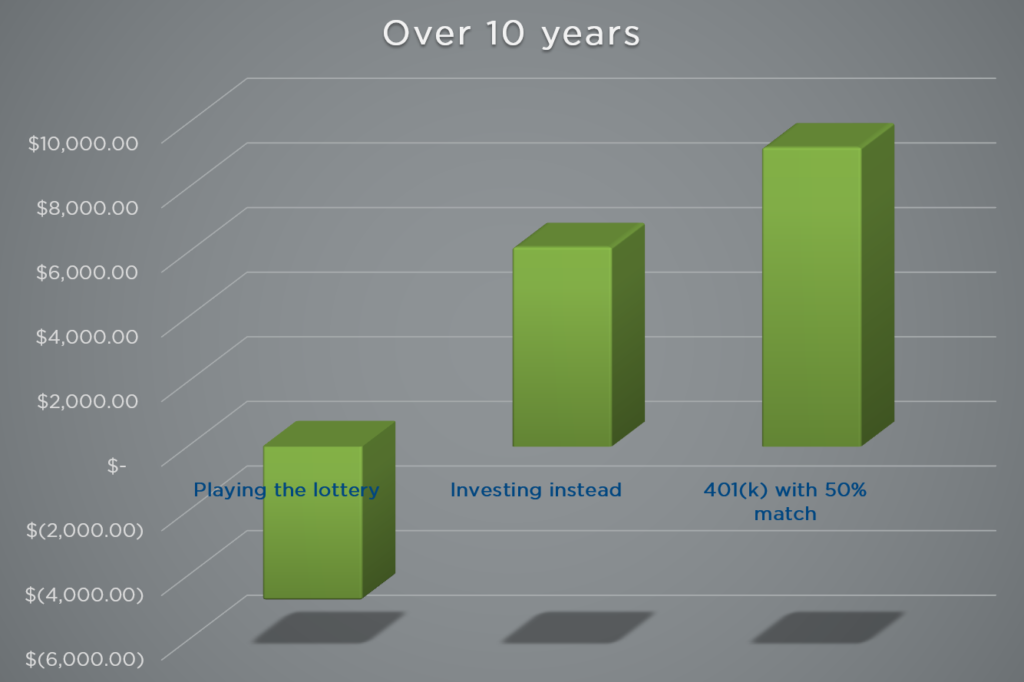
The first reason is just the simple math. If you spend $10 a week on lottery tickets (which is 260 chances to win if you’re buying five $2 tickets per week), that adds up to $520 a year. Granted, some of those tickets will win so let’s assume you win $4 nine times and $7 once for a total of $43 throughout that year. Adding it up, your lottery tickets cost $520 – $43 = $477.  If you do this for 10 years, you would have spent $4,770.

If instead you put that $477 per year into a mutual fund that earned an average 5% per year over those same 10 years, you would have $6,000. Taking it up a notch, let’s imagine you put that $477 into your 401(k) and got a 50% match. In that scenario, after 10 years you would have $9,000. Playing leads to a loss of $4,770 and investing leads to an account worth $6,000 to $9,000.

Reason #2: The dangerous money mindset

The second thing that bugs me even more is the mindset that often goes along with playing the lottery. To me it is a dangerous one — it’s the mindset that says: I’m never going to get ahead anyway, so in order for me to retire, I need to “get lucky.”

This takes the responsibility and accountability toward an individual’s own future and pins it on some unseen force that is out of their control. What irks me is that preparing for a comfortable retirement is, for the most part, 100% in the control of the everyday worker.

Sure, life throws curveballs and it’s tough to juggle the competing priorities of today versus the future, but at the end of the day, everyone is in control of their own money habits and if you have $10 per week to buy lottery tickets, then you definitely have $10 per week to save for your future.

What it really takes to retire comfortably

I’m really close to my 30-year anniversary in the financial planning industry, which means that I have talked with literally tens of thousands of people. With very few exceptions, the people who were in a position to retire did the following:

  • Spent less than they made
  • Invested their savings in things like their 401(k), income producing real estate, a business, etc.
  • When they did take on debt, they paid it off as fast as they could
  • They monitored their spending and investments at least once a quarter

While some of these people may have “gotten lucky” and bought Apple or Alphabet 20 years ago, or bought an investment property that really did well, they still followed these same 4 steps. And that’s what really matters.

Take control of your financial future today by working toward the steps that are proven to work, no luck required.

How To Find A Lost Retirement Account

August 14, 2018

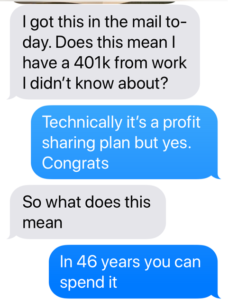
This is a recent texting exchange I had with my 24-year old daughter who works in the medical field:


It got me thinking that if she hadn’t opened her statement or thought it was junk mail, would she ever know she had this plan at work? Since she’s not contributing, there’s a chance she may have never known about it, moved on to another job in the future, and missed out on potential thousands of retirement dollars in the future.

Many of us have changed companies over our careers, and I talk to people on a regular basis who think they might have an old retirement account somewhere, but have no idea how to go about tracking it down. Are you certain that you know where all of your old retirement plans are?

Here’s how to find an orphaned retirement account

First the easy steps:

  • If you remember the name of your 401(k) provider (Vanguard, Fidelity, TIAA, Voya, etc.), first contact them to see if your money is still there.
  • You can also contact the old employer. Look for the company online, and if it still exists, contact the HR department either by phone or email and ask them for your balance and account information.

Now the harder steps:

If the above two steps don’t yield any results, you’ll have to do a little more detective work.

  • You account may have been reported as “abandoned.” To search that, visit the US Department of Labor abandoned retirement plan database. It is searchable, so if you don’t know the Plan Name or exact Company Name, you can search by City and State to narrow the results.
  • Each state has an unclaimed property web site that is searchable as well – to find it, you can either search the name of your state and the term ‘unclaimed property’ or try starting here with a national database. If you have lived in multiple states, make sure you search each state’s site (and include your maiden name if appropriate).

Eureka! You’ve found something

If you are able to uncover old retirement accounts, you’ll have to take some steps to take back control. If it’s been reported as unclaimed property, go through the steps as directed to re-claim it as yours. If the money is still sitting at your old company or old plan, then getting started on re-claiming it may be as simple as updating the address on the account.

Once you’ve regained control of your account, you may want to transfer it to a place where you can keep better track going forward. Options include:

  • Transferring it to a rollover IRA (or existing IRA)
  • Roll it over to your existing retirement plan (if they allow rollovers)

Unless you’re over the age 59 1/2, resist the urge to just take the money and run — there are most likely tax consequences and penalties involved there, and since you didn’t know the money was out there, why not continue to “let it ride” for your future retirement? Happy searching!

How To Choose Your Spending Plan Based On Your Learning Style

August 11, 2017

Just like people, spending plans (a better way to say budgets) come in all shapes, formats, styles, colors and any other distinguishing feature. They can be online, paper and pencil, a spreadsheet, a Word document, envelopes with cash, or multiple online accounts, to name a few. There isn’t really one that’s “better” than the others — the one that is best for you is the one that you stick with.

A good spending plan is one that seems to “get” you. If you have to work hard to get it, chances are you will lose interest after a few weeks and stop using it. Your spending plan may not be the one your coworker or spouse uses, and that’s OK. One way to narrow down the different ways to manage your spending plan is by knowing your learning style.

Discovering your learning style

My wife, like all good teachers, has the ability to adapt what she is teaching to each student’s learning style — different people learn different ways. If you already know your learning style, that’s great! I don’t, so being the lazy blogger that I am, I asked my wife for some good ways to figure out my learning style. She recommended EducationPlanner.org or Learning-Styles-Online. If you don’t already know your own learning style, try one of these — they are quick, less than 15 minutes to complete.

Matching it to your spending plan

Now to match the spending plan with your learning style. Education Planner categorizes people as Visual, Auditory or Tactile, while Learning-Styles uses Visual, Aural, Verbal, Physical, Logical, Social or Solitary.

If your learning style is Visual: Consider a technology based platform that has visual elements. My favorite online platforms include Mint, Every Dollar or You Need a Budget (YNAB), or your bank’s software (assuming it has visual elements like pie charts.)

If your learning style is Tactile, Logical or Solitary: Try spreadsheets — they are very popular especially with those of us who are a little more hands on; our Easy Spending Plan is an example of one.  Your bank or financial institution may also provide a spending plan that works for you. The great news is that the online and bank based software I’ve seen is aware that people learn different ways and allows you to use their platform the way you choose.

If your learning style is Tactile or Physical: Don’t forget the old school way of paying cash as much as possible and keeping receipts (I recommend an accordion file to manage receipts.) Study after study has shown that when we pay in cash, we spend less than when we swipe a card. And despite what my teenager tells me, cash is used by more than just me and drug dealers.

If your learning style is Auditory, Aural, Verbal or Social: Find a partner to work together on your spending plan and talk it out. For privacy, maybe don’t have this conversation in a public place as the folks at the coffee shop don’t need to know your personal business. But having the opportunity to sound it out and socialize could be the missing ticket to budgeting success for you.

For what it’s worth, I scored highest on Visual and lowest on Auditory using Education Planner, while Learning-Styles scored me highest on Physical and Logical and lowest on Aural. (my wife is not surprised to hear that I don’t learn by listening) That is why I use my bank’s online platform, which has graphs and allows me to download into Excel, while I also prefer to pay in cash. I also have a phobia about talking about money in public. If I had found this out before I wrote this blog, maybe it wouldn’t have taken me so long to develop a spending plan…

Once you know your learning style, look at different spending plan tools and find one that seems to get you.  Then comes the hard part: you need to use it. Try it for 3 months and if it is too much work for you, find another one. Don’t quit – keep experimenting until you find one that “gets” you.

Want more helpful financial guidance, delivered every day? Sign up to receive the Financial Finesse Tip of the Day, written by financial planners who work with people like you every day. No sales pitch EVER (being unbiased is the foundation of what we do), just the best our awesome planners have to offer. Click here to join.

Why You Should Talk To A Financial Planner Before Taking a 401(k) Loan

August 04, 2017

According to a report by EBRI, 20% of 401(k) plan participants have an outstanding loan against their retirement account — that is one out of every five employees. For this reason, many companies are now requiring employees who are taking out a 401(k) loan to talk with a financial planner first, to make sure that these people are making the best decision for themselves both today and for their financial future.

People take out loans for a variety of reasons, and when I talk to people who are in the process, I find that for most of them, it makes sense (they are buying a home or need it to pay tuition until their child’s financial aid check arrives). But sometimes there are better options, or often people don’t fully understand the implications of what they’re doing. Even if they end up taking the loan anyway, they are still better off having talked to us first.

Here are four ways that financial planners can help if you are thinking of taking a loan against your retirement.

  1. Deal with financial stress. Many people who are taking a loan from their 401(k) are under a lot of financial stress — they either don’t have a cash reserve or any assets that they can sell for immediate liquidity or their credit cards could be close to maxed out and they have an immediate cash need. A financial planner can help with strategies to deal with the stress and also help you moving forward so that you don’t find yourself in this position again in the future.
  2. Review options. Taking a 401(k) loan may be the best option, but a financial planner will help explore and evaluate possible alternatives that may be better.
  3. Point out the pitfalls. 401(k) loans are paid back from your paychecks. If those paychecks stop for any reason (you quit, get fired or are laid off, etc.), your 401(k) loan could become a taxable distribution if you don’t continue to pay it back. (some employers allow you to continue payments after you’ve left, but others require you to pay it all back within a certain time frame after you leave). If you end up “defaulting” by not paying back any portion of the loan, you will have to pay taxes on the outstanding loan balance, plus a 10% early distribution penalty if you are younger than 59 1/2. There are also implications to the loss of investment growth that a planner can help you to better understand.
  4. Solve the problem behind the problem. As  people are in the process of taking out a 401(k) loan, they are very aware of the crisis that created the need for the loan — maybe it’s a failed transmission or an unexpected medical expense. And while the loan takes care of the immediate cash need, quite often that doesn’t address the root of the problem. It could be a lack of a spending plan (Easy Spending Plan) that has you living paycheck to paycheck, maybe it’s because you don’t yet have a plan to pay off your debt (DebtBlaster Calculator) or you haven’t been able to set up a cash reserve (Daily Savings Calculator) to address situations like this. Once the immediate need is taken care of, a financial planner can work with you going forward to help identify the cause of the crisis and develop a plan to help prevent this from happening again.

Unfortunately, a lot of us (myself included) don’t reach out for help until we are in a crisis. If you find yourself in that situation and are receptive to finding ways to avoid history repeating itself, reach out to a financial planner for help. We do it all the time.

Want more helpful financial guidance, delivered every day? Sign up to receive the Financial Finesse Tip of the Day, written by financial planners who work with people like you every day. No sales pitch EVER (being unbiased is the foundation of what we do), just the best our awesome planners have to offer. Click here to join.


4 Life Lessons I Wish I’d Learned 30 Years Ago

July 14, 2017

The other day I started thinking, “If I could travel back in time, what advice would 55 year-old me give to 25 year-old me?” The list grew and I started to get depressed, so I decided to limit it to two things financial and two things non financial in hopes that you might find some life wisdom in here as well.

Here are the conversations I imagine I’d have with my younger, cockier, less experienced (but oh my, much thinner…) self:

Non financial life stuff

  1. Keep in touch with people who are important to you. In about 20 years your daughter will ask you and your wife (whom you haven’t met yet), “Were all your friends in college so nice?”  The answer is no, you just got rid of the ones that weren’t good for you throughout the years. There will also be some that you regret not keeping in touch with. (There is this thing coming called Facebook which will make this easier.) The bottom line — it’s worth it to keep in touch with the people who are important to you, as they will make life better throughout the years.
  2. Focus on things that you do well and find ways to compensate for things that you don’t do as well.  I would tell Young Steve that spelling will always be a challenge for you, but there is this thing coming called spell check that will help, so don’t waste too much time memorizing words. (Although 2017 spell check still cannot figure out what word I am trying to sspaejkll on occasion.) You will be driven to overcome things you are not very good at and pay less attention to what you are good at, but this is a folly — it should be the opposite. I learned this from a book called “Strengths Finder,” which was published in 2007, and showed me I’d wasted a lot of energy over 20 years trying to “fix” myself rather than focusing on what I already did well. Figure out what your strengths are, what you are really good at and focus your time and energy on improving those. Worry less about your short-comings. (And if possible, write that book yourself in ’05 so you can retire early on the revenues from it!)

Financial life stuff

  1. Figure out a spending plan. I know you hate the word budget – it sounds like diet and they both tell you something you cannot do and you hate that. So here is the trick you play on yourself: it’s not a budget, it’s a “spending plan,” where you plan what you want to spend your money on. And you need one ASAP. Rather than beating yourself up for what you wasted your last paycheck on, it is time to think about what you want to spend your next paycheck on. It doesn’t mean you can’t spend money, it means you will be spending money on what is most important to you. For instance, if you want to take that nice sailing trip with your friends next summer ($1,500), that means taking your lunch to work 3 days a week ($10*3*50 weeks =$1,500). 2017 tools that can help do this include Mint.com, everydollar.com, Easy Spending Plan, your bank’s system or any another system/tool/app available. The particular system doesn’t matter; what matters is that you have a way to make sure you are spending your money on what is important to you and that your system gets you and is easy to use.
  2. Set aside 30 minutes a week to think about your finances to make sure you focus your time and money on what is important to you. Right now, your thought process is what is politely described as “inspirational” (also known as scatter brained), but when you find something you like you really dig into it (also known as OCD). If at 25, not married, no kids you cannot find time to take care of your money, you never will find time to do this. Make the time now. Turns out that you are a morning person, the latest you wake up is 6:30 (you used to think Dad was weird when he did the same thing) and that is when your energy is highest, so do it then. Set an appointment every Sunday morning from 7:00 to 7:30 to go over your finances. Look at what you are spending your money on and make sure it matches your spending plan. Make adjustments as necessary. Review your investments to make sure you are taking an appropriate amount of risk. The bottom line — focus your time and money on what is important to you.

Then I thought, “What do I think 85 year-old Steve will want to tell 55 year-old Steve?” Guess what – at this point, I think it would be the same thing. Only time will tell!


Want more helpful financial guidance, delivered every day? Sign up to receive the Financial Finesse Tip of the Day, written by financial planners who work with people like you every day. No sales pitch EVER (being unbiased is the foundation of what we do), just the best our awesome planners have to offer. Click here to join.