
How An Indirect Retirement Account Rollover Can Go Wrong And How To Avoid It

September 11, 2018

Late last week I received a panicked phone call from my sister. She had received an unsolicited check from a financial institution with no letter explaining what it was for or why she received it.

After we did some investigating, it turns out it was a full distribution from her traditional IRA because the mutual fund it was invested in had been closed by the fund company. Because she did not want to take a distribution from her IRA, she will need to deposit that check into another traditional IRA within 60 days to avoid paying taxes and early withdrawal penalties (she is not yet age 59 ½) on the amount of her IRA.

While a hassle, that process is not difficult or time consuming. But here’s the rub: the fund company withheld 10% for federal income taxes. We’re not sure why 10% was withheld as it is not required to withhold from an IRA, but it is important to note that distributions from an employer plan, like a 401(k), require 20% mandatory withholding for federal taxes.

Why the unnecessary withholding is an issue

To avoid taxes and penalties on the amount withheld, she will need to come up with that 10% amount to make the indirect rollover a complete rollover. Otherwise, she will incur taxes and penalties for the amount withheld that won’t get into the new IRA within the 60 day deadline.

Let’s break it down further

The details

For simplicity sake, I am going to use round numbers to illustrate the problem.

  • The full amount of the distribution was $50,000.
  • $5,000 was withheld, so my sister received a check payable to her for $45,000.
    • If she were to simply cash that check, she’d have to include the full $50,000 as taxable income to her this year, including an additional 10% penalty for the early distribution (maybe that’s why they withheld? We’ll never know).
  • She is not able to come up with an extra $5,000 to complete the full $50,000 indirect rollover into an IRA, so her new IRA will start with a value of $45,000 – down from the $50,000 she had last week.
  • Come tax time, the $5,000 withheld will be included as income on her tax return. Even worse, she will have to pay a 10% early withdrawal penalty on that $5,000!
    • If she is in the 22% tax bracket, that comes up to $1,600 (22% times $5,000 plus 10% times $5,000) in tax and penalties.
  • She will get a refund of $3,400 since the tax and penalty on the $5,000 withheld is only $1,600. But she has now lost over 3% of her IRA value as well as the future tax-deferral on that $5,000.

A unique situation

This is a unique situation – having a distribution happen with no warning or chance to act beforehand (I suspect something was received and discarded on accident, but that is neither here nor there) – but I can only imagine that other recipients of such checks who did not have a financially savvy person to call may have just cashed the check and will find themselves with a big tax surprise in April.

What could’ve been done differently

Had she known this was going to happen, she could have initiated a direct rollover – where the funds move directly from one financial company to another – with no tax implications at all. And no need to worry about getting the funds into a new IRA within 60 days.

The moral of the story

Besides opening your mail and making sure you’re not missing important communications from your financial services providers, the important take-away here is that the simplest way to move retirement money is to avoid being the middle person. If possible, a direct rollover will always be much better than an indirect rollover if your intention is to keep all the funds in the IRA for the future.

This is especially true when rolling funds out of your 401(k) or other employer-sponsored retirement plan, as an indirect rollover does lead to a mandatory 20% tax withholding. When you do a direct rollover, there are no taxes to be withheld, so you don’t have to make up the difference (assuming you have the cash available to do so) or get stuck with unintended income.
How To Start Your Emergency Fund

August 29, 2018

One of the crucial components to your financial foundation is to have an emergency fund (I know, not breaking any news here). Having an emergency fund lets us navigate life’s curveballs (medical bills, car repairs, home repairs, etc.) without having to spiral into credit card or other high interest debt.

But there is often a significant difference between knowing we should do something and taking the all important first step to action. Let’s look at a few simple steps to starting an emergency fund on the way to improving our overall financial stability.

Step 1: Review your spending plan

The purpose of this post isn’t to get in to budgeting (I prefer the term “spending plan”), but one of the biggest hurdles most people face in getting started is the feeling that there just isn’t any money left over to save. To get over that hurdle, try these ideas:

  • Pay yourself first – If your intention is to save whatever is left over in your checking account at the end of each month, it is likely you’ll find there isn’t anything left to save. If you’re like me, money in the checking account finds a way to get spent. Shift your savings intention to the top of your monthly budget – make it a priority and put the money there before you start spending!
  • Find the money – Once you pay yourself first, you may need to find an area or two to cut back in the rest of your spending plan to make it happen. If you decide that you are going to save $50 per month into your emergency fund, look for small adjustments you can make elsewhere to make that happen – it could be as simple as skipping five $10 fast food meals per month.

Step 2: Automate!

Set your saving commitment up to happen automatically – you’ll be surprised the impact this has on getting your emergency fund up and running. I suggest setting up an account at a different financial institution than your checking account. You want to have the two accounts linked but having them at separate places lessens the temptation to move money out of your emergency fund.

Once the account is set up, set up either an automatic transfer from your checking account each month, or check with your employer to see if you can have funds deposited automatically from your pay into your emergency fund.

Step 3: Set milestones

Most financial planners suggest having 3-6 months’ worth of expenses in your emergency fund. That can be a considerable number and seem almost impossible when starting at zero. Make that a stretch goal and instead shoot for having $1,000 to start, then $2,000 and so on.

When you reach a milestone, be sure to celebrate that accomplishment! By having milestones on the path to the goal, it makes a game of it and helps you realize that every dollar saved gets you closer to winning the game. That momentum builds quickly, and you may find you are wanting to save even more to reach your goals along the way.

Getting started is the hardest part

Taking these few steps will help you on your way to building that emergency fund, and hopefully it will be easy riding from there. Like most things, getting started is actually the hardest part. Once you start, it becomes a habit and will make an enormous difference in how you view your own financial situation.

Being able to take that next emergency in stride financially gives you the power to accomplish other financial goals as well. So get started today and know that you can do this!

How To Approach Investing As Retirement Draws Closer

August 15, 2018

One of the things I discuss quite a bit with employees that are approaching retirement is how they should structure their investments as retirement draws closer. Many times, they are considering becoming more aggressive over their last few years in the workforce to try and boost returns and maximize account values. This can be a recipe for delayed retirement if the timing is wrong.

The fundamentals

While the fundamentals of investing – being mindful of how long until you need the money and your risk tolerance – do not change as you approach (or enter) retirement, conventional wisdom says you should really want to take less risk as you approach retirement. The idea being you have less time to recover from market losses than you did earlier in your career.

It’s a (hopefully) long road ahead

But, you don’t want to just plow everything into a stable value fund or cash either. Retirement can last upwards of 30 years or more, so you want some aggressive investments to help that money grow and last. You may be thinking, “OK you’re telling me to be more conservative, but stay aggressive – which one is it?”

Well, like many things in financial planning, it depends. Let’s look at some strategies to help you decide how to best manage your own nest egg as you approach retirement.

Exploring the fundamentals

At any point in your financial life, sticking to the fundamentals is the best way to be a successful investor.

  • When do you need the money? Money you know you will need to spend in the next 5 years should be invested conservatively. Investments like a CD, money market mutual fund, or a stable value fund protect those funds from dramatic market movements.
  • What is your risk tolerance? Knowing how you feel about risk is crucial in setting up your investment allocation. There are investors in their 20s or 30s that are very conservative by nature, just like there are investors in their 70s and 80s that are aggressive. Staying true to your risk tolerance allows you to be comfortable with the risk you are taking, which makes you much more likely to stay with your strategy when markets are down.
  • Don’t react to market moves. This one is easier said than done because it contradicts our human nature. For most of us, the pain of losing value in our accounts is stronger than the joy we feel when our accounts are growing. Selling stock investments at low points locks in losses as we are often selling low after buying high. It’s best to resist watching the market on a day-to-day basis.
  • Rebalance regularly. At least once per year, make sure your allocation reflects your original strategy. If your goal is to have 60% in stocks, 30% in bonds, and 10% in cash, check to make sure that is how your funds are set up. In a year when stocks have done well, you may find yourself with 70% in stocks and 20% in bonds. It can be tempting to keep riding the wave of a bull market, but it’s better in the long run to lock in the gains and stick to your original mix. Rebalance by selling enough of the stock investments (sell high) to get back to your target, then buying enough of the bond investments (buy low) to get back to your target there.

The bucketing strategy

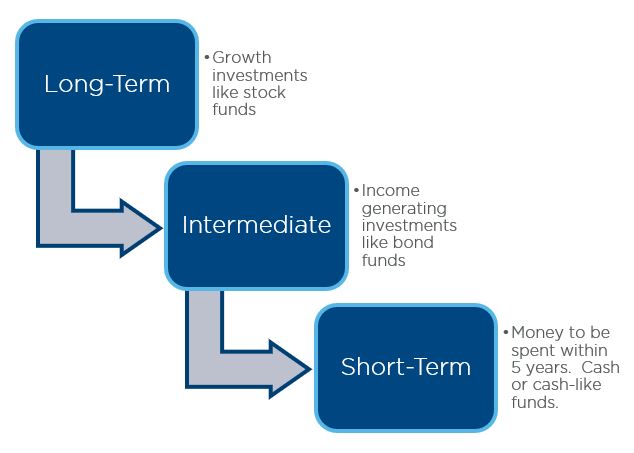
When it comes to making investment changes as you approach retirement, one popular strategy is to think of putting your money in hypothetical buckets.

  1. The first bucket is your short-term funds – money you know you will spend in the next 5 years. This bucket can be thought of almost as a savings account and be very conservatively invested.
  2. The second bucket is your intermediate bucket and should be invested in things that generate income, like bond funds. This is money you’d anticipate withdrawing after 5 years, but before 10 years. This bucket is used to refill your short-term bucket as you spend from it.
  3. The third bucket is your long-term bucket and holds your aggressive investments (think stock funds) and is designed to drive growth. This is the bucket that can help your savings to last those 30+ years you’ll hopefully have in retirement.

Rule of thumb

Another way to look at it is by using a common rule of thumb that says the best balance is investing a percentage in stocks equal to 120 minus your age. So if you are 58, then 62% of your funds would be in stock funds. You may try this rule of thumb, along with the 5-year bucket if you find that simpler.

Final thoughts

As you approach retirement, it is a wonderful time to revisit your retirement accounts and make sure you are in line with your risk tolerance and following good fundamentals. Take some time to review your budget and spending needs over the next couple years, which will help you to clarify how much goes into each bucket. Having your money split into the different buckets can help make sure you have the right balance of safety, income, and growth. This will help your money last as your enjoy your retirement!

When Does A Reverse Mortgage Make Sense?

August 03, 2018

I was having lunch with a friend recently and he raised a question about reverse mortgages. His parents have been receiving mailers advertising the benefits of a reverse mortgage and he wanted to know if it was something they should explore. When this type of product was initially launched, they were considered to be a bad deal. But newer regulations have changed that, so it’s actually a viable consideration in certain instances. Here’s what I told him.

A reverse mortgage is a type of home equity loan that allows homeowners that are 62 or older to use a portion of their home equity to supplement their income and improve their cash flow each month by eliminating their mortgage payment. Here’s how they work.

The basics

  • The bank will make payments to the home-owner (or extend a line of credit) based on a percentage of equity the borrower has in their home. If you still owe on your traditional mortgage, that is paid off with the reverse mortgage, so the monthly mortgage payment ends.
  • You must be at least 62 years old to qualify, and your home must be used as your primary residence.
  • You should either have the home paid off entirely or only a small mortgage remaining.
  • The loan is payable when you:
    • Pass away,
    • Sell the home, or
    • Permanently move out (aka it is no your longer primary residence for more than 12 months)
  • Funds can be used for any purpose – common uses are to supplement income, pay for health care expenses, pay off debt, or pay for home maintenance/improvement projects.
  • You can never owe more than the value of your home, no matter how much you borrow.
  • You are required to participate in mandatory counseling from a third party to explore your options before committing to a reverse mortgage.

How much can you borrow?

The amount you can borrow through a reverse mortgage depends on several factors, including:

  • Your age (will be based on the age of younger spouse if you’re married).
    • Generally, the older you are, the more you can borrow.
  • The value of your home.
    • Limited to the lesser of the appraised value or $636,150.
  • Interest rate.

What does it cost? (aka what are the cons)

This is a critical issue to be aware of if you are considering a reverse mortgage. It is common to see higher closing costs (origination fees, upfront mortgage insurance and appraisal fees) and the interest rate is generally higher than with a traditional mortgage.

Also, you remain responsible for property taxes, insurance, and maintenance costs. And, if you want the home to stay in the family after you’re gone, a reverse mortgage can make that more difficult as the loan needs to be paid at your passing – that may mean the home needs to be sold if no other funds are available.

Does it make sense for you?

A reverse mortgage can be an effective retirement planning tool if you:

  • Don’t plan to move.
  • Can afford to pay property taxes, insurance and the costs of maintaining the home otherwise.
  • Want to improve cash flow or supplement income to pay off debt or pay for other expenses.

On the flip side, a reverse mortgage may not make sense if you:

  • Plan to move or want to keep the home in the family (and your estate would have no other means to pay off the reverse mortgage).
  • Can’t afford the costs of home maintenance, even without a mortgage payment.
  • Don’t have cash available to pay the costs to take out a reverse mortgage.

Final thoughts

In talking to my friend, it turns out a reverse mortgage was not the right fit for his parents and their situation. But, it is good to keep all options open and know what resources you have available to generate income in retirement.

It is a good idea to explore other sources of income before looking at a reverse mortgage. Spend down your retirement savings and try to reduce your expenses first. If you still have a shortfall, a reverse mortgage may make sense for you.


Beware Of This Unnecessary College Expense

July 17, 2018

We are quickly approaching that time of year when thousands of college students head off to school and the joys of communal living in dorms across the country. Perhaps you’ve noticed all the store fliers for big box stores that are filled with colorful images of hip looking dorm rooms.

It can be easy to go overboard when helping your child prepare for their first time away from home, but I’m here to remind you that college is expensive enough (I know, newsflash), and adding thousands of dollars in dorm shopping is really just adding insult to injury after tuition and books.

7 tips to minimize expenses when setting up a dorm room

Be careful where you shop

Shopping at high-end stores or your favorite store (where you love everything they make) is a bad idea. Does your young scholar really need a $250 bedding set? Assuming you don’t have extra bedding laying around your house that they can use, stores like Marshalls and TJ Maxx sell comfortable bedding sets for as low as $40-$60 dollars. If your young adult was like me in college, the bed will never get made anyway unless a parent visit is expected, so save your money.

You may also find deals online at sites like Overstock and Amazon.

Make a list and have a budget

Having a list will keep you focused while shopping and help you avoid buying things you don’t really need (trust me, your daughter doesn’t really need a faux-fur throw rug). There are a lot of lists online to use as a guide if you are not sure what you need for college, and your child’s university probably also has a list of necessary items.

Setting a budget of total spending ahead of time will also help you to resist those impulse purchases, although you may want to give a little bit of wiggle room for one or two things.

Check in with any roommates

Coordinate with any roommates to avoid having two microwaves or mini fridges. This is also an opportunity to discuss what items you think you need and what you can live without.

Look around your home for supplies

Before investing in color-coordinated folders, notebooks and pens, check around your home office and basement. A lot of people find they have leftover folders, notebooks, and pens/pencils at home from the high school years. Plus, your kid may not even need this stuff like you did in college – many students just use their laptop for notes.

You may even have things like coffee makers, clothes hampers, shower caddies and other goodies that can save you some money in supplies. That stuff adds up!

Take advantage of sales and coupons

Many retailers offer good sales and coupons this time of year for college stuff. Keep in mind though that those sales are often just ways for them to get you in the door so you can splurge on other stuff as well. Again, stick to your list and wait for those sales and coupons to save some money on the items you plan to buy anyway.

Talk to other people in college and use hand-me-downs

If you have older kids or friends with kids already in college, talk to them about what things they really needed and what things they took, but didn’t use. You may find you don’t need to buy that microwave or small TV after all.

They may also have some items they don’t need any more that they can give you or sell to you on the cheap.

Know the dimensions of the room

Knowing how much space you have is key before buying furniture for your room, if any. There are creative ways to save space like having elevated bed frames built – but make sure you are not buying furniture that doesn’t fit in the room.

The bottom line is that having the hippest, best-decorated room on campus is not going to be what helps your child excel in college, so be reasonable about what’s really needed, versus what just feels like a need. Going off to college is an exciting time for students and parents. Hopefully these hacks will help you prepare your child for a happy dorm life and save some money in the process!


Can You Contribute To A 401(k) And SEP-IRA At The Same Time?

July 13, 2018

One trend I’ve noticed in recent years is people with full-time jobs starting a business on the side. Some folks are looking to earn some extra cash and some are passionate about a hobby or pursuit and want to try to make a business from that passion.

If you have a side gig such as catering, photography, or blogging in addition to your “real job,” it’s important to know that there are distinct types of retirement plans that you can use for each. Being aware of how they work together can allow you to save more for retirement, while possibly saving on taxes today.

What is a SEP?

First, a quick review of what a SEP-IRA is. Most of us are familiar with our 401(k) plans at work – in order to contribute, you have to work for the company that’s providing it. Similarly, a SEP-IRA is a retirement plan tied to a company, but it’s specifically designed for self-employed individuals and small businesses.

How do contributions work?

Unlike the 401(k), where both the employer and employee are able to contribute to the account, all contributions to a SEP-IRA are considered employer contributions. For 2018, you can contribute the lesser of 25% of your gross salary (or 20% of your net adjusted annual self-employment income) up to a maximum of $55,000. You have until your tax filing deadline to make your contribution, so many people with SEPs choose to wait until then so that they know exactly how much they can put in (your CPA and most tax prep softwares will calculate this amount for you).

Keep in mind that if you employ anyone to help out with your business, you also have to put the same amount in their account as you save for yourself. You can adjust your contributions each year, so if your business is having a great year, you can save more. You can also save less (or not at all) in years that are tight. However, you do have to have self-employed income to make any contributions.

Can I use a SEP-IRA if I also contribute to my 401(k)?

If you are an employee of the company you work for (aka you receive a W-2 at tax time) and you also have a side business that you own, you can actually make contributions to your employer’s 401(k) plan and contribute to a SEP-IRA for your business. That means that having a side gig can allow you to save beyond the 401(k) annual limit of $18,500 (or $24,500 if you’re over age 50)!

Here’s an example of how it might work:

  • Let’s say you are already maxing out your 401(k) at work.
  • Now let’s say you also do a little wedding photography on the weekends, which brings in another $20,000 this year.
  • You could open a SEP-IRA and contribute $5,000 (25% of $20,000) for this year.
  • Because the 401(k) and SEP-IRA are with two different companies with no common control, saving in your 401(k) does not impact how much you can save into a SEP-IRA.
  • It’s important to note that if you have two jobs where you work for someone else and have 401(k)’s at both, that the $18,500/$24,500 limit applies to both across the board; the SEP-IRA, however, could be in addition to the 401(k).

As you can see, the potential to reduce your taxable income and save for retirement becomes very powerful!

Other things to consider

  • It is crucial to run your situation by your tax professional to make sure your strategy is best suited to you.
  • I also suggest reviewing this FAQ site from the IRS to get additional information.
  • My colleague, Scott has also written a great piece about SEP IRAs that can help if you’re looking to set one up.

Understanding your options and having a well-coordinated plan can help you manage your taxes and do some serious savings for retirement!

What Financial Independence Means To Me

July 03, 2018

As we celebrate our Nation’s Independence, I find myself reflecting on the notion of financial independence. I want to share some of my personal journey to financial independence, not to define financial independence, but to share my personal feelings on what it means to me.

A journey, not a destination

Several years ago, I found myself at a crossroads. While I was making decent money as a financial planner, I found myself struggling to support my growing family. We were living check-to-check, not saving for retirement (or any other financial goals), and using credit cards to pay for routine expenses like food and gas.

Not exactly a model of how to manage money, which is not a good place for a financial planner to find themselves! I knew I had to take control of my finances and live the strategies I educated others about. While this is still evolving as our goals and life changes, I remember very clearly declaring financial independence in the spring of 2013!

The changes I made

Financial Independence looks different for everyone, but I laid out several goals that I considered essential to claim my own financial freedom.

  • Adopt AND stick to a budget (aka spending plan) – Understanding where we were spending our money was the first step for me. That allowed us to sit down and decide where we could cut back, make sure we were saving into our emergency fund, retirement accounts, and paying off credit card debt as aggressively as possible. We still use a spending plan (and will forever) because it is the most valuable tool to make sure we live below our means. Everything else builds off the idea of spending less than we bring in!
  • Build an emergency fund – By living below our means each month, we could build 6 months of expenses into a savings account. These two accomplishments got us off the cycle of living check-to-check. Seeing that account grow over time encouraged us that we were on the right track – and the confidence to keep going.
  • Save for retirement – We started contributing to our retirement accounts. To start, we did enough to make sure we received the full match for our employers. We had to tweak our budget to do this, but found the things we cut back on were not essential and it was easier than we expected.
  • Pay off credit card debt – This was my personal nemesis! I could never feel like I was financially independent if I owed a lot of money to credit card companies. After making minimum payments for several years and paying insane amounts of interest, we began to attack the highest interest card first with every extra dollar we could find. This only happened because our spending plan allowed us to make sure we stopped using the credit cards first. Once the highest balance was paid off, we shifted to the next higher rate with even more zeal. In 32 months, we were totally out of credit card debt. The day we made that last credit card payment was an awesome day!

It’s important to see the connection your goals share – especially recognizing how the spending plan is the foundation for taking control of your finances. Living below our means was the first step in our journey to financial independence.

If I can do it, you can too (I promise)

Once I started this journey, real change happened quickly. I quickly noticed my attitude shifted from feeling like I was destined to be in debt forever and never be in control, to a determination I could live within a budget and become financially independent. This mindset is important if you feel like you are “bad with money” or just not meant to get ahead. Recognize that financial independence is intentional, and has very little to do with how much money you make. We can all decide to live with our means – which is the most important step!

Maybe the 4th of July is the day you decide to start your own journey to financial independence. Believe you can get there, then take small steps to start your journey. Before long, you will be on your way. When you reach your goal, celebrate your success and use that to renew your conviction.

I’m not saying it will be easy, but I promise you it is worth it!

Alternatives To Co-Signing

June 29, 2018

You’ve probably figured out that I am not a big fan of cosigning on loans – too much risk and no benefits. But we all want to help those we care about, so what else can we do? Here are a few ideas:

  • Help with a down payment: If you’re being asked to co-sign a mortgage or car loan, perhaps just helping with a down payment is enough, assuming you have the cash available. That could help them qualify for the loan on their own, with no need for you to sign as well. You can do this as a gift (make sure to understand the IRS rules on gifts) or set up a private loan agreement where you will eventually be paid back.
  • Lend the money directly: If you can do it, you can act as the bank and set up a private loan agreement with the borrower and let them use the funds to make the purchase. It’s important to be clear about the agreement and expectations and definitely put it in writing so that you can write it off on your taxes if you don’t get paid back.
    • Potential downside: This could make a relationship awkward, and you take the risk of the borrower missing payments. But, it does protect your credit and spare you any possible legal action.
  • Take out the loan yourself: Since co-signing puts you on the hook for payments but without control, another idea would be for you to put the entire agreement in your name, then create a separate agreement with the borrower to re-pay you. That way you can ensure that payments are made, and if the borrower misses a payment, you have legal rights to the thing it paid for (like the car, apartment, etc.). This obviously doesn’t help the borrower to build their credit, but it puts the protection of yours squarely on your shoulders.
    • Potential downside: This strategy won’t work for student loans, unless you’re the parent, in which case you can take out PLUS loans, but proceed with caution.
  • Help them find a better offer: Rather than just rejecting the request outright, offer to help the borrower find a more affordable option that they can qualify for on their own. Perhaps they need to shop for a less expensive car or different loan terms. If it’s a student loan, you might suggest they take classes at a community college until they can get their credit up – this will save them money over the long haul anyway.

Remember that saying yes to co-signing can lead to a lost relationship and definitely makes it harder to say no in the future. While it might be tough in the short run, it will probably be better in the long run for everyone if the person asking looks for other options or waits until he or she can qualify without help.

Are You Prepared For An Emergency Evacuation?

June 26, 2018

It’s officially hurricane and wildfire season again, and if the past couple years are any indication, we’re likely to see a few natural disasters this summer. Hopefully you’re not impacted, but rather than wait until one is imminent in the news, we all need to take some time to make sure we are ready if we find ourselves in an evacuation situation.

My family was impacted directly a few years ago due to wildfires in Colorado, and it can be an overwhelming scenario. There are many emergencies that may result in the need to evacuate – sometimes you have time to prepare and sometimes you may need to evacuate immediately. Having a plan ahead of time can help ensure you are able to react quickly and evacuate safely.

Before an evacuation

  • Understand what types of disasters are most likely to occur where you live (hurricanes, tornadoes, blizzards, wildfires, earthquakes, etc.) and what the local response plans entail. This includes local places to be used as shelters. We are less worried about earthquakes here in Colorado, but you can be sure we are ready for blizzards around here, even in June!
  • Identify several places you could go if forced to evacuate, perhaps available shelters, or a friend’s home in another town or a motel. Have several options in different directions.
  • Have a communication plan for your family so you can stay in communication and re-unite if separated.
  • Assemble supplies you will need like clothes, food, and water. Include an Emergency Supply Kit and an Emergency Financial First Aid Kit. Store supplies in a place that is safe and accessible so you can get to them quickly if necessary.
  • If evacuation seems likely, have a full tank of gas in your car and keep an emergency kit in the car.
  • It’s a good idea to keep cash on hand as well, perhaps inside your emergency kit. Try to have smaller bills on hand, in case you find yourself in a situation where you can’t change a twenty dollar bill.
  • If your workplace has an emergency phone line, program that in to your phone. If not, make sure you have your supervisor’s contact information stored in your contacts so that you can be in touch with work if needed.

During an evacuation

  • Take all supplies prepared above and a radio. A portable charger for your devices may come in handy as well.
  • Follow evacuation instructions and use recommended evacuation routes to not impede emergency responders. Avoid flooded areas.
  • Take your pets with you and learn how to Plan For Your Pets in an emergency.
  • If you have time, email friends and family and let them know where you are going.
  • Secure your home and unplug electrical equipment.
  • Take one car per family to minimize congestion and leave as early as possible.
  • Check with your neighbors that may need a ride.

Keeping your supplies current

Remember to rethink your supply kits and family needs at least once a year and replace items as needed. As we have heard from local officials after previous events, stuff can be replaced and homes rebuilt, so focus on your safety and the safety of your neighbors should you be forced to evacuate.

For all the ways to be prepared financially, check out the American Red Cross guide on Disasters and Financial Planning.


Is It A Good Idea To Co-Sign A Loan?

June 21, 2018

Have you ever been approached by a friend or family member asking you to cosign on a loan for them? They will most likely promise you that they are good for the monthly payments and just need some help getting approved for the loan. You want to help them out, but is this a smart thing to do? What are the risks to you as a cosigner? These are important questions to ask yourself before you commit to cosigning on a loan.

What’s the big deal?

A lender requires a cosigner when they are not confident a borrower can meet the obligations of the loan. This should be your first warning sign – if a professional lender isn’t sold on the borrower, why would you be?

As a cosigner, you are committing to the lender that you will make all payments on the debt if the primary borrower does not. You become 100% responsible for the debt. If the primary borrower stops making payments, you are expected to make payments on-time to the lender – including any late fees and penalties.

You take on all the risk, without any of the benefits since you have no ownership rights to the property being purchased.

Know the risks

Helping someone get a loan is a generous thing to do, but it is important to understand the risks before signing on the dotted line.

  • Damage to your credit score: Anytime you’re a co-signor on a loan, it is detrimental to your credit score to a certain degree. If the person you co-signed for is late with a payment, your credit will also take the hit. This could mean you won’t qualify for loans you need to take out in the future.
  • Can you afford the payments? You are agreeing to make payments on the loan, so the lender will come to you if the borrower isn’t making the payments. It doesn’t matter why the borrower is missing payments, you should be prepared to step in and start making payments if need be. Setting some money aside in a savings account is a smart step to make sure you have the money if need be.
  • Legal judgments could lead to garnishments: If you do not make payments, you may be hit with legal action (after all the fun of collection letters and phone calls). These could even go as far as wage garnishments or funds pulled from your bank account if you don’t pay.
  • Your ability to borrow may be compromised: Cosigned loans appear on your credit report, so even if the borrower is making the payments, lenders will view the loan as your obligation. This reduces your monthly cash flow in the lender’s eyes, so it can make it harder to qualify for a car loan or mortgage.

Beyond the money

In addition to the possible damage to your finances, cosigning agreements that go bad can damage personal relationships. I have seen people cosign for kids, boyfriend/girlfriends, friends, and spouses, but when someone leaves you with their debt and mess, feelings get hurt and relationships damaged.

Making sure you understand the risks of cosigning can spare you some major headaches down the road. Wanting to help people out is a good thing, but cosigning a loan for someone may not be the best option to provide that help.

How A 529 Account Can Help With Taxes Even If You Don’t Have Anything In It

June 12, 2018

We’ve all heard about 529 plans as a vehicle to save for college, but what about using them strictly as a way to pay, even if you don’t put a cent in before tuition is due? We typically look at these plans through a long-term savings lens to accumulate larger sums of money for a child’s education. But there is also a short-term view that allows you to use a 529 plan to save money on state income taxes, even if you haven’t been saving into a 529 all along — and it’s not just for your kids! If you’re thinking of going back to school, keep reading.

Who it works best for

This strategy really only works if you meet both of the following criteria:

  1. You live in a state that has income taxes AND offers a 529 tax incentive, for example, Minnesota residents can invest in any state’s plan and get a tax deduction, while Colorado residents are only incented to use the Colorado plan. California residents are out of luck — there is no tax benefit to contributing to a 529 plan.
  2. You will be paying qualifying college costs not covered by other forms of financial aid such as scholarships, grants and student loans.

How it works

Assuming you meet the above two criteria, here’s how you can still take advantage of a 529 plan even if you’re opening it just in time to pay college costs. Since I live in Colorado, I’ll use that as an example to illustrate how it works:

  • I want to go back to school to get a graduate degree, but don’t have any money saved in a Colorado 529 — my plan is to pay the costs out-of-pocket as I go.
  • Let’s say my first tuition payment of $10,000 is due in 2 weeks and I’m using money in my savings account to pay it.
  • I open a Colorado 529 plan and deposit $10,000 into the plan today. In two weeks, I send a payment directly from my 529 account to pay my tuition.
  • At tax time, I deduct $10,000 from my Colorado income taxes.
  • Important note about investment choice: Since I would be planning to spend the money in the account right away, I would make sure I chose the money market option and not one of the other mutual funds, out of the risk that the market is likely fluctuate during those two weeks and I could end up with less than $10k on my tuition due date.

Where the tax benefit comes in

Colorado allows me to deduct the full contribution of $10,000 from my state income taxes (assuming I have at least $10k in income) that year. Since Colorado state income is taxed at 4.63%, I would save $463 ($10,000 x .0463) in state income taxes the year I paid my tuition. Pretty good deal, right?

Make sure you read the fine print on timing

Most plans have a holding period that specifies how long money must stay in the account before it qualifies as a tax-deductible contribution, so you may have a plan ahead a few weeks. Colorado’s holding period is 7 days, which is why I used two weeks in my example above — I like to leave a little room for error.

A few other things to consider

Now, while most 529 plans are similar, each state has their rules around how much you can deduct on 529 contributions – and this would not apply in states that do not have a state income tax. Most states put a cap on how much of your annual contribution is deductible. So if I lived in Arizona, where it’s capped at $4,000 per year for married people, I’d probably only put $4,000 of my $10,000 tuition bill into my account, since that’s the max I can deduct in one year.

Before you start this strategy, make sure you’re clear on the rules for your state.

Maxing out all the tax credits

Paying for college may qualify you for various tax credits, so you want to make sure using a 529 this way does not disqualify you from receiving those. Costs incurred during the first four years of college may qualify you for the American Opportunity Tax Credit (check the income limits to see if you qualify).

For costs after the first four years (5th year seniors or grad school for instance), you may qualify for the Lifetime Learning Credit, again subject to income limits.

In my example above, paying the full cost of tuition by routing through a 529 would impact my ability to claim my credit, which may cost me more than I gain with the state income tax deduction. Assuming I would qualify for the federal tax credit it may make more sense for me to pay the first $4k straight from my savings for the federal tax credit, then run the rest through the 529 for the state tax deduction.

Consult your tax professional to make sure you are following the strategy that makes the most sense for you and capturing those valuable tax credits.

What if my job has a tuition reimbursement benefit?

As long as you’re on the hook to pre-pay your tuition, even if you’re later reimbursed by your job, you can still take advantage of this tax saving strategy.

One thing to think about, however, is if your job also has a student loan reimbursement benefit — if your job will reimburse you for tuition AND match some student loan payments, you may be able to get far more benefit from taking out a loan to pay your tuition instead of paying out of pocket. However, for people with kids in college, this can be a great way to save on taxes.

Paying for college can feel like an uphill battle at times. Hopefully this hack gives you one more tool to help you reach your family’s educational and financial goals!

Important Home Maintenance Tasks I Do Every Spring

June 01, 2018

Being a homeowner comes with a lot of pride and satisfaction, not to mention the financial benefits of building equity over time. But it’s not all fun and games — owning a home also involves a lot of work to protect your biggest investment.

Spring is a great time to spruce up the yard, wash away the grimy left overs of a long winter from the garage and windows, and do some basic maintenance to address any other issues that may have popped up over the winter. Here are some of things on my spring to-do list to keep my house intact and running efficiently:

Inspect the roof

I have asphalt shingles on my roof, and they are certainly subject to damage from wind, hail, and water. The roof is the first line of defense against water, so making sure it is in good repair is very important.

How I do it: I like to hop up there in the spring and make sure there are no damaged or missing shingles (I also do this after hail storms we are prone to get in Colorado). If there are, I will call a licensed roofer to handle the repairs to make sure no water is getting into our home.

Clean the gutters

The gutters and downspouts are designed to divert water away from our house to prevent water from collecting around the foundation. Clogged gutters and downspouts can also cause wood trim to rot, which give critters access to the attic.

How I do it: I clean ours in the spring and in the fall to make sure they are running freely. It is easy to do with a blower, hose, or your hands (but wear gloves – you never know what may be in there).

Check the sprinkler system

I am big on having a nice lawn so my sprinklers and drip irrigation are important to keeping everything looking its best.

How I do it: I always run the system through all the zones and walk around the yard, making sure no sprinkler heads are broken. I also adjust the heads that are spraying the wrong way (there is always one or two that want to water the sidewalk and street) to avoid wasting water. (Sidenote: I also try to water early in the morning or later in the evening when it is cooler so water is not wasted in the hottest parts of the day).

Heads that are hitting the house or fence can also cause damage. I have been working with sprinklers for a long time, so I typically do this myself. But if you are not sure how, or you have bigger issues like burst pipes around the backflow, best to call in a pro.

Check seals around windows and doors

Sometimes harsh winter weather can harden or crack caulk around windows and weather seals around doors. This can drive up cooling costs in the summer and let water in.

How I do it: I like to inspect all the seals in the spring then make any needed repairs. This is one I can almost always do myself after a quick run to the hardware store.

Inspect the driveway and sidewalk

Dramatic temperature swings that cause freezing and thawing is brutal on concrete. Large cracks are a safety hazard and possible liability concern for homeowners.

How I do it: After the snow and ice has melted (and there’s little chance of it returning, although this is always a toss-up in Colorado), I take a quick tour of the paved surfaces to see if there are any new issues. This one is out of my skill set, so I suggest a professional to make any needed repairs.

Other things to consider

I also like to wash the windows inside and out (ok, to be honest, my wife does this one). It makes the house look nice and allows more light to come in.

I would also suggest checking for any peeling paint as that can lead to water damage. Other tasks include:

  • Having your A/C unit serviced and filters replaced
  • Cleaning out dryer vents
  • Checking the washing machine fill hose
  • Cleaning and fixing damaged screens
  • Replacing smoke detector batteries

Hopefully this gives you some ideas to help avoid costly damage to your property by doing some maintenance around the house this spring. If nothing else, now you have plans for next (and maybe the next after that) weekend!

How To Figure Out How Much Car You Can Really Afford

May 21, 2018

Let me start by saying I get it. While I am not mechanically inclined, I appreciate a well-appointed ride with some power and handling. And don’t get me started on that new car smell. But I’ve learned over the years through car buying mistakes (my own and others) that over-extending on a car purchase is an easy way to put your budget on its ear and derail other financial priorities. Let’s look at some guidelines you can follow to make sure you don’t bust the budget when buying that next car. 

Start with your gross income 

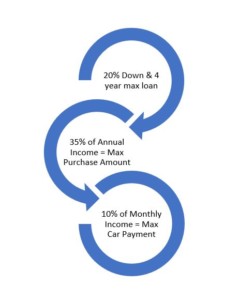
To get an idea of how much car you can afford, a good rule of thumb is to pay no more than 35% of your annual pre-tax income. So, if you make $50,000 before taxes per year, your car purchase price should not exceed $17,500. But you can’t buy a new car for $17,500, you may be thinking. You’re right, but you can find a good used car for that amount (more on that later). 

The 20/4/10 ratio for car financing 

If you plan to finance your car purchase, follow the 20/4/10 rule: 20% down, loan no longer than 4 years, and keep total car payment – including insurance – to a maximum of 10% of your gross monthly income. This will help you to keep your payments and interest costs down while not losing sight of your other financial goals. 

  • Put at least 20% down – This will help lower your monthly payments, but it also protects you from the dramatic loss in value new cars experience (another great reason to buy used). A new car can lose up to 19% of its value in the first year alone. If you put less than 20% down, you can owe more than the car is worth almost right away. This can be an issue if you need to sell before the car is paid off or if the car gets totaled in an accident.
  • Term of the loan no more than four years – The longer you make car payments, the more interest you pay. Also, if you are making payments, you must meet the requirements for insurance your lender has, which often means paying higher rates. If you can pay off the car in three years, even better! If you must stretch the loan to five years or longer in order to afford the payments, that may be a sign you are buying too much car.
  • Keep total car payment (including interest, principal, and insurance) to no more than 10% of your pre-tax income – This will help keep the rest of your budget intact. Having your dream car isn’t worth neglecting your emergency fund, retirement, vacation, or other financial goals. This will also help should your circumstances change, like if you lose your job.

Keep in mind this is just a guideline, and everyone’s situation is different. Using a car affordability calculator can help you run your numbers and make a wise decision about your vehicle purchase.

Last thoughts

As you determine how much car you can afford, keep in mind the costs of fuel and maintenance as part of your process. As we touched on, buying used may provide more value and lessen the hit of depreciation compared to new car. Also, make sure you track your credit prior to applying for a car loan to make sure you can get a low rate with lower payments.

Following these guidelines will help you “stay in your lane” when purchasing your next vehicle!

What I Learned When Our Home Sold In Less Than 24 Hours

April 30, 2018

Editor’s note: This post is part of our Personal Stories series, where our financial coaches share their own financial journey. We hope you enjoy getting to know us a little better and ultimately learn from our mistakes!

OK, so here’s the situation…

Two years ago, my wife and I decided it was time to move to a bigger house. Our house had always been our “10-year home” and we had reached that decade mark and the time had come to try and sell our home. Our goals were to:

  • Move into the school district we wanted our kids to go through middle and high school in
  • Add 1,000 – 1,500 of finished square footage for our growing brood
  • Update to a newer home with more modern finishes and floorplan.

The housing market in our area had been heating up over the several years leading up to the spring of 2016, so the timing seemed right to cash in on our home.

“I got this”

We met with our real estate agent and started planning the strategy for listing our home about 3 months prior to putting it on the market. We put in a lot of sweat equity to try to impress prospective buyers, including:

  • Repainting the entire inside of the home
  • Replacing all the carpet
  • Refinishing the hardwood floors
  • Decluttering – especially the unfinished basement that had turned into a grave yard of old baby clothes (our kids were 6 and 9 at the time), old sporting equipment (never know when you might need that broken treadmill from the 90’s right?), and everything else we had collected (and never used) from the last 10 years of life
  • Having professional listing photos taken

At the end of the day

After working with our agent and agreeing on an asking price, we put our house on the market. After about 45 minutes of calm, requests for showings started to pour in. We had 12 requests the first day the house hit the MLS! Within 24 hours, we had 3 above asking offers in hand – we were floored! Despite our initial idea of not accepting any offers until after the first weekend passed, we agreed on the right offer and that was that. A little over a month later, we were at the closing table and the deal was done.

If I could turn back time

We knew we were in a seller’s market, but it turns out we were in a price point that was absolutely on fire based on lack of inventory. Our agent knew this and did his job in telling us, but we were still shocked at how quickly the home sold. In hindsight, I don’t think we would have spent the time and money on cosmetic upgrades as I am not convinced they did anything to help sell the house.

I also think we could have asked for a higher price, but we were concerned about the appraisal coming in to validate the deal (and our home before this home sat on the market for a long time, which was not fun).

We also needed to start our home search quicker. Things happened so fast, that we felt a bit behind the 8 ball in terms of where we going to move. We decided to build our new home (that is a whole other post) and ended up in an apartment for 6 months while that was being completed. We could have saved some hassle and cost by planning the build better around the sale of our home.

What we got right

The de-clutter was the best idea ever! It made our move so much easier and helped us get a grip and say never again to accumulating so much stuff we never use. Not to mention, we made a little extra cash in a yard sale and had a lot of donations we could write off.

If I could tell you just one thing

Do your homework. Understand your local housing market well in advance of listing your home. In our case, we spent unnecessary time and money staging a house that would have likely sold for the same price and in the same time without the things we did. But in other market conditions, staging can be the key to make your home stand out. Your real estate agent is a key resource in helping you understand the local market and is a crucial part of the process.

3 Cash Management Tips That Work

April 05, 2018

One of the most common things we talk to people about at Financial Finesse is deciding to take control of your spending. The most crucial step in making that happen is figuring out how to manage your cash flow. In order to take that commitment and turn it into habits that stick, you’ll need some strategies to help you along the way.

Let’s look at a few ideas that can help you master your cash flow – try one or two of them out to see what works best for you.

1. The Planned Spending Account system

The problem: Most people tend to have just two bank accounts – a checking account and a savings account. With the best of intentions each month, we often set a goal to transfer any money left over each month from our checking account to our savings account. But if you are anything like me, money in the checking account has a way of being spent, leaving little to nothing to move into savings at the end of the month. Even worse, too often money is transferred out of savings into checking because there always seems to be unexpected expenses not in the budget that come up. This cycle is frustrating and doesn’t get us closer to our goals.

If you’re one of those people who feels like every time you start to get ahead with savings, something else random always seems to pop up, then this method is for you.

How to fix it

Things like vacations, car repair/maintenance, clothing, and gifts are examples of expenses you know you will have through the year, but not necessarily every month. Since you know they are coming, these expenses are not emergencies. So why pull from your emergency savings to pay for them?

How do you set that money aside so it doesn’t get spent from your checking account or deplete your emergency savings account? The answer is adding a third account – the planned spending account.

Here’s how it works:

  1. Open a third bank account (preferably a savings account at a separate bank so it isn’t as easy to move money to your checking account) that is just for planned expenses that do not occur every month.
  2. Add up all needs that occur regularly but not monthly, like property taxes, car registration, hair cuts, etc. Also include less predictable wants like clothes, vacations, and gifts. Figure the total for planned spending for the year, divide that by 12, then deposit that amount into your planned spending account automatically each month. It really is that easy!
    Planned Spending Category Annual Amount Monthly Estimate
    Car Insurance $1,800 $150
    Clothing $800 $67
    Vacation $900 $75
    Gifts $600 $50
    Medical expenses $2,000 $167
    Home repairs $1,200 $100
    TOTAL $7,300 $609
  3. Now when the Holidays come around or the car needs an oil change, how have the money set aside to pay those bills. No need to raid your emergency fund or pull out the credit card!  This system may mean you move less into your savings each month, but you will see your savings grow because you won’t be making withdrawals either.  This system is also great for helping you get out of debt and reaching your other financial goals.

    Month Deposit Bills Expenses Balance
    January $609 Clothing $315 $294
    February $609 Medical bill, home repair $390 $513
    March $609 Car insurance, gifts $550 $572
    April $609 Car repair $300 $881
    May $609 Clothing, home repair $380 $1,110
    June $609 Car insurance, medical $1,100 $619

2. The Cash Only system

The problem: Swiping a card makes it far too easy to spend-spend-spend, without really feeling how much is actually going out. Before we know it, we’ve blown our budget and may even have to “borrow” from savings to make ends meet.

How to fix it

One way to help control impulse spending is to commit to only spending cold, hard cash on these items. Commit to only using cash for all shopping during the week: grocery store, dining out, entertainment, etc. Resolve that when the cash is gone, you’ll be done spending and will go without for the rest of the week. Several of my colleagues use this method to great success.

Here’s how it works:

  • It is ok to use checks, auto-pay or EFT for household expenses – no need to stuff an envelope with cash and send it to your landlord or mortgage company. This is for everything else.
  • If you use the Planned Spending Account system described above, pay your irregular expenses from that account.
  • For all other expenses that you haven’t accounted for in your Planned Spending Account, use your budget or spending plan to total your nonessential expenses for the month, then divide by 4.3 (number of weeks in the month) to determine how much is available for the week.
  • Then either write a check for cash or go to the ATM on the same day each week to get your cash for the week.
  • When you go out, leave the checkbook and credit cards at home.
  • When the cash runs out, no more spending for the week.

Many of us think if we carry cash, we will be inclined to overspend. But if you stick with this system, you will most likely find that you’ll spend less. Think about how much more real it is to hand over six $20 bills at the grocery store rather than inserting your card into the chip reader — you’ll quickly find yourself re-thinking impulse buys.

Potential downsides

You will want to make sure you are careful with your cash – one of the risks with using this system is lost cash and carrying a lot of cash can be dangerous. And while this system will help you avoid debt, you will lose out on credit card rewards and may make it harder to build your credit score. You’ll have to decide which is more important to you.

3. The Envelope system

The problem: Oftentimes an examination of past spending can lead to a realization that you have been spending a lot more on certain categories than you’d like. Trip to Target and Costco, anyone? But finding a way to stick to the new limits you set is the never-ending challenge.

How to fix it

This is an oldie-but-a-goodie! The idea is to take out enough cash each pay period to cover your budgeted expenses, then create an envelope for each category in your budget: Groceries, Entertainment, Dining Out, etc.

Here’s how it works

  • On payday, head to the bank or ATM and take out enough cash to cover your budgeted spending until you’re paid again.
  • Divide the cash into envelopes and label for each category.
  • If a certain store is a weakness, give it its own envelope.
  • When you go out to eat, take your Dining Out envelope with you and pay with that cash. Heading to the grocery store? Grab that envelope.
  • Once that cash is gone, then you are done spending in that category until your next paycheck.

Note that it is ok to “borrow” from other categories if necessary, but no going to get more cash out of your account! You will have the most success if you stop spending once the envelope is empty.

If you like the idea of the envelope system, but are not crazy about carrying around cash and envelopes, there are also several apps that help with this same idea.

Worth it in the end

Whether your goal is to just stay on top of your spending, reduce your debt, prepare for the unexpected, save more for retirement or simply save for other financial goals, pairing your commitment to controlling your cash flow with these systems will help. If you find that one method isn’t working for you, try another — as long as you’re feeling more in control of where your money is going, it’s working!

Annuities 101

March 15, 2018

Have you ever heard a financial advisor describe the virtues of an annuity and found yourself thinking it sounds like a pretty good deal? Or maybe you are interested in an annuity because you like the idea of a guaranteed source of income when you retire? Perhaps, being the savvy investor you are, you’ve also read or heard that annuities are a rip-off and mostly benefit the agent that is selling them.

What to make of all this? As my colleague Erik outlines in this post, annuities aren’t all good or all bad. Let’s consider some common types of annuities, how they work, and the pros and cons of each. 

Immediate Income Annuity

Here’s how it works: You provide a lump sum of money to the insurance company, and in exchange, they promise to make regular payments to you right away. The amount of each payment you receive depends on your age, and the terms of the annuity (payments for your life only, your life and the life of someone else, or for a fixed period). 

Pros 

  1. Guaranteed income for the term of the annuity. 
  2. No account management or maintenance fees. 
  3. No maintenance or work once it is set up. 
  4. Reliable income which can simplify retirement planning. 
  5. You can add inflation protection to income payments (although that’s an additional cost).

Cons 

  1. Once you purchase an immediate income annuity, you lose access to your money (beyond your regular payments). The lump sum you deposited can no longer be used for emergencies (or anything else). 
  2. If you do not choose inflation protection, the purchasing power of your payment can be eroded. 
  3. If you pass away shortly after starting your payments, the remainder of the annuity goes to the insurance company unless you add a beneficiary, which requires you to purchase a death benefit and can be pricey.

Deferred Income Annuity

Here’s how it works: Like an immediate annuity, you provide funds to an insurance company in exchange for a stream of income payments. The difference is that a deferred income annuity does not require a single lump sum payment and you don’t start receiving payments until a later date. During the “accumulation phase,” when the policy is growing in value due to your payments and/or the interest rate paid by the annuity company, you can decide to make a single premium payment or a series of payments over time. Those funds then accrue interest, tax-free, until you choose to start receiving income payments. 

Pros 

  1. Interest accrues tax-deferred until funds are withdrawn. 
  2. Most deferred annuities guarantee against a loss of principal. 
  3. Guaranteed income payments for life (for you or your spouse) if you choose to annuitize. 
  4. Includes a death benefit component, so your beneficiary receives any remaining value if you pass away before the annuity ends. 

Cons 

  1. Be aware of the surrender period – a period at the beginning of the contract that prevents you from withdrawing funds without paying a surrender charge. You will also pay a penalty from the IRS if you pull funds prior to age 59 ½.
  2. Earnings are taxed as ordinary income. Principal is also taxed as ordinary income if you use pre-tax retirement money (like a traditional 401(k) or IRA). 
  3. Fees can really add up when you consider mortality and expense charges, administrative fees, charges for special features and riders, and high commissions for agents. 

Variable Annuity

Here’s how it works: Variable annuities share some common traits with fixed annuities like tax-deferred growth and various payout options. Unlike a fixed annuity, a variable annuity takes your premium money and invests it in sub-accounts that you determine based on your risk tolerance. As such, a variable annuity is a higher-risk alternative to a fixed annuity. One popular hybrid of a fixed and variable annuity is the equity indexed annuity (kudos to my colleague Cynthia for this great look at these). 

Pros 

  1. Allows you to participate in the market to maximize your return and the amount of your future income payments. 
  2. Tax-deferred growth and multiple payout options. 

Cons 

  1. You assume the investment risk – your annuity’s value is subject to loss based on sub-account performance or you may find your sub-accounts underperform if you invest too conservatively. 
  2. Limited access to money due to surrender period. 
  3. Fees, Fees, Fees! If you want to lessen the risk with a variable annuity, you can add additional riders to the contract to protect income. These can be costly, and are in addition to administrative fees, mortality expenses, and expenses associated with the investment sub-accounts you choose. Michael, a fellow planner here at Financial Finesse, covers these fees and the concern with them in this post.   

Other things to consider

  1. It’s usually a terrible idea to put all your money into an annuity. Diversify into other investments like stocks, bonds and cash to ensure you have flexibility to cover emergencies and other needs above your fixed income sources. 
  2. Make sure the insurance company is on strong financial footing. Check ratings at agencies like Moody’s, Fitch, A.M. Best and Standard and Poor’s to make sure the company you are doing business with can fulfill their promise when accepting your money. 

Tying it all together 

As you can see, annuities can be a great tool to help you increase the amount of fixed income you can bank on in retirement. This can make great sense if your other fixed income sources like Social Security and pension benefits don’t totally cover your fixed expenses.

But it is also clear that annuities, especially deferred and variable contracts, can become very expensive options to provide that income. If you are considering an annuity as part of your retirement plan, make sure you understand the benefits along with the costs and restrictions that come along with your investment. 

How To Avoid Penalties On Unpaid 401(k) Loans

March 01, 2018

One of the biggest risks to borrowing from your retirement through a 401(k) loan is the heightened likelihood of the loan becoming a taxable distribution if you leave your job (voluntarily or not) while still paying back a 401(k) loan. Because 401(k) loans are paid back via payroll deduction, when your paycheck goes away, so does the ability to repay it, so many employers require payment in full within 60 days of leaving.

New tax law provides relief

While some employers do allow you to continue to make loan payments if you leave your job, one provision of the new tax law that hasn’t gotten much attention can make a huge difference to people who find themselves in a bind with an outstanding loan and no more job. Basically if you “default” on your 401(k) loan, there is a way to still repay it, but the details matter.

What’s the big deal? 

Prior to January 1, 2018, employees generally had two options to prevent the loan balance from becoming a taxable distribution if they left their employer with an outstanding loan: 

  1. Pay the loan back in full. It is rare that an employee is able or willing to go this route. 
  2. Repay the loan balance via “rollover” by contributing the amount still owed to an IRA within 60 days of leaving your job.  

If you don’t pay back the loan, then any balance from a pre-tax 401(k) becomes taxable income, and if you are younger than 59 ½, you will also owe a 10% penalty for taking an early distribution from your retirement account. Since one of the advantages of taking a 401(k) loan is that it is not taxable if repaid, this can be a hard pill to swallow. 

What’s changed? 

The new law, which applies to distributions treated as being made after December 31, 2017, extends the rollover deadline from 60 days to the tax filing due date (including extensions) for the year in which the loan was considered defaulted. Let’s look at a couple of examples of how this works: 

  • Example 1: You leave your job in January of 2018. You could feasibly have 20½ months to pay back the balance of your loan by depositing the amount owed into a rollover IRA. Why so long? Because you have until the filing due date of your 2018 tax return, which can be extended all the way until October, 2019. If you file in April, the payments would be due by then, so this would be a reason to extend your return (keep in mind this does NOT extend time to pay any taxes due, including if you end up NOT completing the rollover).
  • Example 2: You leave your job in December of 2018. You still have 10½ months (until October of 2019) to pay back the loan via contributions to your rollover IRA, but you may have to stretch a bit more financially to make it happen.

Keep in mind that even if you can’t pay it all back by the deadline, you should still pay back as much as you can to avoid those taxes and penalties.

The logistics 

It’s important to note that you’ll have some paperwork to do in order for this to work. Here’s what I mean:

Let’s say you leave your job in June, while still owing $2,000 on a 401(k) loan. If you extend your tax return for that year until October, you’d have about 16 months to pay back your loan; that’s $125 per month. 

  • Because your old job has no way to know you are paying the loan back into your rollover IRA, they will issue a 1099-R for the $2,000, showing it as a distribution to you.
  • The company where you have your rollover IRA will then also send you a Form 5498 showing you made $2,000 in rollover contributions to the account (make sure the deposits are recorded as a rollover and not new contributions). 
  • If your plan is to pay the loan back via monthly deposits to your rollover IRA, it’s best to check with the IRA company first to make sure they are equipped to handle that while treating each payment as a rollover — it could be a real hassle if they code monthly deposits as new contributions, which WON’T satisfy the loan rollover rule. You may have to set up a separate savings account to collect your monthly payments, then make one lump sum rollover contribution to satisfy the loan rules.

Because it is unclear what type of documentation the IRS will require, make sure to keep all forms and communication you receive and consult your tax professional to help you reflect this process on your tax return. Keep in mind that this process could take a few back-and-forth letters with the IRS, due to the timing of when the 1099-R and Form 5498 are mailed.

To avoid any issues, if you know you are planning on leaving your job, your best bet is to not take a 401(k) loan at all. However, if you find yourself unexpectedly moving on from your current job and have an outstanding 401(k) loan, keep these new rules in mind. Your future self will thank you when it comes time to retire and your present self will thank you for saving a lot of money on taxes and penalties! 

How To Make The Most Of Your Tax Refund

February 19, 2018

Ah yes, the annual tradition of gathering receipts and channeling our inner accountant! Tax Season is upon us. For millions of Americans, it also a time of great anticipation as we await the annual windfall that is our tax refund. Considering that in 2016, the average tax refund was a little over $3,000, it is easy to let our minds go to all the fun we can have with our tax refunds.

But before spending all your refund on a new TV or a car that will saddle you with high payments for the next 5-6 years, take a deep breath and think about how you can use that money to improve your current and future financial situation instead.

Option 1: Shoring up your financial foundation

If you’re still working on getting the 4 pieces of financial security in place, this can be one way to fast-track it.

  • Establish or strengthen your emergency fund – Most experts recommend having 3-6 months of expenses saved in an emergency fund to deal with unexpected expenses or even bigger events like job loss and illness/injury. Having one in place can allow you to stop using credit cards to deal with unexpected bills.
  • Pay down high interest debt – If you have credit cards or other high interest debt (north of 6% interest rate), using your refund to pay that down will save you a lot of money in interest. Once you pay off your cards, stop using them! Breaking the cycle of debt (see emergency fund above) will allow you to save for other goals and keep more of your hard-earned money.
  • Save for retirement – Using your refund to fund an IRA to help you prepare for retirement may not seem as fun as a trip to Vegas – but is a great way to get the most bang for your refund buck (and could even help you to increase your refund).

Option 2: Give your goals a boost

We all have financial goals that we are saving for, and a tax refund is a fantastic way to give those an extra boost! Here are some examples to consider:

  • Saving for college – Open or add money to the kiddos 529 plan.
  • Vacation – Set money aside for that next vacation rather than paying off the card after the fact.
  • New car fund

Option 3: A little bit of everything

It is ok to treat yourself with your tax refund, but be careful about spending all your refund on indulgences. Instead, think about splitting your refund to take care of past, present, and future you!

  • Past You – Pay off those lingering debts.
  • Present You – Treat yourself! Take 10-20% of your refund to get or do something for yourself.
  • Future You – Increase your savings for emergencies or other goals.

Making good choices with your tax refund can go a long way to improving your financial situation – now and in the future. Focusing on your priorities may not get you all the things you want right now, but it will help you get the things you want most in the long run! Happy Tax Refund Season!


Want more helpful financial guidance, delivered directly to your inbox? Sign up to receive our posts, written by financial planners who work with people like you every day. No sales pitch EVER (being unbiased is the foundation of what we do), just the best our awesome planners have to offer. Click here to join.

How I Finally Found My Dream Job As A Financial Planner

October 06, 2017

For the past decade plus, I have been helping people with their finances. It’s what I love to do. But getting to my dream job was a different journey than what I thought it would be. I started in the financial planning business to help people and scratch an entrepreneurial itch I’d had for some time.

The challenge of getting started as a financial advisor

At my first firm, I quickly learned that being an advisor meant selling life insurance and annuities. Success was measured by how many prospects I could get in front of and how much commission revenue I could generate through product sells. This wasn’t exactly what I wanted to be doing — I knew I was helping my clients, but also knew I needed to expand my training to be able to provide help in all aspects of their financial lives.

So I completed the gauntlet that is CFP® certification, and landed at a large wealth planning firm in a consulting role working with affluent clients. I was delivering financial planning for my clients and helping them manage their assets – my dream job (or so I thought).

Something’s missing

I was loving my work with clients and I was a good financial planner. I especially enjoyed building relationships and managing investment portfolios.  I was making a nice living, working with a team of incredibly smart and honest professionals, and delivering on comprehensive wealth management for my clients. But it always felt like something was missing.

Measuring my impact

I started asking myself how much of an impact I was really having for my clients who were already in great financial shape before I ever met them? I was left unfulfilled by helping wealthy clients become marginally wealthier. To be honest, I knew they would be fine regardless if their portfolios had a good quarter or not. What about the people who don’t have a lot of assets for an advisor to manage? Who is helping them?

Following the money

In order for most advisors or financial planners to make a living, they have to sell a product or service. That means they have to find clients that:

  1. Need/want that product or service; and
  2. Can afford to pay for said product or service.

There is nothing wrong with an advisor expecting to be compensated — most are honest and hardworking and should expect to be paid for their services. But there is a disconnect. Those people struggling with debt or cash flow problems would benefit tremendously from working with a financial professional, but the compensation structure in the financial services industry essentially denies them access to the help they need.

Where financial wellness benefits come in 

Luckily for me, I found Financial Finesse a couple of years ago, a company dedicated to unbiased financial planning guidance delivered by experienced, qualified professionals available to people in any financial situation.  I had to bide my time to meet the 10 year experience requirement, but I am so glad I did.

Being with the company that pioneered the idea of employers providing financial wellness to their employees as part of their benefits is amazing. We help employers provide an important benefit to their employers that is shown to improve absenteeism, increase productivity, and save on health care costs as financial stress is reduced. We help employees find actionable solutions to their pressing financial issues through a coaching model with no hidden agendas.

Living my purpose

And I get to live my purpose by helping people make good financial choices and reach their financial goals — now that is my dream job.

Want more helpful financial guidance, delivered every day? Sign up to receive the Financial Finesse Tip of the Day, written by financial planners who work with people like you every day. No sales pitch EVER (being unbiased is the foundation of what we do), just the best our awesome planners have to offer. Click here to join.