
Expense The Unexpected: The Emergency Fund

February 09, 2025

Finances are different for everyone, and so are the life events we all go through. An emergency fund is your financial line of defense against life’s lemons. Although there are many financial rules of thumb, there is no “normal” way to handle your emergency fund. However, there are some answers to common questions to help you financially prepare for unexpected expenses.

What is the reason for my emergency fund?

The emergency fund is your safety net to avoid getting into a difficult financial situation due to loss of income and significant, unexpected, one-time expenses. Having one in place can reduce stress, anxiety, and other emotions that could make handling the non-financial aspects of an emergency much more difficult.

It may seem a little obvious that an emergency fund is for emergencies. However, one of the challenging aspects of an emergency fund is knowing what expenses qualify as an emergency. This fund’s sole purpose is to prepare you for costs that you cannot or would not typically plan out. For example, oil changes and new tires are vehicle expenses you know you will have at some point. However, you wouldn’t typically plan for vehicle costs that could vary widely depending on the situation. Examples of this are towing costs, medical care, and insurance deductibles you might pay in a car accident, something you would not plan to happen.

How much do I need?

How much would a new furnace cost? If you could not work, how much would you need to cover essential expenses until you could? Asking yourself these kinds of questions will help you set a goal amount for your emergency fund. The Expense Tracker can help you add those expenses up, or you can use your online banking to crunch the numbers. That exercise can also help you figure out how much you can afford to save each month as you work up to your goal amount.

The general rule of thumb is three to six months of your expenses. However, you can always start with a goal you find achievable. Say, for example, $1,000. Once you reach that goal, aim for three months of rent, then three months of the following essential expense, and so on.

How do I save that much?

Start small – If you have not started your fund, consider putting $25 from every paycheck into a savings account. You can use the Daily Savings Calculator to see the impact that even a few dollars will make in the long run. Then, check your budget or spending plan to see how much you can save after you’ve paid essential expenses and before budgeting for discretionary spending.

Keep it separate, saver – Open a separate savings account to help you resist the temptation to dip into it. Remember, this account is for emergencies, so keep it away from your daily spending accounts and separate it from vacation and holiday savings. This method will help you stay organized, visualize your progress, and provide you peace of mind.

Automate your savings: Set up a direct deposit or automatic monthly transfer to your separate savings account. Your employer may be able to take money directly out of your check and deposit it for you. Otherwise, set up an automatic transfer from checking to savings on payday. This method will help you avoid adding a manual transfer to your list of to-do’s that you may end up not getting around to doing.

Will I ever need to change the amount?

As your life changes, the amount you need in your emergency fund will change as well. It’s a good idea to revisit your emergency fund plan every six months or any time you experience a life event that impacts your income. Marriage, starting or adding to your family, buying a home, and divorce are just a few examples of when you may need to increase your emergency fund. A good savings plan can roll with the punches right alongside you!

How do I prioritize emergency savings against debt and other goals?

Deciding whether you should pay down debt, increase cash savings, or invest is all about the big picture. Since everyone has different financials, that picture will not be the same for everyone. What is going to impact you the most financially? Paying down debt and saving money long term or having a plan B that allows you to keep making minimum payments if you lose income? There is no right or wrong answer. Perhaps a good compromise is to have one month’s worth of minimum credit card and loan payments before you start to pay down debt or invest aggressively. You will have peace of mind knowing that you won’t fall further into debt or face collection action, and you will have started your path to being debt-free!

Your emergency fund is there to help you expense the unexpected. So make a plan and use the above suggestions to be ready for whatever comes your way!
The Difference Between Federal And Private Student Loans

February 07, 2025

With the average cost of college steadily rising, student loans have become a big part of how families pay for college. Most student loans are classified as either federal or private. Federal student loans are loans made or guaranteed by the U.S. government, and private loans are essentially non-federal student loans made through lenders such as banks, credit unions, state agencies, or schools. There are important differences between these loan types and knowing the difference can help you make the most informed decision.

The main types of federal student loans are:

Direct Subsidized Loans – typically for undergraduate students with financial need. Student loan interest is paid by the government while the student is in school at least half-time, during the 6 month grace period after college and possibly if student loan payments are delayed.

Direct Unsubsidized Loans – can be used by undergraduate and graduate students regardless of financial need. Interest accrues while the students are in school, during the grace period and during any student loan payment delays and is added to the loan principal. You can pay the interest while you’re in school to mitigate this difference between direct and indirect if you are able.

Direct PLUS Loans – graduate or professional students and parents of dependent undergraduate students typically use this loan to pay for college. To qualify, the borrower must not have an adverse credit history and the student must be enrolled at least half time.

Federal loans typically offer more benefits than private loans such as:

  • Lower interest rates, in general
  • Loan forgiveness options based on public service employment, certain occupations or certain payment plans
  • A variety of options to modify payments if you experience a hardship such as permanent disability or financial hardship
  • Lack of credit checks, in general

However, these benefits also come with harsh consequences for default such as possible wage garnishments, difficulty discharging if you file for bankruptcy and even forfeited tax refunds and Social Security payments.

Private loans vary per lender, but typically private loans share these characteristics:

  • Interest rates tend to be higher than most federal student loans
  • Variety of interest rates and repayment periods
  • Loan forgiveness programs are not available
  • Fewer options if you find yourself going through a financial hardship. This varies per institution, so before getting a private loan ask about repayment programs if you experience a hardship
  • Credit check and/or a co-signer may be needed to get loan

As long as your loans are classified as student loans, the interest you pay may be eligible for a deduction, and that’s true for both federal and private loans. The bottom line is that before you opt for any student loans, make sure you know the difference. Many students find themselves learning about the difference the hard way, once it’s too late to go back and find other ways to pay.

How To Become A Millionaire In Just 15 Minutes

February 07, 2025

I was recently speaking with my colleague Doug Spencer about how many people joke about winning the lottery and he asked me: “What are your odds of winning a lottery?” I know the odds are always outrageous, so I’ve never played the lottery, but I decided to look up those odds and give Mr. Spencer a smart answer. I searched the Internet and found that, according to the lottery mathematics page in Wikipedia, the odds of winning a standard lottery (picking six numbers correct numbers out of 49) are 1 in 13.98 million. It doesn’t matter how many people play. Those are just the odds of picking those numbers. By comparison, you have better odds of becoming an astronaut, giving birth to identical quadruplets, or winning a gold medal in the Olympic Games.

The point Doug wanted to make to me is that the odds of collecting a massive amount of wealth by chance are slim, and the odds of doing so on purpose, however, are actually very certain. His method is simply to add 1% to your annual savings rate every year from now until you retire. It can even be done automatically in most cases through your employer’s auto-escalation feature in a 401(k) or other retirement savings plan. This got me to thinking about those numbers more seriously, and that’s when I discovered just how true his secret is – and how I can become a millionaire in just 15 minutes with incredibly little effort.

The first five minutes of your day = 1%

The standard American work week is 40 hours or eight hours per day. It just so happens that 1% of that eight hours is 4.8 minutes. I’m going to round that off to 5 minutes here. That means that in the first five minutes of every day, I’ve earned 1% of my income, and that’s what I’m going to add to my savings.

It takes four minutes to calculate how this might work

I used an auto-escalation calculator to learn what would happen if, starting at age 25, I contributed 1% of my income to my 401(k) and used moderately aggressive funds, and increased that contribution by 1% each year until I was contributing 20% (45 years old). According to a Tower’s Watson survey of employers, the average pay raise per year is 3% for American workers, so by adding just 1% each year to my savings rate, I’m still getting the advantage of my pay increases and not missing that 1%. If my company matching contribution is 6%, and I start off making $48,000 a year, then by the time I retire at 65, I will have amassed over one-million dollars in my 401(k) account! It took me four minutes to open up and run this calculator with a few different scenarios. Your time may be quicker.

In just three minutes I can sign up

Actually signing up for an auto-escalator in most 401(k)s is a breeze. Just log in and find it as an option under contributions. In some plans, it happens automatically when you sign up for the 401(k) or when you are auto-enrolled at the beginning of employment. When I walked through the process with a participant in a plan with whom I recently spoke, the whole process took less than three minutes!

Two minutes to check your investments

While you’re accessing your 401(k), take just a couple of minutes to review your investments and re-balance to fit your investment plan, if necessary.

Take a minute to think of future you

Write yourself a quick thank you note from the future.

How To Create A Plan To Payoff Your Student Loans

February 06, 2025

Once you decide to tackle your student loans, it is important to be proactive and work student loan debt management into your overall financial plan. When it comes to managing student loans, here are some action steps that may help you reach your financial goals related to paying down student loan debt:  

How much do you owe? 

Before you can create a plan to pay off student loan debt, you need to assess how much and what type (federal vs. private) of student loan debt you have. You also need to determine the terms of your loan(s) including the length of the loan, interest rate, minimum required payment, and payoff date. 

Action Step 1: 

  • Determine the amount of federal loans borrowed (Direct, FFELP, Perkins & Grad PLUS) and contact information for the servicer of each loan via the National Student Loan Data System at StudentAid.gov. For Private Student Loans contact your loan servicer directly. If you are unsure of the private lender, review your credit report for free.  

Estimate your payoff date 

Determine how long it will take to be student loan debt-free (and the total cost of debt). After organizing and possibly refinancing your various student loans, you are able to use a student loan calculator to see when you will be debt-free. If you continue to make the minimum required payments, this figure is much easier to calculate since it will be based primarily on your original loan payoff date. However, many people are motivated by the desire to reduce the cost of borrowing and want to see how extra payments help them in the long run.  

Action Step 2: 

  • For Federal Student loans use this Loan Simulator  to estimate federal student loan payments under various repayment plans (standard, graduated, pay as you earn, income-based, income-contingent, etc.). For Private Loans, try the Cost of Credit Calculator. 

Refinance or consolidate? 

Another proven method to lower the cost of borrowing and put more of your money to work chipping away at those student loan balances is to refinance or consolidate loans to a lower interest rate (if available). Just remember that extended repayment plans may lower your monthly payments but they can also increase the total interest paid over the life of your loan, so you might want to try to stick with the shortest loan term you can comfortably afford. Keep in mind that if you are refinancing federal loans with a private loan you may be forfeiting flexible repayment options offered by federal loans. Also review if you are eligible for Public Student Loan Forgiveness. You will need to maintain the Federal Loan in the proper repayment plan in order to remain eligible.  

Action Step 3: 

  • Look into refinancing your private loans to get a lower interest rate. Investigate if refinancing a federal loan is the right move for you. 

Check for employee benefits 

While most employers do not currently have a student loan repayment plan, more and more companies are offering special deals on student loan refinance programs like SoFi or actual repayment plans like Tuition.io or Summer.   Services like Candidly help you optimize your debt repayment strategies to reduce payments, refinance at a lower rate, or accelerate repayment to reduce the overall cost of borrowing.   

Action Step 4 

  • If your employer does offer some type of assistance, make sure you’re fully aware of the rules so you can take advantage. 

Free up extra cash 

Instituting a budget can help you monitor and track your spending while setting limits in advance. This process will enable you to identify potential areas to cut back spending or free up extra dollars that may then be applied to your highest interest debt (or the loan with the lowest balance if you want a quick win). The Debt Blaster calculator  helps you see how extra payments can fast track the loan payoff process.  

Action Step 5 

  • Pay the minimum on all loans and put extra dollars towards the highest interest rate student loan.  But also consider your other financial goals before making extra payments on student loans.   

Student loan payments do not have to be a constant burden. Whether you are already overwhelmed by your student loans or simply want to reach a state of financial freedom a little faster, there are a variety of repayment options that can save you significant money. The most important thing is to make sure your student loan repayment strategy fits into your total financial plan and meets your short and long-term objectives. 

How To Prioritize Debt Payoff Against Your Other Priorities

February 06, 2025

Whether it’s student loans or credit cards, it’s tempting to want to make paying off debt your top priority, but should it be? In some situations, other goals might come first. Here are some questions to ask yourself: 

Am I able to pay essential expenses? 

If you’re in a really tight financial situation, make sure you can pay your rent/mortgage, make your car payment, keep food on the table and the lights on even if that means falling behind on credit card bills. Instead, see if you can negotiate those debt payments, work with a credit counseling service, and possibly consider bankruptcy protection.  

Do I have adequate emergency savings? 

 You want to be able to pay your essential expenses in the future even if your income is reduced by a job loss. That’s why financial planners generally recommend your first savings goal should be to build up an emergency fund that covers at least 3-6 months of necessities.  

Am I contributing enough to my retirement plan to get the full match? 

If not, don’t leave that free money on the table! Even paying down high-interest debt can’t compete with a guaranteed 50-100% return from getting your employer’s match.  

What’s the interest rate on the debt? 

 If the interest rate is above 8% (like most unsecured consumer debt such as credit cards), you’re probably better off paying down the debt before saving or investing for any other goals (except the above) because there’s a good chance you’ll save more in interest by paying down the debt than you’d earn by saving or investing that money. If the interest rate is below 6% (like a lot of secured debt, such as mortgages and car loans), you are probably better off investing extra money. That’s what’s called “good debt” because the interest rate is lower than what you are likely to earn on your investments in the long term. If the interest rate is between 6-8% (like a lot of student loans), you can go either way.   

Once you’ve decided to prioritize paying down your debt, pay it off fastest by putting any extra payments towards the highest interest debts first. As each balance is paid off, you would then put those payments towards the remaining debt with the highest interest rate. You can use our Debt Blaster calculator to keep you motivated by seeing how quickly you can pay the debt off and how much interest you will save with this strategy.  

Financial Rules of Thumb: The 50-30-20 Rule

February 05, 2025

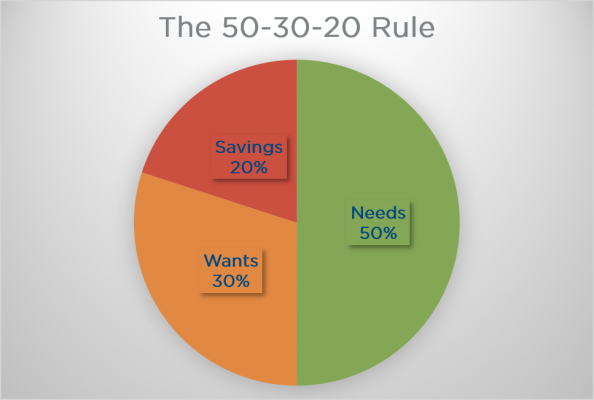
One way to measure whether or not a particular expense or goal fits into your spending plan is to measure it against your existing financial goals and commitments. A popular way to look at this is called “The 50-30-20 Rule.”

The 50-30-20 Rule

The rule basically says that one way to achieve financial security is to limit your fixed expenses (or needs) to 50% of your after-tax income, your discretionary expenses to 30%, and setting aside 20% toward your goals. Let’s break that down by type so you can see what we mean.

50% to “needs.”

Examples of things that fit in this category include:

  • Housing
  • Transportation
  • Food
  • Clothing
  • Utilities
  • Healthcare

One part of this rule that’s often debated is how much of these categories are true needs versus wants (or discretionary spending). Let’s take the purchase of a vehicle as an example. How much you spend on a vehicle can vary widely. For many people, having a vehicle is a need. They need it to get to work and earn money to pay bills. On the other hand, plenty of people live in big cities who get by just fine without this “need!” Likewise, we all need food to live and clothing to avoid being arrested in public. However, spending on these two categories very easily bleeds over to wants.

Making trade-offs

So you have to be honest with yourself about whether the things you’re putting in this category are absolutely vital to your life or if part of the expense could be classified as a want. Maybe another way to think of it is as a trade-off — it’s fine to spend more on housing if having a more expensive place is important to you; it just means you’ll need to spend less on a car to make it balance.

30% to “wants.”

Examples here include:

  • Entertainment, including cable
  • Dining out
  • Gym membership
  • Hobbies
  • Personal care beyond the basics
  • Cell phone beyond the basic plan

As you can see, the rules can be tricky, so you have to be honest with yourself. Most of us need regular haircuts to maintain a decent appearance. However, spending on a pricey salon cut goes above and beyond, so it belongs in this category.

20% to goals

This category obviously includes savings (including what you put into your retirement account at work) and includes debt payments. So if you’re paying $250 per month on a student loan, that counts toward your 20%.

Tying it all together

Remember, this rule is meant to be a guideline, particularly when you’re just getting started and have no idea what you should be spending on things like rent or a car payment. But it can also offer insights into areas where you may need to cut back. For example, if you run your own numbers and find that your needs far exceed 50%, it may be time to think bigger picture about making some changes – do you need to sell your car for a cheaper payment? Think about moving to lower housing or transportation expenses?

This rule can help show you whether or not you can afford to add a new want into your life. If your wants are way beyond 30%, that definitely means that you can’t afford to add a payment for something like a boutique fitness membership, cleaning service, or upgraded cable package to your life at this point.

Why You Need to Start Saving Money RIGHT NOW

February 05, 2025

Pretty much every personal finance resource will tell you that the earlier you start saving, the better off you’ll be due to the effect of compound interest. It’s a bit of a, “well, duh,” thing, but there’s more to it than just the fact that you’ll have longer to save if you start early. The thing is, the earlier you start, the earlier you can actually stop saving if you want to. Continue reading “Why You Need to Start Saving Money RIGHT NOW”

7 Ways to Start Earning More Money Today

January 21, 2025

What do you think of when you hear the word “budget”? Chances are, it makes you think of restrictive things like sacrificing or cutting back. But a budget is simply a tool to help us achieve our life goals more deliberately and successfully. One way to balance a budget is to cut back, but another way is to increase income. Here are seven ways to do that – several of which I’ve done myself.

1. Become a Tasker on TaskRabbit. Have you learned how to read the language of IKEA assembly directions, or do you get a special thrill from the sound of the vacuum sucking up debris? These are just two everyday skills people are willing to pay someone else to do. Take a look at their website to see what skills of your own you may be able to put to use.

2. Childcare. Overworked parents will pay a teenager top dollar to watch their kids for a night out. Imagine what they’d pay a fully employed, responsible adult…easy money! Even services like Care, Sittercity, and Babysitease connect you with families seeking help. I was a sitter for BabysitEase in Cincinnati, and it was great! If I had a Saturday night with no plans, I just logged into the website and signed up for whichever family looked like the most fun for me.

3. Pet-sit. If kids aren’t your thing, consider offering your services as a pet sitter. This idea is another side gig I held until recently. I signed up for a local pet-sitting franchise that performed a background check on me and then offered to check in on people’s cats and dogs while they were out of town. I only did the ones I wanted to, and they did all the work of collecting the money, providing insurance in case something happened, etc.

4. Teach others your hobby. Are you the person your friends and family turn to with questions about technology, fitness, or even just how to apply their makeup properly? Services like Dabble are a great way to teach others how to do what you love while making some extra cash. I have an acquaintance who uses Dabble to teach other crafters how to knit and crochet on weekend afternoons.

5. Sell the products of your hobby. Several years ago, I signed up for a booth at a local craft fair where I sold fingerless hand-warmers that I had knitted myself while binge-watching the latest show. One of my ongoing coaching clients uses Etsy to sell her original paintings to escape her paycheck-to-paycheck lifestyle without leaving her beloved apartment. It doesn’t cost anything to set up your store.

6. Personal shopper. Everyone knows their way around the grocery store or can easily learn to navigate one. A friend recently told me how she easily started shopping with Instacart to earn some extra cash when her hours at work decreased. She mentioned how user-friendly the app was and how friendly the people she’d delivered to were, often giving a nice cash tip after dropping off the groceries.

7. Charge for your carpool. I’ve met some of the most interesting people while riding around town in rideshare cars via Uber and Lyft. They are authors, nurses, and even office workers who give one ride each day after work before heading home.

No matter what way you decide to earn some extra cash, make sure you take the extra step and apply that cash toward your savings goals. While the money you earn may seem like just a little, it adds up. Make the most of your spare time to help get you where you want to go faster. 

Insider Tips: How To Work with Your Creditor to Adjust Payment Terms

January 21, 2025

When you’re having trouble making payments on your debt, you may feel like throwing in the towel and ignoring the bills and calls. That’s understandable, it’s a lot of work to figure this out. However, in the long and short term, it’s worth it to stay on top of things. Here are some tips to work with your creditors to help you stay afloat with as little damage to your long-term financial wellness as possible. 

Be proactive 

Contacting your creditors BEFORE you miss a payment is a best practice that’s often skipped. We often hear people are afraid that if they tell a creditor that they are having trouble that the creditor will require them to pay everything back right away; but that is typically the opposite of what happens. At the end of the day, the companies you owe money to want to be paid back – it’s in their best interest to help you make that happen, even if it means that it takes a little longer than the original plan. 

Requesting a payment holiday 

If you just need a little grace for a month and you’ve otherwise been on time with your payments, most creditors will grant you a “payment holiday,” meaning you can skip a payment without penalty. You’ll still pay interest on the amount of the skipped payment, which is the downside, but if taking a month off will help keep you afloat, it’s better than not paying. The most important thing to know about this is you have to ask.   

Giving yourself a payment holiday by just skipping a payment without notifying your creditor is a late payment, and usually comes with a fee and often an increase in your interest rate. After a certain number of days, they can report the skipped payment to the credit bureaus, which will hurt your credit score for years to come.  You’ll still owe the interest, so it’s best to ask. If you’ve already missed a payment, it still can’t hurt to call and ask about your options.  

Tell the truth and stick with your story 

You don’t have to give them all the details, but it’s helpful to tell the truth:   

  • “My overtime got cut and we are in the process of making adjustments, but we don’t have any money to pay this month.” 
  • “I was out of work last month due to a back injury, and I’m trying to get caught up.” 
  • “The interest rate increase has made it impossible for me to keep up.”

Ask for your options and take notes 

Different types of creditors may offer different options, so make sure you take notes on what you’re offered.  

Mortgage payment adjustments 

If you find yourself unable to make mortgage payments due to loss of income, you can ask for an application to modify your loan. There’s paperwork involved, but if your situation is long-term, a loan modification can keep you in your house with a more affordable payment. 

Auto loan adjustments 

You may not be able to modify your car note (although it’s worth it to ask), but you can usually request that your payment due date be changed to work better with your cash flow.  Resist the urge to just mail in your keys – you’ll still end up owing the difference between what your car is worth and what you owe. If your credit has improved, you may benefit from refinancing your car note.  

Student loans 

If you have federal loans, look into different repayment plans to lower your payment. Private loans may be more challenging to negotiate, but many lenders will give you a few months’ grace period if you’re out of work and can’t pay.   

Credit card debt adjustments 

Beyond requesting a payment holiday, you may be able to request a change to your payment date if that will help with cash flow. You may be offered a debt settlement by your credit card company. Keep in mind that settling a debt for less than the total balance will lower your credit score, but if doing so can help you avoid bankruptcy or having the account go to collections, settling it is the preferable route.  

Get everything in writing 

While most of these techniques involve making a phone call, make sure you get any new agreements in writing before you act. Take detailed notes of your phone calls, including names or ID numbers of agents you speak with, as well as the specific terms you are offered. Also request confirmation in writing via email or regular mail. This will help you to ensure that the new terms are in effect and will also serve as proof if any creditors try to walk back their offers after the fact.  

Consult a credit counselor if you feel you’re in over your head 

If you find that this is too much to handle, The National Foundation for Credit Counseling (NFCC) offers free consultations and low-cost debt management plans– the counselors will basically do all of the above on your behalf. Be aware of anyone who suggests you stop paying or requires you to start paying them instead. Any company that reaches out to offer you debt settlement services or with promises of wiping debt out is likely to harm your finances more in the long term, even if they can offer short-term relief. Counselors through NFCC can help you understand the legal options available to you and make sure you aren’t taken by a scam that will make things worse. 

Tips For Juggling Unpaid Bills to Keep the Lights On

January 21, 2025

When there’s more month than money, as the saying goes, you may find yourself wondering how to pay all your bills. While there’s no real way around paying what you owe without serious consequences to your future financial wellness, here are some short-term tips to weather a financial challenge in a way that can help you keep the lights on.

Evaluate the potential damage of paying late

While it may seem counter-intuitive, when you’re juggling bills, you first want to have an idea of the consequences of missing payments. You should always reach out to your providers before skipping a payment to see if there are options to keep your account in good standing due to a missed payment. But when there’s no other option, sometimes you just have to skip a month. Here’s a quick run-down of common bills and their likely consequences:

  • Rent or mortgage: Leaving your mortgage or rent unpaid for a month will likely cost you a late fee, but it takes a while to be foreclosed on or evicted. As a courtesy, let your lender or landlord know what’s going on if you have to pay late – they may work with you.
  • Utilities: You usually have to miss several months of utilities before they can be turned off, although being more than 31 days late usually means it will be reported on your credit report. Call your utility company to explore programs they may have for customers going through a hardship before you skip a payment.
  • Internet and cable: You probably already know you should cancel the cable if you can, but these days internet service is pretty vital to most households. You usually have to skip a couple months of payments before your internet is turned off. Check with your local government or school district if you have kids in the house – there may be a program to get free internet if you can prove a need (your internet service provider may also be able to point you to resources to help).
  • Cell phone: You will probably lose service only after a few days of missing a cell phone bill payment. Look into a cheaper plan or switch to pay-as-you-go if possible.
  • Credit cards: Missing a payment doesn’t mean immediate default, but you’ll have a late fee and a skyrocketing interest rate as a consequence. Call your card company and ask if you can skip a month before your bill is due – most will give you a “payment holiday” at least once a year, which will save you the late fee and keep your interest rate down.
  • Car payment: Same goes for a missed car payment – you won’t have your car repossessed after just one missed payment but could face a late fee and higher payments in the future. Call your lender to see if they have any options to lower your payment for a few months or to give you leeway on your due date.
  • Student loans: Skipping student loan payments can spiral to default pretty quickly, and this type of debt doesn’t usually go away in bankruptcy, so contact your lender before your payment is late to request forbearance. Most lenders, even private loan servicers, will usually give you up to 3 months off but you have to apply first.
  • Car insurance: Paying even a day late can make your policy lapse – this can lead quickly to losing your license and even jail time if you get caught. Call your insurance company to see if you can lower your bill first.
  • Health insurance: You can also quickly lose coverage if you pay this insurance late, so this should be a top priority if it’s not already being paid through work.
  • Medical bills: You usually have up to 90 days to work something out with your provider beyond a due date, but if you have ongoing medical needs, unpaid bills could stand in the way of your provider being willing to see you again. Request a payment plan for large bills and for smaller bills, send at least a few dollars each month to keep the account out of collections if possible.

Note that skipping a bill payment almost always leads to a hit to your credit, which can trail you for years to come. We know that sometimes this can’t be avoided, but it’s our job to make sure you understand the full consequences – just be aware that it could stand in the way of purchasing a home or car in the future.

Prioritize accordingly

Using the above information, rank your bills by which to pay first:

Most important – must pay

  • Cell phone (assuming having a phone is critical to your life)
  • Car insurance
  • Health insurance

Make every effort to pay if possible

  • Car loan
  • Student loan
  • Credit card

Can wait if needed, although only for a couple months max

  • Rent or mortgage
  • Utilities
  • Cable and internet
  • Medical bills

Shift when needed

If you’re facing several months of being unable to pay all your bills, then you will need to re-shuffle as things progress. For example, if you’re being threatened with eviction, then rent jumps to the top of the list; if the electricity is turned off, then obviously pay that over a student loan or credit card bill. And if you need more medical services, then you may need to pay off a bill there first.

When your challenge doesn’t have an end in sight

It’s important to note that most of these tips assume that the financial challenges you’re facing are temporary – they are intended to help you get through a tough time with minimal long-term impact on your credit and finances. The assumption is that you will find a way to eventually get back to paying all your bills unless you’ve found a way to get out of them, so we are sharing tips to survive until you reach the other side.

If you’re facing a more permanent challenge such as a disability or loss of income that can’t be overcome, you’ll likely also need to make bigger picture changes to your lifestyle to survive financially. This could include moving, selling big things like a car or expensive furniture or finding a roommate to help with the bills.

Take time to breathe

Even though it might feel as if bills and late notices are raining down upon you nonstop, don’t just ignore them. There is often a way to approach them so you can find a workable solution.

It’s worth it to consider the alternatives, even if it does take a bit more work and endurance – your future self will be glad you did.

Should You Take a Hardship Withdrawal?

January 21, 2025

If you are considering a hardship withdrawal, by definition you have a challenging, time-sensitive financial problem. You are probably feeling very worried and anxious about your situation. When money is tight, it is tempting to look to your retirement plan for resources to solve the problem.

Under certain limited circumstances, you may be able to access funds in your 401(k) or 403(b). However, just because you could withdraw funds doesn’t mean that you should do it. A hardship withdrawal should only be used as a last resort, in a truly urgent situation. Why?

It is expensive both now and later. You will pay income taxes on the amount you withdraw, as well as an additional 10% penalty if you are under age 59½. If the withdrawal is large, it could bump you up into a higher marginal income tax rate. Plus, you’re taking away funds that should grow to provide income in retirement for your future self.

Here are some questions to help you to find the best choice for your situation:

1. Does this have to be paid right away?

Sometimes a need is urgent, very important and immediate. Some examples include preventing eviction or foreclosure, paying for medical treatment, or repairing your home after a natural disaster so you can live in it. In those cases, a hardship withdrawal for the amount of the need may be the only way you could stay in your home or get the care you or a family member needs. If the bill does not have to be paid all at once, such as a past-due medical expense or a home purchase you could defer, it may be better not to take a hardship withdrawal.

2. Do I have any other sources of funds?

Have you considered all your options? While your cash situation isn’t ideal, make sure you have thought about all things you could sell or places you could borrow from to raise funds:

  • Do you have any non-retirement investments you could liquidate such as stocks, bonds, or CDs even if it means you would take a loss? Taking a loss on an investment is usually much less costly over the long run than withdrawing funds from your retirement plan.
  • Do you have a Roth IRA? If so, you can withdraw the contributions – but not the earnings – without taxes or penalty.
  • Can you borrow against your home equity or take a personal loan?
  • Do you have non-essential personal property you could sell to raise some cash? Some examples might include a second car, motorcycle, art, collectibles or jewelry.

3. Could you take a retirement plan loan?

Before deciding on a hardship withdrawal, explore taking a loan from your 401(k) or 4013(b). Many, but not all, employer-sponsored plans permit loans that allow you to borrow up to fifty percent of your vested balance up to a cap, whichever is less, for a one to five year period. Some plans also permit longer term loans for the purchase of a home.

The interest rate is usually low and paid into your own account, payments are deducted from your paycheck, and it’s not reported to the credit bureaus. A retirement plan loan has downsides, but they’re not as impactful as a hardship withdrawal.

4. Would the IRS consider your situation an allowed “hardship?”

A hardship is something that causes suffering or privation. The IRS allows hardship withdrawals from qualified retirement plans when the employee has immediate and heavy financial need, limited to certain:

  • Medical expenses incurred by you, your spouse or dependents
  • Payments to avoid eviction from or foreclosure of your primary residence
  • Post-secondary education expenses for you, your spouse, children or other dependents
  • Funeral expenses for you, your spouse, children or other dependents
  • Expenses to repair damage to your primary residence
  • Costs to purchase a primary residence

Note that credit-related needs such as satisfying payday loans, title loans or credit card debts are not covered under the definition, nor are tax bills or business expenses. See IRS guidelines here.

5. Are you taking out funds to purchase a home or pay tuition?

Finally, just because the IRS considers a home purchase or tuition payment a hardship does not mean it’s always wise to take a withdrawal for those reasons. A hardship withdrawal is meant for a true emergency. If the only way you can purchase a home is by taking a hardship withdrawal from your retirement plan for the down payment, you may not be financially ready yet to be a homeowner. As for tuition, consider exploring other options listed in #2 and #3 first, such as borrowing against your home equity or taking a retirement plan loan.

Once you’ve worked through these questions, if it seems like a hardship withdrawal is the best choice for you, know that you’ll have to go through an application process to move forward. You may be required to demonstrate heavy and immediate financial need, that you’ve considered a retirement plan loan but the payments would be burdensome, and that your financial need can’t be satisfied through other channels. Expect the process to take a few weeks.

If you do take a hardship distribution, you won’t be able to pay the money back and you may be precluded from contributing to your plan for six months. Your distribution will be included in your taxable income, plus you’ll pay an additional 10% penalty if you’re younger than 59½. If you have access, consider contacting your workplace financial wellness or employee assistance program (EAP) for financial coaching, to help you put together a plan to manage your cash flow so you can get back on track.

How To Throw A Money-Savvy Super Bowl Party

February 06, 2023

The Philadelphia Eagles will battle the Kansas City Chiefs for the Super Bowl Championship game on Sunday, Feb. 12th, 2023, and Rihanna will be headlining the halftime show. Of course, you’re excited, but with Super Bowl tickets north of $5,000 and food inflation up over 11% since last year, you might think throwing a Super Bowl Party worthy of such a game is out of reach! Fear not, I’m here to share some valuable tips to create an invaluable party experience!

Here are the tips I think will give you the biggest return on your time and money:

Start with a Financial Game Plan

Being prepared with a budget in mind is key to keeping your spending under control. Pick a reasonable amount of money you are willing or able to spend based on your other financial priorities and monthly cash flow needs. Doing this will help you avoid going into debt and increasing your financial stress while helping you maximize fun!

Shared Experience Shared Expense – Use a Potluck approach!

Now that you have your budget, implement the money-saving power of a potluck to make those dollars stretch!  

Step 1: Start an email chain with the most responsible communicators of each household.

Step 2: Establish the menu and share it in the chain. Extra points if you can attach a shared document so that everyone can sign up in an organized fashion.

Step 3: Make it a BYOD (Bring You Own Drinks). Trying to provide drinks, especially alcoholic ones can get costly.

Keep It Simple

The simpler the menu, the easier the party will be to fund and manage. Try sticking to 1-2 of each: Appetizers, Mains, Sides, and Desserts. For example, my plan for appetizers are wings and guacamole with chips. A crock pot of chili and pizza (Costco pizzas are $10 and can feed four hungry adults!) make a filling entree. A tray of vegetables and fruit is always a crowd-pleaser. Finally, for dessert, cupcakes and cookies are sure to wow any partygoer.

Shop at Discount/Big Box Grocers and Buy Generic

Discount grocers like Aldi and big box retailers like Costco can provide big savings. Add buying their generic brand to your strategy, and you have the perfect combo of savings without sacrificing taste and variety. You can also keep an eye out for Super Bowl specific deals at your local grocery stores and shop the sales. At this time of year, things like wings, avocados, and snacks of every variety will be on sale.

You get bonus points for suggesting these money-saving ideas to your fellow “potluckers” too!

Decorate with Savvy

Your friends are there for the food and the company, not the extravagant decorations. Keeping it simple here will go a long way. Simply picking streamers, napkins, and perhaps plastic tablecloths that share your favorite team colors will go a long way. You might have some stored away in your house. If not, a quick stop at your local dollar store should provide you with plenty of low cost options!

Now enjoy the game and bask in your money-saving glory!

With a little money savvy, teamwork, and creativity, you can create an amazing party worthy of Rihanna, er I mean the Super bowl. I hope you find these tips helpful. Enjoy the game!

Managing Money In A Recession

February 01, 2023

As much as we would love to avoid them, recessions are a natural part of the economic cycle.  Unfortunately, whether we have a recession, how bad it is, and how long it is are all out of our control.  Even the Federal Reserve can try to ease the pain, but they cannot prevent them from occurring.  So, the key is understanding what steps you can take to minimize the pain and put yourself in a better long-term situation. 

Here are some basic steps that you can take to improve your financial resilience during a recession: 

Avoid new debt  

The worst thing you can do in a recession is to add to your monthly obligations.  This is a time to avoid using your credit cards unless you will pay in full and get purchase rewards. If possible, delay major purchases such as a new car or anything you’d buy on credit.  Instead, focus on saving to make any purchase. Then, you may be able to take advantage of discounted prices and/or discounts for paying cash. 

Increase your emergency fund to the next level

The best thing you can do with extra cash is to add it to your savings account. In times like these, it’s critical to have at least one month months worth of expenses in your emergency fund.  While challenging, the peace of mind it can provide in case of a job loss in the household is priceless. If you want to be cautious, double your emergency fund from 3 to 6 months of expenses.  But, only do so if you have good cash flow. 

Use the Saving for Goals calculator to determine a monthly savings goal to reach your new emergency fund goal. 

Cut expenses

One of the easiest ways to prepare for rough times is to start living on less.  By cutting back on a few extras, you can free up the cash flow to build up your savings. Additionally, you can see what you need each month in case your income is reduced.   

If you use a budgeting app or spreadsheet, review your current expenses and see what areas you could cut back for a little while without impacting your necessities.  If you don’t use an app or spreadsheet, use the Expense Tracker to find your trouble spots.  Maybe eat out one less time a month or do a date night at home for a little while. It’s a good exercise to review your streaming services and other subscriptions to evaluate which ones aren’t worth the money. 

Eliminate debt payments

While eliminating most debt is generally a good idea, focus on reducing your monthly expenses.  Look for any small debts you could pay in full within 3 – 6 months and eliminate the payment completely.  Use the Debt Blaster to see how many small debts you could repay in short order. 

Normally you would use the extra money to pay down high interest rate cards.  In a recession, make sure that have – or are on track to have – that extra money in your emergency fund.  If you do, use that extra cash to pay down the credit cards. If not, you may want to build up your savings first.  You can always pay extra on those cards when the economic situation has stabilized. 

Improve your job skills

When the job market is cooling off, make yourself more valuable to your current employer. This will, in turn, make you more attractive to a future employer if you get laid off.  Look for professional certifications or classes you could take or seek out additional training on the job. Remember to check if your employer offers programs to help pay for it. The younger you are, the more this will help you climb the ladder in good times and bad.  As your career progresses, you want to ensure you bring so much value to the table that you’re never considered a potential layoff candidate. 

Buy low on your investments

Consider tax reduction strategies if you have leftover cash flow after these steps. What investment steps can you take today to improve your returns and lower your taxes in the future?   

As scary as it is when things are down, putting more money into your investments makes a lot of sense, as stock prices tend to fall in a recession.  When shopping, everyone wants to get a bargain or a sale price. Thats why stocks often go down during a recession.  That’s the opportunity that recessions usually give us, often making it a great time to invest for a much lower price.  If you have more cash and have taken the other steps, increase your 401k contributions to “buy the market on sale.” 

Sell wisely

Selling investments when they are down can also be a great thing.  First, if the investments are outside of a qualified retirement account (401k, IRA, etc.), you can use the losses as a tax-saving strategy.  When there’s a major move in the markets, it can be a great time to rebalance.  Your goal may have been a portfolio that is 70% stocks and 30% bonds.  In a normal recession, it would be common for stocks to go down and bonds to go up. So now, your portfolio is more like 60% stocks and 40% bonds.  If you sell the bonds at a profit, you get to buy more of those stocks on sale to get back to that 70/30 mix, and you are better positioned to profit when the market rebounds. 

Convert to Roth

Lastly, if you expect to be in a higher tax bracket in the future, a recession can be a great time to convert your existing pre-tax, AKA traditional retirement funds, to a Roth.  When you convert pre-tax to Roth, you have to pay taxes on the money that hasn’t been taxed yet, so all of it in this case.  The idea is that if your $25,000 rollover IRA is now down to $20,000, you just got the long-term benefits of tax free growth in a Roth IRA, but you paid taxes on $5,000 less income to make it happen! 

Difficult or uncertain economic times are always scary. However, following these steps can relieve stress and anxiety and maybe even make this an opportunity to create brighter days ahead.  

Gifts For Your Honey That Last A Lifetime

January 31, 2023

With Valentine’s day just around the corner, it’s time to remind our partners how much they mean to us.  Some of us may go big with our gifting, others may take a more measured approach. Either way, it’s a perfect opportunity for a lifetime gift- financial security that lasts well beyond Cupid’s special holiday.

Retirement Accounts

Helping your relationship collectively secure retirement truly is the gift that keeps on giving.  Look at how much each of you contributes to your 401(k) at work and consider increasing your contributions by 1%.  Even better, sign up for the automatic contribution rate escalator feature if your plan offers it.  This will gradually up that savings rate automatically every year and really boost those balances in the long run.  You can also contribute to an IRA / Roth IRA.  In fact, if you haven’t made contributions for last year, you can still do that through the tax filing deadline.  And then, you can do the same for this year.  Sweeter than a box of chocolates!

Life Insurance

Making sure your honey is taken care of if something happens to you is a true act of love.  Review your existing policies and fill out a needs worksheet or calculator to determine how much coverage you need.  Add additional coverage if there is a gap between what you have and what you need.  For the best deal, review your insurance options at work and compare those to private insurance options.

Estate Planning

A close relative to life insurance, estate planning is all about making sure your wishes are honored. This puts the people you love most in the best position to carry on financially as easily as possible.  Reviewing or creating a few key documents can help maximize inheritance and minimize the hassle of sorting everything out.

Last Will allows you to make gifts, establish guardianship for minor children, and create a Trust upon your death.

Beneficiary Designations states who receives the money from accounts like your retirement accounts and life insurance policies.  Review those today to ensure they are set up per your wishes.

Transfer on Death / Payable on Death accomplishes the same as your beneficiary designations but applies to bank and non-retirement investment accounts.

Power of Attorney authorizes someone to make financial and healthcare decisions on your behalf should you be incapacitated.

Living Will lets you spell out your wishes regarding critical care decisions like life support, resuscitation, and feeding tubes.  This can be a huge stress relief for your spouse/partner in clearly handling a difficult situation.

We all want to show our special someone how much they mean to us. While gifts are lovely, planning for their future is the gift that keeps giving.  Most employers offer resources to help you with life insurance and estate planning, so it’s not a big chore.  What better way to say “I love you” than making sure they are taken care of for a lifetime?

The Challenges Of Financially Cohabitating Couples

January 31, 2023

Are you among the growing number of unmarried Americans living with a partner? When financially cohabitating, you get a lot of the savings that a married couple typically would enjoy. You don’t have to maintain separate homes or pay redundant bills and purchases, like internet and other household items. Not having some financial benefits of marriage can present some real challenges. Here are some things to consider:

Money Management

You can open joint bank and credit card accounts, simplifying household expenses and making you feel like a couple. If one partner has poor credit, the other can add them to their credit cards to improve their score. The money in the bank accounts is also immediately available to each of you should something happen to you and vice versa. (Of course, having joint accounts can be messy if you split up, making you create your own “divorce” process.)

However, putting too much money in a joint account can trigger having to file a gift tax return. That’s because the IRS considers half of all deposits gifts to the other person. If the gifts exceed $17,000 this year, you need to report it to the IRS. Any excess over $17,000 reduces the recipient’s total lifetime gift and estate tax exemption.

Estate Planning

This is one of the most important areas for non-married couples. You likely won’t be each other’s default beneficiary and won’t be considered family for medical purposes. So, you’ll want updated wills, durable powers of attorney, and health care directives. Having beneficiary designations on any retirement accounts, health savings accounts, life insurance policies, and trusts is also crucial. You can get free basic documents from Free Will, DoYourOwnWill.com, and MyDirectives. However, MyDirectives only allows you to draft advance health care directives but provides free online storage. If you’re considering hiring an estate planning attorney, see if your employer offers a prepaid legal plan you can sign up for during your open enrollment or discounted legal help through an employee assistance program.  

Unfortunately, you won’t be able to roll each other’s inherited retirement accounts into your own retirement account to defer taxes. Anything passed between you at death won’t get the unlimited estate tax exemption married US citizens get. You also won’t be able to pass on your remaining estate tax exemption to each other. Fortunately, the current $12.92 million estate tax exemption means this is unlikely to affect most people. (If you’re worried about estate taxes, consult an estate planning attorney.)

Employee Benefits

You and your partner likely won’t be eligible for employee benefits such as being on each other’s employer-provided health insurance unless you’re domestic partners. Even in that case, the federal government levies a tax on the value of the benefits to the partner. Some employers will cover that cost. If yours doesn’t, you may have to decide if it’s worth paying the tax or getting insurance someplace else.

Government Benefits

You won’t have the option to file taxes jointly, which saves most married couples money, especially if one spouse earns a lot more than the other or if they have children. Speaking of children, you can’t adopt a child together unless you’re domestic partners in some states. The federal government doesn’t recognize domestic partnerships. So, you can’t petition to keep a non-citizen partner in the US or collect spousal or survivor Social Security benefits. Not being eligible for survivor Social Security benefits may make life insurance more valuable even when you’re retired.

Should you get hitched?

As you can see, there are a lot of financial benefits you give up by not being married, so you may want to factor these into your decision of whether or not to say “I do.” Of course, marriage also has its financial drawbacks, especially if you eventually get divorced. That’s one reason why deciding to get married shouldn’t just be financial.

How To Spend On Special Occasions

January 31, 2023

Super Bowl Sunday and Valentine’s Day are two of the most highly celebrated events of the year. Not only are they wildly popular, but they also happen very close to each other, making for a wildly expensive February for many people.

One estimate suggests that Americans will spend upwards of $16.5 billion on Super Bowl related purchases this year (2023). That costs around $85.36 per person, primarily on food and drinks.  However, these figures do not include the cost of tickets to the big game, which start at $5,368 for the cheap seats and max out at $41,430 for the best seat. Yikes!

Valentine’s Day follows right behind Super Bowl this year, just two days later. According to the National Retail Federation, Americans are likely to spend another $26 billion on this event. Most of these purchases will be toward candy, cards, jewelry, dining out, and flowers, costing around $192.80 per person.

Following closely on the heels of the December holidays and with income tax filing time just around the corner, many household budgets will feel the pinch from added expenses. As you celebrate the big game and a night out wining and dining with your main squeeze, it’s important to remember that celebrations don’t have to also put the squeeze on your checkbook. Here are a few tips to make sure you don’t overspend while still enjoying all the festivities.

Blocking and Tackling with a Budget

You’ve heard this one before, right?  That’s because it works. Creating a budget ahead of time is one of the best ways to ensure you don’t overspend, especially during emotionally charged occasions like Super Bowl Sunday, Valentine’s Day, birthdays, anniversaries, etc. It can be helpful to plan out all your expenses beforehand, so you know exactly how much money you will need for food, decorations, gifts, and other accouterments. Setting aside funds throughout the year for expenses you know are coming – holidays, birthdays, tires for the car – via a planned spending account can save you from going into debt or over-drafting your checking account.   

Party in the Cheap Seats

Despite what billions of dollars of advertising tell us constantly, a holiday or special occasion doesn’t require much spending.  In fact, many people find creative and interesting ways to have a good time without overspending and regretting it later; a sort of financial quarterback sneak, if you will. Here are some of their ideas:   

Game Day Special Occasion
Suggest a potluck dinner (or party, tailgating, etc.) with friends.  It may take a little coordination over who is bringing what, but no one spends too much individually on food and beverages.   Instead of splurging on a romantic dinner at an expensive restaurant, take a cooking class together and enjoy intimate candle-lit dinners at home (or on the beach, at the park, wherever).
Make homemade snacks, appetizers, etc. Don’t fall for glitzy pre-made items or pricey take-out. Give homemade crafts or gifts. Not only are these truly personal, but you also get to explore your creative side.  
Make your own decorations – this can be part of the party. Check out free printables (and recipes) on Pinterest. Make fun “coupons” your significant other can “cash in” for favors or projects around the house.
Quiz your friends or host a Super Bowl trivia contest with fun dollar store prizes. Enjoy movie night or spa day at home
Make Super Bowl Bingo Cards for the TV commercials. Redeem those credit card rewards points you’ve been hoarding. 

Keep Emotions on the Bench

Lastly, keep your emotions on the sidelines when celebrating special occasions like Super Bowl Sunday and Valentine’s Day. We often tend to get caught up in the moment and spend more than we can really afford because we want to make our celebrations as grand or memorable as possible. Here are some ideas to help you stay mindful of your emotional state while shopping for decorations or gifts and avoid any expensive penalties by racking up unnecessary debt:

  • Make a shopping list and stick to your game plan.
  • Remember your budget – don’t go out of bounds.
  • Cash is king (or, in this case, the all-star). Use it.
  • Have a post-game spending review. What went well?  What could you do better?

Ultimately, it’s important to remember that special occasions and holidays don’t have to be spendy for them to be memorable! By creating a budget beforehand, staying mindful of your emotions while shopping, and embracing your own creativity – you can easily celebrate and enjoy without breaking the bank or taking on expensive debt.  

Mindful Money Management

June 29, 2020

As the world attempts to emerge from the Covid-19 lockdowns and tentatively eases up social distancing restrictions, I noticed something unusual.  I haven’t been spending nearly as much money as I usually do.  This makes sense, of course; I have hardly been going anywhere to spend money (except for online shopping at Amazon, that is).  Being forced to limit our activities, and subsequently our spending, might be a silver lining to this whole pandemic thing and it has me thinking. Since we are getting accustomed to spending less because we were forced to do so, how can we steer this into an ongoing and positive savings behavior? 

Most of us understand that having an adequate emergency fund is one of those fundamental financial priorities, yet keeping enough in that cash account is a challenge for way too many of us. Likewise, saving up for vacations and large purchases, rather than charging them to a credit card and taking forever to pay off an expensive balance is a habit with which many of us struggle. And there is the all-too-common struggle with getting out of debt.  Since we are already slowing down our usual spending, why not channel some of that idle cash toward other goals we want to improve? 

Easy to say, but not so easy to do, right?  I agree.  I also admit, even as a seasoned personal finance professional, I am not a fan of budgeting.  Keeping track of my own budget, that is. I’m not anti-budget; you should have your own budget (or my preference, a “spending plan”). I just don’t enjoy the process of budgeting, and from my conversations with many people over the years, chances are neither do you. Let’s change that.  

Becoming More Mindful 

A few years ago, as my age and blood pressure began to noticeably creep up, I began exploring the world of mindfulness meditation as a way to relax, calm my noisy mind, and keep that pesky blood pressure at bay (yes, it did work; no BP meds for me!).  As I discovered with my physical health, mindfulness at its core is the ability to focus, particularly on something you want to change, but without becoming overwhelmed or unduly emotional about it. I’m not the first person to marry mindfulness practices with money management, however.  

The Japanese have been applying mindfulness to money for quite some time. They also have a lovely word for the tool they use, kakebo (or sometimes spelled, kakeibo, and pronounced “kah-keh-boh”). Creation of the kakebo concept is attributed to journalist Hani Motoko who in 1904 first touted this relatively simple household finance journal as a tool to help housewives keep better track of the household accounting.  There is more to it than simple accounting, of course.  More on that in a moment.  

First, as an American who routinely coaches and counsels other Americans on money habits, let me first clarify the idea of mindful spending and then discuss how kakebo fits into the mix. Whereas a budget is largely a cold, heartless, unfeeling mathematical process that ruthlessly pits income against cash outflow, mindful spending warms up and humanizes this activity by including awareness (that’s the mindful part) of why we spend money on the things we do in accordance with not only our needs but also according to what is important and meaningful to us. As humans with big brains and opposable thumbs, we certainly apply logic to our decisions (budgeting), but ultimately, it is our feelings and emotions (mindfulness) that drive our actions.  Why else would companies spend so much money on marketing and promotion? 

As you are probably thinking, yes, mindful spending can seem like the touchy-feely-woo-woo side of personal finance. It is that, but it is also pretty easy to do.  Mindful money management can be as simple as pausing for a moment before we pull out the cash, credit or debit card and think about how we are feeling as we start to make a purchase. Thinking about how spending makes us feel gives us an opportunity to check in with ourselves and identify habits we might want to change. So pause. Take a breath. What are you feeling?  Is this expense a want, or a need, or a stress response? Will it be truly beneficial to you or to someone who is important to you?  I told you this was going to get all touchy feely.  It’s okay.  Give it a try. Embrace it.  

Create Your Kakeibo 

If you want to take things a step further, this is where a kakeibo can help you. If you are familiar with the envelope system of budgeting, kakeibo uses that concept at its core. What makes kakeibo different, however, is its incorporation of the touchy-feely concepts related to how we feel about different expenditures. For instance, kakeibo categorizes all spending into just four basic categories:   

  • Needs (must pay these; rent, food, insurance, etc.) 
  • Wants  (feels good but could exist without it) 
  • Culture (think, museums, activity groups, club memberships, experiences) 
  • Unexpected expenses (emergencies, repairs, etc.) 

These simple categories can make the mindfulness part easier to manage as you focus on where spending does or does not match your goals and priorities. The entire concept focuses on four key questions to contemplate each month: 

  1. How much money is available to spend? 
  2. How much of it would you like to save? 
  3. How much do you spend each month? 
  4. Where are opportunities to improve? 

Crafting your own kakeibo is very simple. Here is how to get started: 

  1. Download a free kakeibo journal from Credit.com (saving money already!).  
  2. Write down your monthly income and expenses. 
  3. Set your monthly savings goal. 
  4. Track your spending each week.  
  5. Calculate how much you spent on needs, wants, unexpected, and cultural purchases. 
  6. How much was left for savings? 
  7. Reflect on your performance (and write that down, too).  Did you meet your goals?  Why or why not?  What will you focus on improving next month? 

That’s it!  You are now mindfully spending.  Kakeibo was meant to be a physical, written process, but you can apply some automation to it if you like. Personally, I like to use the pen and paper method first, then switch to using an app or two. For instance, the GoodBudget app is free and simple, easily adapting to your kakeibo strategy.  You can also record personal notes within the app to assist with capturing and focusing your mindful thoughts. Give it a try and don’t be discouraged if you note a few weak spots or experience a setback or two.  As with meditation, the key is to keep doing it. There is no “wrong” way to go about it.  Find your own path. You do you.  Breathe.