
How Golf Can Help With Your Finances

May 23, 2018

With a busy work schedule, two incredible kids (a.k.a. “the monsters”), research and writing obligations, there isn’t too much time in my life for golf these days. But as I prepare to join my buddies for our annual Memorial Day golf outing this weekend, I’m hoping I’m not too rusty. While daydreaming about hitting the golf links for what Mark Twain referred to as “a good walk spoiled,” it dawned on me that the game of golf has many parallels to managing our personal finances.

Goal setting

It is essential in golf (or any other important endeavor) to set realistic goals. I used to play regularly to a five handicap when I was a card carrying member of the “DINK” society (Dual Income NKids). My goal during those days was generally to try and shoot in the 70’s – not pro material but not too shabby either. Now since I only play about five to six rounds a year, I am just trying to shoot in the mid- 80’s. Priorities change and I have adjusted my expectations to the reality that I shouldn’t expect to immediately return to my previous form.

This is also true with managing our personal finances. It is important to set “SMART” and realistic goals. This makes the financial part of our lives more relevant and is the first step on the path to success.

Practice, patience, and persistence

Perhaps the biggest similarity between the game of golf and our financial lives is the need for practice and effective routines. The best golfers develop their swing and mental toughness with a never-ending process of hitting balls on a range and they use strength and training programs to support their swing development. I realize that I will not get back to the good old days of golf anytime soon but over time and with some practice, it is a real possibility.

As our financial lives develop, we need to develop routines and discipline to help simplify how we manage our money too. From routine budgeting and paying ourselves first to automatic savings programs and debt reduction strategies, it is possible to simplify our financial lives by creating habits.

We might not always get things right the first time, but just like weekend golfers get an occasional “mulligan” from their buddies, we should all take advantage of a second chance to get our personal finances in order – no matter how far off the beaten path we may have ventured.

Tracking progress over time

Whenever I do decide to start taking my golf game seriously again, it will be important for me to track my scores and see how I am progressing over time. This will help with motivation and let me know when I need to adjust my training routine. Golfers can track their progress using a handicapping system or by simply saving old scorecards.

Proper tracking is required when taking financial life goals seriously too. Goals should never be set and forgotten. Here are some suggestions to track your financial progress:

  • Track your net worth on an ongoing basis using a financial organizer.
  • Review your investment portfolio and track how your investments are doing in comparison to appropriate benchmarks.
  • Review your risk tolerance on a regular basis and as your life goals or circumstances change.
  • Re-balance your investments on a regular basis.
  • If you are working on paying off debt, make sure you are getting there the quickest way possible by using a DebtBlaster calculator.
  • Check your credit history. Order a free copy of your credit reports every 12 months from annualcreditreport.com and use services such as creditkarma.com and freecreditscore.com.

Rewarding yourself

The game of golf can be frustrating to both beginners and veterans of the game. Whether the obstacles are lakes, creeks, sand, or my unorthodox swing, there are potential setbacks around every corner of the golf course. The best approach is to prepare for them and minimize their effects.

However, it does come with some rewards to make up for all the lost balls and broken clubs. It is a great way to get outside and enjoy exercising (especially if you decide to walk the course like I do), nature, the sound of the ball rattling around the bottom of the cup after a perfectly aligned putt, the camaraderie of spending time with friends after a round, or signing a card knowing you just reached a personal best.

The same is true with managing personal finances. Whether the potential obstacles are taxes, inflation, economic uncertainty, health care costs, or paying for my kid’s college education while balancing the need to save for retirement, there are ways to prepare for obstacles without letting them paralyze you with fear.

Long-term goals also take time to achieve and sometimes it helps to have a little reinforcement along the way so managing our personal finances should include some built-in rewards for progress. The next time you review your family’s personal spending plan (a.k.a. “budget”) or pay off a credit card balance in full, be sure to reward yourself a little.

Golf is similar to financial planning in that they both require goals, practice, patience, and persistence. Of course, they can also both be frustrating at times. But with the right attitude, consistent routines of good habits, and proper guidance from coaches, a path to success can be established.


A version of this post was originally published on Forbes
How To Figure Out How Much Car You Can Really Afford

May 21, 2018

Let me start by saying I get it. While I am not mechanically inclined, I appreciate a well-appointed ride with some power and handling. And don’t get me started on that new car smell. But I’ve learned over the years through car buying mistakes (my own and others) that over-extending on a car purchase is an easy way to put your budget on its ear and derail other financial priorities. Let’s look at some guidelines you can follow to make sure you don’t bust the budget when buying that next car. 

Start with your gross income 

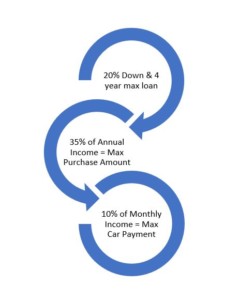
To get an idea of how much car you can afford, a good rule of thumb is to pay no more than 35% of your annual pre-tax income. So, if you make $50,000 before taxes per year, your car purchase price should not exceed $17,500. But you can’t buy a new car for $17,500, you may be thinking. You’re right, but you can find a good used car for that amount (more on that later). 

The 20/4/10 ratio for car financing 

If you plan to finance your car purchase, follow the 20/4/10 rule: 20% down, loan no longer than 4 years, and keep total car payment – including insurance – to a maximum of 10% of your gross monthly income. This will help you to keep your payments and interest costs down while not losing sight of your other financial goals. 

  • Put at least 20% down – This will help lower your monthly payments, but it also protects you from the dramatic loss in value new cars experience (another great reason to buy used). A new car can lose up to 19% of its value in the first year alone. If you put less than 20% down, you can owe more than the car is worth almost right away. This can be an issue if you need to sell before the car is paid off or if the car gets totaled in an accident.
  • Term of the loan no more than four years – The longer you make car payments, the more interest you pay. Also, if you are making payments, you must meet the requirements for insurance your lender has, which often means paying higher rates. If you can pay off the car in three years, even better! If you must stretch the loan to five years or longer in order to afford the payments, that may be a sign you are buying too much car.
  • Keep total car payment (including interest, principal, and insurance) to no more than 10% of your pre-tax income – This will help keep the rest of your budget intact. Having your dream car isn’t worth neglecting your emergency fund, retirement, vacation, or other financial goals. This will also help should your circumstances change, like if you lose your job.

Keep in mind this is just a guideline, and everyone’s situation is different. Using a car affordability calculator can help you run your numbers and make a wise decision about your vehicle purchase.

Last thoughts

As you determine how much car you can afford, keep in mind the costs of fuel and maintenance as part of your process. As we touched on, buying used may provide more value and lessen the hit of depreciation compared to new car. Also, make sure you track your credit prior to applying for a car loan to make sure you can get a low rate with lower payments.

Following these guidelines will help you “stay in your lane” when purchasing your next vehicle!

4 Money Hacks Millennials Can Use To Make The Most Of Their Assets

May 14, 2018

If you’re a Millennial, you’re probably familiar with various “life hacks” to make life easier. Why not do the same with your finances? Here are four hacks you can use to easily get more from various financial assets:

1) Use a Roth IRA for emergency savings

When you’re early in your career, you may not have had enough time to build up an emergency fund but may not want to forego the tax benefits of saving for retirement to do so. Enter a Roth IRA. With this account, you can do both at the same time.

Since you can access the sum of your contributions at any time and for any reason without tax or penalty, it can serve as part of your emergency fund. (If you use the “backdoor method” to get around the income limits, you’ll have to wait 5 years before you can withdraw the amount you convert penalty-free.) You may have to pay taxes and a 10% penalty on any earnings you withdraw before 5 years and age 59 ½, but the contributions come out first. Anything you don’t withdraw can grow to be tax-free for retirement. Giving up this tax opportunity and having to file a withdrawal form every time you take money out can also make you think twice before spending the money on an “emergency.”

If it’s part of your emergency fund, the Roth IRA should be invested in something safe like a CD or money market fund. That’s because you don’t want it to be down in value when you need it. Once you have enough emergency savings someplace else, you can invest the Roth IRA more aggressively for retirement.

2) Consider a Traditional IRA for grad school

If you don’t have a retirement plan at work or if you meet the income limits, you can deduct contributions to a traditional IRA. Otherwise, you can contribute pre-tax to a retirement plan at work and then roll the money into a traditional IRA once you leave the job. In either case, the IRA money is penalty-free for qualified education expenses. You’ll have to pay taxes on the withdrawals but you’ll likely be in a lower tax-bracket if you’re not working full-time anymore. Just be sure to keep any money you plan to use in the next 5 years very conservative like a money market fund or a stable value fund.

If you need the money for retirement or end up not needing it for education expenses, you can also convert the traditional IRA to a Roth IRA while you’re in school. You’ll have to pay taxes on the amount you convert, but again, you’re likely to be in a lower tax bracket. The amount you convert to a Roth IRA can be withdrawn penalty-free after five years and the earnings can be withdrawn tax and penalty-free after five years and age 59 ½.

3) Use a health savings account for retirement

HSAs have the most potential tax benefits since the contributions are pre-tax and the withdrawals are tax-free for qualified health care expenses. (These medical expenses don’t have to be in the same year you make a withdrawal so you can pay for health care expenses out-of-pocket to let the HSA continue growing tax-free and then later withdraw the money tax and penalty-free as long as you keep the receipts.) When you turn age 65, you can also use the money for anything without penalty so it’s part of your retirement savings (still tax-free for qualified medical expenses, including some Medicare and long term care insurance premiums). You have to be in an HSA-eligible high deductible plan to contribute, but these plans are most beneficial while you’re young and in relatively good health so your medical expenses are likely to be low.

4) Use a home for income

Known as “house hacking,” you can purchase a home or multi-family unit and have your roommates or tenants pay at least part of your mortgage. Putting extra rooms on sites like Airbnb and Homestay can yield even more income. (Just make sure you’re not violating any building rules or local laws.) Some people even manage to essentially get paid to live in their home if the rental income exceeds their expenses. You also benefit from any appreciation in the property and you can deduct depreciation on an investment property from your taxes.

This is a good strategy to use before you have a family, especially if you would be living with roommates anyway, but there are some downsides to be aware of. First, you need to have enough savings for a down payment and closing costs plus a good credit score and a low debt-to-income ratio to qualify for a low mortgage rate. You then have to play landlord, which means finding and vetting tenants, maintaining the property, and covering the mortgage during vacancies. Finally, you’re tied down in the sense that moving can mean having to sell the property or hire someone else to manage it.

Financial planning is about making your money work as hard for you as you do for it. Don’t just make it work harder though. Use these hacks to make it work smarter too.


This post was originally published on Forbes.

What To Do If You’re Struggling With Your Mortgage Payments

May 08, 2018

Losing your home to foreclosure and potentially being homeless is one of the biggest financial hardships you can face. However, there may be situations in which walking away from your home actually makes sense. Here are some questions to ask yourself: 

Do you have equity in your home or are you underwater?

Home equity is the difference between the value of your home and what you owe. You get to keep any equity leftover after a foreclosure sale, but that equity is likely to be reduced by late payment and foreclosure fees assessed by the mortgage company. Mortgage companies will typically also accept offers for less than the home’s value in order to sell it quickly and because they won’t benefit from selling it for any more than the mortgage value. On the other hand, if your home value is significantly less than what you owe, a “strategic default” can be your best financial choice even if you can afford the payments.  

How much can you afford to pay?

Start by look at your bank and credit card statements over the last few months and record your expenses on a worksheet like this. Then see if you can find ways to reduce any of those expenses to make the mortgage payments. If you want to keep your home, you may want to prioritize the mortgage payments even over unsecured debt payments like credit cards and personal loans. After all, defaulting on either type of debt will hurt your credit but the latter can be wiped out in a bankruptcy without losing your home. A bankruptcy can hurt your credit score more, but a foreclosure can make it harder to get a mortgage in the future. Plus, we all need a roof over our head.

Are there alternatives to foreclosure?

Once you know how much you can afford to pay towards your mortgage and it’s not enough to get current, contact your mortgage company and see if you can work out a plan with them to avoid foreclosure. This may mean modifying the terms of the loan to make it affordable for you or giving the home up through a short sale or a mortgage release/deed-in-lieu of foreclosure. These options will hurt your credit score but not as much as a foreclosure. 

If you’re having trouble making your mortgage payments, don’t despair. There are options that can keep you in your home or you may even be better off walking away from it. If you’re not sure what to do, see if your employer offers a financial wellness program with free access to an unbiased financial planner who can help you decide which option is best for you. 

This Millennial Learned The Downsides of Private Student Loans The Hard Way

May 07, 2018

I recently spoke to a young man who was evaluating his options regarding a private student loan that was in default. He had attended a prestigious school where his mother was a professor, which allowed him to attend tuition-free. However, his family had not saved to cover the other costs of college, including room and board, books and fees, so he found himself taking on student loan debt in order to cover those costs. Due to his mom’s employment and his family’s financial situation, he was offered very little in federal loans, requiring him to turn to the private market to fill the gap.

Fast forward to graduation, when he moved across the country to a high-cost-of-living city to seek a job in a competitive field, and he found himself still looking for work when the 6 month grace period expired on his student loans.

What happened next

At this point he learned very quickly how federal and private loans differed — while he was able to defer his payments on the federal loans until he found employment, and then was able to choose an income-based payment plan to accommodate the fact that he was in a field that starts out with very low pay, with room for rapid salary growth, the lender of his private loans was less sympathetic. Within months, he was in default on all of his private loans, despite numerous attempts to work with the lenders to work out a way to stay in good standing.

Where he is today

Ten years into his career, this young man has been very financially successful. So much so that he’s been able to completely pay off his federal loan, but the private loans continue to plague his credit score. Despite the loans being considered in default, he has been making payments on them ever since he found employment, but due to the fees and interest that had accrued during those early months of unemployment, the payments barely make a dent. The rub is that the lender is unwilling to work with him to put the loans back in good standing unless he is able to catch up on all the missed payments from all those years before first.

Evaluating his options

One thing he’s been considering is whether to settle the defaulted loans, by offering to pay a lump sum and call the loans “Paid as Agreed.” The upside to this is that it will start the clock on those defaulted loans falling off his credit report after 7 years, with the negative effects on his credit score softening with each passing year. The downside is that in the near-term, his credit score won’t really see any boost — having a settled debt on your record is actually just as bad as having a defaulted debt on your record. But in the long run, settling will make the default history, eventually. He was disappointed to learn this, as he had been hoping that settling would at least show that he’d paid, but alas, that’s not how prospective lenders see it.

What he would have done differently

The key take-away from this tale of debt is not just that private student loans should be used with caution, as the flexibility offered by federal loans simply doesn’t exist, but also what he shared with me about his regrets. When talking through these consequences, he lamented that he wished that he and his parents had known what they were getting in to when they accepted these loans in the first place. He had borrowed this money in order to take advantage of a study abroad program, as well as to live on campus, when he could have just as easily lived at home.

In other words, if he’d known then what he knows now, he would have simply not taken the loans as he didn’t NEED them, they just enabled him to do some really cool things that other students (like me, for example) didn’t get to do because they simply couldn’t afford it. In retrospect, he actually couldn’t afford those things either, which just reinforces one of my favorite financial planning mantras: student loans are NOT financial aid.


How My Wife Started A Successful Business & What It Took To Get There

May 04, 2018

Editor’s note: This post is part of our Personal Stories series, where our financial coaches share their own financial journey. We hope you enjoy getting to know us a little better and ultimately learn from our mistakes!

OK, so here’s the situation…

For several years my wife had been dropping hints that it was her dream to have her own business. She had a distinct vision for how she wanted to disrupt an industry and provide a unique service that she could not find anywhere else. I had always been mildly encouraging saying, “Sure if our income has progressed to this level and if we paid off all of our debt except for our home and if we got our savings to a certain level, then it will be worth a shot.” Suddenly without even realizing it, we hit those goals and my wife handed me a business plan.

“I got this”

Off we went into the wonderful world of starting a business. While we did a lot of things right, we have learned (and are still learning) some crucial lessons on this journey. For example, without realizing it, when I laid out those goals of paying off our debt and building savings, I was implementing a very crucial step to us being able to sustain a new business. To the extent that your business has overhead costs, the stronger you will need to be financially to stand behind that business. Here’s how we did it.

Counting the costs

When my wife handed me the business plan, I found she had made an itemized list of every expense she could find for the business and the time frame for each expense. She had taken hours to uncover the real-world cost of every piece of equipment, researched leasing costs, and estimated salaries for the first 3 years of the business. It allowed us to make realistic estimates for how much we would need to set aside and a time frame for profitability. Consider using the Small Business Adminstration’s template to lay out your costs.

Planning for error

My experience is no one has a perfect business plan. Even the most meticulous planning can be derailed by real life. That means making sure you have resources over and above what you have budgeted, in case things go sideways. In addition to your savings, assess your access to low interest loans. Banks generally will not lend to a start-up business, so having a good personal financial reputation is very helpful.

At the end of the day

These days my wife has a successful business that enables us to raise 3 children and live in the neighborhood we desire. Her work provides the flexibility to accommodate the fact that I occasionally travel for work, and being a business-owner allows her to choose how big she wants to go, depending on where we are in life.

If I could turn back time

One thing I’d say she’d do differently would have been to get a little more experience in her particular industry before launching her business. From the outside looking in, it can be easy to see that an industry needs a shakeup. For instance, Netflix wasn’t the first company to present an alternative to cable. On the other hand, it can be helpful to spend some time in that business to understand the reasons why companies do things a certain way.

In our circumstance, my wife always wondered why the level of personable service was so low in her chosen industry. If she had found a mentor or worked part time in the industry, she would have discovered that hiring and keeping employees was a challenge for everyone in the business. With a little real-world experience, we could have planned to manage this obstacle. Start networking in your desired industry to get an idea of those real-world obstacles. You can also find business mentors through the SBA here.

If I could tell you just one thing

It’s worth it to take the time and get your finances in order first before launching a business from scratch. There are success stories of people of who ran their business solely on their credit cards, but those are few and far between. There are far more stories of people who failed at a business using credit cards, and wound up back in the daily grind, saddled with high interest debt and nothing to show for it.

Your likelihood of a successful business goes up substantially if you have a firm financial foundation. Start where you are doing the things you can do. Go ahead and start itemizing the expenses, lay out your business plan, and try to get some of that on the job experience and mentoring. These are all things that cost you nothing but you can use that time to build the financial foundation to be ready when opportunity knocks.

The Worst Money Mistakes I’ve Made

April 26, 2018

This question was posed to me recently by a fellow financial planner. His question certainly caused me to pause and think. Over the years, I’m fairly certain that I’ve made a number of unwise money decisions, but two in particular stand out as blunders I’m not particularly proud of. Borrowing from a popular late night TV sketch, let’s take a look at some of the silliest money mistakes we’ve all done or seen and see what useful life lessons we can take from those.

Buying a timeshare

While honeymooning in Mexico, my wife and I fell for the sales pitch and bought into a long-term resort condo timeshare. For those who like to travel frequently and also have the budget to support that lifestyle, vacation time shares might be a reasonable move. At that point in our lives, however – young, early career, modest incomes – we were not the ideal candidates. We also did not pay attention to the ongoing additional fees often tied to timeshare ownership.

Furthermore, we had no idea how illiquid these “investments” are. As anyone who has ever tried to sell a timeshare to someone else can tell you, the supply greatly outstrips demand. In other words, selling your timeshare is close to impossible. If you do find a buyer, expect to sell at a very deep discount to what you likely paid for the property.

What I learned from this mistake

After many years and thousands of wasted dollars, we were eventually able to dump ours and walk away. What important financial life lessons did we learn? Ultimately, we learned never to make a major financial commitment driven primarily by emotion. We were young, on our honeymoon in a beautiful location, and all too agreeable to an opportunity to repeat that experience. Marketers, of course, are very aware of this, and we fell for it all.

Now we know it is much better to first say no and then take plenty of time (days, weeks, or even months) to think things over before committing thousands of dollars to purchase something we may or may not use or continue to enjoy as much as we originally thought. As a result, we’ve avoided the purchase of numerous boats, campers, and vacation homes over the years. These days, when we want to vacation in a fun location, plenty of economical rental choices are available through sites like Airbnb.com or VRBO.com without the long-term commitment or expensive maintenance fees.

Student loans (sometimes)

Student loans can be a good investment. For a relatively modest interest rate, in today’s environment at least, you can leverage other people’s money into an education that boosts your future income significantly, making the comparatively small amount of interest you pay in the short run well worth it in the long run.  However, like any financial tool, student loan debt can also be abused or misused.

For example, at one point in my career, I decided earning my MBA might be a good move, and I applied for student loans to help finance this venture. Along the way, however, my career ambitions took a different tack, and I elected to focus instead on earning my CERTIFIED FINANCIAL PLANNER™ designation and subsequently, a master’s degree in personal financial planning (a decision I have never regretted). Although I had abandoned my MBA pursuits at the time, the student loan debt used to finance that pursuit remained and still had to be paid. Fortunately, I had not borrowed a large sum for this and we paid it off fairly quickly.

What I learned from this mistake

The financial lesson here is to carefully consider the commitment of time, effort, money, and ongoing personal motivation needed to make a particular career choice work. If a substantial amount of student loan debt will be necessary to obtain a degree, we need to be prepared to remain committed to that career choice, at least until we repay the student loan debt. Otherwise, we will very likely be stuck with paying for a decision error over many, many years with zero return on our investment. Another consideration is whether or not the degree we are pursuing really has the future income potential to justify taking on large amounts of debt to finance it.

To err is human

As financial planners, we have the benefit of working with many people from a variety of backgrounds and circumstances. This not only gives us a front row seat to many of the money errors and financial regrets our clients have endured, but it also enables us to share the related financial lessons with others. In no particular order, here are a few of the more common silly money mistakes that can provide helpful lessons for us all:

  • Carrying long-term credit card debt – The insidious evil of carrying credit debt month after month is the reverse compounding effect. Just as positive compounding helps us become wealthy by earning interest on interest, the reverse is true of debt. The negative compounding begins to make our credit purchases exponentially more expensive over time. Transferring balances to a 0% balance transfer card or otherwise refinancing to a lower interest rate is a good start to reducing our debt risk. The quickest way to get out of debt, however, is to employ the DebtBlaster approach we recommend at Financial Finesse and pay off the highest interest debts first, gradually rolling up those monthly payments until the last credit card in the list is receiving a monthly payment equal to the combined payments you were making on all of your cards.
  • Lending money to family – Money decisions driven by emotion rarely turn out well, and what gets more emotional than a plea for money from a family member? If you do lend money to family, most planners recommend formalizing the loan with a written agreement that includes at least a modest amount of interest. Practically, however, treat it the same way you would treat giving money as a gift. Make sure your family loan won’t negatively impact your own cash flow if your family member borrower cannot or does not pay you back. These arrangements work best if you don’t expect to receive the money back in the first place.
  • Borrowing from your retirement plan – On the surface, borrowing from your traditional 401(k) or 403(b) savings plan at work might seem harmless, but it has some obvious and not-so-obvious risks. On the positive side, you are borrowing your own money and paying yourself back with interest. Furthermore, doing this will not affect your credit score one way or the other. However, you will be paying your retirement plan loan interest with after-tax dollars. The not-so-obvious downside to this strategy is that these same after-tax dollars you used to pay the interest will be taxed again when you eventually spend this money in retirement.

Financial planners are just as human as anyone else, and in many instances, we were not always professional financial planners our entire careers. We’ve made many of the same money mistakes our clients sometimes experience. Consequently, we understand and have compassion for the frustration and disappointment that comes from looking back on a financial mistake and wondering how on earth we could have been so foolish. Although our individual “silly money mistakes” may have been expensive, they do not need to be permanent, and we can always learn from them.

How To Attend Every Wedding This Year Without Going Broke

April 24, 2018

I was chatting with one of our Client Service Managers, Cassie Brunelle, about how expensive it can be to have great friends in your 20’s — everyone’s either getting married or celebrating milestone birthdays, and these days that involves a lot more than just showing up to a hotel ballroom with a gift off the couple’s registry. Cassie may not be a financial coach, but she’s a great role model for everyone else in showing that you can make it to all of these events without compromising your other goals like paying off debt, building up your emergency fund and capturing your full match at work. Here’s how she’s doing it this year:

Like many people my age (mid-late twenties) the era of weddings has set in full force. Not just attending weddings, but being involved in them as a member of the bridal party, while also attending and planning bach trips and occasionally the bridal or couples shower. Between May 2017-October 2018, I will have attended 7 weddings, 4 bachelorette weekends, 3 engagement parties, and 2 bridal showers, four of which I will have been a bridesmaid.

Adding up the costs

The dollars amounts attached to these events can sometimes feel completely ridiculous, but is there a real price tag on an unforgettable weekend celebrating with your friends? Yes there is, but the question is, is it worth it?

In my case, I have successfully justified the expenses, but at what cost? I have had to forgo some other plans and adjust my timeline to some personal financial goals to make it work, but I’ve also employed a number of tactics, tips, and reminders that I’ve compiled below to keep me from having to get a roommate or take on high interest credit card debt.

How I’m avoiding FOMO without taking on massive debt

If you’re reading this and you’re like me, and want to support your friends as they enter a new chapter (and also just don’t want to miss out on a weekend full of memories), then I hope you use some of these ideas to make it a little easier on yourself.

1. How to save when you’re in the bridal party

Being a bridesmaid/groomsman is an honor, but also comes with a commitment to be there for various events, to purchase a particular dress or suit, provide emotional support, and be a team player whether that be setting up and breaking down parts of the wedding or reception, running last minute errands, or making sure the bride/groom eats something (and doesn’t overindulge). Here’s how I’ve been able to do this on a budget:

  • Buy second hand. Yes, you might actually be able to find the dress the bride chose without having to buy it off the rack. Most designer bridesmaid dresses have triple digit price tags, and for a dress you will likely wear once, that can be tough money to spend. I’ve used sites like Tradesy, Poshmark, and Bridesmaid Trade to find the same dress that someone else had to buy and wear once. You have to pay close attention to the details, such as color and sizing (since you can’t return), and make sure there is no obvious wear and tear, but it can save you a ton. The upside is also you can resell your dress on these sites after the wedding too.
  • Do your own hair and makeup. The beauty bill attached to being a bridesmaid can easily reach $300 between hair, makeup, nails, a spray tan, and other grooming, just for one weekend! To avoid this, I’ve planned my haircut/color appointments to occur right before I have these events and have also invested in some high quality makeup, nail polish, and hair tools that I can travel with and do my own hair, makeup and nails. So instead of paying $300 per wedding, I invested around that same amount into products and hair appointments to last me through three weddings.
  • Have real conversations with the bride/groom. You may see a different side of your friend when it comes to wedding planning. For some it’s emotional and overwhelming, and sometimes they may feel unheard especially if their respective families are very involved. It’s important to have a real conversation of what they expect from their bridal party, and perhaps what areas they are flexible so you know what won’t disappoint them. Be realistic with what you can commit to and understand that it’s better to be honest from the beginning than hold onto resentment through various events that are meant to be fun!
  • Reduce the extra. I’ve seen bach parties quickly spiral into too much decor, too much food, and in rare cases, too much alcohol. If you are attending a bach weekend, something my friends have instilled is that everyone contributes something — it can be a game, decorations, party favors, or planning some activity, but this takes the onus off one person (usually the maid of honor/best man) and helps spread the love (and the cost). If we are purchasing something that we expect others to chip in (either an activity, personalized hats, or tattoos with the groom’s face on them) that expense needs to be approved by the group. We have tried to stay in homes or Airbnbs as much as possible so we can make meals at the house and split a grocery bill instead of splitting meals at restaurants.

2. Saving on travel and accommodations

If you are like me and you have to travel to the majority of these weddings, which includes the cost of airfare and hotel, here a few money saving tips:

  • Get used to sharing. Hotel blocks for weddings can be expensive, so sharing rooms with friends is a great way to reduce costs. If you want to forgo the hotel (which can have added costs with amenities and late night room service), booking a large Airbnb to share with friends is a great way to reduce the expense and spend time together. There’s usually a kitchen too, so meals can be prepared instead of ordering from restaurants.
  • Use your credit card points. If you know you have travel coming up, find a credit card that will earn you bonus miles for opening the account (be careful here as there is always a minimum amount to spend in order to earn the miles, and watch out for fees). Whether you have a card with a specific airline or one that earns you miles, it can be advantageous to stockpile these points to use for wedding related travel. It’s important to be mindful that these cards often carry higher interest rates, so make sure whatever expenses you put on the card are within your budget to pay off each month.
  • Stay with friends! Typically the bride and groom get married in one of their hometowns, which can mean free rooms to stay in should you want to forgo a hotel or Airbnb.
  • Plan ahead. Try to get as many details as possible for destination weddings and jump on booking a hotel or Airbnb ASAP, and try not to procrastinate booking flights. My friend group has booked places 6 months in advance so we can break up our payments into 2 or 3 chunks instead of having a larger expense all at once. You’ll be prepared and have peace of mind knowing when you arrive that the payment has already been taken care of.
  • Book your flights with arrival times in mind! Reduce the cost of Uber/Lyft from the airport by arriving at the same time as other guests. Airports can be far from the destination hotel so if you are traveling alone, try to link up with at least one person at the airport so you can avoid the trek alone, and if you are in an urban area you can take public transit together.

3. Other areas you can save

  • Gifting. Sometimes it can feel like a lot to travel for a wedding, buy a new outfit, pay to stay somewhere, and get the bride and groom a gift. Group gifts are great because each person can contribute the amount they are comfortable with toward either a gift card or toward a larger gift such as a grill, couch, or personalized decor. Or if you simply can’t afford it all, take advantage of the one-year rule, which gives you up to one year to send a gift to newlyweds and still consider it timely.
  • Buy a good pair of (neutral) dancing shoes. Having versatile outfits and a good pair of shoes will make it easier to pack for each wedding, and if you only have to buy one pair of good shoes to wear to every wedding, it will be a worthy investment.
  • Have an accountability partner. Am I the only one guilty of feeling more generous than usual during wedding season? Especially if it involves traveling and seeing friends I haven’t seen in awhile, the splitting of bills and rounds of drinks can get a little messy. This is where Venmo is a great in the moment way to make sure you don’t get stuck with the entire bill, and having someone remind you that maybe you don’t need to buy a round at the after-party just because you’re drunk with love for everyone in the room. Leaving your credit cards behind and carrying cash can help combat this impulse. I’ve made a plan for wedding weekends that involve multiple nights of fun and spending to have a friend to check in with on our spending; no one wants to see those surprise charges on their credit card the next morning.
  • Remember you can say no. I know it can be very hard to decline an invite to a wedding, bachelorette party or other event related to an impending marriage, but you still can in a tactful and clear way. It’s a delicate balance of being there for your friends and also doing what’s best for you. Having a clear conversation up front should your friend ask you to be in the wedding party or play any role that puts a financial commitment on you is important in setting boundaries and managing expectations.

    If you want to really be there for your friend, but know it will cause you undue stress because of other commitments in your life (maybe you’re planning a wedding for yourself!) be realistic with your loved one up front. If you’re not, it can lead to resentment and misunderstanding in the future, and you don’t want to lose a friend over events that are meant to be joyous and fun.

These are just the things I’ve done, but here are tons of other tips for saving as a wedding guest from Refinery 29, Money Crashers, Loverly, and even the NY Times.

Just know that you’re not alone, and take some extra time to find little ways to save. Life can get busy, and missing out on big events can be a bummer so preparation, planning ahead, and voicing any concerns up front will help you have the most fun celebrating with your friends this year!

Re-establishing Your Financial Identity During Divorce

April 23, 2018

Many divorces start out rather amicable. When two people decide they will  “consciously uncouple,” there is often a high level of trust as they begin to unwind their lives. However, once you make this decision the process can still take a while. Depending on where you live an uncontested divorce can take from 2 days up to 18 months. In other cases, it may be to your advantage to end the year married for tax filing purposes. The tendency can be to postpone doing things like establishing separate accounts, refinancing the home, closing credit cards, etc. because with such momentous change on the horizon; why disturb the status quo? 

Things can change quickly

Then something happens, like one person gets into a new relationship, and things sour quickly. All those divorce nightmares you heard about can suddenly become a reality if you have financial exposure to someone that sees you as an adversary. This is why it makes sense to start limiting financial exposure as soon as possible once the divorce decision has been made.  

Here are some steps to take immediately and a few tips to consider after the divorce is final. Because there could be long-term legal ramifications to these decisions it would make sense to consult with a family law attorney along the way.  

What you should consider right away

Checking and savings

If all your accounts are owned jointly, you will need to establish new accounts. If you have accounts in your name only already in place then it may make sense to operate in those accounts going forward. You can choose to operate out of a joint account for joint expenses like mortgages and utilities (more on this in a moment) but keep in mind that you will be responsible for any account mismanagement, like overdrafts.  

Credit cards

If you have credit cards in your joint names the best practice is to either close or freeze these accounts. If you have separate accounts but your spouse has a card in their possession as an authorized user, it may make sense to close their card and have the number reissued.  

Your home

If you are in the divorce process and you have mutually agreed that the home would be too much for one of you to keep, go ahead and start the selling process. While that sale is in process it probably would make sense for one of you to stay in the home. That person would be responsible to keep the house staged for showing. It would be ideal to have some written agreement in place outlining how expenses for the residence will be split until a sale occurs or the divorce is final. 

Accounts with beneficiary designations  

Any account where you can change the beneficiary without a spouse’s consent should be updated immediately. Others, such as your retirement accounts, will have to wait until the divorce is final, depending on your state. Be sure to update any POD or TOD provisions on financial accounts and don’t forget any life insurance you have.

Cash flow

As soon as possible, readjust your budget for your new standard of living. This is the perfect time to lay out a spending plan that keeps you on track for your future goals.  

Once the divorce is complete

Beneficiary update part 2 

Now that you’re officially unmarried, make sure you update all accounts that required spousal permission. These are typically retirement related benefits like 401ks and pensions.  

Healthcare and other benefits

Reassess your benefits to make sure they are right fit for your newly constructed household. For instance, you may be in a situation where a lower or higher deductible would make better sense now that you are on your own. 

Estate planning 

Move forward with updating your estate plan for your new reality. Update who would serve as your executor for your estate and who would serve as power of attorney for finances and healthcare. If you have a trust, you’ll want to make sure your ex isn’t named as successor trustee, nor are any in-laws named. You may also need to update potential guardians for any minor children.

Mortgage 

If your spouse is keeping the house, be diligent in making sure the mortgage is refinanced with your name removed. Any mortgage delinquencies will also affect your credit, as my colleague learned the hard way. 

Revisit your spending plan 

Sometimes the financial terms of the separation can change at the last moment. You will need to update budget considering these changes. This is also a good time to review your plan with a financial planner.   

Retirement

Use a calculator to determine if you are still on track for retirement. Also contemplate how your social security benefits can be affected by your decisions going forward.  

Going through a divorce is emotionally and financially challenging. No matter what you’re feeling in the moment, it’s important to make decisions keeping your “5 years from now” self in mind, the person who will look back on this stressful time and sigh with relief. Do what you can to avoid also looking back and wondering, “what was I thinking??”

How Expensive Is Your Marriage?

April 12, 2018

Twenty or so years ago, my employee Greg and his soon-to-be wife, Susan, opted to take a pre-marital course that would help them prepare for life as a couple. They had talked about their plan for their marriage before stepping into a counseling room, but they both knew there were aspects they hadn’t considered.

Not everyone discusses this stuff first

There were several other couples in that course and Greg was shocked when he realized that most of them had never discussed their life goals — let alone their financial ones — until that day, which in some cases was just weeks before their wedding date.

It’s not unusual for us to never have discussed these topics with our spouse before our lives are merged, and sometimes our marriages end up costing us more than we anticipated. That’s when we need to sit down and re-evaluate what we’re doing differently from when we were single.

How expensive is your marriage?

Income & expenses

The first is how much your expenses and income increased after getting married. If your income has increased at a higher rate than your expenses, your marriage is saving you money. But if your expenses have increased at a higher rate than your income, it’s costing you money.

Net worth

The second deals with your net worth after marriage. Determine what your net worth (total of investments and value of assets like your house, car and other tangible property minus all debts) was before you got married. How has that changed since being married?

It is possible you are spending more than you’d like but are acquiring valuable assets in the process, which puts you in a better position financially than when you were single. Alternatively, you might be doing well with your expenses as a married couple but making poor investment decisions, causing your financial situation to worsen even though your day-to-day money management has improved.

Other costs to evaluate

Day-to-day expenses

Go to the grocery store alone and purchase everything you need as a household for the next week. The following week, do the shopping with your spouse. Then compare the two experiences.

Do you purchase more or less when you shop together? Some couples work as a check and balance, discussing purchases and finding ways to save as they go down the aisles. Others become more impulsive and get into a spending frenzy, which ends up costing more money than they would have spent as individuals.

Major purchases

Consider evaluating your behavior in how you currently make major purchases.

  • Do you and your spouse make the decisions together?
  • Do you have a plan for the expense?
  • Have you done some comparison shopping?

Look at the criteria you’ve used to make your most recent major purchase. Then imagine you’re making the purchase again, only this time, sit down with your spouse, create a savings plan and do some extensive comparison shopping. If you find your purchase was the best you could have made, you’re in decent shape. If you didn’t make the best purchase, you may want to beef up your criteria.

Investments

A good way to evaluate whether you and your spouse are on the same page with your investments is for each of you, independently, to revisit or look over your current investments. Then, individually make hypothetical changes to how you’d manage your portfolio.

Compare your strategies, risk tolerance and some future investments you’d consider buying. How different are your strategies? How could your different ideas about investing be affecting your current portfolios? Some couples share similar investing strategies and others differ tremendously.

Cost of borrowing

Test your knowledge of your credit strength. Was your credit score higher when you were single? Is it stronger now? Do you know when to use joint credit accounts vs. individual credit? Do you know how much debt your spouse has? Couples should know how to leverage their credit and be fully aware of each others’ debt loads.

Taxes

The marriage tax penalty became less of an issue in 2018, now that tax brackets have changed to all but the highest earners seeing a difference when they marry someone with a similar income, but it’s still something to consider. Even though the tax brackets have changed, most married couples still benefit the most from filing jointly due to the rules around other deductions. 

Look at your tax liability and how it is affected by the alternative minimum tax. Since AMT doesn’t follow the same formula as regular tax brackets, it can be easier to trigger when earning two incomes. Sit down with your CPA to determine if this affects you.

Gifts for each other

To determine if you’re spending unnecessarily on each other, look at whether or not you both have the same ideas about gifts. Do you put a spending cap in place? How do you each go about purchasing gifts? You can also evaluate the gifts you’ve purchased over the course of your marriage. How much did you spend on them? How valuable does your spouse find the gifts? There has been a lot written about the different ‘gifts’ people value most; you could be spending on your spouse when they may not want a purchased gift at all.

Ways to reduce the cost if you find it’s too high

Re-evaluate your household budget

Define roles in the budget and track your spending together on a regular basis, re-evaluating it every quarter. List all the major purchases you anticipate within the next year and set goals for when you want to acquire them.

Create a savings plan; if you both have different ideas on what purchases you want to make within the year, you can use this opportunity to synchronize your plans. Then, do some comparison shopping. Consider more than just cost; look at quality, warranties or anything that could end up costing you in the long run.

Watch out for the “his and hers” mentality

If you opt to manage separate accounts, make sure you at least have a joint investment account so you can meet your investment goals together. Also be sure to utilize each spouse’s strengths in your investing strategy. You may find that one is a long-term strategist and the other is a good decision maker on when to buy and sell.

After you’ve tested your knowledge of each other’s goals and strategies, you should have a better idea of how you can work together to maximize your investments.

Find balance for your life goals

Gauge if your goals match. Your spouse might be anticipating a large family and this could be more expensive than you had planned, or they may feel strongly about sending your kids to Ivy League schools. If your goals don’t match, you both should consider how and where to compromise so your finances aren’t at stake.

Keep your credit strong

Each of you should maintain strong credit scores and use them for leverage. If a couple has shared debt, each is individually liable for it regardless of who incurred it during the marriage. Joint liability can hurt the couple if they don’t, or if one of them doesn’t, manage their credit, since it drags both credit scores down.

Discuss your attitudes about debt before you plan to use joint credit. Does your spouse feel debt is a disadvantage or even dangerous? Or maybe they feel it’s necessary to meet your financial goals. Either way, you may want to be prepared to make substantial compromises if your opinions differ.

Make your gifts more meaningful

If you’re spending money on your spouse to show your affection, consider how they prefer to receive it. The book The Five Love Languages by Gary Chapman describes the different ways people react to love. Your spouse might prefer quality time over receiving gifts. Just an understanding of how to show your spouse affection in a way they will most appreciate it can save you money in places you may have never considered.

Evaluate your tax options

Run a tax calculator for you and your spouse filing together and also as married filing separately. Then determine how to make a penalty less impactful or even turn it into a benefit. You can run a free estimate on each scenario at turbotax.com. For most married couples, it’s most beneficial to file jointly.

Understanding and synchronizing our values and financial behaviors in marriage is by no means easy, but most married couples would probably argue that sharing their lives with the person they love makes all the work worthwhile. Wouldn’t it be great to not only enjoy your marriage, but to have it cost you less, too?

3 Cash Management Tips That Work

April 05, 2018

One of the most common things we talk to people about at Financial Finesse is deciding to take control of your spending. The most crucial step in making that happen is figuring out how to manage your cash flow. In order to take that commitment and turn it into habits that stick, you’ll need some strategies to help you along the way.

Let’s look at a few ideas that can help you master your cash flow – try one or two of them out to see what works best for you.

1. The Planned Spending Account system

The problem: Most people tend to have just two bank accounts – a checking account and a savings account. With the best of intentions each month, we often set a goal to transfer any money left over each month from our checking account to our savings account. But if you are anything like me, money in the checking account has a way of being spent, leaving little to nothing to move into savings at the end of the month. Even worse, too often money is transferred out of savings into checking because there always seems to be unexpected expenses not in the budget that come up. This cycle is frustrating and doesn’t get us closer to our goals.

If you’re one of those people who feels like every time you start to get ahead with savings, something else random always seems to pop up, then this method is for you.

How to fix it

Things like vacations, car repair/maintenance, clothing, and gifts are examples of expenses you know you will have through the year, but not necessarily every month. Since you know they are coming, these expenses are not emergencies. So why pull from your emergency savings to pay for them?

How do you set that money aside so it doesn’t get spent from your checking account or deplete your emergency savings account? The answer is adding a third account – the planned spending account.

Here’s how it works:

  1. Open a third bank account (preferably a savings account at a separate bank so it isn’t as easy to move money to your checking account) that is just for planned expenses that do not occur every month.
  2. Add up all needs that occur regularly but not monthly, like property taxes, car registration, hair cuts, etc. Also include less predictable wants like clothes, vacations, and gifts. Figure the total for planned spending for the year, divide that by 12, then deposit that amount into your planned spending account automatically each month. It really is that easy!
    Planned Spending Category Annual Amount Monthly Estimate
    Car Insurance $1,800 $150
    Clothing $800 $67
    Vacation $900 $75
    Gifts $600 $50
    Medical expenses $2,000 $167
    Home repairs $1,200 $100
    TOTAL $7,300 $609
  3. Now when the Holidays come around or the car needs an oil change, how have the money set aside to pay those bills. No need to raid your emergency fund or pull out the credit card!  This system may mean you move less into your savings each month, but you will see your savings grow because you won’t be making withdrawals either.  This system is also great for helping you get out of debt and reaching your other financial goals.

    Month Deposit Bills Expenses Balance
    January $609 Clothing $315 $294
    February $609 Medical bill, home repair $390 $513
    March $609 Car insurance, gifts $550 $572
    April $609 Car repair $300 $881
    May $609 Clothing, home repair $380 $1,110
    June $609 Car insurance, medical $1,100 $619

2. The Cash Only system

The problem: Swiping a card makes it far too easy to spend-spend-spend, without really feeling how much is actually going out. Before we know it, we’ve blown our budget and may even have to “borrow” from savings to make ends meet.

How to fix it

One way to help control impulse spending is to commit to only spending cold, hard cash on these items. Commit to only using cash for all shopping during the week: grocery store, dining out, entertainment, etc. Resolve that when the cash is gone, you’ll be done spending and will go without for the rest of the week. Several of my colleagues use this method to great success.

Here’s how it works:

  • It is ok to use checks, auto-pay or EFT for household expenses – no need to stuff an envelope with cash and send it to your landlord or mortgage company. This is for everything else.
  • If you use the Planned Spending Account system described above, pay your irregular expenses from that account.
  • For all other expenses that you haven’t accounted for in your Planned Spending Account, use your budget or spending plan to total your nonessential expenses for the month, then divide by 4.3 (number of weeks in the month) to determine how much is available for the week.
  • Then either write a check for cash or go to the ATM on the same day each week to get your cash for the week.
  • When you go out, leave the checkbook and credit cards at home.
  • When the cash runs out, no more spending for the week.

Many of us think if we carry cash, we will be inclined to overspend. But if you stick with this system, you will most likely find that you’ll spend less. Think about how much more real it is to hand over six $20 bills at the grocery store rather than inserting your card into the chip reader — you’ll quickly find yourself re-thinking impulse buys.

Potential downsides

You will want to make sure you are careful with your cash – one of the risks with using this system is lost cash and carrying a lot of cash can be dangerous. And while this system will help you avoid debt, you will lose out on credit card rewards and may make it harder to build your credit score. You’ll have to decide which is more important to you.

3. The Envelope system

The problem: Oftentimes an examination of past spending can lead to a realization that you have been spending a lot more on certain categories than you’d like. Trip to Target and Costco, anyone? But finding a way to stick to the new limits you set is the never-ending challenge.

How to fix it

This is an oldie-but-a-goodie! The idea is to take out enough cash each pay period to cover your budgeted expenses, then create an envelope for each category in your budget: Groceries, Entertainment, Dining Out, etc.

Here’s how it works

  • On payday, head to the bank or ATM and take out enough cash to cover your budgeted spending until you’re paid again.
  • Divide the cash into envelopes and label for each category.
  • If a certain store is a weakness, give it its own envelope.
  • When you go out to eat, take your Dining Out envelope with you and pay with that cash. Heading to the grocery store? Grab that envelope.
  • Once that cash is gone, then you are done spending in that category until your next paycheck.

Note that it is ok to “borrow” from other categories if necessary, but no going to get more cash out of your account! You will have the most success if you stop spending once the envelope is empty.

If you like the idea of the envelope system, but are not crazy about carrying around cash and envelopes, there are also several apps that help with this same idea.

Worth it in the end

Whether your goal is to just stay on top of your spending, reduce your debt, prepare for the unexpected, save more for retirement or simply save for other financial goals, pairing your commitment to controlling your cash flow with these systems will help. If you find that one method isn’t working for you, try another — as long as you’re feeling more in control of where your money is going, it’s working!

What I Wish I’d Known Before My Divorce

April 03, 2018

As a guy who has gone through a divorce, I always feel a special need to help those who are about to go through that process or who have gone through it and are in the process of rebuilding. I joke that prior to my divorce, I was on track to retire by 55 and live very comfortably, and after the divorce, I’m on track to retire at 85.  But…I’ve never been happier!

What’s it worth?

Is a smile on your face and a lighter mental burden worth an extra 20-30 years of working? For me, the answer is a clear YES, but so many others wrestle with that question for years before either remaining in the marriage or going through a divorce.

I’ve talked with a number of people recently who are not sure which direction their marriage is going. They wanted some ideas on how to be prepared financially so that they are not devastated or blindsided by things that could happen if the marriage ended in divorce. I always hope that they can work on fixing whatever is wrong in the marriage, but if they go down that path, here are a few things that I wish I had determined in advance:

1. Property values

In my divorce, there was an enormous amount of time spent on arguing about the value of my boat. I lived on it for the first 3-4 years after we ended the marriage and I thought it was worth far less than my ex thought it was worth. Boats are a non-essential item and after the housing collapse, stock market collapse and abysmal economic recovery, boat values dropped substantially. I knew people who bought boats in the mid-six figures and couldn’t give them away during the recession. (Between maintenance, slip fees, gas and insurance, boats are not low-cost items.)

Each spouse should complete (separately, without comparing notes) a financial statement from a court or this net worth & budget worksheet. This will be an important part of any financial settlement and could help identify areas where spouses view things differently. If one spouse has an asset that is valued at $10 and the other has it valued at $100,000, there is an obvious discrepancy here.

Getting it resolved out of court

A resolution to that situation prior to a court ordering an independent valuation can be a major cost saving and can also prevent months and months of delays.  (Delays are costly….trust me on that one!) Similarly, if one spouse has an asset (such as an interest in a family-owned beach house) on their sheet and the other spouse does not, filling out this form can help reconcile the differences prior to mediation or litigation.

2. What is going to happen with the primary residence?

Again, this was an area of contention in my divorce. The smart thing to do financially would have been to sell the house and for each of us to buy smaller places in the same school district. My ex, however, grew up in the neighborhood where the house is located and she was committed to staying there.

My initial thought was that she wouldn’t be able to make that work financially (What do I know? I’m just a financial planner) even with alimony and child support thrown in. She was given 3 years to refinance to get my name off of the mortgage.

When it goes wrong

However, in those 3 years she apparently had some other financial things happen that caused her credit score to drop and she couldn’t get approved for a refinance on her own. So I was stuck on the mortgage, and when she missed mortgage payments, my credit score took a big hit.

That created a problem for me recently when I was applying for a mortgage on my current house. In retrospect, I should have fought harder to make the refinance happen instantly or else sell the house. I was more concerned with not disrupting my kids’ lives than with my credit score and it has caused some longer term irritation.

The house is usually the #1 financial obligation in most marriages, and having a well thought out game plan for what to do with it will save you from headaches down the road. Know what your current costs are and what your future costs will be if you move out of the existing house and either buy another home or rent a place. Americans spend a large percentage of their income on housing, so using a divorce as a way to downsize your housing costs can prove to be a spectacular long-term decision.

3. To litigate or mediate

My ex and I did a full-blown litigation since only one of us wanted to mediate or collaborate. We are all entitled to our opinions and our own decisions, but at times those decisions can be rather costly! If at all possible, working with a mediator or collaborative divorce attorney can be far easier and less expensive than a full-blown litigation. Having a conversation with your spouse (or soon-to-be-ex spouse) about this in a calm setting where you can make clear headed decisions can be a tremendous cost saver.

If you are looking for a mediator, here are some things to consider. And for those who haven’t heard of collaborative divorce, here’s a quick primer on it. Either mediation or collaborative divorce can lead to a far friendlier, more positive and less expensive outcome than traditional divorces that go to litigation.

4. Future expenses

This one sounds simple and maybe basic, but far too many people don’t know what the “day after the divorce” looks like. In working with someone who is just starting the mediation process, we determined that she would not be able to afford her home. She is now considering selling the house and using the equity to buy a small condo that could be paid off in 10 years after the divorce.

She’ll actually be closer to her retirement goals as a single woman than when she was part of a two-income marriage! Using the net worth and budget worksheet to project what life looks like post-divorce will help guide some decisions about where to live, what expenses might need to be minimized, and if there are things that need to just flat out be eliminated. It’s tough to picture this, but it’s worth the effort.

Divorce is costly as it is. Not preparing in advance can only make it more so. If you are in the process of contemplating a divorce or are in the early stages, taking these steps could help you walk through the process with as little damage to your long-term goals as possible.

Should You Save More For Retirement Or Pay Off Debt First?

March 29, 2018

This is a common question posed to financial planners and advisers: “Should I save more for retirement or pay off debt first?” Even well-known personal finance pundits disagree on this one. Mathematically, this is a fairly simple question to answer. Behaviorally, however — actually taking action and sticking with the plan – approaching this question can be much more difficult.

Let’s assume you sat down recently and reviewed your monthly budget. During that exercise, you were happy to discover that you have a couple hundred “extra” dollars available each month. You now face the happy dilemma of deciding what to do with those dollars. Your basic options are simple, of course. You could spend it, you could save it, or you could pay off some debt.

What the experts say

As I mentioned, even seasoned financial pros disagree as to the exact approach to take when deciding between paying off debt or contributing more to retirement savings. What we all agree on, however, is the importance of having and staying with a definite plan to pay off expensive consumer debt in a timely fashion.

For example, personal finance radio personality Dave Ramsey recommends not even bothering with retirement savings at all until you first pay off all consumer and student loan debt (but it’s okay to carry a low-interest rate mortgage). Once you become debt-free, he then suggests redirecting 15% or more of your income toward retirement savings. He’s a bit of a lone ranger in that opinion though.

Almost every other personal finance expert recommends more of a balanced approach, such as:

  1. Contributing to your employer’s retirement plan at least up to the percentage they will match.
  2. Regularly setting aside cash into an emergency fund every pay period.
  3. Paying off consumer and student loans, either in descending order according to interest rate or ascending order according to balance (i.e., pay off the small balances first).

Which is better?

We could spend hours standing around the water cooler debating the pros and cons of each approach (and financial planners often do). The important part is to pick a strategy – any strategy – and then stick with it. Briefly, though, let’s consider the upside and downside to these strategies, including some practical armchair psychology that might help you determine which method best fits your personal preferences.

The mathematical approach

If the purity and logic of a straight mathematical approach appeals to you, then the solution to the debt vs. savings dilemma is probably fairly clear. Do both. Here’s how:

Retirement savings

Contribute at least up to the maximum matched percentage in your employer’s retirement plan. This will capture an instant and guaranteed return on your investment, and you won’t feel as if you are missing out on a benefit by not participating. (If you prefer a side-by-side comparison, CalcXML provides an online calculator to help you compare the after-tax return on investing with the after-tax cost of debt.)

Debt pay-off

With respect to your debt payments, the strategy is also quite straightforward. Pay the minimum required monthly amount on all debts to keep them current, of course. All available additional dollars from your budget (after retirement plan and emergency fund contributions) goes to the highest interest rate debt until it is fully paid. We call this the DebtBlaster approach, and it is by far the quickest way to eliminate your debt.

However, it may not be the most satisfying from an emotional or psychological perspective. Consequently, there is the risk that you may not stick with it long enough to fully get yourself out of debt. If this could be a concern for you, read on.

The psychological approach to debt

According to research, the purely mathematical approach to paying off debt may not be the best approach for everyone. Paying off the smaller balances instead, regardless of the interest rates being charged, seems to provide greater motivation toward sticking with a debt repayment strategy. Mathematics aside, what you do or don’t do ultimately determines your success or failure. Intuitively, most of us understand that breaking up a large task into smaller bites makes it easier to accomplish.

The same is true when it comes to getting out of debt. Maybe Dave Ramsey is onto something with this approach. Consider going for the short term win and the relatively quick sense of satisfaction to fuel your motivation toward paying off all your consumer debt.

The psychological approach to retirement

The psychology behind successfully saving for retirement is a bit more complex. Unless you are far along in your career, retirement can seem far away and abstract. This adds more urgency to immediate needs and problems like getting out of debt, paying for the kids’ college, or buying a house – all goals with more immediate gratification tied to them.

Furthermore, people often struggle to fully understand how compound growth works, which leads us to underestimate how much our savings could potentially grow. Perhaps worse, our difficulty with compounding leads us to also underestimate the cost of waiting, making that option appear much too attractive and fostering procrastination.

Overcoming the barriers

An effective way to combat these psychological savings barriers is to make retirement more tangible by giving ourselves a monthly savings target. Generally speaking, if you are saving enough money from each paycheck to replace approximately 80% of your pre-retirement income once you retire, you are very likely on track with your retirement savings efforts. Use the retirement estimator calculator to see how your current savings measure up. If there is a substantial gap, the calculator can help you see how much additional you need to contribute to your retirement plan at work or to an individual retirement account or perhaps to both.

The best approach? What motivates you?

Now that you’ve examined different perspectives of the debt vs. investing issue, what do you do with this knowledge? It’s not what we know that ultimately matters, it is what we choose to do. Consider taking a best-of-the-best approach:

  1. Contribute to your employer’s retirement plan at least up to the maximum amount they will match. Free money is free money, and nothing beats a guaranteed return on your investment.
  2. Go for the small, quick win and pay off your smallest credit card and consumer loan balances first. That’s one less bill to pay each month and having one less bill just feels good.

With modest apologies to all of my math teachers, math just never felt quite that good. Use those good feelings of accomplishment to help motivate you to stay on track and hammer away at the next debt on your list until you kill that one too.

If you have two debts with similar balances, then focus on pouring additional dollars into the debt with the highest interest rate. Take advantage of both mathematics and psychology to help dig your way out of debt and land firmly on the path toward financial independence.


A version of this article was originally published on Forbes.


How To Put Your Finances On Auto-Pilot

March 26, 2018

Years ago, I had a friend who was a single, recently divorced, full-time working mother of four, with three of the kids under the age of 5. To call her life busy would be an understatement. She asked me for help organizing her finances and I agreed — I knew whatever strategy we developed had to be easy and automated. Here’s what we did:

Automating the budget

The first thing we worked on was her budget. We looked at a variety of budgeting websites (there are many great money management websites), and she decided on Mint, which she said was the easiest to learn. She also liked that it helped her to keep on track without her having to input a lot of information.

Putting some rules in place

Once we got her information loaded and categorized her expenses, we made sure to put rules in place in Mint to continuously assign each expense to a particular budget category. We then changed some of the budget categories to ones that matched her needs.

What she loves most about this step

What she loved most was that Mint created the initial budget based on her current spending, was able to tell her when she got off budget, and it alerted her to high withdrawals or when she was close to maxing out her credit cards. This made her aware of her spending so she quickly developed a plan to pay off her credit cards. It also recorded all her credit card transactions, including an unapproved charge that she was able to get taken off.

Automating bill payment

Next set up electronic bill payments through her bank. She was a little nervous about just setting up automatic payments with the vendors, so we decided to go this route, but make it as easy as possible. To get started, she entered each of her bills, including the account numbers and passwords to her online account, then selected the ebill option through her bank.

Most of the bills took about one billing cycle to show up, but soon she was able to see all of her bills online. She also set up email reminders through her bank so as soon as a bill arrived, she got the email. Once the ebills were set up, she was able to log on to her bank and pay her bills in about one minute.

When e-billing isn’t an option

For the bills that did not have an ebill option, she set up the bills manually and was able to still pay online except the bank would issue a check rather than send the funds electronically. This is how she set up her childcare and mortgage payments, including reminders so she would not forget them. Instead of her having to mail a check or go to each child’s daycare to make a payment, she could quickly go online to pay the bills.

Automating emergency savings

The next thing we did was to set up a savings account for emergencies. She recognized that she did not have the discipline to save with an account attached to her checking account so we opened an account at another bank and linked it to Mint instead of opening it at her bank. Then she contacted her payroll department to automatically have a small amount withdrawn and put into savings. Because she was still working on her budget, we choose an amount small enough for her to do continuously.

Automating retirement

We then looked at her employer benefits and realized that she had not increased her 401k plan contributions in about 4 years. We did an auto escalate — this is a feature that allows you to automatically increase your 401k plan contributions annually, up until you reach a certain amount. She initially was a little nervous about doing this until I told her that she can choose an amount that she is comfortable with and she can always stop it if it gets to be too much of her paycheck. We chose to auto escalate 1% annually up until she got to 10%.

Automating investing

My friend is about as hands off as you can get when it comes to investing. She had not opened her statements in years. We talked and decided that a target date fund based on her retirement date was the best option for her. The fund itself does the re-balancing and adjusting, giving her a sigh of relief.

Automating tax savings

Between my friend’s four kids, she joked that she spent a quarter of her month at either a doctor’s or dental appointment. She then complained about the co-pays and always feeling blindsided by an unexpected medical expense. I mentioned doing a healthcare FSA, an account that allows you to put money aside pre-tax and then use the funds tax-free for medical expenses. She also set up a dependent care FSA for her childcare expenses as well. Both of these steps will save her tons of money in taxes, while also allowing her to use payroll deductions to set the money aside.

With all of these features in place, I told my friend that she is now a money management ninja ready to conquer all of her financial goals. The best part is that her time and effort spent on money will be minimal going forward.

Now if only there was a way to automate parenting…

What Pro Athletes Wish They’d Known Sooner

March 23, 2018

At Financial Finesse, I have had the honor of working with former NFL, NBA, and MLB players through the financial wellness benefits their leagues have established for them. As we work together, these guys have generously confided in me many things that they and their wives wish they’d known during their pro career. Most of us may never be professional athletes, but I’m pleasantly not surprised to note that what they’ve shared really does apply to all of us. Here’s a few things they’ve had to say:

  1. Having money in the bank right now doesn’t make you a successful businessman. I think that anyone who’s ever experienced an unexpected event like a job loss or major illness can relate to this — times may be good now, but they may not always stay that way. If you’re flush with money these days, lucky you! Enjoy, and use that money to secure your financial future as well — get at least 6 months expenses into your emergency fund, pay off any debt, and get some invested for retirement.
  2. I wish I’d started my business while I was playing, not after I left the league. We’ve had some debate about this on the planner team at Financial Finesse, but what I think he means is that before you lose your current stream of income (or give it up), make sure you’re set up to keep things going. Before you quit your 9-to-5 to pursue your dream of starting a business, start learning what your new adventure will entail by learning the vocabulary, shadowing someone else who’s doing it, and immersing in the hard work that goes with the glamour. Try to get a year’s worth of expenses set aside — that will give your business a solid year to get up and running, without you having to worry about turning a profit in order to pay your bills.
  3. Enough is never enough. You’ll never have a paycheck like the one you have right now. Don’t take it for granted! This one is pretty specific to pro athletes and highly paid entertainers, but it’s the truth! Save early and save often.
  4. I bought houses and some family lived in them. I didn’t start charging rent until two years after I’d left the league. You need to have that conversation and take that action before you leave the league. It just gets more awkward, and possibly disastrous, afterward. Lesson for the rest of us: if your income is helping to take care of others and your situation changes, don’t wait to give them a heads up that the change will affect them, too. We talk to so many people who are barely able to make ends meet due to a spouse’s disability or job loss, and yet they are still funding their adult children’s lifestyle. You have to change the agreement when your situation changes.
  5. I failed to run my life like a business while I was playing. I wish I’d done at 25 what I’m doing now. I wish I’d learned to run it like a business. You should always be looking at the numbers to make sure what’s coming in is enough to cover what’s going out, while also accumulating more to invest in the future. That’s the essence of running your life like a business.
  6. There will be awkward conversations, especially with your S.O. [significant other], no matter what happens when you leave the league. Be transparent. This is your time to shine, and she has her time to shine. The successful ones hash that out now. Your life partner can make or break you financially. Do the work to make sure you’re both playing for the same team.
  7. I spent 4 years NOT wanting to call Financial Finesse because I was convinced I could handle things on my own. I’m so glad I finally called. If I’d done it sooner, my life might have been better. There is no weakness in reaching out for help from the resources that are available to you. Whether that’s making use of a financial wellness benefit or calling your EAP for help with something else going on in life, it’s always a smart move.
  8. I should have been more aware of the benefits I would have AFTER I left the league, and more assertive about keeping them. I talked to a former player who missed out on hundreds of thousands of dollars of disability income simply because he moved and didn’t open his mail for two months! Many people I get to know across a variety of industries don’t know what benefits they have right now beyond a 401k and health insurance, and even fewer know that they could take some of those benefits with them when their job or career ends. Investing a little time right now in meeting with HR or researching your benefits internally may make a world of difference to you and your family, financially.

How To Adopt Financial Habits That Stick

March 16, 2018

If your goal is to become a better steward of your hard-earned money, what does it take to improve your odds of succeeding once you decide to make some positive financial changes? It helps to make your goals as specific as possible.

Since the acronym SMART was introduced in a Management Review article in 1981, many of us have become familiar with the notion of making our goals:

Specific
Measurable
Assignable
Realistic
Time-related

For example, common personal financial goals might include contributing a set percentage of pay to your retirement plan at work, paying off all credit card debt within 24 months, and building emergency savings equal to three months of take-home pay within 5 years.

Behavioral change is tricky business

Although SMART is a handy and easily remembered acronym for developing and articulating goals, it doesn’t do much to actually keep us motivated to achieve them. Changing the way we think about and spend money means finding ways to change our behaviors, and humans are largely creatures of habit. Accordingly, becoming a better money manager means modifying those habits and establishing some key financial priorities.

Translating intentions into action

For example, becoming better prepared for retirement could mean committing to regularly saving a specific percentage, say 10% or more, of every paycheck to your employer’s retirement savings plan and simultaneously learning to live on less than we earn. Becoming a better saver means committing to regular transfers from a checking account to an emergency fund savings account every payday. Getting out of credit card debt means committing to a cash-only lifestyle while also paying off the highest interest rate cards first.

Deciding what we need to do and being very specific about it is relatively easy. It is the commitment part that presents most of us with an ongoing and often difficult challenge.

Getting from tricky to sticky

Creating meaningful and lasting behavior changes is no small task, nor is the process for doing so consistently and successfully fully understood, even by experts. University of Pennsylvania research professors Angela Duckworth and Katherine Milkman, both PhDs with considerable achievements under their respective belts, recently launched an impressive and appropriately named project called “Making Behavior Change Stick.”

The goal of the project is to better understand the various nudges and incentives that help people consistently make better decisions with respect to health, education, and personal finance by utilizing a research team comprised of large corporate sponsors and professionals from the fields of psychology, economics, medicine, computer science, marketing, and sociology.  This particular research project is relatively new, ambitious, and ongoing. It will be interesting to follow the various insights that it uncovers over time.

What we’ve learned at Financial Finesse

In the meantime, my colleagues and I have a considerable amount of experience with facilitating behavioral change within the realm of personal finance via financial education and individual financial coaching tied to workplace financial wellness programs. Data from our 2016 Year in Review research summary shows that improving behavior is the key to improving employee financial wellness among a sizable cross-section of large employers with active financial wellness programs in place for their employees.

Gradually adopting positive financial behaviors leads to improved cash management, less debt, and better preparedness for retirement, particularly among repeat users of financial education and coaching resources. The availability of individualized financial coaching appears to be particularly helpful in facilitating sticky financial behavior changes that are both effective and enduring. Whether you participate in a formal financial wellness program or not, some of the best practices that can make your financial behavioral changes more sticky and less tricky include:

Automate. Put as many decisions on autopilot as possible. Using your bank’s electronic bill pay feature to schedule regular monthly credit card payments so they are always made on time is one example. Another is setting up automatic transfers every payday from your checking account to a savings account in order to build up an emergency fund.

You are probably already saving for retirement with automatic payroll deductions to your 401(k), 403(b) or similar employer retirement plan. Use similar techniques to automatically save for other goals or to help get out of debt faster. Instead of having to make many great decisions every month, make a few great decisions now that automatically repeat themselves every month from now on.

Be mindful. Practice mindfulness and recognize that many of our decisions are driven as much or more by our emotions as they are by logic. We are only human, and emotional biases are going to creep into our thoughts and decision making abilities.

Rather than trying to bottle up or ignore our emotional and often illogical sides, we can choose instead to acknowledge and explore them. The next time we fall short of a financial goal or slide back into bad spending habits, we can use those opportunities to carefully examine both why we made those choices and what we were feeling at the time, along with considering what we could do differently next time. Celebrate the small wins along the way. These are what add up over time to become much bigger improvements.

Find a money coach. Have you ever stopped to consider how many superstar level athletes, people who in every sense of the word are quite literally at the top of their game, continue to work with personal coaches and trainers? Although a coach can certainly help us learn new skills and techniques that make us better, their real and lasting value comes from helping us stay better at those important skills and techniques.

Financial coaches are available through a variety of channels. Check your financial wellness benefit or you may already work with a financial advisor or planner who can provide you with financial coaching from time to time. If not, the Certified Financial Planner Board of Standards, Inc has a free planner search tool on their website, www.letsmakeaplan.org.

These are just some of the techniques that we’ve found helpful in creating behavioral change that can produce results. The key is to find what works best for you. Which ones will you adopt to finally tackle those financial goals?


This post was originally published on Forbes.

I’m Pregnant! Here’s What To Do Next

March 14, 2018

Having a baby is an exciting time! It’s also a time to make financial adjustments. As my husband and I prepare to welcome our second baby boy within the next month, we are definitely looking forward to our new life and prepared for many aspects of our life to change, some more than others. Our free time, family time, and date nights will look differently than they do now. Our financial world will change also as our monthly expenses increase.

If you are expecting or planning to extend your family in the future, check out some of the things my husband and I have learned along the way about adjusting financially to a new baby.

Before the baby’s arrival

Prepare for additional expenses

1. Understand your company’s maternity leave policy and be flexible — you can’t predict every aspect of your leave. A few of my colleagues have shared excellent tips for this step:

2. Learn about the medical expenses involved. Ask your doctor’s office if they require you to prepay any maternity costs, like the fee for delivering your baby, and when the payment is due. My doctor’s office has a policy requiring pre-payment months in advance for your maternity and delivery costs.

In essence, I gave them an interest-free loan and now have a credit on file with them until they bill my insurance company once my son is born. However, the payment was required in order for me to continue seeing the doctor, so I had to comply.

When selecting your doctor, it’s a good idea to you inquire about how they handle those expenses and be sure you’re comfortable with their process. You may need to start budgeting to pre-pay before you even conceive if that’s required.

Check out Medical Bills 101: From Pregnancy to Delivery for additional guidance on potential medical expenses during this season.

3. Add in the cost for help around the house

  • Maid Service: The tail end of pregnancy can be tiring and may slow you down a bit. No matter how much of a superwoman you are, you might find that you could use some help around the house. Consider hiring a maid service to help with cleaning, dusting, organizing, or whatever your custom needs are. Just be sure to factor the cost into your budget. Ask friends, neighbors, coworkers for a referral. Groupon usually has some good deals as well. We finally broke down and hired a cleaning person a couple weeks ago and I can’t even tell you how much of a difference it’s made.
  • Food Prep: Things will be a bit busy once the baby gets here. Consider bumping up your grocery budget to account for a month or so of meal prep, potentially ordering in a bit more, or using a service like HelloFresh or Blue Apron to make preparing meals easier.

4. Start preparing for the cost of child care. We have all heard how expensive child care can be. If you are planning to return to work, it’s a good idea to start budgeting for childcare ahead of time. Maybe you’ll be open to having a nanny (a professional child care provider) or an au pair (often an international student who comes to live with you as a part of an international education program in exchange for childcare).

Your costs may even start during your maternity leave — you may just need a babysitter to watch your little one while you get a couple of hours away for self-care, run errands or to go on a date.

5. Prepare to update your health coverage. As soon as you can, you’ll want to make sure you add your new baby to your health insurance, but don’t wait too long — when you have a qualifying event like a new baby which allows you to make mid-year changes to your benefits, you’ll have a limited amount of time to make the change. Add a reminder on your calendar or wherever works so you can be sure everyone is appropriately covered.

6. Get your financial foundation in a solid place. You’re not going to be able to save for college or retirement until you’ve balanced your budget, controlled your debt, and prepared for emergencies. Even if this is your 4th child, your budget is going to change, so work to get a spending plan in place if you don’t have one already. Get your debt under control using the DebtBlaster Strategy. Finally, build your emergency fund so that you have enough to cover at least six month’s worth of expenses.

7. Try living on just one parent’s income. Even if you’re planning to return to work like I am, challenge yourself and your family to live on just one income during the months you’re expecting — this can be a great way to super-charge that emergency fund or help you to get through any unpaid time you take for maternity or paternity leave.

8. Learn about your other work benefits so you can make the most of them. Look into Employee Benefits New Moms Need to Know like the Dependent Care FSA that allows you to pay for daycare, and other eligible expenses pre-tax. You may also have purchase discount programs available for things like furniture, diapers and even baby clothes. Make the most of that!

Adding a baby to the family is an experience to embrace and enjoy! Putting some effort towards making sure you’re prepared financially will help you focus on the things that are more important during this season like creating experiences you’ll remember for a lifetime.


8 Ways To Make The Most Of A Big Raise

March 05, 2018

“I’m so tired of driving this old beat up car. As soon as I make some more money, I’m getting my dream car. I deserve it.”

“We have so outgrown this house. There just isn’t enough space for us, to entertain, or for anything really. As soon as I make some more money, I’m getting my dream house. It’s about time I get something I really want.”

“I can’t even remember the last time I had extra money to just splurge with. As soon as I get a raise, that’s the first thing I’m putting money aside for.”

Have you ever found yourself saying some version of these things to yourself? I can definitely relate — early on in my career, I often found myself daydreaming about the ways I would spend additional income.

Hitting the pause button

Depending on your line of work, big bumps in income may come along often or only rarely, but regardless, when they do, it’s easy to quickly start dreaming of a bigger home, nicer car or even just a fancier wardrobe. At the extreme, many of us think that having a higher income will make our lives easier, only to find that when we look back over the years of small increases, nothing’s really changed in the way we feel about our financial situations.

The next time you find yourself with a bump in income, before you start bookmarking properties or loading up your shopping cart, PAUSE. This is the perfect time to consider how to make the most of your new pay rate and to ultimately make sure that you never have to revisit these thoughts again.

Here are eight suggestions that may not sound very exciting, but when taken seriously, can get you to the point of NOT needing a big raise in order to have the life you want.

  1. Accelerate debt payoff – Use the Debt Blaster calculator to find out just how much sooner you can get those lingering student loans or credit cards paid off by adding a bit more to your monthly payments.
  2. Bump up your emergency fund – More income means you’d miss it more if it went away, so use this time to add to your savings BEFORE taking on more financial responsibilities (like a new car or a bigger house) that make it harder to do so.
  3. Max out your Health Savings Account (HSA) – Maybe you haven’t elected the High Deductible Health Plan (HDHP) before because you didn’t want the risk of having a big out of pocket hit, which often makes sense for situations where money is tight. Now that you make more money, the risk may be outweighed by the opportunity to save more tax-free for future expenses, like starting a family.
  4. Contribute more to your 401k – Retirement may seem way off (especially if it literally is), but saving more in your earlier years will give you more options for later years. Use the Retirement Estimator calculator as a way to gauge how even just one percent more saved at a young age could mean retiring a year or more earlier than you expect.
  5. Save for short and long-term goals in a Roth IRA – You can put an extra $5,500 into a Roth IRA for 2018, and even more if you’re 50 or older. When just starting out, a lot of people actually use a Roth IRA as savings account. Since whatever you contribute you can always take out tax-free and penalty-free, it can be a way to build up an emergency fund, while also boosting your long-term savings. Check out these 12 benefits of a Roth IRA on top of that. (By the way, you can still make a 2017 contribution to a Roth IRA by the tax filing deadline of April 17, 2018.)
  6. Purchase some stock through your Employee Stock Purchase Plan (ESPP) at work – If your employer offers an ESPP, it’s a great way to get more bang for your buck because you purchase shares of your employer’s stock at a discounted price. You can leave that money alone until retirement or some people prefer to sell right away to take the earnings from the discount, then put that money toward their next big vacation.
  7. Think bigger – Is there something really cool that you’d love to have, but always figured you could never afford, like a vacation property, or a cleaning person? Depending on how big your income jump is, and assuming you have the Big 3 (emergency fund, no high interest debt and saving enough for retirement) in place, perhaps it’s time to shift your money mindset to something you never considered a possibility before, rather that using the additional money to just upgrade to a bigger house or fancier car.
  8. But not too big — Beware of lifestyle inflation: our “needs” tend to grow as our income grows. I’m not suggesting that you continue to live like a college student, but living below your means is the key difference between most “everyday” millionaires and those who may earn the same salary, but spend every dime they have.

At the end of the day, the point is to enjoy life and a part of enjoying life is having enough money to pay the bills and save for the future while still living in the moment! You put in the hard work needed to get to this new income level. Now, make the most of it by putting some of that extra money towards living life now and making sure you are financially stable in the future.

How To Avoid Penalties On Unpaid 401(k) Loans

March 01, 2018

One of the biggest risks to borrowing from your retirement through a 401(k) loan is the heightened likelihood of the loan becoming a taxable distribution if you leave your job (voluntarily or not) while still paying back a 401(k) loan. Because 401(k) loans are paid back via payroll deduction, when your paycheck goes away, so does the ability to repay it, so many employers require payment in full within 60 days of leaving.

New tax law provides relief

While some employers do allow you to continue to make loan payments if you leave your job, one provision of the new tax law that hasn’t gotten much attention can make a huge difference to people who find themselves in a bind with an outstanding loan and no more job. Basically if you “default” on your 401(k) loan, there is a way to still repay it, but the details matter.

What’s the big deal? 

Prior to January 1, 2018, employees generally had two options to prevent the loan balance from becoming a taxable distribution if they left their employer with an outstanding loan: 

  1. Pay the loan back in full. It is rare that an employee is able or willing to go this route. 
  2. Repay the loan balance via “rollover” by contributing the amount still owed to an IRA within 60 days of leaving your job.  

If you don’t pay back the loan, then any balance from a pre-tax 401(k) becomes taxable income, and if you are younger than 59 ½, you will also owe a 10% penalty for taking an early distribution from your retirement account. Since one of the advantages of taking a 401(k) loan is that it is not taxable if repaid, this can be a hard pill to swallow. 

What’s changed? 

The new law, which applies to distributions treated as being made after December 31, 2017, extends the rollover deadline from 60 days to the tax filing due date (including extensions) for the year in which the loan was considered defaulted. Let’s look at a couple of examples of how this works: 

  • Example 1: You leave your job in January of 2018. You could feasibly have 20½ months to pay back the balance of your loan by depositing the amount owed into a rollover IRA. Why so long? Because you have until the filing due date of your 2018 tax return, which can be extended all the way until October, 2019. If you file in April, the payments would be due by then, so this would be a reason to extend your return (keep in mind this does NOT extend time to pay any taxes due, including if you end up NOT completing the rollover).
  • Example 2: You leave your job in December of 2018. You still have 10½ months (until October of 2019) to pay back the loan via contributions to your rollover IRA, but you may have to stretch a bit more financially to make it happen.

Keep in mind that even if you can’t pay it all back by the deadline, you should still pay back as much as you can to avoid those taxes and penalties.

The logistics 

It’s important to note that you’ll have some paperwork to do in order for this to work. Here’s what I mean:

Let’s say you leave your job in June, while still owing $2,000 on a 401(k) loan. If you extend your tax return for that year until October, you’d have about 16 months to pay back your loan; that’s $125 per month. 

  • Because your old job has no way to know you are paying the loan back into your rollover IRA, they will issue a 1099-R for the $2,000, showing it as a distribution to you.
  • The company where you have your rollover IRA will then also send you a Form 5498 showing you made $2,000 in rollover contributions to the account (make sure the deposits are recorded as a rollover and not new contributions). 
  • If your plan is to pay the loan back via monthly deposits to your rollover IRA, it’s best to check with the IRA company first to make sure they are equipped to handle that while treating each payment as a rollover — it could be a real hassle if they code monthly deposits as new contributions, which WON’T satisfy the loan rollover rule. You may have to set up a separate savings account to collect your monthly payments, then make one lump sum rollover contribution to satisfy the loan rules.

Because it is unclear what type of documentation the IRS will require, make sure to keep all forms and communication you receive and consult your tax professional to help you reflect this process on your tax return. Keep in mind that this process could take a few back-and-forth letters with the IRS, due to the timing of when the 1099-R and Form 5498 are mailed.

To avoid any issues, if you know you are planning on leaving your job, your best bet is to not take a 401(k) loan at all. However, if you find yourself unexpectedly moving on from your current job and have an outstanding 401(k) loan, keep these new rules in mind. Your future self will thank you when it comes time to retire and your present self will thank you for saving a lot of money on taxes and penalties! 

How To Get Late Fees Reversed Even If You Actually Paid Late

February 28, 2018

First of all, I need to clarify that I would never advocate paying bills late — not only can it become costly, but it can quickly ruin your credit score — even after you’ve paid a late bill, once it’s on your report as a late payment, it stays; only time will heal that wound. This post is specific to rare instances where you realize you forgot to make a payment and less than one billing cycle has passed (past due accounts are typically reported on a monthly basis to credit bureaus).

The story

A couple of weeks ago, I logged in to my bank account and realized that the payment for my credit card hadn’t posted and it was at least 3 days after it was due. A feeling of dread took over as I slowly logged in to my credit card to find that yep, I had a late fee and interest charges assessed on my entire balance. (Now that I’m debt-free, I pay my card off every month and just enjoy the cash back rewards)

I SWORE I had scheduled the payment weeks before, but as I searched my email, I couldn’t find any confirmation. The reality was, I’d forgotten. A costly mistake as the late fee alone was $35, plus interest for that month’s charges, which happened to be a month where I had a lot of work travel, so a higher balance than normal.

You may have a get out of jail free card

Most people, upon realizing that the error was truly their own, would be likely to just pay the fee and interest and then set a reminder to make sure this Never. Happens. Again. However, I figured it couldn’t hurt to plead for mercy. Here’s what I did:

  • Submitted a payment for the full balance immediately.
  • Opened an online chat window with a card company rep.
  • Explained that I’d simply forgotten to schedule the payment but had since paid in full.
  • Pointed out my long history as a cardholder as well as my record of on-time payments.
  • Asked if there was any way I could have the fee and/or interest reversed?

After a brief pause while the agent looked into it, I got the best news: as a valued card member, they were happy to make this one-time exception and reverse all charges. Success!

I had to wait about a week for all the charges to reverse, and then the following month, more interest charges showed up for the few days that I’d carried that balance over into the next statement cycle, but a quick chat message with a reminder of the previous conversation was all it took to have that reversed as well.

You’ll never know if you don’t ask

The lesson here isn’t to be sloppy with making bill payments – do it too many times and not only will those fees add up, but it could also really hurt your credit score. However, if you’re diligent about paying on time and happen to have a little brain fart like I did, it doesn’t hurt to ask for mercy. And with online chat windows, you may not even have to pick up the phone!

Scheduling autopayments

You may find yourself asking why I don’t just set up my bills to go on auto-pay, which is a legitimate question. I do use auto-pay for my bills that have a consistent amount due, like my cell phone and even electric bills, but for credit cards, I prefer to keep it manual because the amounts can fluctuate greatly, so I want to be sure that there will be enough in my account to cover the payments. Sometimes that requires me to move funds from my savings, especially when I’ve charged something that I’d been saving for like a vacation. Another reason I do it this way: because I enjoy it. (nerd alert!)

If you tend to keep a bigger cushion in your checking account (my Type A personality has me keeping the “cushion” in an attached savings with a higher interest rate), then scheduling auto-pay for everything may be an alternate solution. Just make sure you’re still logging in periodically (ideally at least once a month) to check that things are working!