Build or Buy: What It Costs to Create a Financial Wellness Benefit

September 25, 2026 Build or Buy: What It Costs to Create a Financial Wellness Benefit


White Paper | 2026
Construction workers in safety equipment at a building site
Employer Strategy

Build or Buy: What It Costs to Create a Financial Wellness Benefit

What employer sourcing data, replication cost research, and organizational learning theory indicate for large employers and retirement plan providers weighing the decision.

Financial Wellness
Think Tank™
Key Takeaways

Most large employers have settled the question of whether to offer financial wellness support. The open question is how to source it. This report examines what building a program internally would cost, how long it would take, and what expertise it would require.

  • HOW PROGRAMS GET BUILTEmployers rarely build alone. Among those with a financial wellness strategy or developing one, 87 percent had outside help building it, and 66 percent used a dedicated financial wellness vendor, up from 47 percent in 2020.1
  • WHAT IT COSTSBuilding an enterprise-scale platform is estimated at $21 million to $38 million in product and content development, derived from disclosed venture funding for workplace financial wellness platforms and published software industry research and development benchmarks.3, 4, 5
  • HOW LONG IT TAKESTime is the more binding constraint. None of the workplace financial wellness platforms with public funding histories reached maturity in under a decade, and several were still raising capital in their eleventh and twelfth years.3
  • THE REAL BARRIERThe deeper barrier is expertise, not budget. In about one in seven cases studied, copying an established product cost as much as or more than the original development, and in a substantial share of those the reason was know-how the original developer had accumulated over years and never published.2
  • EVEN SPECIALISTS BUYEven dedicated providers buy capability rather than build it. One venture-funded provider that had raised roughly $70 million acquired another company in 2023 to close a gap in its own workplace financial education, then made a second acquisition to add estate planning.3
  • RETIREMENT PLAN PROVIDERSA provider begins with more of the infrastructure in place than an employer does, though what remains to build is the expensive part. Plan sponsors are meanwhile going elsewhere, with nearly half having a financial wellness program and 13 percent saying it comes through their retirement plan.8
Section 01 What Is Being Built

Financial wellness benefits can mean many different things. EBRI’s employer survey tracks 16 distinct offerings under that heading. They differ in how they are delivered, what they cost, and what regulation applies to them.1 A cost estimate averaged across all 16 describes nothing an employer would actually build.

This report examines one of them, the workplace financial wellness program. A program of this kind gives employees one-on-one guidance from credentialed professionals, certified financial planners in the United States or locally recognized equivalents in other countries, who make no product recommendations. It adds technology-delivered support available at any hour, an assessment that produces a personalized action plan, plus interactive tools for major life events. The program connects to the benefits an employer already offers, so employees find what is available to them. It also covers program design, employee communications, and measurement of results. Employers put their priority here. The three offerings most often named as a company’s single highest priority are financial planning education, personalized financial coaching, and personalized credit or debt management coaching. Together they account for 42 percent of responses.1

Section 02 How Employers Are Sourcing Programs

Among employers that have a strategy for improving employee financial wellness or are developing one, 87 percent had outside help building it.1 The most common source was a dedicated financial wellness vendor at 66 percent, followed by benefits consultants at 59 percent and retirement plan providers at 40 percent.1 Fifty-nine percent said their own company was involved as well. Employers are not handing the work to a vendor so much as adding outside expertise to their own.

The share citing a dedicated financial wellness vendor rose from 47 percent in 2020 to 66 percent in 2025, while the share citing their own company stayed close to 60 percent.1 Designing a program with no outside help is now uncommon.

Outside help
87%
Of employers with a financial wellness strategy, or developing one, had outside help building it1
Vendor reliance
66%
Cited a dedicated financial wellness vendor, up from 47 percent in 20201
Who Helps Design the Financial Wellness Strategy
Share citing each source, among employers with a strategy or developing one, 2020 to 2025
Financial wellness vendor The company itself
Who helps design the financial wellness strategy, 2020 to 2025 Financial wellness vendor: 47 percent in 2020, 54 in 2022, 55 in 2024, 66 in 2025. The company itself: 60 percent in 2020, 60 in 2022, 56 in 2024, 59 in 2025. 0% 20% 40% 60% 80% 2020 2022 2024 2025 47% 60% 66% 59%
Source: Employee Benefit Research Institute, 2025.1 Respondents are benefits decision makers at companies with 500 or more employees that were at least interested in offering financial wellness programs, and could select more than one source. Figures cover employers with a financial wellness strategy or developing one. Sample sizes differ by wave: n=250 in 2020, n=250 in 2022, n=262 in 2024, and n=406 in 2025.1
Section 03 What Building It Yourself Would Cost

Building costs more than most internal estimates assume. Edwin Mansfield and colleagues studied what it costs to copy an established product, looking at 48 new products across a variety of industries.2 On average, copying ran about 65 percent of the original developer’s cost and about 70 percent of the original development time.2 In all but one case the copying firm got no help from the original developer, which is the position an employer is in when it builds without a provider’s cooperation.2

The averages hide a lot of variation. In roughly half the cases the cost ratio came in either below 0.40 or above 0.90, and in about one seventh of cases copying cost as much as or more than building from scratch.2 The time ratio varied as widely, and in some cases copying took longer than the original work.2 For planning purposes, 65 percent is the number to work from, with the caveat that half the cases landed well above or below it.

To make use of these findings, we need to look at what building these programs actually costs. Disclosed venture funding for workplace financial wellness platforms is a reasonable starting point. Three platforms built for large enterprise workforces each raised on the order of $70 million or more.3 Capital raised is not the same as development cost, because venture funding also pays for sales, marketing, and overhead. Benchmarks from software companies that have gone public put research and development at roughly 26 to 30 percent of operating expense.4 Survey data on private software companies shows that venture-backed firms spend more on both research and development and customer acquisition than self-funded ones, another reason to treat capital raised as a ceiling.5 Applying a conservative 30 to 50 percent to those totals gives an estimated $21 million to $38 million to develop a program of this kind from nothing. This is an estimate built on public disclosures and industry benchmarks, not a verified figure. It is also cumulative spend across a build period measured in years rather than an annual budget line, and it buys a starting point rather than a finished program.

What an in-house build does and does not include

An employer can skip

  • Customer acquisition
  • Sales and marketing
  • Multi-tenant architecture
  • White-labeling and cross-client reporting

An employer still has to build

  • The content library, and every update to it
  • Coach recruitment, training, and supervision
  • The technology platform and its integrations
  • Compliance review and the education-advice boundary
  • Program design, communications, and measurement
The estimate above already removes the left column, which is why 30 to 50 percent of capital raised is used rather than the full total. The right column is what remains, and unlike a provider, an employer cannot spread any of it across other clients.
Development
$21–38M
Estimated product and content development for an enterprise-scale platform, cumulative over roughly a decade3, 4, 5
Time to maturity
10+ yrs
No platform with a public funding history reached maturity in less than a decade3
Replication
65%
Average share of an original developer’s cost borne by an imitator, with half of cases falling below 0.40 or above 0.902

Financial Finesse’s own experience building and maintaining a financial coaching platform over more than two decades is consistent with development costs in this range, and with a timeline measured in years rather than budget cycles.7

Time is the bigger obstacle. None of the platforms with public funding histories reached maturity in less than ten years, and several were still raising money in their eleventh and twelfth years.3 These were companies that did nothing else, with specialist staff and money raised for this one purpose. An employer building a program alongside its existing benefits work has no reason to go faster. Few benefits plans look ten years ahead, and few of the leaders who would approve the project will still be in the role when it finishes.

The companies building these platforms have reached the same conclusion. One venture-funded provider that had raised roughly $70 million, at a $400 million valuation, bought another company in 2023 to fill a gap in its own workplace financial education, then bought a second one months later to add estate planning.3 This was a firm whose only business was this product, with money and specialists on hand, and it decided twice that buying beat building.

Section 04 What Building Requires

Cost is only half of the decision. The other half is capability, which internal estimates usually leave out.

Wesley Cohen and Daniel Levinthal called this absorptive capacity: an organization’s ability to see the value in outside expertise, take it in, and put it to use.6 It is the related know-how a team has built up over years of work, which is what lets it judge and use something new. It builds slowly, and it cannot be bought quickly.6

A financial wellness program runs on behavioral finance, coaching methodology, and a clear grasp of where financial education ends and regulated advice begins. Benefits teams are usually strong in plan design, vendor management, and compliance. Few have comparable depth in the three disciplines a program depends on. A team without that background can still build a program, but it is more likely to build one that does not work.

Expertise most benefits teams hold
Built through years of benefits administration
Plan design and benefits architecture. Vendor selection and management. Regulatory compliance across an existing benefits portfolio. Employee communications at scale.
Expertise an effective program requires
Accumulated in a different discipline entirely
Behavioral finance and the drivers of financial decision making. Coaching methodology that produces measured change. The regulatory boundary separating financial education from regulated advice.

Mansfield found the same thing. Where copying cost as much as building from scratch, it was not because the copy was better. In a substantial share of those cases the original developer knew more: it had built up specialized experience with related products that never appeared in any patent and that outsiders could not easily get hold of.2 That is absorptive capacity, described nine years before Cohen and Levinthal gave it a name.

Two other findings apply directly to financial wellness. Copying cost more when less of the original spending had gone to research and more had gone to building the product and getting it to market, because research results become visible to outsiders while the build work has to be done over.2 And products that needed regulatory approval cost about 31 percentage points more to copy.2 A financial wellness program is mostly build rather than research, and it runs up against the line between education and advice. Both put it at the expensive end of Mansfield’s range.

Section 05 Commitment, and the Case for Building

Choosing a provider does not take the employer out of the work. A program gets results when the organization commits to it, promotes the resources to its people, and gives them time and encouragement to use them. A good provider supplies the harder part, a tested program and the guidance to launch and run it. The commitment still has to come from the employer.

When building makes sense

Building internally is the right call for a narrow set of organizations. It fits a company that has the right mix of expertise across personal finance, employee benefits, and software development, and that can keep paying for those people to maintain and update the platform over the long term. A financial wellness program is never finished. Content needs updating, compliance needs review, and the technology needs investment as employee needs and regulations change.

For an organization without that expertise, the research offers no discount for replication, and the full estimated range of $21 million to $38 million or more should be expected.2, 3 An organization that already has deep expertise in all three areas may get closer to the 65 percent average, which puts development at roughly $14 million to $25 million, because it starts with the know-how Mansfield identified as the reason copying costs run high.2, 3 Two things pull against that lower figure. It comes from an average with wide variation, and every financial wellness program carries the regulatory exposure that raised copying costs in his data.

Without the expertise
$21–38M or more
No replication discount applies. An employer working outside its core competence should expect the full estimated development range, or above it.2, 3
With aligned expertise
$14–25M
Reflects the average imitation ratio, available only to an organization already holding the technical base across personal finance, employee benefits, and platform development.2, 3

That combination of expertise is rarer than it looks. Knowing financial products is not the same as giving unbiased guidance across a whole benefits package, and neither one covers the coaching methodology that produces measurable results. The survey data gives a rough sense of how rare it is. Finance and insurance firms made up 34 percent of respondents, double the next largest industry, so the employers best equipped to build were well represented among those who went to an outside vendor instead.1

Keeping a program running is harder than launching one. Several of the platforms with public funding histories were bought by larger firms instead of reaching scale on their own, and others stalled after early rounds.3 These were companies whose only business was this product.

Section 06 For Retirement Plan Providers and Advisors

Retirement plan providers are active in this category. Among employers that have a financial wellness strategy or are developing one, 40 percent say a retirement plan provider helped design it. More say a dedicated financial wellness vendor did, at 66 percent.1 A separate survey of plan sponsors shows the same split from the other direction. Nearly half had a financial wellness program in place, but only 13 percent said it came through their retirement plan.8 Most of the employers who have one got it somewhere else. Every employer with a plan already has a provider, so this is not a matter of employers lacking the relationship. They have it, and they are still going elsewhere. That leaves plan providers and advisors with a decision of their own, whether to build a program to offer plan sponsors or to license one built elsewhere.

Plan providers already have some of the infrastructure a program needs. Multi-tenant systems, cross-sponsor reporting, and sponsor relationships exist because running a recordkeeping business requires them. A vendor starting out has to build all of that. A plan provider does not. The parts still missing are the expensive ones. Building something that already exists saves the cost of working out what to build, but not the cost of building it.2

Coaching is the clearest case. A recordkeeping system serves another sponsor at almost no added cost, because software scales without adding staff. Coaching does not work that way. Every additional participant who wants a session needs someone qualified to deliver it, so the cost grows with the number of people, not the number of clients. The decade-long timelines still apply.3

A six-part test for an existing offering
  • One-to-one guidance from credentialed professionals who make no product recommendations, available to every participant
  • Technology-delivered support available at any hour
  • An assessment that produces a personalized action plan for each participant
  • Interactive tools and life-event resources
  • Integration across each sponsor’s own benefits set, not the retirement plan alone
  • Program design, employee communications, and measurement of results for each sponsor
A provider delivering all six to every sponsor it serves is already running a program of this kind, and the cost analysis in this report does not apply to it. Where an item is missing, or reaches only some sponsors, that is what a build would have to add.

Plan providers face the same decision employers do, with a head start on the parts that were never the hard ones. What is left is the coaching, the content, and the compliance work, and those take years to build and people to run.

The Bottom Line

For nearly every organization weighing this, financial wellness is a valuable benefit rather than a source of competitive advantage. The workable rule is to build what is core to the business and buy what is not. That holds equally for an employer building for its own workforce and for a retirement plan provider building for its sponsors, though a provider starts with more of the infrastructure already in place.

Building can make sense when all of these hold

  • The organization already has deep expertise in personal finance, employee benefits, and software development
  • It can fund content updates, compliance review, and technology investment for as long as the program runs, not only through launch
  • A timeline measured in years fits its planning horizon
  • The program sits close enough to the core business to justify that sustained investment

Buying is the better fit when any of these hold

  • The expertise sits outside what the organization does
  • Budget authority covers a project but not an indefinite operating commitment
  • The benefit is needed sooner than a build could deliver it
  • Financial wellness matters to the people it would serve but is not a source of competitive advantage

An established program carries a development cost that has already been absorbed, estimated in the tens of millions of dollars over a timeline measured in years, along with the accumulated expertise that determines whether a program changes behavior. That leaves the organization free to focus on the part no vendor can supply, which is a real commitment to the financial health of the people it serves. Anyone weighing a build estimate against a purchase has a straightforward next step. Ask a specialist provider’s consulting team what the same capability costs to buy, and compare the two figures.

References

Funding figures cited in this report are drawn from publicly disclosed venture financing rounds and are presented as order-of-magnitude estimates. Development cost figures are Financial Finesse estimates derived from those disclosures and published software industry operating expense benchmarks, not verified company financial statements. Reference 7 draws on Financial Finesse proprietary data; the underlying figures are held internally and are not disclosed here. Mansfield, Schwartz, and Wagner examined manufactured product innovations in chemicals, pharmaceuticals, and electronics and machinery; their ratios are applied here as the closest available empirical benchmark for replication cost rather than as a direct measure of software and services development.

1Spiegel, Jake, and Bridget Bearden. “2025 EBRI Financial Wellbeing Employer Survey: Focusing on the Bottom Line Continues.” EBRI Issue Brief, no. 648. Washington, DC: Employee Benefit Research Institute, December 11, 2025. Multi-year figures drawn from the accompanying 2025 Financial Wellbeing Symposium presentation, Question 105. Accessed September 3, 2026. Financial Finesse is among the organizations that provided funding for this survey.
2Mansfield, Edwin, Mark Schwartz, and Samuel Wagner. “Imitation Costs and Patents: An Empirical Study.” The Economic Journal 91, no. 364 (1981): 907–918.
3Financial Finesse compilation of publicly disclosed venture financing rounds, acquisitions, and company announcements for workplace financial wellness providers, drawn from company press releases and venture capital databases. Accessed September 3, 2026.
4Blossom Street Ventures. “Percent of SaaS Revenue for R&D, S&M, COGS, and G&A.” Analysis of software companies completing initial public offerings since October 2017. Accessed September 3, 2026.
5SaaS Capital. 2026 Spending Benchmarks for Private B2B SaaS Companies. Accessed September 3, 2026.
6Cohen, Wesley M., and Daniel A. Levinthal. “Absorptive Capacity: A New Perspective on Learning and Innovation.” Administrative Science Quarterly 35, no. 1 (1990): 128–152.
7ProprietaryFinancial Finesse Financial Wellness Think Tank™, internal review of the company’s own platform development and maintenance history, 1999 to 2026. Underlying figures are not published.
8Newport, an Ascensus company. Compensation, Retirement, and Benefits Trends Report, 2025/2026 Edition: Executive Summary. October 2025. Based on responses from 594 organizations; roughly three quarters have fewer than 250 employees and less than $50 million in annual revenue. Accessed September 3, 2026.

Making the Most of Open Enrollment

September 01, 2026 Making the Most of Open Enrollment | Financial Finesse
Financial Finesse
White Paper | 2026
Woman reviewing household finances
For Financial Finesse Clients

Making the Most of Open Enrollment

A look at the value already being created for employees during open enrollment, and where the opportunity goes further.

Financial Wellness
Think Tank™
Overview
Executive Summary

Open enrollment, the window each year when employees make their benefits selections, gives employees more reason to engage with their benefits than any other point in the year, and Financial Finesse’s Financial Wellness Think Tank™ data shows they respond accordingly. Webcast attendance climbs sixfold, coaching calls nearly seven times, and use of its online financial wellness hub more than doubles, all compared with the rest of the year.1 For clients already offering Financial Finesse, that surge is a genuine opportunity: many of the employees showing up during open enrollment are engaging with the benefit for the first time, and the guidance they receive measurably eases the financial stress that so often accompanies benefits decisions.

This report explores how that opportunity takes shape in practice: the scale of engagement already underway, the value employees find in the program whether they attend a webcast or work directly with a coach, and the added reach that on-site delivery offers for employees who are not sitting at a desk.

6x
rise in webcast attendance during open enrollment vs. the rest of the year
6.8x
rise in employees calling a financial coach during open enrollment
2.5x
rise in online financial wellness hub usage during open enrollment
01 — Meeting Employees Where They Are
The Case for On-Site Delivery

Webcasts and coaching cover most of the workforce, but not every employee sits at a computer during the day. Two client examples illustrate the value of extending the benefit on-site, through both individual and group sessions.

Distribution Centers
2.2x
A large healthcare employer sent coaches to lead open enrollment workshops in person at its distribution centers. Engagement was 2.2 times higher than with online-only delivery.1
Targeted On-Site Coaching
3.5x
A separate company targeted its open enrollment efforts on locations experiencing significant benefits changes. Coaching utilization at those locations was 3.5 times higher during open enrollment than during the rest of the year.1

On-site delivery, whether in one-on-one sessions or group workshops, extends the reach of open enrollment communication to employees who are less likely to engage through a screen. On-site coaching is worth considering for groups that are particularly difficult to engage online, or that are experiencing a significant change to their benefits.

02 — The Opportunity
Engagement Already Exists

What makes this surge valuable is that it is not a one-time fluke. It repeats every year across the client base, which means clients can plan around it with confidence. Employees do not simply need to be reminded that Financial Finesse exists during open enrollment; they actively seek it out, whether that means logging into the online hub, attending a webcast, or picking up the phone to talk with a coach. Clients that lean into that existing momentum, promoting the program more heavily during this window rather than spreading communication evenly across the year, are working with employee behavior rather than against it.

03 — The On-Ramp
A Great Opportunity to Reach New Users

Open enrollment does more than intensify engagement among employees already familiar with Financial Finesse. It also draws a disproportionate share of employees who are engaging with the benefit for the first time. Thirty-three percent of employees who attend an open enrollment-focused webcast are engaging with the financial wellness benefit for the first time, compared with 22 percent for webcasts on other topics throughout the year, roughly one and a half times the rate.1 Open enrollment, in other words, is a great opportunity to reach employees who might not otherwise engage with their benefit at all.

33%
of OE webcast attendees are engaging with the benefit for the first time
22%
first-time engagement rate for webcasts on other topics, year-round

For many employees, that first touch does not end there. Thirty-two percent of employees who first engaged with Financial Finesse through an open enrollment webcast have already re-engaged with the benefit in less than a year, through another webcast, a coaching session, or the online hub, and likely more as the rest of that year plays out.1 For a meaningful share of the workforce, open enrollment is the reason they started using a benefit that might otherwise have gone untouched.

32%
of first-time OE webcast attendees have already re-engaged with the benefit in less than a year
04 — Strong Results
Employees Leave Prepared and Satisfied

Whether an employee attends a webcast or works directly with a coach, the response is strong.

96%
of OE webcast attendees say they feel better prepared to make a financial decision1
98%
of OE webcast attendees say Financial Finesse is an important part of their benefits package1

That satisfaction carries through into the numbers Financial Finesse tracks for loyalty: open enrollment webcasts carry a net promoter score of 87, and individual coaching sessions booked during open enrollment carry a net promoter score of 94.1 For context, a Net Promoter Score is generally considered good above 20 and excellent above 70 on the standard scale used across industries.2 Financial services firms see a typical median score of 60 and an excellent score starting around 78.3 Both of the scores Financial Finesse sees during open enrollment sit well above those thresholds.

87
net promoter score for open enrollment webcasts
94
net promoter score for individual coaching sessions during open enrollment
05 — The Human Impact
Reduced Financial Stress

The value of open enrollment engagement extends beyond usage figures. Employees who attend an open enrollment benefits event report a measurable decline in financial stress. Financial Finesse’s Financial Wellness Think Tank™ data shows a 40 percent net decrease in the number of employees reporting overwhelming or high financial stress after attending an open enrollment event, alongside a 36 percent net decrease among returning users overall.1 Both figures point to just how effective these engagements are at easing the stress that so often surrounds financial decisions.

40%
net decrease in employees reporting high or overwhelming financial stress
36%
net decrease in financial stress among returning users, year-round

Attendees describe this effect in their own words. Comments collected from open enrollment webcast attendees point to the same theme: clarity in place of confusion, and calm in place of stress.1

Anita was engaging and made things easy to understand, made me feel smart, not stressed and enthusiastic about benefits.

Anita was well informed and provided much needed clarity regarding the change in benefits, along with their cost comparison.

Benefits were explained in easy to understand terms and helped me know what is available and would be useful for me to use.

Extremely tailored to me and presented in an easy-to-understand format. This stuff is confusing, so it was nice to have it broken down for us.

For me being relatively new to the US, it was very helpful to understand the differences in various health plans.

It helped me look at medical plans in ways other than least coming out of paycheck.

Overview of benefits available and how to discern what will serve me best.

Very useful information, helps me understand and maximize my benefits.

06 — Recommendations
Getting More From the Benefit You Already Have

Promote the program as a whole

Webcasts and coaching each earn strong satisfaction scores during open enrollment. Communicating the full range of support available lets employees engage in the way that suits them best.

Treat open enrollment as an acquisition moment

Because a disproportionate share of first-time users engage during this window, promotion aimed at employees who have never used the benefit deserves as much attention as reminders sent to existing users.

Extend delivery on-site where it counts most

On-site coaching is worth considering for groups that are particularly difficult to engage online, or that are experiencing a significant change to their benefits. In-person group and individual sessions during open enrollment produce engagement gains that virtual delivery alone does not reach.

Conclusion

Open enrollment is already a highpoint for engagement. The opportunity in front of most clients is to make fuller use of the moment: promoting the full range of program support, and extending delivery on-site where the workforce is not sitting at a desk.

Financial Finesse’s data suggests the return on that effort compounds. Thirty-two percent of employees who first engaged with the benefit during open enrollment have already re-engaged with it in less than a year, and that figure is likely a floor, since some have not yet reached a full year since their first engagement. Either way, it is engagement that, for many of them, may not have happened at all without that open enrollment moment.1

References

Data cited throughout this report is drawn from Financial Finesse’s Financial Wellness Think Tank™, including engagement records across webcasts, financial coaching sessions, and the online financial wellness hub, together with post-engagement survey responses collected from open enrollment participants across Financial Finesse’s client base. Company examples are drawn from anonymized client engagements and are not attributable to any single named organization. Net Promoter Score benchmarks are drawn from independent third-party industry research and are cited separately from Financial Finesse’s own data.

1.
Financial Finesse Financial Wellness Think Tank™. 2026. “Open Enrollment Engagement and Financial Stress Outcomes.” Internal analysis. El Segundo, CA.Proprietary Research
2.
SurveyMonkey. 2025. “What Is a Good Net Promoter Score (NPS)?” SurveyMonkey Curiosity at Work. Accessed August 13, 2026.
3.
Resonate CX. 2026. “NPS Benchmarks: What Is a Good Score by Industry.” Resonate CX Blog. Accessed August 13, 2026.

The State of Global Financial Wellness Benefits

August 05, 2026 The State of Global Financial Wellness Benefits
Research Brief | 2026
Businessman traveling and checking his phone
Global Benefits Research

The State of Global Financial Wellness Benefits

A survey of recent research on the global financial wellness market: growing demand among multinational employers, the cost of employee financial stress, and how an effective program reduces that stress no matter where employees are located.

Financial Wellness
Think Tank™
01 Executive Summary

Financial stress among employees is a global condition, not a market-specific one. It carries a measurable cost to the employers whose workforces experience it, which is why multinational employers are rolling out financial wellness support at a pace no one would have predicted just five years ago. This brief surveys recent research from Fidelity International, WTW, and Aon on the scale of employee financial stress worldwide, the cost it imposes on employers, the speed at which multinationals are responding, and how an effective, well-communicated financial wellness program reduces that stress for employees regardless of where they are located.

02 Global Workforces Are Under Financial Stress

Financial stress follows employees across borders. Recent global research documents lost concentration, absence, and disengagement tied to money concerns in every region surveyed, drawing on more than 700,000 data points from over 28,000 workers across 140 markets.1 Certain life events carry a measurable financial cost. Saving for an emergency or major purpose, marriage or partnering, and aging and caregiving responsibilities are each associated with lower financial wellness scores among the workers affected by them, relative to workers who have not experienced those events.1 The pattern is consistent enough across markets that it reads less like a series of local problems and more like a single global condition employers are only now fully reckoning with.

03 Financial Stress Is Expensive

Financial stress does not stay contained to an employee’s personal life. It follows them to work, where it shows up as lost focus and reduced output.

Concentration Impact
2 in 3
stressed workers say financial stress affects their ability to concentrate at work1
Employer Responsibility
80%+
of multinational employers feel very or extremely responsible for supporting employee financial wellness1

That link between stress and concentration is the mechanism by which a personal problem becomes a business cost, and it is reflected in how employers now describe their own role. More than four in five multinational employers report feeling very or extremely responsible for supporting employee financial wellness, a level of ownership that tracks closely with how directly financial stress is now understood to affect workplace performance.1

04 Multinationals Are Responding, Fast

Employers are turning that sense of responsibility into concrete commitments through a specific mechanism: the global minimum standard, a defined floor benefit that a company guarantees to every employee worldwide, regardless of what already exists locally, typically layered on top of local programs rather than replacing them. The benefits most commonly built into these standards today cluster around life insurance and employee assistance programs, offered as a global minimum by roughly three-quarters of multinationals.4 Financial wellness support has not yet reached that same level of standardization, even though employer ownership of the underlying problem, established above, is already high.1 Adoption of the minimum-standard approach overall has moved from a minority practice to the norm in under five years, and the pace of that shift matters to financial wellness specifically because it shows how quickly a benefit category can move from optional to expected once multinational employers begin treating it as part of the baseline every employee receives.

Global Minimum Benefit Standards, Adoption Over Time3
Share of multinational employers with a global minimum standard in place
Reported adoption
Source: WTW, Priorities for Employee Benefits: A Global HQ Perspective (2024).

Aon’s own 2024 research projected this trend would keep accelerating, expecting the prevalence of global minimum standards to roughly double within a couple of years.4 One year into that window, Aon’s 2025 Global Benefits Trends Study confirms the commitment is holding: “implementing global minimum standards to drive global equity” now ranks among the top five global strategic priorities for multinational employers.5 The multinationals moving fastest on financial wellness specifically are the ones setting the pattern other employers will likely follow.4

05 The Communication Gap

Rolling out a financial wellness program does not guarantee employees use it. A well-designed program still depends on employees knowing it exists, and a substantial share currently do not.1

Awareness Gap
4 in 10
employees are unaware of the full range of benefits available to them1
Communication Gap
72%
of multinationals leave benefits communication entirely to local teams, without central guidelines4

Most multinationals rely on local human resources teams to communicate benefits, with global headquarters typically providing broad design principles but limited practical guidance on delivery. Only about a third include communication guidelines in their global benefits framework, and the task of introducing a new benefit locally is often left to whichever team happens to own it in that market.4 That gap matters because local markets differ enough in language, preferred communication channels, and trust in employer messaging that a single global approach rarely travels well from one market to the next. A financial wellness program is only as effective as the plan built to introduce it locally, which is why a market-aware communication plan deserves the same attention as the benefit itself, built alongside it rather than added after launch, and why employees who do not know a benefit exists are not positioned to use it, wherever they happen to work.1

Workers who say their employer supports their financial wellness report job satisfaction at nearly one and a half times the rate of workers who say their employer does not, 52 percent versus 34 percent.1 That holds true across the same wide range of markets where financial stress itself proved consistent. Building an effective program and making sure employees know it exists are both necessary, and the data reviewed here suggests many multinationals have advanced further on the first than on the second.

Summary of Findings

Three factors are driving a new reality: a workforce under sustained financial pressure across every region, the tangible cost to employers when that pressure goes unaddressed, and a rapidly evolving employer response. As a result, global minimum standards are becoming the norm among multinationals, not the exception.1,3,5

The research is consistent on what makes a program work once it exists: employee satisfaction rises when a defined financial wellness program is in place and employees know about it, and that effect holds across every market surveyed.1,2,4 Fewer than a third of multinationals communicate their global benefits framework consistently, and a large share of employees cannot describe what is already available to them.1,4 For a multinational weighing whether to build or strengthen a global financial wellness program, an effective, clearly communicated program reduces employee financial stress wherever that employee is located, and communication, not geography, determines whether it does.

All figures below are drawn from the third-party research sources listed. Retrieval dates reflect the date each source was accessed for this brief.
1.Fidelity International. “The Fidelity Global Financial Wellness Report 2026.” Fidelity International, February 2026. Accessed July 9, 2026.
2.Fidelity International. “Values in Practice: Global Benefits Standards.” Fidelity International Global Employer Survey 2025. Accessed July 9, 2026.
3.WTW. “Almost Three-Quarters of Employers Have Set a Global Minimum Standard for Employee Benefits.” Priorities for Employee Benefits: A Global HQ Perspective survey (2023 HQ Priorities Survey). WTW, January 30, 2024. Accessed July 9, 2026.
4.Aon. “Global Minimum Benefits Standards Are Becoming the New Normal, Aon Reports.” 2024 Global Benefits Trends Study. Aon plc, July 11, 2024. Accessed July 9, 2026.
5.Aon. “2025 Global Benefits Trends Study.” Aon plc, 2025. Accessed July 9, 2026.

What Are the Most Used Employee Benefits?

June 18, 2026

The most commonly offered and used employee benefits in 2025 are health insurance, retirement savings plans, paid leave, flexible work arrangements, and life and disability insurance. These five categories form the core of virtually every employer benefits package in the United States. Beyond these essentials, a second tier of high-value benefits, including mental health support, financial wellness programs, professional development, and family care benefits, is growing rapidly in both availability and employee engagement.

The core five: benefits nearly every employer offers

According to SHRM’s 2025 Employee Benefits Survey, which gathered responses from nearly 4,000 HR professionals across organizations of all sizes and industries, health coverage remains the most universally offered benefit, with 97 percent of employers providing it and 88 percent rating it as extremely or very important.

1. Health insurance

Health coverage is the anchor benefit of the American employment relationship. The vast majority of employers offer a preferred provider organization plan, while 64 percent offer a high-deductible health plan linked with a savings or spending account. For most employees, health insurance is the single most financially significant benefit their employer provides, and it consistently ranks as the top factor employees consider when evaluating a job offer.

2. Retirement savings plans

Retirement savings and planning benefits tied with leave benefits for second place in employer priority rankings for the fourth consecutive year, with 81 percent of employers rating them as extremely or very important. Ninety-three percent of employers offer a traditional 401(k) or similar defined contribution plan, with 85 percent of those offering an employer match averaging 6.3 percent. Retirement benefits are considered essential across all employee generations, and employer matching contributions represent some of the most tangible financial value in any benefits package.

3. Paid leave

Vacation leave and sick leave continue to be two of the most provided benefits of any type, and leave benefits have tied for second in employer priority rankings for four consecutive years. Paid time off is among the benefits employees value and use most consistently, and its availability has a direct impact on recruitment, retention, and daily employee wellbeing.

4. Flexible work arrangements

Flexible work arrangements are offered by 68 percent of organizations, underscoring their lasting appeal in a post-pandemic workforce that has come to expect schedule and location flexibility as a standard feature of employment rather than a perk. For many employees, particularly those with caregiving responsibilities, flexibility is as important as compensation in their overall job satisfaction.

5. Life and disability insurance

Group life insurance and short and long-term disability coverage round out the core benefits package for most employers. According to BLS data, benefits average approximately 31 percent of total compensation for civilian workers, and although life and disability insurance represent a small share of that investment, these benefits provide financial protection employees rarely think about until they need them, at which point their value is immeasurable.

The growing second tier: benefits that are gaining ground

Beyond the core five, a second tier of benefits has moved from “nice to have” to “expected” over the past several years, driven by shifting workforce demographics, rising financial stress, and a growing employer recognition that total wellbeing, financial, mental, and physical, drives workforce performance.

Mental health and EAP benefits

Employee assistance programs and mental health benefits have risen sharply in employee demand. Programs that integrate physical, emotional, and financial wellbeing are driving higher engagement and retention, according to SHRM’s data, though structured wellness programs have declined to 39 percent of employers in 2025, down from 53 percent in 2021. The opportunity for employers is clear: mental health benefits that are well-designed, well-communicated, and easy to access generate meaningfully higher utilization and measurably better outcomes.

Financial wellness programs

Financial stress is the most pervasive source of employee anxiety in the American workforce, and demand for employer-sponsored financial wellness benefits has grown significantly as a result. Benefit managers are being advised to focus on financial wellness as a core component of a competitive benefits strategy to meet the changing needs and expectations of today’s workforce. Financial wellness programs that provide employees with access to credentialed financial coaches, such as the program offered by Financial Finesse, go well beyond general financial education to deliver personalized guidance that measurably reduces financial stress and improves employee financial outcomes.

Professional development and learning

Professional and career development benefits are rated as extremely or very important by 65 percent of employers. For younger employees in particular, access to learning, upskilling, and career development resources is among the most influential factors in job selection and retention. Employers who invest in their employees’ professional growth build loyalty that shows up in tenure and engagement data.

Family and caregiving benefits

Caregiving support has emerged as a significant gap in most benefits packages. Only 13 percent of employers offer elder care referral services, and just 10 percent provide paid prenatal leave beyond legal requirements, despite a workforce that is aging and facing growing caregiving demands on both ends of the generational spectrum. Dependent care FSAs, backup childcare, and flexible leave policies are increasingly important differentiators for employers competing for talent.

The utilization gap: offered is not the same as used

One of the most important and underappreciated facts about employee benefits is that availability and utilization are two very different things. Employers invest significantly in building comprehensive benefits packages, yet research consistently shows that a large share of those benefits go unused by the employees who need them most.

On average, only about a quarter of employees with access to wellbeing benefits, including physical, financial, and emotional support, actually use them.[1] For EAPs specifically, industry-wide utilization has held remarkably steady for years, with most traditional EAPs reporting engagement rates between 3 and 8 percent of the eligible employee population, with the median sitting at approximately 5 percent.

This utilization gap matters for two reasons. First, it means that the employees who most need support are frequently not receiving it. Second, it means that employers are not realizing the full return on their benefits investment. A benefit that goes unused generates no value for the employee and no return for the employer.

Financial Wellness Think Tank™ research consistently shows that financial coaching programs with strong employer communication, easy access, and unlimited no-cost engagement for employees achieve significantly higher utilization than benefits that require employees to self-identify a need and navigate a separate access process. The design of the benefit, not just its availability, determines whether employees actually use it.

What employees value most: the benefits picture in 2026

The benefits landscape is shifting in meaningful ways. Healthcare costs are expected to climb in 2026, putting cost control and benefit value at the center of planning discussions, as medical inflation, specialty drug spending, and higher utilization continue to drive spending. At the same time, employees are placing greater weight on benefits that support their total wellbeing, financial security, mental health, and flexibility, alongside the traditional core benefits of health coverage and retirement savings.

For HR leaders, the strategic imperative is not simply to offer more benefits. It is to offer the right benefits and to ensure employees can find, understand, and actually use them. The most competitive benefit packages in 2026 will be those that address the full spectrum of employee wellbeing, with financial wellness, mental health, and flexibility alongside the core five, and that are built for genuine engagement rather than checkbox compliance.

FAQs

What are the most common employee benefits?

The most commonly offered employee benefits are health insurance, retirement savings plans such as a 401(k), paid leave including vacation and sick time, flexible work arrangements, and life and disability insurance. These five categories form the core of most employer benefits packages in the United States.

What benefits do employees actually use the most?

Health insurance, paid leave, and retirement plans see the highest consistent utilization because they are either automatically enrolled or tied to immediate financial need. Benefits like EAPs, financial wellness programs, and mental health support tend to see lower utilization despite high demand, primarily due to awareness gaps, access friction, and stigma.

What employee benefits are growing in popularity?

Financial wellness programs, mental health and EAP benefits, flexible work arrangements, professional development, and family caregiving support are among the fastest-growing benefit priorities for both employers and employees heading into 2026.

How much do employee benefits cost employers?

According to BLS data, benefits average approximately $15.33 per hour for civilian workers, representing about 31 percent of total compensation. For a full-time employee earning $60,000 annually, that translates to roughly $25,000 to $30,000 in annual benefits cost.


This analysis draws on data from the SHRM 2025 Employee Benefits Survey, the U.S. Bureau of Labor Statistics, and Financial Wellness Think Tank™ research. The Financial Wellness Think Tank™ is the research division of Financial Finesse, the leading independent global provider of unbiased financial coaching as an employee benefit.


[1] As reported by Harvard Business School.

The Power of Pairing Financial Coaching and Your EAP

June 18, 2026

Employee assistance programs have been a staple of employer benefit packages for decades. They offer confidential counseling, mental health support, substance abuse resources, and referrals to community services. For many employees navigating crisis moments, an EAP is a genuine lifeline. And yet, despite their availability, EAP utilization rates remain stubbornly low, typically ranging from 3 to 6 percent of eligible employees in any given year. Most employees who could benefit from the program never use it.

That utilization gap is worth examining carefully, because it points to something important about how employees experience stress and seek help. But it also points to a broader question that HR leaders should be asking: in a workforce where financial stress is the single most pervasive source of anxiety, is an EAP alone sufficient to meaningfully improve employee wellbeing? The answer, supported by a growing body of research, is no. And the solution is not to replace the EAP. It is to pair it with something that addresses the root cause the EAP was never designed to treat.

What EAPs do well, and where they stop

EAPs are built to help employees manage the psychological and emotional dimensions of stress. A skilled EAP counselor can help an employee develop coping strategies, process anxiety, navigate a difficult relationship, or find treatment for a substance use disorder. These are meaningful, important services.

What an EAP counselor is not equipped to do is help an employee build a budget, eliminate high-interest debt, optimize their benefits elections, or create a retirement savings plan. When the source of an employee’s anxiety is a $4,000 credit card bill, a student loan in default, or a complete absence of emergency savings, emotional coping strategies can provide temporary relief. They cannot resolve the underlying problem. The stress returns, often with compounding intensity, because the financial circumstances that created it remain unchanged.

This is the fundamental limitation of relying on an EAP as the primary response to workforce financial stress. It treats the symptom while leaving the cause unaddressed.

Financial stress is not a financial literacy problem

It is tempting to assume that what financially stressed employees need is information and resources like financial worksheets, webinars, articles on budgeting basics, or access to estate planning documents. Many EAPs include exactly these kinds of general financial resources in their offerings, and some employers point to this as evidence that financial wellness is already covered.

Financial Wellness Think Tank™ research tells a different story. General financial education resources, however well designed, rarely produce the behavior change that moves employees from financial distress to financial stability. What does produce that change is personalized, one-on-one engagement with a credentialed financial professional who understands the employee’s specific situation, asks the right questions, and helps them build a plan they actually feel capable of executing.

The distinction matters because financial stress is not primarily an information deficit. Employees generally know they should have an emergency fund. They know high-interest debt is harmful. They know they should be saving more for retirement. What prevents them from acting is a complex combination of competing financial pressures, emotional avoidance, limited bandwidth, and a lack of confidence that improvement is actually possible for them specifically. That combination is not resolved by access to a resource library. It is resolved by a trusted, credentialed coach who helps the employee see a clear path forward and holds the emotional space for the conversation.

The reinforcing loop: when both programs work together

The most compelling argument for pairing financial coaching with an EAP is not additive. It is multiplicative. These two programs, when offered together, create a reinforcing cycle of wellbeing that neither can generate alone.

Financial stress is one of the most significant drivers of the anxiety, depression, and emotional overwhelm that EAPs are designed to address. Research from the National Safety Council and the National Opinion Research Center at the University of Chicago found that employees experiencing mental distress cost employers nearly $5,000 per person annually in lost work days alone.[1] A meaningful portion of that mental distress has financial stress at its root. When financial coaching reduces the financial pressure an employee is carrying, it directly reduces the psychological burden that the EAP is working to treat. The EAP counselor’s work becomes more effective because the underlying stressor is being addressed simultaneously.

The flow also runs in the other direction. An employee who is struggling with anxiety or depression often lacks the mental and emotional bandwidth to engage productively with their financial situation. Financial decisions require cognitive clarity, a capacity for future thinking, and the ability to tolerate discomfort. These are precisely the capacities that mental distress erodes. An EAP that helps an employee stabilize their mental health creates the psychological conditions under which financial coaching is most effective. The employee can engage more fully, retain guidance more readily, and take action more consistently.

What emerges is a reinforcing loop. Reduced financial stress supports better mental health. Better mental health creates the capacity to improve financial behavior. Improved financial behavior further reduces stress. The cycle, once initiated, is self-sustaining. And its benefits extend beyond financial and mental health into physical health as well, since chronic stress is a well-documented driver of cardiovascular disease, immune suppression, and a range of stress-related conditions that drive up employer healthcare costs.

This is what it means for the whole to be greater than the sum of its parts. An EAP and a financial coaching program operating in parallel, with employees able to access both as their needs require, produce outcomes that neither program produces in isolation.

Why EAP utilization matters

The persistently low utilization rates of EAP programs deserve attention in this context. When fewer than 1 in 20 employees engages with an EAP in a given year, it is reasonable to ask whether the program is reaching the employees who need it most. The answer is frequently no.

Employees experiencing the greatest financial and emotional distress are often the least likely to seek help proactively. Stigma, skepticism, and the overwhelming nature of the distress itself create barriers to engagement. Financial coaching, when delivered as an employer-paid benefit with strong program communication and easy access, tends to reach employees earlier in their distress cycle, before crisis sets in, and across a much broader range of the workforce. Financial Wellness Think Tank™ data consistently shows that employees engage with financial coaching around concrete, immediate questions: how to handle a specific debt, how to optimize a benefits election, how to start saving when money feels tight. These entry points are far less stigmatized than seeking mental health support, and they create a relationship of trust that can open the door to broader conversations about stress and wellbeing.

In this sense, a well-utilized financial coaching program can also function as a point of connection for employees who might eventually benefit from EAP services but would not have sought them out independently. The two programs, properly communicated together, can expand the reach of the entire wellbeing benefit ecosystem.

The complete picture of employee wellbeing

HR leaders who are serious about improving workforce wellbeing are increasingly recognizing that financial health, mental health, and physical health are not separate domains. They are deeply interconnected dimensions of the same person, and they respond to intervention in interconnected ways.

An EAP that operates without a financial coaching partner is addressing emotional and psychological distress without access to one of its most prevalent causes. A financial coaching program that operates without an EAP is helping employees build financial stability without a support structure for the emotional weight that financial stress carries. Together, they form something closer to a complete response to the full complexity of employee wellbeing.

Financial Finesse’s coaching model is built with this integration in mind. CFP® professionals who coach employees are trained in both financial and emotional intelligence, meaning they recognize when a financial conversation is also a mental health conversation, and they know how to hold that space while connecting employees to the appropriate support. That human dimension of the coaching relationship is what makes the pairing with an EAP so natural and so effective.

Offering an EAP is a meaningful commitment to employee wellbeing. But it is not enough on its own, particularly in a workforce where financial stress is the dominant source of anxiety for a significant portion of employees. The employers who will see the greatest return on their wellbeing investments are those who recognize that financial coaching and EAP services are not competing line items in a benefits budget. They are complementary pillars of a wellbeing strategy that addresses the whole employee, and whose combined impact is measurably greater than either program can deliver alone.


This analysis draws on Financial Finesse Think Tank™ research and published data from the National Safety Council, the National Opinion Research Center at the University of Chicago, and industry benchmarks on EAP utilization and workforce wellbeing. The Financial Wellness Think Tank™ is the research division of Financial Finesse, the leading independent global provider of unbiased financial coaching as an employee benefit.


[1] As reported by Business Insurance Online. 

What Do Financial Wellness Programs Include?

May 29, 2026

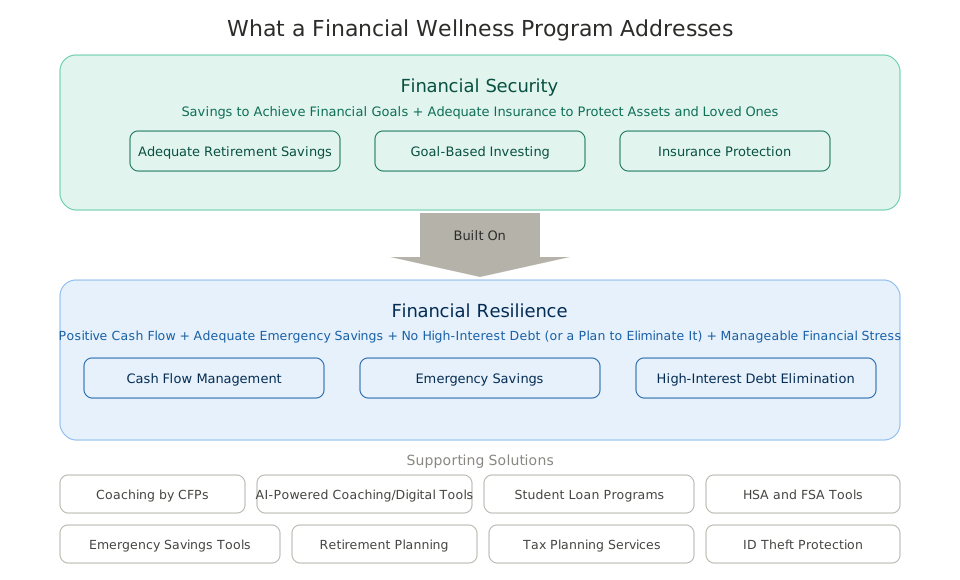
A financial wellness program helps employees build a stable financial foundation, reach long-term financial goals, and maximize the value of their compensation and benefits. At its core, it provides access to credentialed financial coaches, personalized guidance for real-life financial decisions, and practical tools—often including AI-powered coaching, financial calculators, and trusted educational content—to help employees take action. The most effective programs address both financial resilience, which is the ability to absorb financial shocks, and financial security, which is the ability to grow and thrive financially over time.

The two goals of a financial wellness program

A well-designed financial wellness program works on two levels simultaneously: helping employees withstand financial setbacks and helping them build toward lasting security.


Financial resilience: the foundation

Financial resilience means an employee can absorb unexpected financial shocks without falling into a crisis. Financially resilient employees have positive cash flow, a meaningful emergency savings cushion, either no high-interest debt or a clear plan to eliminate it, and manageable levels of financial stress.

Without this foundation in place, longer-term financial goals are nearly impossible to pursue. A coaching program that skips this layer and jumps straight to investment planning is putting the cart before the horse.

Financial security: the next level

Once resilience is established, the program shifts focus to financial security. This means having adequate savings to reach meaningful financial goals and appropriate insurance coverage to protect assets and loved ones.

Financial security looks different for every employee. For one person it means funding a child’s education. For another it means retiring at 62. For another it means buying a home. A strong program meets employees where they are rather than applying a one-size-fits-all approach.

What guidance looks like inside a financial wellness program

The guidance component of a financial wellness program answers the financial questions employees are actually asking. Questions like:

  • “How much should I have in an emergency fund?”
  • “Should I pay off debt or invest in my 401(k) first?”
  • “Am I taking advantage of all the benefits my employer offers?”
  • “When can I realistically retire?”

This guidance should come from credentialed coaches, such as Certified Financial Planner® (CFP®) professionals, who are trained to help employees understand their options and feel confident acting on them. When available and appropriate, live coaching should be coupled with well‑vetted AI‑powered coaching. Programs offered through Financial Finesse, for example, provide unlimited access to unbiased CFP® professional financial coaches (or in‑country equivalents) who combine financial expertise with emotional intelligence, as well as Aimee, a safe AI‑powered coach.

What solutions a financial wellness program includes

Guidance alone is not enough. Employees need resources to act on the coaching they receive. The solutions layer of a financial wellness program connects employees to tools and programs that help them execute. These solutions typically span several categories:

  • Cash and debt management: Resources for budgeting, managing cash flow, credit counseling, and structured plans for eliminating high-interest debt, including credit card debt and personal loans.
  • Savings programs: Emergency savings tools designed to help employees build a financial cushion, often integrated directly with payroll for automated contributions.
  • Student loan assistance: Programs that help employees navigate repayment options, refinancing decisions, and employer-sponsored student loan contribution benefits.
  • Retirement planning: Support for maximizing 401(k) contributions, understanding employer match structures, and planning for a sustainable retirement income.
  • Healthcare savings: Guidance on Health Savings Accounts (HSAs), Flexible Spending Accounts (FSAs), and how to use these tools to reduce out-of-pocket healthcare costs.
  • Insurance and protection: Help evaluating life, disability, and supplemental insurance coverage to ensure employees are adequately protected, along with identity theft protection resources.
  • Tax planning: Year-round guidance on tax-smart financial decisions, not just tax filing support.
  • Family and housing support: Resources covering dependent care benefits, childcare savings accounts, and guidance on major decisions like homebuying.

These solutions are not a checklist. What matters most is that employees receive guidance from a credentialed coach who helps them understand which solutions apply to their specific situation, and then connects them to the right tools to take action.

How the program is delivered matters

The most effective financial wellness programs are employer-paid benefits, meaning there is no cost to the employee at the point of use. When employees have to pay out of pocket to access financial coaching, utilization drops sharply, and the employees who need help most are often the ones least likely to reach out.

Delivery should be flexible. Employees need to access coaching on their schedule, through their preferred channel, whether that is a phone call, chat, or digital self-service. Multilingual and global delivery matters for employers with distributed workforces.

AI-powered tools are increasingly part of well-designed programs, helping scale access and personalization. Financial Finesse pairs AI-powered guidance with certified human coaches, so employees benefit from both the empathy, motivation, and judgment of a credentialed professional and the reach of technology.

FAQs:

What is the main goal of a financial wellness program?

To help employees build financial resilience, meaning the ability to handle financial shocks, and financial security, meaning the ability to reach long-term financial goals.

Who delivers the guidance in a financial wellness program?

Guidance should come from unbiased credentialed professionals such as CFP® professionals who have expertise in both financial planning and the emotional dimensions of financial stress and, when available and appropriate, well‑vetted AI‑powered coaching tools.

Is a financial wellness program just about retirement savings?

No. While retirement planning is an important component, a comprehensive program also addresses emergency savings, debt management, insurance, tax planning, healthcare savings, and other financial priorities employees face at every life stage.

How is a financial wellness benefit different from a financial advisor?

A financial advisor typically manages investments on behalf of clients and may have minimum asset requirements. A financial wellness benefit is an employer-paid resource available to all employees, focused on unbiased coaching and guidance across a broad range of financial topics rather than investment management.


Financial Finesse is the leading independent global provider of unbiased financial coaching as an employee benefit, driving measurable improvements in employee financial wellness and proven employer ROI. Employees receive unlimited access to CFP® professionals and AI-powered guidance that expands reach and personalization with trusted human oversight at every step.

2025 Workplace Financial Wellness in America: A Year in Review

April 16, 2026

On the surface, 2025 looked like a step backward. Financial Wellness Scores dipped to 4.72 and the share of employees reporting high or overwhelming stress rose to 26.8%, returning to roughly 2023 levels after a promising one-year recovery. But the headline is incomplete…

The Risks Of Employer Stock

February 09, 2025

One of the biggest risks lurking in people’s investments is having too much in a current or former employer’s company stock. What’s too much?

Rule of thumb

You should generally have no more than 10-15% of your investment portfolio in any single stock. It’s worth noting that an investment adviser can lose their license for recommending more than that.

More than just a stock when it’s your job

So why is this such a bad idea? What if your company stock is doing really well? Well, remember Enron, anyone? While it’s practically impossible for a well-diversified mutual fund to go to zero, that could easily happen with an individual stock. In that case, you could simultaneously be out of a job and a good bulk of your nest egg.

Now, I’m not saying your company is the next Enron. It could be perfectly managed and still run into trouble. That’s because you never know what effect a new technology, law, or competitor can have, regardless of how good a company it is.

Nor does the company have to go bankrupt to hurt your finances. Too much in an underperforming stock can drag down your overall returns, and even a well-performing stock can plummet in value just before you retire. As volatile as the stock market is as a whole, it’s nothing compared to that of an individual stock.

Why do we over-invest in our own companies?

So why do people have so much in company stock? There are two main reasons. Sometimes, it’s inadvertent and happens because you receive company stock or options as compensation. For example, your employer may use them to match your contributions to a sponsored retirement plan. Other times, it’s because people may feel more comfortable investing in the company they work for and know rather than a more diversified mutual fund they may know little about.

A general guideline is to minimize your ownership of employer stock. After all, the expected return is about the same as stocks as a whole (everyone has an argument about why their particular company will do better, just like every parent thinks their child is above average). Still, as mentioned before, the risks are more significant. That being said, there are some situations where it can make sense to have stock in your company:

When it might make sense to keep more than usual in company stock

1) You have no choice. For example, you may have restricted shares that you’re not allowed to sell. In that case, you may want to see if you can use options to hedge the risk. This can be complicated, so consider consulting with a professional investment adviser.

2) You can purchase employer stock at a discount. If you can get a 10% discount on buying your employer’s stock, that’s like getting an instant 10% return on your money. If so, you might want to take advantage of it but sell the shares as soon as possible and ensure they don’t exceed 10-15% of your portfolio.

3) Selling the stock will cause a considerable tax burden. Don’t hold on to a stock just because you don’t want to pay taxes on the sale, but if you have a particularly large position, you may want to gift it away or sell it over time. If you do the latter, you can use the same hedging strategies as above.

4) You have employer stock in a retirement account. This is a similar tax situation because if you sell the shares, you’ll pay ordinary income tax when you eventually withdraw it. However, if you keep the shares and later transfer them out in kind to a brokerage firm, you can pay a lower capital gains tax on the “net unrealized appreciation.” (You can estimate the tax benefit of doing so here.) In that case, you may want to keep some of the shares, but I’d still limit it to no more than 10-15% of your total portfolio.

5) You have a really good reason to think it’s a particularly good investment. For example, you work at a start-up that could be the proverbial next Google. It may be too small of a company for analysts to cover, so it may genuinely be a yet-to-be-discovered opportunity. In that case, go ahead and get some shares. You may strike it rich. But remember that high potential returns come with high risk so ensure you’ll still be financially okay if things don’t pan out as hoped.

The ups and downs of the stock market typically get all the media and attention. But your greatest investment risk may come from just one stock. So don’t put all your eggs in it.

What Is An HSA And Why Should I Participate?

February 09, 2025

An HSA is a type of tax-deferred account designed to help you save for your health care costs for current and future years. An HSA essentially works like an IRA for medical expenses. However, it differs from a Flexible Spending Account (FSA) in that money not spent in a calendar year can remain in the account to be used in future years – or retirement.

HSAs are only available to you if you have coverage through a qualifying high-deductible major medical health plan, referred to as an HDHP. If you can participate in an HSA, you should know these facts:

  • HSAs can be funded with pre-tax income up to certain IRS limits. The money can be withdrawn tax-free for qualified medical expenses, including prescription drugs.
  • You can reimburse yourself right away for qualified medical expenses, or at any time in the future, as long as your HSA was open when the expense was incurred. Just hold on to your receipts, bills, or explanation of benefits.
  • You can also make contributions directly to an HSA via deposit for the prior tax year up until the tax filing deadline (generally April 15th).
  • You may not contribute to an HSA if you are covered by a non-high deductible medical plan including Medicare, TRICARE, a spouse’s family plan, or an FSA or HRA (yours or your spouse’s, unless it is limited purpose).
  • The amount of your HSA contribution directly reduces your taxable income for federal tax purposes, and in most states (CA and NJ are exceptions), so you will pay tax on less income overall.
  • Any money not spent in the year contributed grows tax-free (for federal and most states) in the investment funds you choose, if an investment option is available.
  • If withdrawn for non-qualified medical expenses before age 65, the money will be taxed as ordinary income and will incur a 20% penalty as well. However, once you turn 65, the money may be withdrawn for non-qualified medical expenses without this penalty (only the taxes will be due).
  • HSA accounts may be transferred if you change employers, similar to a rollover from one 401(k) to another.

ACTION ITEMS:

1. Consider participating in an HSA if you want to save money by paying for qualified medical expenses with tax-free dollars or you are looking for other ways to save for retirement on a tax-preferred basis.

2. Be aware that a high-deductible health plan with an HSA may not be the best option for those who have ongoing medical conditions and treatments, or for those who do not have sufficient funds set aside to pay the higher out-of-pocket costs.

3. If you plan to defer much of your HSA balance until retirement, make sure to invest for the long term among the investment options available to you.

Why You Should Max Out Your HSA Before Your 401(k)

February 09, 2025

Considering that most employers are offering a high-deductible HSA-eligible health insurance plan these days, chances are that you’ve at least heard of health saving accounts (“HSAs”) even if you’re not already enrolled in one. People who are used to more robust coverage under HMO or PPO plans may be hesitant to sign up for insurance that puts the first couple thousand dollars or more of health care expenses on them, but as the plans gain in popularity in the benefits world, more and more people are realizing the benefit of selecting an HSA plan over a PPO or other higher premium, lower deductible options.

For people with very low health costs, HSAs are almost a no-brainer, especially in situations where their employer contributes to their account to help offset the deductible (like mine does). If you don’t spend that money, it’s yours to keep and rolls over year after year for when you do eventually need it, perhaps in retirement to help pay Medicare Part B or long-term care insurance premiums.

Not just for super healthy people

But HSAs can still be a great deal even if you have higher health costs. I reached the out-of-pocket maximum in my healthcare plan last year, and yet I continue to choose the high-deductible plan solely because I want the ability to max out the HSA contribution. Higher income participants looking for any way to reduce taxable income appreciate the ability to exclude up to IRS limits each year. It beats the much lower FSA (flexible spending account) limit.

Even more tax benefits than your 401(k)

Because HSA rules allow funds to carryover indefinitely with the triple tax-free benefit of funds going in tax-free, growing tax-free and coming out tax-free for qualified medical expenses, I have yet to find a reason that someone wouldn’t choose to max out their HSA before funding their 401(k) or other retirement account beyond their employer’s match. Health care costs are one of the biggest uncertainties both while working and when it comes to retirement planning.

A large medical expense for people without adequate emergency savings often leads to 401(k) loans or even worse, early withdrawals, incurring additional tax and early withdrawal penalties to add to the financial woes. Directing that savings instead to an HSA helps ensure that not only are funds available when such expenses come up, but participants actually save on taxes rather than cause additional tax burdens.

Heading off future medical expenses

The same consideration goes for healthcare costs in retirement. Having tax-free funds available to pay those costs rather than requiring a taxable 401(k) or IRA distribution can make a huge difference to retirees with limited funds. Should you find yourself robustly healthy in your later years with little need for healthcare-specific savings, HSA funds are also accessible for distribution for any purpose without penalty once the owner reaches age 65. Non-qualified withdrawals are taxable, but so are withdrawals from pre-tax retirement accounts, making the HSA a fantastic alternative to saving for retirement.

Making the most of all your savings options

To summarize, when prioritizing long-term savings while enrolled in HSA-eligible healthcare plans, I would strongly suggest that the order of dollars should go as follows:

  1. Contribute enough to any workplace retirement plan to earn your maximum match.
  2. Then max out your HSA.
  3. Finally, go back and fund other retirement savings like a Roth IRA (if you’re eligible) or your workplace plan.

Contributing via payroll versus lump sum deposits

Remember that HSA contributions can be made via payroll deduction if your plan is through your employer, and contributions can be changed at any time. You can also make contributions via lump sum through your HSA provider, although funds deposited that way do not save you the 7.65% FICA tax as they would when depositing via payroll.

The bottom line is that when deciding between HSA healthcare plans and other plans, there’s more to consider than just current healthcare costs. An HSA can be an important part of your long-term retirement savings and have a big impact on your lifetime income tax bill. Ignore it at your peril.

How To Choose A Healthcare Plan

February 07, 2025

Depending on the choices you have, choosing a healthcare plan can be frustrating – with different plans that have different structures and costs, how will you know which one is best for you and your family?

Start with any tools your employer offers

Your benefit provider may offer access to tools that help with this decision, so check for that as a first step for a more personalized answer based on the plan options available to you. It may be some type of quiz or interactive process that asks you to make a rough prediction of your anticipated healthcare needs – if you have a tool like that, definitely start there. Doing so won’t commit you to a particular plan, but it can help you narrow the options based on your answers.

Beyond using the decision support tools that may be offered, there are a few key things to consider. Here’s how to choose.

It’s all about balance

Big picture, choosing the best plan for you and your family comes down to whichever plan balances your personal healthcare needs with care that you can afford – no one wants to find themselves underinsured, but lots of people end up over-insuring. In some cases, that’s intentional – lots of people tell us they’d rather know they are covered just in case, and we can’t argue with that if you know the trade-offs you’re making. If instead you’re trying to find the best value without overpaying, it may require a little more legwork.

What are the premiums?

Before you start comparing the details of each plan, make sure you factor in this cost, which is the one thing you can count on spending no matter what for your healthcare. It can be tempting to choose the lowest premium, and if you expect to use your plan very little beyond preventive care services (which are covered 100% under most plans), then that may be all you need to consider.

If you think there’s any chance you’ll need to use your healthcare, then keep looking beyond the premium.

How does the coverage differ under each plan?

Make sure the plan you choose actually covers your needs. If you want to keep your primary doctor and other providers, make sure they are in-network so you don’t end up paying more for their services. See the extent to which any procedures or prescription drugs you’re expecting to need over the next year are covered as well.

A few more things to consider:

  • If you or a dependent have chronic health issues and one spouse has access to a plan with lower deductibles and co-pays, make sure that child or spouse is on that plan.
  • If you have traditionally had your entire family on one plan but both spouses have health coverage available, you should start looking into whether your doctors and providers are in the networks of both plans. If so, see if it may make sense to go ahead and put the spouses on different plans. Even if your company isn’t charging a premium for “covered” spouses, it may be less expensive overall to be on different plans.
  • As always, take a good look at any pending issues such as braces, lasik, etc. that are in your family’s future and plan accordingly.

How much might you have to pay out-of-pocket?

It’s important to compare the different ways you’ll share the costs of your care with your insurance company through co-pays, deductibles and coinsurance. You may also want to compare out of pocket maximums if you anticipate large expenses for the year. 

Is there an HSA option?

If you’re looking for a healthcare option that also offers the ability to save for future medical expenses, even into retirement, you may want to pay special attention to any HSA-eligible plans.

Why give Health Savings Accounts a look?

If your employer is contributing to your HSA, that’s free money that can help to offset your out-of-pocket costs since your employer is essentially putting some of that money into your pocket. (Your HSA is your money so you can take it with you when you leave or retire.) If you plan to contribute to the HSA, calculate how much you can save in taxes. (You can get the same tax benefit by contributing to an FSA for health expenses, but the contribution limits are lower and you probably won’t want to contribute as much since the FSA is mostly “use it or lose it.”)

A case study: how one mom chose her plan for her family

As a real-life example, one of our coaches worked with someone who was trying to decide between a traditional PPO plan with a $1,000 family deductible versus an HSA-eligible plan with a $2,600 family deductible. The coverages would have been similar for her, but she was concerned by potentially having to spend so much out-of-pocket to reach her deductible under the HSA plan.

When we factored in the premium difference, we found that the PPO plan premiums were an extra $49 a month or $588 a year. In addition, her employer was willing to contribute $2,000 to her HSA. So, by choosing the HSA-eligible plan, she would basically be saving $2,588, which turned out to be more than the difference in the deductibles. Even if she spent the whole $2,600, she’d still be ahead under the high deductible plan.

In addition, if she decided to contribute an additional $3,000 to her HSA, she would save another $720 in federal taxes at the 24% tax bracket (not including state taxes or the tax savings on any future earnings in the account).

Of course, your numbers will be different, and your decision may not be as simple based on other factors. The lesson here is that you need to consider all of the factors, not just the premiums and the deductibles.

Choosing the ideal plan

Choosing a healthcare plan is a highly personal decision and there’s no perfect way to go about the decision without a crystal ball to tell you how the year ahead will go. Definitely take advantage of any decision-support tools your employer is offering, then check that against other possible scenarios in your life.

There are things you can anticipate such as braces, ongoing treatments or childbirth, but even the best laid plans can go awry with your health. The ideal plan for you is the one that covers the most likely scenarios you and your family will encounter without paying too much for coverage you don’t need.

Why You Should Treat Your HSA Like An IRA

February 07, 2025

Would you raid your Roth IRA or 401(k) to pay for car repair bills? I suppose if you have no other choice, you might. But ordinarily, we want to use our tax-advantaged retirement accounts only as a last resort because we want that money to grow tax-free or tax-deferred for as long as possible.

The HSA is the only account that allows us to make pre-tax contributions and withdraw them tax-free. Why then are we so willing to tap into our HSAs for medical expenses?

Making the most of your HSA

Yes, there’s no tax or penalty on those withdrawals since that’s what they’re meant to be used for. But HSAs can also be a tax-free retirement account since the money grows to be tax-free if used for medical expenses at any time, including retirement.

Since there’s a pretty good chance you’ll have some health care costs in retirement, you can count on being able to use that money tax-free. (If you keep the receipts for health care expenses you pay out-of-pocket, you can also withdraw that amount tax-free from the HSA later since there’s no time limit between the medical expense and the withdrawal.) You can also use the money penalty-free for any expense after age 65, although it would be taxable just like a pre-tax retirement account.

An example

Let’s say you contribute $3k per year to an HSA and don’t touch the money for 30 years. If you just earn an average of 1% in a savings account, you will have over $105k. But if you invest that $3k each year and earn a 7% average annual return, you’ll end up with over $300k or almost 3 times as much!

That’s why I recently decided to take advantage of our company’s switch to a new HSA custodian by transferring my HSA funds from a savings account to an HSA brokerage account. Since I don’t intend to touch this money for a few decades, I can invest it more aggressively and hopefully earn a higher rate of return. In the meantime, I’ll just pay my health care costs out of my regular income and savings.

Take care with any fees

One little hiccup that I noticed is that my custodian charges a $3 fee for the brokerage account if I don’t keep at least $5k in the savings account. At first glance, it’s tempting to keep $5k in the savings account to avoid that fee but the $36 a year in fees is only .72% of the $5k. That means if I can just earn more than an extra .72% in the brokerage account, I’ll be ahead. Given historical returns, I think that’s a pretty good bet.

Guidelines for making the most of your HSA

Here are some guidelines to make the best use of your HSA:

  1. First, make sure you have an adequate emergency fund to cover health care expenses. If not, ignore everything in this blog post until you do.
  2. If you have the option of a health care plan with an HSA, consider getting it. The premiums are lower so you generally save money in the long run if you’re in good health.
  3. Try to max out your contributions. (If you do it through payroll deductions into a section 125 cafeteria plan, you can also avoid FICA tax on the contributions). Aside from getting the match on your 401(k) and paying off high interest debt, this is generally the best use of your money because  the contributions are both pre-tax and can be withdrawn tax-free (for health care expenses).
  4. If you have a brokerage option, invest as much of your HSA as you can in a portfolio that’s appropriate for your time horizon and risk tolerance. (Make sure your expected returns justify any fees you may have to pay.)
  5. Don’t touch your HSA money unless you absolutely need to. Instead, use your regular savings (see #1) to cover medical expenses.
  6. Keep the receipts for any health care expenses you pay out-of-pocket since you can withdraw those amounts from your HSA tax-free anytime.
  7. Have tax-free money to help cover health care expenses in retirement!

How We Are Deciding Which Spouse’s Insurance Plan To Use

February 06, 2025

My husband recently changed careers and is starting with his new employer at the end of this month. We’re all very excited about the transition as a family, but we have a very important decision to make: are we going to stay covered under our current health insurance plan that I have through work or are we going to move over to his plan? Or should the kids join my husband on his plan while I stay on my own? Decisions. Decisions.

How do you decide whose health insurance to use?

When both partners have benefits through work, it’s a good idea to re-examine your family coverage each year. Here are some of the things that we are considering as we decide which benefits to choose. These questions might trigger some points that are important to you and your family as well as you make your decision whether to stay put or move on to your spouse’s plan:

Questions to ask

  1. Are our current doctors considered in-network under my husband’s plan (especially the kids’ doctors)?
  2. Do my husband and I like the primary doctor options who fall in-network under his plan?
  3. If my husband has employee-only coverage at work, does his employer cover his monthly premium? (mine does)
  4. How do the monthly premiums and deductibles compare to what’s available under our current plan?
  5. Once we hit the deductible, how much is our coinsurance (the percentage we are responsible for paying)?
  6. Is a high deductible health plan (HDHP) an option with his employer and how much, if anything, does his employer contribute to a health savings account on his behalf?
  7. Are there any upcoming specialists we’ll need to see? Surgeries any of us will need? If so, are they covered? And how much would we be responsible for paying?
  8. Are there any specific medications we know we’ll need that are not covered under my husband’s plan?

These are some of the things we’ve started to consider. Thinking through your situation and coming up with your list of questions like these, or points that you want to be sure you address, will help you choose the coverage that best meets your needs. Be sure to break down the costs and compare apples to apples when choosing the right health insurance plan and steer clear of common mistakes that are often made during enrollment.

When you need to switch mid-year

It’s important to note that our decision happens to fall during my open enrollment period at work, but if it were outside of my company’s open enrollment period, my husband’s change in employment status (and thus his new eligibility to be covered under a health plan) would be considered a qualifying life event and we’d have a short time frame (typically 30 days) to make changes to our health plan.

Think Tank Research Best Practices

June 03, 2024

In our Workplace Financial Wellness in America report, we saw a substantial increase in the percentage of workers
who said they were experiencing high or overwhelming levels of financial stress…

Workplace Financial Wellness in America: A Year in Review

May 31, 2024

Abstract:

Looking back, 2023 was a year of two opposing stories—and two different economies. For investors, stock market gains helped propel savings balances to levels not seen for several years. By contrast, financially vulnerable workers continued to feel the economic pressure of persistent inflation and higher federal interest rates. These factors have a tremendous impact on financial resilience and retirement preparedness, as well as financial stress levels. Given the strong relationship between financial stress and job satisfaction, mental and physical health, and productivity, the argument for offering financial coaching that helps American workers improve in these areas remains clear.

To read the full Report, download now.

  • Download

2022 Workplace Financial Wellness in America: A Year in Review

May 23, 2023

Abstract:

The state of financial wellness of the U.S. workforce fell in 2022 as high inflation and economic uncertainty raised employee financial stress to levels not seen since the Great Recession. The rise in financial stress has contributed to declines in overall wellbeing as self-reported mental and physical health have fallen to their lowest points in two decades. Employees that engaged in their financial coaching benefit made substantial improvements in financial behavior; those that engaged with a live financial coach fared even better than those that engaged exclusively with a virtual financial coach. Working with employee resource groups (ERG) to deploy financial coaching benefits tailored to minority experiences has proven to be effective at increasing employee engagement and improving financial outcomes.

To read the full Report, download now.

  • Download

Race and Financial Stress Special Report

October 25, 2022

Executive Summary:

The racial wealth gap in America has garnered much attention as part of the fight against social injustice. It is highly encouraging to see many of our partners that have not only publicly pledged their support in this fight, but are actively searching for ways to make tangible headway within their organization. Many are leaning on their financial wellness benefits to do just that, as they understand that improving the financial wellness of their most vulnerable employees will, over time, drive results in this quest for financial equity amongst the races.

In this special report, we’ll explore:

  • The current racial disparities in financial wellness
  • What role income plays in these disparities
  • How financial wellness is successfully driving improvements to narrow the gap
  • Ideas on how to improve financial wellness disparities within your organization

To read the full Report, download now.

  • Download

2021 Financial Wellness Year in Review: A Q&A with Financial Finesse founder and CEO, Liz Davidson

June 20, 2022

Abstract:

This Q&A is designed to provide quotable commentary on Financial Finesse’s 2021 Financial Wellness Year in Review.

To read the full interview, download now.

  • Download

2021 Financial Wellness Year in Review

June 20, 2022

Abstract:

Workplace stress has risen steadily for over a decade, and with the help of a global pandemic has reached a tipping point in 2021. Workers are increasingly expecting more support from their employers, and they are willing to change jobs to get it. To compete for talent, employers must shift their approach to benefit design and corporate culture to accommodate the new workforce. This report examines the divergence in financial wellness priorities that is signaling a shift in the employer-employee relationship and offers guidance for how employers can handle this workplace revolution.

To read the full Report, download now.

  • Download

2020 Financial Wellness Year in Review

May 25, 2021

Abstract:

The state of financial wellness of the U.S. workforce improved in 2020 despite the economic challenges created by the COVID-19 pandemic. The greatest improvement occurred in the areas of cash flow, debt management, and homebuying. Employees that maintained a handle on cash flow and an emergency fund prior to 2020 fared best during the pandemic, leading many employers to add financial resiliency to their list of key focus areas in 2021. As concern for racial financial equity and equality grows, we expect to see more emphasis on diversity and inclusion (D&I) in workplace financial wellness initiatives in the coming years.

To read the full Report, download now.

  • Download