
How to Teach Financial Adulthood

September 12, 2016

Sex education is required in public schools – and financial education should be as well, wrote CNN journalist Heather Long in a popular article recently. “The American Dream isn’t possible without understanding how to save, invest and use debt wisely,” she noted, “Yet we mostly leave it up to people to figure what to do with their money on their own.” Certainly anyone who’s tried to figure out what health insurance plan is best for them, is struggling with paying off student loans or saving for retirement, or tried to decipher the fine print of a credit card disclosure can attest that they were less than ideally prepared for the labyrinth of modern financial decisions.

While Long isn’t the first person to write about this important issue, the fact that she conflated money and sex ed helps raise the profile of an essential debate. Whose responsibility is it to provide financial education – schools, parents or both? What are the essential financial skills needed for adulthood?

Long writes that, “The reality is rich kids tend to be a lot more financially literate than working class kids. Wealthy kids learn about money at home — or at their private schools. Poor kids do not. It’s yet another reminder why the “friends and family” plan to learn about money is so flawed.”

I think she’s painted way too rosy of a picture. Most Americans, regardless of economic status, feel underprepared to navigate the complexity of financial responsibilities they must shoulder in the 21st century economy. As a nation, we are still a long way from having some kind of uniform financial education that builds financial capability and prepares kids for the economic realities of adulthood. The Common Core state standards adopted by 42 states do not specifically incorporate financial literacy (although certain math standards do have practical applications).

If you’ve got kids, you cannot afford to wait while society tries to figure this out in terms of public policy. The financial and economic world is only becoming more complex. What can parents do right now to promote financial education at school at and home?

Understand what it means to be financially literate

The non-profit Council for Economic Education has developed National Standards for Financial Literacy, a framework for teaching personal finance in kindergarten through 12th grade. The idea is that a young adult who has mastered these elements has a much better chance of making solid decisions about money and to understand the trade-offs between different choices they will face in their financial lives. The standards cover the basics of:

  • Earning Income
  • Buying Goods and Services
  • Using Credit
  • Saving
  • Financial Investing
  • Protecting and Insuring

The CEE has created lessons teachers can use in the classroom. However, you don’t have to be a classroom teacher to benefit from reading and understanding these standards. Parents can download the standards here and use them as a guide for evaluating your children’s financial capabilities and pinpointing where they could use some extra learning opportunities. Additionally, share them with your school principal and your children’s teachers, including the CEE’s suggestions on learning exercises by grade, which correspond to Common Core standards for language arts and math.

Chances are, if you are reading a financial wellness blog, you already have a good handle on the six categories contained in the standards. However, if you find that some are trouble spots for you, consider putting some attention into improving your own financial literacy. The best place to start is your employer, which may have a workplace financial wellness and/or retirement planning education program that you can participate in with workshops, webcasts, online resources and/or one-on-one coaching. There has never been a better time in history to be a student of personal finance. Free resources are everywhere, including helpful personal finance education sites like the AICPA’s Feed the Pig, FINRA’s The Alert Investor and the Khan Academy, just to name a few.

Don’t assume school-based financial education is enough

According to the CEE’s 2016 Survey of the States, only 17 of 50 states have mandated personal financial education courses for high school students, and only 5 of them require at least a semester of personal finance basics. That’s not nearly enough. Entering adulthood without adequate financial education can often lead to unwanted debt and overwhelming financial stress. According to Financial Finesse’s 2016 Financial Stress Research, 85 percent of employees surveyed reported some level of financial stress, and one in four (25 percent) reported experiencing unmanageable (high or overwhelming) financial stress levels.

Just like with sex education, the best way to communicate financial information to your children is to share your values in an age-appropriate way. This is something that should happen throughout your child’s growing up years. Be open about the financial decisions you make every day and spend time as a family talking about money and the economy. As a basic guide, try New York Times’ columnist Ron Lieber’s book about raising financially savvy kids, The Opposite of Spoiled: Raising Kids Who Are Grounded, Generous and Smart About Money. There are also many online resources with age-appropriate personal financial games and lessons, such as kids.gov, the Consumer Financial Protection Bureau’s Money As You Grow and practicalmoneyskills.com.

Does your school district have a financial education program? If yes, what do you think of it? Email me at [email protected] or follow me on Twitter @cynthiameyer_FF.
 

Five Fantastic Summer Money Reads

July 11, 2016


image

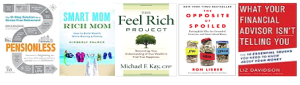
What if you headed to the beach this summer with a great book that could change your life? Would that be worth a few afternoons of reading (especially if you’ve got your feet up, drinking the beverage of your choice)? I am a voracious reader of finance books, some for the blog and some just for my own learning. Many of them just rehash the same old content – not the books on this list! Consider stocking up on some of these perspective-changing, personal finance page-turners for the summer months:

Pensionless: The 10 Step Solution for a Stress-Free Retirement

Before I picked up U.S. News and World Report editor and columnist Emily Brandon’s excellent book to read, I was struck by the title, Pensionless: The 10 Step Solution for a Stress-Free Retirement. That term, “pensionless,” summarizes exactly where millions of Baby Boomers and Generation Xers find themselves in the age of disappearing defined benefit plans and having to shoulder the entire burden of saving for retirement. Brandon breaks down this elephant into bite-sized pieces, with a chapter each on the ten most important steps to funding a secure retirement and avoiding actions that could blow up that security. Her journalist’s eye for making it clear and simple serves the reader well, particularly her guidance on Social Security and Medicare. Follow her guidelines, and while you may still not have the endangered species of the company-provided pension, you’ll have a solid retirement nest egg.

Smart Mom, Rich Mom: How to Build Wealth While Raising A Family

The other day we received a glossy, die cut, colorful solicitation from a global insurance company informing us of their comprehensive homeowner’s insurance for fine homes. Did my husband want a complimentary lifestyle and insurance review? Wait a minute! We own this home together. Why did the insurance solicitation address him independently?

There’s still the assumption that men make the important financial decisions. In her new book, Smart Mom, Rich Mom: How to Build Wealth While Raising A Family, financial journalist Kimberly Palmer turns that assumption upside down. Her no-nonsense, funny personal finance guide for moms offers wisdom for women in every life stage.

This is, in many ways, a book about being in a relationship while navigating both your personal and your family economy without losing yourself. Palmer takes on some tough subjects with wit and humor, like how couples can split up financial responsibilities, the terror that can accompany a choice to be a stay-at-home parent, and the pull of saving for your children’s college while you are also saving for retirement. Each chapter includes useful action steps to put your decisions into practice.

Feel Rich Project: Reinventing Your Understanding of True Wealth to Find True Happiness

Financial Life Planner and columnist Michael F. Kay, CFP® is out to inspire you to feel rich. He believes that if you feel truly rich, e.g., your actions are aligned with your deepest values, you’ve got a much more realistic shot at setting the right financial goals for you – and knowing when you achieve them. Unlike so many financial authors who offer you the money version of a fad diet book, Kay dives deeply into the way personal beliefs and values drive financial behavior. The Feel Rich Project: Reinventing Your Understanding of True Wealth to Find True Happiness offers 10 chapters of thought-provoking exercises designed to uncover and reboot your beliefs about money. This book is best accompanied with a blank notebook and a good pen, as you write your way to your true north.

As I write this post, my eight year old son is looking over my shoulder, begging me for a new pair of $80 Steph Curry high top sneakers because, “everyone is getting new shoes for the end of the school year.” He’s eight! I’m not surprised, though. Our kids face a tsunami of consumer messages that tell them they must buy something now.  How can parents keep materialism at bay?

The Opposite of Spoiled: Raising Kids Who are Grounded, Generous and Smart About Money

New York Times columnist Ron Lieber, a parent himself, has written a practical guidebook for teaching kids about money and values, The Opposite of Spoiled: Raising Kids Who are Grounded, Generous and Smart About Money. In it, he takes on modern parenting behaviors, such as giving extravagant tooth fairy gifts or discouraging teenagers from working, as ways parents inadvertently give their children messages which undermine their financial success as adults. Lieber covers everything your kids are asking about: allowances, designer clothing, part-time jobs, cell phones, birthday parties, etc. in a witty and approachable way.

If you’ve got kids or are thinking of having them, The Opposite of Spoiled will change the way you think about your own money habits and what you’re teaching your children. As for my son, the answer on the sneakers was no (despite my admiration of Curry’s talent). He’ll have to save for them on his own with his allowance.

What Your Financial Advisor Isn’t Telling You: 10 Essential Truths You Need To Know About Your Money

Did you know that with a modest income, you could become an automatic millionaire by taking full advantage of your employee benefits at work or that your choice of partner is the most important financial decision you’ll ever make? In What Your Financial Advisor Isn’t Telling You: 10 Essential Truths You Need To Know About Your Money workplace financial wellness pioneer and our Financial Finesse CEO Liz Davidson shares ways to find your own financial security, maximize your employee benefits for your unique situation and practice financial self defense. The book comes with a companion website, where you can find the resources cited in the book, as well as ways to join the Financial Independence Day Community and create your own peer-to-peer learning group.

What’s your favorite summer money read? Send me your suggestions at cynthia.meyer@financialfinesse .com. You can also tweet them to me @cynthiameyer_FF.