
Why You Shouldn’t Be So Obsessed With Your Credit Score

September 27, 2017

I saw a headline recently about how to get your credit score above 800 that really had me shaking my head. My first thought was, “Who cares?” It’s true that a good credit score is essential to obtaining the best rates when borrowing to buy a home or a car, but it’s definitely not the end-all, be-all that a lot of young people seem to be obsessing over.

Once your credit score is over 750, you pretty much qualify for all the best rates anyway. Working to take it higher is really more about perfectionism or competitiveness that won’t really offer you any financial perks that you don’t already have. In fact, I’ve seen too many people actually hurt their financial situations in an effort to increase their score.

Your credit score is only a measure of one part of your financial wellness.

Great credit, bad finances

I remember working with a woman who was drowning in debt. She was scraping by to make her minimum payments and couldn’t pay her bills without using her cards, but her credit score was still pretty good because she was paying on time and hadn’t maxed out any cards. When I suggested she enter credit counseling to get it under control, she balked.

Credit counseling would be a ding to her credit score and she needed to keep that up so she could get more credit. I felt helpless. Keeping her score up was more important to her than addressing the thousands of dollars she was losing to interest each year and there was nothing I could show her that would change her mind.

Great finances, bad credit

On the flipside, I have a friend who has zero debt, a fully-funded emergency fund and is on track to retire, but he has a terrible credit score because he has avoided debt and has no real credit history.

The wrong way to compare

If you were to compare the financial wellness of these two people based on credit score alone, you’d get a completely wrong picture. It’s kind of like the thin person who looks super healthy but has high blood pressure, cholesterol issues and vitamin deficiencies. Keeping your weight down is just one component of good physical health.

Your credit score is simply a measure of your ability to pay lenders back when you’re supposed to. If you’re planning to borrow money soon, then it’s something to be worried about. But if you have no plans to buy a home, finance a car, go back to school on a loan or apply for any other type of credit, don’t worry about it so much.

What you should focus on instead

Generally speaking, the people that tend to obsess over their credit score are doing so because it’s something concrete they can measure. It’s just like getting on the scale each Monday morning to assess the weekend’s damage. But there are better ways to track your overall financial wellness that are much more likely to get you to financial independence.

Tracking your financial wellness by net worth

I used to focus on my total debt as a measurement of my financial wellbeing, but that can be a little depressing. It also wasn’t considering the fact that I was increasing savings in other ways so I started tracking my net worth instead, which has been incredibly motivating.

How to find your net worth

Your net worth is all your assets (savings, retirement accounts, home, car, etc.) minus all your liabilities (credit cards, student loans, mortgage, car loan, etc.). If you’re just getting started in life, chances are you have a negative net worth, but that’s ok. As long as it’s growing each month, you’re good.

High income does not always mean high net worth

Remember when Kanye West asked Mark Zuckerberg for a loan and we all pointed and laughed at the extravagant lifestyle he lives? He may have been asset rich, but he was also liability rich. He had a negative net worth. Your net worth is the ultimate measure of your financial wellness and your goal should be to increase that number, month over month.

If you can get your net worth up while also paying your bills on time, chances are you will have a decent credit score by default, although I once unfollowed an NFL player on Twitter for tweeting about paying his cable bill late “just for fun.”

Having a high income and a lot of money in the bank doesn’t a good credit score make (in fact, neither of those factors affect your score at all), but concentrating on keeping more of the income you make and paying back more of what you owe is bound to help you achieve financial freedom. Isn’t that ultimately what we’re all after anyway?

This post was originally published on Forbes, July 2nd.
How’s Your Financial Life?

January 06, 2017

With today being my first post of 2017, it’s a great time to spend an hour or two over this weekend looking back at the year that was and looking forward to the year that is just starting. I have an annual tradition that I started long ago and will continue for as long as I am lucid. Feel free to use my annual process as a starting point, tweak it, and make it your own.

Each year, I put together a quick “How’s my financial life?” spreadsheet. I only need a few reference sources and in less than 30 minutes, I feel like I have a much clearer understanding of where I stand financially. Along the top of the spreadsheet, I list the year and on the vertical (Column A), I list the things I want to measure annually. Here are the things I measure and where I find the information:

Total Assets – I use this Financial Organizer. The goal is for this to increase each year.  Tracking the dollar and percentage increases are things I’ve added to my simple spreadsheet over time.

Total Debt – This is also found on the Financial Organizer. The goal is for this to decrease annually and eventually get to $0!

Net Worth – This is simply the total assets minus total debt. An increasing net worth is my primary financial goal each year.  This is another thing I track in dollar and percentage terms.

Annual Income – I use my last pay stub of the year. This is a number that should go up each year and if it doesn’t – that could be a warning sign. Or it could mean that you’ve happily retired or downsized your work stress level.

Estimated Mortgage Payoff Date – I pay a bit of extra principal with each payment and at year end, my mortgage company can calculate when the mortgage will be paid in full at my current level of extra principal payments. You can also build this yourself with an “amortization calculator.” (If you Google that term, you’ll find a bunch of them). This is important to me because when my mortgage is paid off, I’ll consider myself financially secure. At that point, my embedded cost of living will be property taxes, insurance, utilities, food and fun.

401(k) Balance and 401(k) Contributions for the Year – For the contributions, I need my last pay stub for the year and for the balance, I can either log on to the website of my 401(k) provider or quickly check Mint for my balance. Each year, I enjoy seeing the balance go up! (I wasn’t so happy with this back in 2008, though.)

Savings Balance – This is one I like to track in order to make sure I have an adequate emergency fund. I enjoy seeing it go up, although it took a big step backward last year because I used a chunk of savings as the down payment on a house. So while I wasn’t ecstatic when I saw that the balance went down, I understand why it did and will work to build it back in short order.  I can check this balance in Mint while I get my 401(k) balance, so locating the info is the easiest part of the job.

Life Insurance Death Benefit – I check this each year to ensure that should this be my last year on the planet, my mortgage can be paid off, my kids’ college can be handled without loans and there could be something left over for them to have a little head start in life, along with a few of my favorite charities getting a few bucks to do the great work that they do. I have to check a file in my desk to make sure that my information is up to date. We had a change in benefits at work and I replaced one policy with another last year so this is a data point that is in flux.

Date of Last Will Update – This is another item that I need to look in my desk drawer files to confirm. Looking at it this year, I’m probably due for an update. The last update of mine was almost 10 years ago, right after my ex-wife and I separated. (It’s amazing how quickly a decade can fly by when you’re having fun!) Hitting the 10 year mark or a significant life change are my triggers for updating this important document, along with my powers of attorney and healthcare directives.

Those are the data points that I can put together in the time that it takes me to watch one college basketball game. (Hey, it’s nice to have a pleasant distraction while working on your financial life.) So pick a game to watch and get busy.

3 Numbers That Matter More Than Your Credit Score

June 22, 2016

While knowing your credit score and the elements that impact it is important to your overall financial well-being, I sometimes find that people are overly concerned about it at the peril of other more important financial measurements. Your credit score only really matters when you’re applying for a loan, certain types of insurance and increasingly, when applying for a job. If none of those things are on your horizon, then your score is more like your high school ACT scores – perhaps a point of pride, but pretty irrelevant for the time being. Here are three more important numbers you should be focused on instead:

Net Worth

What is it: Assets (bank accounts, investments, home, car – basically cash or anything you could turn into cash) minus liabilities (credit card balances, car loans, student loans, mortgages, 401k loans – anything you owe).

Ideal number: As high as possible.

Why it matters: Your net worth is the ultimate measure of your ability to weather financial storms and maintain financial choices in life. The higher your net worth, the more financial freedom you can afford. There are countless cases of people who were millionaires on the asset side but broke on the net worth side as cautionary tales of neglecting this important number. Many of these people suffered during the last recession when their debts were called.

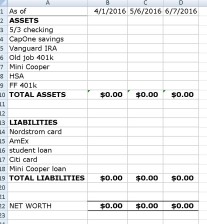
How to track it: I calculate my net worth on a monthly basis using Google sheets at the same time I sit down to set up any bill payments for the month. Here’s a snapshot of what it looks like:

Net worth snapshot

One nice side effect of this is the fact that I’m checking on all of my accounts at least once a month, so I can also do a quick check for anything fishy.

Worth noting: I pay all my credit cards off each month, but I include them on this sheet because that’s money I still owe that is reflected in my checking account above. It’s the only way to have a truly clear picture of what I have. I keep things like my student loan and Mini Cooper loan on there both for historical accuracy as well as for the psychological thrill of seeing a big fat ZERO under old debts. It’s a little, “Yay me! Look how far you’ve come!” moment each month.

Retirement Readiness

What is it: The best way to measure whether you’re saving enough to retire comfortably when you want to, especially if you have many years to go until retirement.

Ideal number: On track to replace about 80% of your current income, unless you’re within 5 years of retirement (when you can be more specific about how much you’ll need each year).

Why it matters: Retirement, which really just means transitioning to living off your savings one day, is one financial goal that pretty much all of us share. Whenever anyone asks me what to do with extra money or if they can afford to take on an additional debt payment or savings goal, my first question is, “are you on track for retirement?” Even though it may be one of your longest-term goals, it should be in the top 3 in terms of priorities.

How to track it: There are countless calculators out there, but for people with a 401k or other workplace savings plan, I prefer this Retirement Estimator.

Worth noting: Many people who say they aren’t on track to retire have never run a calculator. Knowing is the first step!

Emergency Fund

What is it: A cash cushion in place to tap into in case of an unexpected loss of income due to job loss or extended illness or injury.

Ideal number: 3 months of expenses, minimum. For single income households or career fields that aren’t as certain, at least 6.

Why it matters: Life happens and when it does, having cash that’s easily accessible takes away much of the financial stress and allows you to focus your energy on finding a job, healing or adjusting to the new normal.

How to track it: If you’re starting from zero, start with a goal of setting three months of rent or mortgage aside. Then tack on three months of your next highest expense and so on until you have all essential expenses covered. Once you’re at three months, make sure you adjust for any changes such as a new home, new baby, etc.

Worth noting: It can be tempting to keep a credit card on hand instead of the cash or want to invest the cash for higher earnings, but resist. Should something happen, consider the probability that it could be due to an economic downturn when credit may not be as easily accessible and/or the stock market could be down. The best place for your emergency fund is in a high yield savings account.

These are the three numbers you want to focus on. Even if you’re not at the ideal numbers yet, you’ll be well on your way to financial freedom if you can find a way to track them on a consistent basis. And you just may find your credit score improving as well.

Is Your Financial Plan Too Complicated?

August 17, 2015

I am a big fan of the KISS principle when it comes to having a written financial plan.No, I don’t mean the Paul Stanley and Gene Simmons version of KISS. (Although I’m a big fan of Rock & Brews every time I’m out in El Segundo, California.) I mean Keep It Simple Stupid (or keep it simple smarty-pants if the word “stupid” is deemed offensive in your household). Continue reading “Is Your Financial Plan Too Complicated?”

Your 4 Week Financial Check-Up Challenge: Week 1

May 18, 2015

Live – Plan – Thrive!!! That is the simple and straightforward mantra that I use to explain the financial life planning process. When it comes to getting and keeping others engaged in the financial planning process, the biggest challenge isn’t usually related to financial knowledge. It’s a general lack of planning. As the old saying goes “people don’t plan to fail, they fail to plan.” Continue reading “Your 4 Week Financial Check-Up Challenge: Week 1”

Before the Ball Drops

December 30, 2014

New Year’s Eve is a time to reflect on the past and ponder your future, but many of us spend more time planning how we will be celebrating on the last night of the year instead of planning ahead on how to achieve our New Year’s resolutions.One of the most common resolutions is to improve financial well-being, either by saving more or paying down debt.  So before you head out tomorrow night, reflect on your financial past by taking the time to calculate your net worth so you know where you stand as we head into 2015. Continue reading “Before the Ball Drops”

Is Your Financial Life a Thriller?

June 13, 2014

I have heard a lot of people say jokingly that they wish they had the financial resources of a random famous person. Take Michael Jackson. Houses, cars, amusement parks in his backyard, animals galore…he seemingly had it all from a financial wherewithal standpoint.  Continue reading “Is Your Financial Life a Thriller?”

I Don’t Even Know Where to Start!

May 23, 2014

I just got a new laptop and had to figure out what to do with all of my old files, work and personal, along with music, photos, and video. It was a chaotic mess.  There was my old personal laptop, my old work laptop, an old desktop and an iPad all in one corner.  It was like the land where technology goes to die.  I wasn’t totally sure how to manage the craziness that had become my tech life.  Continue reading “I Don’t Even Know Where to Start!”

Is Your Financial Plan on Track?

April 15, 2013

Are you making progress in your financial life or are you simply trying to keep the train on the tracks when it comes to managing your personal finances? We track the financial well-being of employees in the workplace on a quarterly basis and it is obvious that not everyone out there feels that their financial life is on track. In our 2012 Year in Review research report, retirement preparedness remains a significant concern with only 17% of employees knowing their on target to reach their retirement income goals. Financial stress also remains a potential problem with 82% of the employees participating in the workplace Financial Wellness Assessment reporting some degree of financial stress.  Continue reading “Is Your Financial Plan on Track?”