
The Hidden Secret To Finding The Best Mutual Funds

July 31, 2017

How do you evaluate the tsunami of information you find when you’re trying to pick the best mutual fund for your portfolio? Even if you’ve narrowed down your choice so you know what type of fund (index fund vs. actively managed, large cap vs. small cap, growth vs. value, etc.) there are still hundreds of choices available.

Should you pick the fund that did the best last year, or over the past ten years? My colleague Kelley addressed this already and the answer is a firm no. When my financial planner calls me to recommend a fund, she does this all the time and it drives me bananas. I tell her that’s like looking in the rear view mirror while you are driving.

There’s a better way to evaluate. The key is to look for one simple number, the Sharpe Ratio.

How much return would you have gotten for the risk you took?

The higher a fund’s Sharpe ratio, the better the fund did, adjusted for risk. And by risk, I mean the risk that the price could fall (you won’t care if the fund goes up more than expected, right?) The Sharpe Ratio tells whether the fund manager makes wise decisions  – what to buy, how much of it, and when to sell it – and how much risk they were willing to take with someone else’s money. Did they bet the farm on a few stocks, risk a lot and get lucky (or not), or did they have good returns without too much risk?

You can use the Sharpe Ratio of an index fund in that fund category to see what the average risk is, then compare. For example, if the 10 year Sharpe Ratio of the index is .54, but an actively managed fund in same category for the same period is .78, you’ll know the fund may worth considering. If another fund in that same category only has a Sharpe Ratio of .15, for example, you should walk away from it. Keep in mind that most actively managed funds do not beat an index fund consistently over time (if you’re into math, see here for the research), so this is a simple way to separate the better ones.

Make sure it’s calculated net of fees

You have to compare apples to apples. It doesn’t help much if an actively managed fund beat the index by 1.5 percent if the fees are also 1.5 percent. Make sure the fund’s Sharpe Ratio is after fees, not before.

Where to find the Sharpe Ratio

The Sharpe Ratio is easy to find on most mutual fund ratings, such as Morningstar and Lipper (if you have a brokerage account, you may be able to download longer Lipper profiles there). You can also generally find it in the fund’s prospectus, although you’ll have to dig through a lot of legalese to get there.

In my opinion, after decades as an investment adviser, the Sharpe Ratio is by far the best measure of a mutual fund when you’re trying to choose among several with similar objectives. All the other stuff is generally just fluff.


Want more helpful financial guidance, delivered every day? Sign up to receive the Financial Finesse Tip of the Day, written by financial planners who work with people like you every day. No sales pitch EVER (being unbiased is the foundation of what we do), just the best our awesome planners have to offer. Click here to join.
Why is an Index Important in Investing?

May 22, 2017

Everywhere you turn, you hear or read personal finance experts advocating the use of index funds in your portfolio. Employees often call our Financial Helpline asking if their 401(k) funds are index funds or wondering what exactly an index fund is and how to pick the right one for them. They also ask how they can know if their mutual fund is performing well. The key to both is understanding indexes.

An index is a statistic

An index is a statistic measure of change in the prices of major groups of stocks or bonds which represent an area of the overall market. In investing, indexes are used as a guide to constructing portfolios, and to set a starting point (benchmark) and measure portfolio performance over time. Indexes are usually capitalization-weighted, meaning that the largest companies have the most influence on the index. Common indexes like this include:

  • The S&P 500®, which includes 500 large companies in a market capitalization weighting, and is widely viewed as a benchmark for the U.S. stock market. If you’ve got a “large company growth fund” in your retirement account, it’s likely its performance will be compared to the S&P 500. You can track the index by entering symbol SPX.
  • The NASDAQ Composite Index includes all the stocks which trade on the NASDAQ market. It includes a lot of technology companies, but isn’t limited to them. You can track this by entering symbol IXIC.
  • The Russell 2000 Index includes 2,000 small companies in the U.S. You can track this by entering symbol RUT. If you’ve got a “small company” or “small cap” fund in your retirement account, it’s likely that its performance will be compared to the Russell 2000.
  • The Bloomberg Barclays U.S. Aggregate Bond Index tracks a range of types of fixed income securities to represent the types of bonds in the bond market. If you have a “total U.S. corporate bond” fund in your retirement account, it is likely its performance will be compared to the Bloomberg Barclay’s U.S. Aggregate Bond Index. Bloomberg Barclays has many common bond indexes and you can find and track yours here.

Another well-known index that is frequently reported as an indicator of the total U.S. economy, the Dow Jones Industrial Average, is a measure of 30 U.S. blue chip stocks from all industries except transportation and utilities. It is a price-weighted average, which means that the most expensive stocks influence the index the most. You can track this by entering symbol DJIA.

An index fund mimics the index

An index fund is a type of mutual fund with a portfolio designed either to match directly or track the performance of an index. For example, an S&P 500 index fund would hold stocks of the companies in the S&P 500 index in direct proportion to how they are represented in the index. When you choose an index fund, you’re choosing a passive method of managing your investments. You won’t outperform the index, but should closely track the performance of the index, with slight underperformance due to trading costs and fees. Index funds are a great way to minimize the fees in your retirement plan or other investment portfolio, which can really add up over a long period of time. Not all index funds are created equally, however, so make sure you read the fund fact sheet and prospectus before you invest. Not sure about how to choose the right funds for you in your retirement account? Start here with an easy to read post from fellow planner Kelley Long on how investing is like choosing a pizza.

An index gives you a way to compare how you’re doing

Comparing your mutual fund to an index that contains similar stocks or bonds is an excellent way to measure how your fund is doing over time. A fund will generally disclose its benchmark, the index against which the fund management measures its performance. For a passive index fund strategy, the comparison is simple. An actively managed fund, which is designed to try to beat an index (although most don’t), may have a composite benchmark (made up of several indexes in pre-set proportions).

The upshot: do a review of your retirement accounts and other investments. Do you own index funds, and if so, what indexes do they track? Do you have a diversified portfolio of funds which track different indexes? Do you have actively managed funds, and if so, what indexes are they measured against? How did they do? If you’re not sure about where to start, call your Financial Helpline or call your financial coach if you have one.

Do you have a question you’d like answered on the blog? Please email me at [email protected]. You can follow me on the blog by signing up here and on Twitter @cynthiameyer_FF.

How Should You Invest in an HSA?

May 18, 2017

I’ve written about how to invest in a Roth IRA, your employer’s retirement plan, and a taxable account, but a new type of tax-sheltered account that’s growing in popularity is a health savings account or HSA. (If the new health care bill passes, HSAs could become even more important as the contribution limits would be doubled.) Like a health care FSA, HSA contributions are tax-free and can be used tax-free for qualified health care expenses, but unlike FSAs, you can leave the money in the account to be used for future health care expenses (and for any purpose without penalty after age 65). For this reason, many plans allow you to invest money in the account. Before investing your HSA, here are some things to consider:

When might you use the money?

Anything you might spend in the next few years shouldn’t be invested at all. That’s because a downturn in the market could force you to sell investments at a loss and even leave you without enough money in the account to cover your health care costs. If you use the account for current expenses, you might want to leave at least enough in cash to cover your deductible for the next year or two. On the other hand, if you plan to cover any current health care costs with other savings and not touch the HSA, you can invest as much as the plan will allow you (many require you to keep a minimum amount in cash) to grow as much as possible tax-free for future medical expenses.

How should you invest it?

You can either look at your HSA as a standalone account or as part of your overall retirement portfolio. In the former case, you can invest it in a fully diversified asset allocation fund or a balanced portfolio based on your risk tolerance and time frame. In the latter case, you can use it for investments that may not be available in your employer’s retirement plan.

Where should you have your HSA?

Unlike with your employer’s retirement plan, you don’t have to wait until you leave or turn age 59 ½ to transfer your HSA to a different provider. If you want to invest in something not available from your current provider, you may want to consider other options. Just be aware that your contributions from your payroll and your employer will likely continue being deposited in your current HSA so you’ll have to keep transferring the balance periodically.

Not sure what to do? Consider consulting with an unbiased financial planner to discuss your options in more detail. In the meantime, don’t let analysis paralysis stop you from contributing to an HSA at all. You can always leave it in cash until you make your decision.

Should You Be In an Asset Allocation Fund?

February 09, 2017

One of the most common questions we get on the Financial Helpline is how to choose investments in your employer’s retirement plan. Investing can be complex and intimidating so it doesn’t surprise me that people are looking for help with their decision. What does surprise me is how few of them understand and use an option that was created to help simplify their decision.

Depending on your plan, you may have a target date or a target risk fund available to you. Both are “asset allocation funds” that are designed to be fully-diversified “one stop shops.” All you need to do is pick one fund that most closely matches your target retirement date or your risk level. (Target date funds can also be “set it and forget it” because the funds automatically become more conservative as you get closer to the target retirement date.)

If you think of investing as getting you from point A to point B, asset allocation funds are like the commercial jets of investing. They’re much cheaper than a private jet (a financial advisor) and much simpler than piloting your own plane (picking your own investments). That’s why when I first heard about these funds early in my financial career, I assumed they would take over much of the mutual fund industry and even replace the need for a lot of financial advisors. While they have seen a meteoric rise, especially as the default option in retirement plans, they still aren’t utilized as much as I thought they would be. I think there are 3 main myths responsible for this:

1. Putting everything in one asset allocation fund is having all my eggs in one basket. What you don’t see is that an asset allocation fund is actually a basket of baskets. Each fund is composed of several other funds. In fact, one asset allocation fund is usually more diversified then the typical mix of funds that I see people in.

So why not have other funds in addition to it? Isn’t that making your portfolio even more diversified? The problem here is that these funds were professionally designed to hold a certain proportion of investments so adding others will throw the balance off. It’s like adding extra ingredients to a chef-prepared meal. Only do it if you really know what you’re doing (in which case, you probably don’t need an asset allocation fund anyway).

2. I can probably do better on my own. Remember that these funds were put together by professional money managers who’ve been trained in investment management and do this for a living. What’s the chance that you’ll create a better portfolio? One study of 401(k) participants showed that investors who chose their own funds did worse on average than those who just went with a target date fund.

Part of that is due to lack of knowledge. However, a lot is also likely due to the temptation to buy investments that are performing well and then sell them when they eventually underperform, which is a recipe for buying high and selling low. If nothing else, asset allocation funds provide discipline… assuming you don’t trade these funds too of course.

3. Asset allocation funds are always more expensive. You would think that this professional management would come at a steep price. After all, paying for investment management typically costs .5-1% of your portfolio. However, asset allocation funds are generally only slightly more expensive than other funds and if they’re composed of index funds, they can actually cost much less than most actively managed funds. Check the fund’s expense ratio before making assumptions as to their cost.

That all being said, there are reasons not to use an asset allocation fund. You may not have one available in your plan or the one you have may be too expensive. Sophisticated investors or those with an advisor may want to create a more personalized portfolio that better matches their risk level or complements outside investments to maximize tax-efficiency. But if those situations don’t apply to you, consider an asset allocation fund. Flying commercial may not be a perfect experience, but it’s better than the alternatives for most people.


Should You Care About a Mutual Fund’s Past Performance?

February 08, 2017

The primary reason that investors choose to subject their hard-earned savings to the ups and downs of the stock market is that history has shown that over long periods of time, it’s one of the best ways to grow your savings in order to outpace inflation and maintain purchasing power. One of the biggest investing mistakes I see though is what we call “performance chasing” or making investment choices based solely on the past performance of a particular investment. I’d argue that past performance is actually the last criteria anyone should consider when deciding which funds to buy and is almost completely irrelevant when looking at index funds. Here’s what I mean.

Past performance is often the first thing people look at when presented with a list of mutual funds, like in their 401(k) account. I get it. You want the best and you want your money to grow as much as possible!

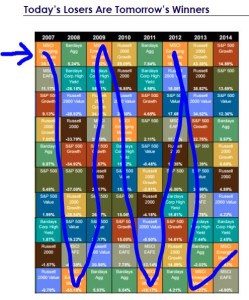
But this is a key mistake that can actually lead to losses rather than gains over time. The problem is that the fund that did the best last year or over the past three to five years is statistically LESS likely to be the best next year, so by buying the “best” based on the past, you may actually be buying high, which is the opposite of everyone’s favorite stock market adage: “Buy low, sell high.” This chart shows that. Just follow the orange square representing “MSCI Emerging Markets” over the 7 years shown:

chart

An investor who chases performance and buys the MCSI Emerging Markets at the end of 2007 because it was the “best” would have lost half their money over 2008. That same investor may be likely to sell at the end of 2008 because they wanted to “stop losing money” and therefore would have completely missed out on the recovery of that sector, when it “won” again in 2009! That’s an extreme example, but follow any of the colored squares over the years and understand a little better why it’s a losing game to only invest in what’s done the best in the recent past. Instead try to spread your investments out over all parts of the market and just “let it ride.”

For investors who like to put their money into actively managed mutual funds, there is a reason past performance matters – so that you can see if the fund is meeting its objective to match or exceed its benchmark. Past performance means nothing without the context of its benchmark. For example, let’s say you’re looking at a mutual fund with the objective of outpacing the S&P 500. Such a fund may include words like “Large Cap” or “US Large Company” or “Capital Appreciation” in its title.

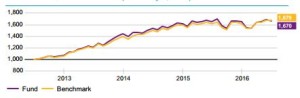
When researching any fund’s performance, look for a chart on the fund fact sheet that shows its performance alongside its benchmark. Here’s one example, showing a fund that is matching its benchmark quite well:

Fund performance graph

If the lines moves pretty much in tandem together or the fund line is consistently higher than the benchmark line, it means the fund managers are doing their jobs consistently well. If you were to look at a chart and see the fund losing to the benchmark as a pattern, then you may want to reconsider it as an investment, even if the fund is in positive territory. In other words, even if your investment is up 10% this year, if its benchmark is hitting 15%, your fund is failing you.

Likewise, if your fund value is down, it doesn’t necessarily mean you’re in the wrong fund. Markets go up and down. As long as the fund’s benchmark is down as far or further, you’re okay to stick with it.

So what does matter when choosing a mutual fund?

The one guarantee about mutual fund investing is the most important criteria in fund selection: fees. You will pay fees, guaranteed. But you can control how much. That doesn’t mean you want to select funds based solely on the criteria of the lowest fees, but if you’ve taken your risk tolerance quiz to determine a suitable mix of stocks and bonds (see the chart at the very end of the questionnaire for suggestions) and have more than one fund option to fulfill your investing allocation, then fees should be one of the deciding criteria.

What if you’re investing in index funds? Then the only use that past performance really has for you is in helping you to set realistic expectations for how your money will do over the long haul. Look at the performance numbers over the past 10 years or more and that should give you a reasonable idea of the growth you can expect for your own money. Assuming you’re only investing money that you don’t need for 10 years or more, you really shouldn’t care what happens over the next one, three or even five years.


Have you signed up to receive the Tip of the Day via email each business day? If not, head over to the main blog page and sign up!


Don’t Make Jeb Bush’s Mistakes…With Your Investments

March 03, 2016

A couple of weeks ago, former Republican presidential front-runner Jeb Bush tearfully exited the race. The self-described policy wonk’s economic proposals may not have won him the election, but they might actually help him with his investment portfolio. Here were some of his policies during the campaign and how they might apply to his finances: Continue reading “Don’t Make Jeb Bush’s Mistakes…With Your Investments”

What Are Your Funds Really Costing You?

October 16, 2015

In one of my recent conversations with an employee preparing for retirement, we covered a lot of territory over a number of sessions. In running his retirement projections, he was WAY ahead of the curve. He had his estate plan prepared by an excellent attorney. Continue reading “What Are Your Funds Really Costing You?”

What Makes A Good Mutual Fund?

June 25, 2015

That’s a common question I get in our investing workshops. Most people instinctively look at performance. After all, that’s how we typically measure ability and try to predict future performance in most areas but investing is different. Continue reading “What Makes A Good Mutual Fund?”

The “Hidden” Sales Charge

June 17, 2015

I received a call recently from an investor that was a little confused about differences in mutual fund share classes. It seems this individual opened an IRA with a financial advisor a few years ago and purchased an “A” share mutual fund. Then, just a few days ago, they received a letter from the custodian informing them that “B” shares would no longer be available for purchase. The investor had never heard of a “B” share and wasn’t quite sure what this meant, so they decided to call the Financial Helpline. Continue reading “The “Hidden” Sales Charge”

When Should You Sell Your Mutual Fund?

September 18, 2014

As the stock market reaches new highs, have you been wondering if you should sell and take profits before the next eventual dip? If the stock market does take a dip, should you sell and cut your losses? With the launch of our “Ask a Planner Week” on Monday, here was the first question we received: “I have absolute percentage rules for taking profits and losses on individual stocks. When should one consider taking profits or losses on index funds?” Continue reading “When Should You Sell Your Mutual Fund?”

How to Invest in Mutual Funds

May 15, 2014

Over the last couple of weeks, I’ve written about the advantages of investing in individual stocks and some tools to make the process simpler and easier. However, most people don’t invest directly in individual stocks. After all, it’s more time consuming and is generally not available in the employer-sponsored plans like 401(k)s that people generally do the bulk of their investing in. Continue reading “How to Invest in Mutual Funds”

Time to Dump Your Mutual Funds?

May 01, 2014

No, I’m not talking about “sell in May and go away.” If you invest in stocks, you probably do so through mutual funds. After all, they’re available in your employer’s retirement plan and you get a degree of instant diversification even if you don’t have much to invest. But here are some reasons you might want to consider investing directly in individual stocks: Continue reading “Time to Dump Your Mutual Funds?”

Understand the Facts About Target-Date Funds

December 02, 2013

During a recent series of retirement workshops geared toward early and mid-career employees, I received numerous questions regarding the role of target date funds in their 401(k).  This brought up an interesting discussion about hands-on vs. hands-off investing options. Target-date funds are supposed to provide simple solutions for people seeking an all-in-one fund that is diversified.  Yet, a tremendous amount of confusion surrounds these seemingly basic asset allocation tools.  Furthermore, not all target date funds are created equal so it’s essential to first look under the hood if target date funds are a part of your investment plan for retirement. Continue reading “Understand the Facts About Target-Date Funds”

What Eating Halloween Candy Can Teach Us About Financial Success

October 31, 2013

When I was a little kid, I used to look forward to being able to gorge on all my Halloween candy. It didn’t take long for me to realize what economists call “diminishing marginal utility.” Each additional piece of candy would bring me less pleasure than the last. It would eventually get to the point where eating more candy would only make me feel sick. Continue reading “What Eating Halloween Candy Can Teach Us About Financial Success”

Following the Herd to My Worst Investment Ever

July 09, 2013

Back in early 1999, as Internet stocks were all the rage, I invested that year’s Roth IRA into the Putnam New Opportunities Fund, which had double digit returns for their 1 and 3 year historical performance. Now, I know past returns don’t indicate future performance,  and I also had that little voice in the back of my mind that was saying it was too good to be true, BUT the Putnam wholesaler had recently visited my office and was saying how hot the fund was, and as a broker myself, I was able to buy in at NAV, meaning I didn’t have to pay the front end sales charge. I couldn’t resist.  Continue reading “Following the Herd to My Worst Investment Ever”

When It Comes to Investing, Don’t Just Follow the Money

January 16, 2013

This week, USA Today came out with an article on how more money poured into stock mutual funds in the last week than any other week in the last eleven years.  Now at first glance that may come as good news as investor confidence seems to be returning in the wake of a resolution to the fiscal cliff dilemma, but before you jump on the stock market bandwagon, remember the words of renowned investor Warren Buffett.  When asked about his philosophy on investing, he is known to have said he is greedy when others are fearful, and fearful when others are greedy.  In other words, Warren Buffett, one of the greatest investors of all time, has a tendency to go against the flow when it comes to investment decisions. Continue reading “When It Comes to Investing, Don’t Just Follow the Money”

Have You Outgrown Your Mutual Funds?

September 27, 2012

When it comes to investing, many of us stick to mutual funds. After all, they’re generally the only option in employer retirement plans (except perhaps for company stock) and financial advisers like to sell funds because they’re relatively easy for them to manage. They also make a lot of sense when you’re just starting out with investing and don’t have enough to purchase in individual securities. However, as your portfolio grows, you may want to consider purchasing individual securities, especially if your portfolio is taxable. Here are some reasons why: Continue reading “Have You Outgrown Your Mutual Funds?”

6 Tips for Making the Best 401(k) Investment Choices

July 18, 2012

Investing for retirement can be an intimidating undertaking. Setting aside money in your 401(k) plan is difficult enough, but determining how to invest it presents its own set of challenges. The good news is that you don’t need to be a seasoned, savvy investor in order to make the right choices. In fact, once you determine your risk tolerance and know what to look for in a fund, picking the right one is largely a process of elimination. Continue reading “6 Tips for Making the Best 401(k) Investment Choices”

Top 4 Ways to Begin Investing for Retirement Today

July 04, 2012

If you haven’t been saving for retirement, putting even a little away on a monthly basis can have a huge impact on your future quality of life – especially if you invest in a tax-advantaged retirement account like your employer’s 401k plan or an IRA. This is because of compound interest: If you don’t have to pay taxes on the interest your account earns, that interest stays invested and earns yet even more interest – and the longer you’re invested, the more money you can make. For example, a mere $50 invested every month for 30 years will turn into almost $75,000 if it earns 8% annually – even though your total investment was only $18,000. Continue reading “Top 4 Ways to Begin Investing for Retirement Today”