Why is an Index Important in Investing?

May 22, 2017

Everywhere you turn, you hear or read personal finance experts advocating the use of index funds in your portfolio. Employees often call our Financial Helpline asking if their 401(k) funds are index funds or wondering what exactly an index fund is and how to pick the right one for them. They also ask how they can know if their mutual fund is performing well. The key to both is understanding indexes.

An index is a statistic

An index is a statistic measure of change in the prices of major groups of stocks or bonds which represent an area of the overall market. In investing, indexes are used as a guide to constructing portfolios, and to set a starting point (benchmark) and measure portfolio performance over time. Indexes are usually capitalization-weighted, meaning that the largest companies have the most influence on the index. Common indexes like this include:

  • The S&P 500®, which includes 500 large companies in a market capitalization weighting, and is widely viewed as a benchmark for the U.S. stock market. If you’ve got a “large company growth fund” in your retirement account, it’s likely its performance will be compared to the S&P 500. You can track the index by entering symbol SPX.
  • The NASDAQ Composite Index includes all the stocks which trade on the NASDAQ market. It includes a lot of technology companies, but isn’t limited to them. You can track this by entering symbol IXIC.
  • The Russell 2000 Index includes 2,000 small companies in the U.S. You can track this by entering symbol RUT. If you’ve got a “small company” or “small cap” fund in your retirement account, it’s likely that its performance will be compared to the Russell 2000.
  • The Bloomberg Barclays U.S. Aggregate Bond Index tracks a range of types of fixed income securities to represent the types of bonds in the bond market. If you have a “total U.S. corporate bond” fund in your retirement account, it is likely its performance will be compared to the Bloomberg Barclay’s U.S. Aggregate Bond Index. Bloomberg Barclays has many common bond indexes and you can find and track yours here.

Another well-known index that is frequently reported as an indicator of the total U.S. economy, the Dow Jones Industrial Average, is a measure of 30 U.S. blue chip stocks from all industries except transportation and utilities. It is a price-weighted average, which means that the most expensive stocks influence the index the most. You can track this by entering symbol DJIA.

An index fund mimics the index

An index fund is a type of mutual fund with a portfolio designed either to match directly or track the performance of an index. For example, an S&P 500 index fund would hold stocks of the companies in the S&P 500 index in direct proportion to how they are represented in the index. When you choose an index fund, you’re choosing a passive method of managing your investments. You won’t outperform the index, but should closely track the performance of the index, with slight underperformance due to trading costs and fees. Index funds are a great way to minimize the fees in your retirement plan or other investment portfolio, which can really add up over a long period of time. Not all index funds are created equally, however, so make sure you read the fund fact sheet and prospectus before you invest. Not sure about how to choose the right funds for you in your retirement account? Start here with an easy to read post from fellow planner Kelley Long on how investing is like choosing a pizza.

An index gives you a way to compare how you’re doing

Comparing your mutual fund to an index that contains similar stocks or bonds is an excellent way to measure how your fund is doing over time. A fund will generally disclose its benchmark, the index against which the fund management measures its performance. For a passive index fund strategy, the comparison is simple. An actively managed fund, which is designed to try to beat an index (although most don’t), may have a composite benchmark (made up of several indexes in pre-set proportions).

The upshot: do a review of your retirement accounts and other investments. Do you own index funds, and if so, what indexes do they track? Do you have a diversified portfolio of funds which track different indexes? Do you have actively managed funds, and if so, what indexes are they measured against? How did they do? If you’re not sure about where to start, call your Financial Helpline or call your financial coach if you have one.

Do you have a question you’d like answered on the blog? Please email me at [email protected]. You can follow me on the blog by signing up here and on Twitter @cynthiameyer_FF.
Why You Should Love Investing

April 13, 2017

When a lot of people think of financial planning, they think of investing…with dread. It sounds complicated, time consuming, and risky. But for me, investing is actually my favorite part of financial planning. Let me tell you why…

In most areas of life, we generally get what we put in, whether that’s in terms of the price we pay or the amount of time and hard work we expend. In other words, you get what you pay for. However, investing is the one area of life where you get rewarded for being both cheap and lazy.

Let’s start with the first step, which is diversification. As you’ve probably heard, you don’t want to put all your eggs in one basket, but you still have to decide how many of your “eggs” or money to put in each “basket” or asset class: stocks, bonds, cash, and real assets. What makes this confusing is that there’s a ton of conflicting views on this so investment expert Meb Faber decided to compare 9 of the top recommended asset allocation strategies by various other investment experts and see how they performed since the 1970s. What he found is that the difference between the best and the worst performing strategy was only 1.6% and if you removed the worst performing portfolio (which is an outlier since it only has 25% in stocks), the difference was only 1%. When he compared the models of the major financial institutions, he found that the difference was only about half a percent.

However, just because they ended up in similar places doesn’t mean that they performed similarly from year to year. Each of the models had many years in which they outperformed and many in which they under-performed. If you chose a model based on which was the top performing over the previous decade, you would actually have done much worse. Whether you use a one-stop shop asset allocation fund, a robo-advisor, one of the model portfolios listed in one of Faber’s blog posts above, or a financial advisor’s recommendation, which portfolio you pick is less important than that you pick one (to make sure you’re reasonably diversified) and stick with it through thick and thin. (Everyone, even Warren Buffett, has periods of under-performance.)

There’s one other way you can sabotage your returns: costs. It’s been estimated that the average mutual fund costs .9% a year in expenses and 1.44% a year in transaction costs. (This doesn’t even include any loads or commissions you may pay to purchase the fund.) That 2.34% would be enough to turn the best performing strategy into the worst.

It’s not like you’re getting anything for those costs either. In fact, a recent Morningstar study called low fund fees “the most proven predictor of future fund returns.” Warren Buffett has said the same thing. So as you choose which funds to use in your portfolio, look for ones with low fees (called the expense ratio) and low turnover (which leads to lower transaction costs). If index funds are available, they tend to have the lowest costs and hence tend to outperform more expensive actively managed funds over long periods of time.

The moral of the story is that investment success boils down to three simple rules:

  1. Be diversified. Pick a reasonably diversified portfolio. Don’t be a greedy pig (bet on individual stocks) or a fearful chicken (keep all your money in bonds and cash). After all, both pigs and chickens get slaughtered.
  2. Be cheap. Use low cost funds to implement your asset allocation strategy. In this case, you get what you don’t pay for.
  3. Be lazy. Once you have your portfolio, stick with it. Don’t try to time the market or otherwise, mess with it other than to rebalance it periodically back to the original allocation or to switch to lower cost funds as they become available.

Think about it. Where else are you most rewarded for being both cheap and lazy? Now do you love investing? If so, the first step is to save so you have something to invest, but that’s another story…


Should You Care About a Mutual Fund’s Past Performance?

February 08, 2017

The primary reason that investors choose to subject their hard-earned savings to the ups and downs of the stock market is that history has shown that over long periods of time, it’s one of the best ways to grow your savings in order to outpace inflation and maintain purchasing power. One of the biggest investing mistakes I see though is what we call “performance chasing” or making investment choices based solely on the past performance of a particular investment. I’d argue that past performance is actually the last criteria anyone should consider when deciding which funds to buy and is almost completely irrelevant when looking at index funds. Here’s what I mean.

Past performance is often the first thing people look at when presented with a list of mutual funds, like in their 401(k) account. I get it. You want the best and you want your money to grow as much as possible!

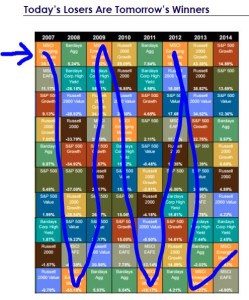
But this is a key mistake that can actually lead to losses rather than gains over time. The problem is that the fund that did the best last year or over the past three to five years is statistically LESS likely to be the best next year, so by buying the “best” based on the past, you may actually be buying high, which is the opposite of everyone’s favorite stock market adage: “Buy low, sell high.” This chart shows that. Just follow the orange square representing “MSCI Emerging Markets” over the 7 years shown:

chart

An investor who chases performance and buys the MCSI Emerging Markets at the end of 2007 because it was the “best” would have lost half their money over 2008. That same investor may be likely to sell at the end of 2008 because they wanted to “stop losing money” and therefore would have completely missed out on the recovery of that sector, when it “won” again in 2009! That’s an extreme example, but follow any of the colored squares over the years and understand a little better why it’s a losing game to only invest in what’s done the best in the recent past. Instead try to spread your investments out over all parts of the market and just “let it ride.”

For investors who like to put their money into actively managed mutual funds, there is a reason past performance matters – so that you can see if the fund is meeting its objective to match or exceed its benchmark. Past performance means nothing without the context of its benchmark. For example, let’s say you’re looking at a mutual fund with the objective of outpacing the S&P 500. Such a fund may include words like “Large Cap” or “US Large Company” or “Capital Appreciation” in its title.

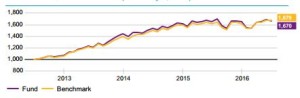
When researching any fund’s performance, look for a chart on the fund fact sheet that shows its performance alongside its benchmark. Here’s one example, showing a fund that is matching its benchmark quite well:

Fund performance graph

If the lines moves pretty much in tandem together or the fund line is consistently higher than the benchmark line, it means the fund managers are doing their jobs consistently well. If you were to look at a chart and see the fund losing to the benchmark as a pattern, then you may want to reconsider it as an investment, even if the fund is in positive territory. In other words, even if your investment is up 10% this year, if its benchmark is hitting 15%, your fund is failing you.

Likewise, if your fund value is down, it doesn’t necessarily mean you’re in the wrong fund. Markets go up and down. As long as the fund’s benchmark is down as far or further, you’re okay to stick with it.

So what does matter when choosing a mutual fund?

The one guarantee about mutual fund investing is the most important criteria in fund selection: fees. You will pay fees, guaranteed. But you can control how much. That doesn’t mean you want to select funds based solely on the criteria of the lowest fees, but if you’ve taken your risk tolerance quiz to determine a suitable mix of stocks and bonds (see the chart at the very end of the questionnaire for suggestions) and have more than one fund option to fulfill your investing allocation, then fees should be one of the deciding criteria.

What if you’re investing in index funds? Then the only use that past performance really has for you is in helping you to set realistic expectations for how your money will do over the long haul. Look at the performance numbers over the past 10 years or more and that should give you a reasonable idea of the growth you can expect for your own money. Assuming you’re only investing money that you don’t need for 10 years or more, you really shouldn’t care what happens over the next one, three or even five years.


Have you signed up to receive the Tip of the Day via email each business day? If not, head over to the main blog page and sign up!


Why I’m Investing 100% of My 401(k) into One Stock Fund

December 15, 2016

Like many companies, Financial Finesse recently changed the fund line-up in our 401(k). As part of the new offering, we now have target retirement date funds that are fully-diversified “one stop shops” that automatically become more conservative as you get closer to the target retirement date. But rather than this more diversified approach, I’m choosing to put 100% of my 401(k) into an S&P 500 index fund. While this strategy is certainly not for everyone, here’s why I decided it makes sense for me:

It complements my investments outside the 401(k). If you have retirement investments outside your employer’s retirement plan, you might want to look at all of your retirement accounts as one big portfolio. In my case, the bulk of my outside retirement investments will be in real estate and microcap and international value stocks. Since I’m a very aggressive investor with my retirement portfolio, I have no interest in bonds or stable value. Therefore, domestic large cap stocks can best diversify my overall portfolio without sacrificing much in expected returns.

Index funds tend to outperform actively managed funds. It’s also the only index fund offered in the new plan. This is an important point because studies have shown that index funds tend to do better than the vast majority of actively managed funds in the long run, primarily because of their low fees and trading costs. While value stocks tend to outperform in the long run and growth stocks would better complement my already value-heavy portfolio, both advantages can be wiped out by the higher costs of active management.

Warren Buffett recommends it. Arguably the greatest investor alive today has recommended index funds to both Lebron James and average Americans. He’s also put his money where his mouth is, instructing his trust to invest 90% of his estate in an S&P 500 index fund for his wife when he passes away and betting a $1 million to charity that a simple S&P 500 index fund would outperform a selected group of top hedge fund over 10 years. (It’s year 9 and he’s way ahead so far.) If it’s good enough for Buffett, it should be good enough for me.

Of course, this certainly doesn’t mean everyone should put 100% of their employer’s retirement plan in an S&P 500 index fund. If you don’t have much outside your plan, your portfolio may not be diversified enough without international and small cap stocks. Unless you’re also a very aggressive investor, you’ll probably want some bonds and cash as well to reduce the portfolio’s risk. This is why most people are probably better off investing in a more diversified portfolio like the target date retirement funds we have now.  As always, you’ll want to make sure you’re making an informed decision that’s best for you.


Choosing Investments is Like Choosing a Pizza

April 20, 2016

When financial planners talk about how to invest your money in the market, we often discuss dividing it up among stocks, bonds and cash (also known as your asset allocation). But then when you actually go to make your investment choices, there’s a chance that not one of the options will have the word “stock” or “cash” in it. One of the most confusing things about investing and financial instruments is the fact that there are so many words that mean the same thing. For example: stock, equity, share, capital, blue chip, mid cap, small cap, large cap …they all generally refer to the same thing: ownership in a public company. Likewise, bonds, fixed income, municipals, T-bills, etc. are all referring to similar debt instruments used by companies and governments to finance operations and projects.

I often think that if more people understood that many of the financial terms we hear refer to the same thing that there would be a lot less stress around investing and everyone would feel more comfortable taking advantage of the growth that investing in the markets can offer. So I thought I’d try instead to describe a metaphor that is near and dear to my heart to try to make it easier to understand the different options out there: pizza. When it comes to pizza, there are four main options for how to get a delicious pie onto your plate (on a sliding scale of cost and effort) similar to the options available for investing for long-term goals:

  1. Make your own from scratch
  2. Buy pre-made frozen
  3. Pay someone to deliver it to you, ready to go
  4. Have it served to you at a restaurant

Each level requires a different amount of money and effort. Choosing how to invest money in the market is similar. Here’s how it compares:

1. Make your own from scratch. Making your own pizza requires skill, knowledge and practice, but once you know what you’re doing, it’s the least expensive and can be the most delicious. My husband has mastered the art of homemade pizza, starting with dough he makes from scratch, but it took a couple of years and LOTS of practice (and worthless pizza) to get it right.

To me, this is similar to researching individual stocks and mutual funds and buying them through a discount broker. You have to know what you’re doing or you can end up with nothing, but people who know what criteria to look for and how not to take too much risk can really grow their money. For investors looking to learn the art of DIY investing, start with money you can afford to lose and start reading. The book “Grande Expectations,” was what brought home to me how the stock market really works and why buying the hottest name stock or fund isn’t necessarily the best investing strategy.

2. Buy pre-made frozen. Putting a frozen pizza in the oven and knowing exactly when it’s done (and exactly how long to let it cool so that it doesn’t burn the roof of your mouth) requires some skill and it’s still a pretty cheap way to go. The investing equivalent would be using index funds or ETFs to create your own investment mix. This requires that you understand how to create an asset allocation that is appropriate for your timeline and risk tolerance, but with a little understanding of what the different indices are, it’s pretty simple to put together a decent mix. The trick is knowing when to make changes as time progresses and also knowing when NOT to make changes (for example, not selling when the market tanks and re-balancing even when the market is hot).

3. Pay someone to deliver it to you, ready to go. Minimal effort but a little bit more money. You have to pay to get it to your door, after all.

The investing equivalent would be target date funds. You don’t have to do anything but pick one and let it ride. No pizza or investing knowledge required, you just pick the one that fits you the best (for target date funds, that’s the year that you expect to need the money such as your retirement age).

4. Have it served to you at a restaurant. Paying for someone to make your pizza and serve it to you piping hot along with beverages is similar to paying a financial advisor to manage your investments for you. You can describe what flavors you like and your server will help you pick the best pizza combo.

It’s the same thing with your financial advisor. She’ll listen to your goals and risk tolerance and then suggest an investment mix that is appropriate for you. Along with that, your financial advisor should look at how your investments fit into your overall goals and make suggestions for any changes to support those goals, much like a server at a restaurant might suggest the best beer pairing or salad to start. This is definitely the most expensive option, but if you want a little more hand-holding with your investing, it’s worth it.

In my experience, most people are delivery-types (target date funds will do the trick) but because they’ve heard you should diversify and not just hold one thing, they often think that means they need to choose more than one fund. It’s important to know that a target date fund is already diversified. Just like a pizza is the perfect assembly of crust, sauce, cheese and toppings, a target date fund can be broken down into the perfect mix of large cap, mid cap, small cap, international, fixed income, money market and sometimes even commodities – the fancy way of saying stock, bond and cash funds. But instead of you having to figure out how much of each to select, that decision is made by experts who specialize in asset allocation – just like the pizza chef knows the best mix of ingredients according to the type of pizza you ordered. Now, who’s hungry for pizza?

Don’t Make Jeb Bush’s Mistakes…With Your Investments

March 03, 2016

A couple of weeks ago, former Republican presidential front-runner Jeb Bush tearfully exited the race. The self-described policy wonk’s economic proposals may not have won him the election, but they might actually help him with his investment portfolio. Here were some of his policies during the campaign and how they might apply to his finances: Continue reading “Don’t Make Jeb Bush’s Mistakes…With Your Investments”

All You Need To Know About Investing In 3 Simple Steps

April 16, 2015

Whenever I talk to people about investing, I find that most people fall into one of two groups. One group feels that investing is too complicated for them so they want to hire a professional to manage their money for them. The other group is make up of active investors who try to time the market with statements like “I think the market is too high to get in right now” or “I’m going to wait for prices to come down before I buy” and/or pick stocks or actively managed funds that they think will outperform the market. The problem is that there’s no evidence that market timing or even actively picking stocks really works (unless monkeys or cats are doing the picking). If the vast majority of professional money managers continue to underperform the market with these methods, do you really think you can in your spare time? Continue reading “All You Need To Know About Investing In 3 Simple Steps”

3 Investment Myths Busted

February 26, 2015

Think you know everything you need to know about investing? I recently read three articles that dispel some conventional wisdom when it comes to your investments. Here are the busted myths along with the implications of what they could mean for you: Continue reading “3 Investment Myths Busted”

The Gym Rat’s Guide to Investment Terms

February 12, 2015

Investing and the financial world in general can be pretty confusing. There are a lot of terms you may not know and concepts you may not be familiar with. It can even start sounding like another language! Continue reading “The Gym Rat’s Guide to Investment Terms”

How to Minimize Your Investment Costs

October 09, 2014

In my last 2 blog posts, I discussed the various ways financial advisors can be paid and how they can present conflicts of interest to an advisor. But how would your actual investment returns be affected? Let’s take a look at some scenarios: Continue reading “How to Minimize Your Investment Costs”

The Three Most Useless Things a Financial Columnist Tells You

September 11, 2014

I often like to question much of the conventional wisdom of the financial services industry so I was intrigued when I saw this article titled “The four most useless things financial advisors tell you” by Howard Gold. Instead, I found myself questioning most of the conclusions in the article itself as pretty useless (with one exception). Let’s take a look at each of these “four most useless things:” Continue reading “The Three Most Useless Things a Financial Columnist Tells You”

Can You Beat the Market…With Index Funds?

June 19, 2014

Last week, I wrote about different types of index funds and how some “index funds” aren’t as diversified or as low cost as they may seem. However, there’s also a case for certain types of diversified index funds that are designed to outperform traditional index funds. They come in two flavors: equal weight and fundamental index funds. Continue reading “Can You Beat the Market…With Index Funds?”

How Buying Clothing is Like Investing

May 29, 2014

Last week, I wrote about how I was able to buy a new set of clothes without breaking the bank. In the process, I realized something else too. It turns out that putting together a wardrobe is a very similar to putting together an investment portfolio. Here are some lessons I learned and how they apply to investing: Continue reading “How Buying Clothing is Like Investing”

Investments That Survived the Fiscal Cliff

January 07, 2013

We are still here.  The Mayan calendar ended December 21, 2012 but fortunately we didn’t.  The fiscal cliff hung over into the wee hours on New Year’s Eve but was averted so taxpayers making less than $400k are breathing a sigh of relief that their income taxes aren’t going up — only the payroll taxes are going back to 6.2% (an increase of 2%). This is certainly good news for most Americans but it gets better. Dividends and capital gains tax rates were also saved from the fiscal cliff – they stayed the same for most Americans. Continue reading “Investments That Survived the Fiscal Cliff”

Where Real Money Can be Found

July 25, 2012

Everyone loves a good bargain, and it seems that summer is high season for great sales.  Starting with Memorial Day all the way through the 4th of July, Back to School, and Labor Day, the deals are everywhere.  In fact, if advertisements and promotions are to be believed, we can save so much money at the big box stores that our retirement accounts and college savings plans should be fully funded by early October. Continue reading “Where Real Money Can be Found”

Do You Know What’s Really in Your Water Bottle…or Your Portfolio?

June 22, 2012

My kids absolutely LOVE bottled water.  I remember that when bottled water first came into the public eye, my friends & I laughed and said that if we came up with catchy packaging, a cool name, and maybe even a slogan that sounds like we care about something, we could make millions of dollars selling regular tap water to people who are far too easily separated from their hard earned dollars. Little did we know that we underestimated how much money we could make big time!!!! It’s not MILLIONS, it’s BILLIONS…per month!!! Continue reading “Do You Know What’s Really in Your Water Bottle…or Your Portfolio?”

Why I Didn’t Invest in Facebook

May 31, 2012

No, it’s not because I’m a Facebook hater. In fact, I think I’m one of the few Facebook users who actually really likes Facebook (yes, even the timeline). I wish I could say that I anticipated the company’s weakened growth forecast but it’s not that either. Nor is it because I necessarily think that the growing shift to mobile will turn Facebook into the next MySpace. The reason I didn’t buy Facebook stock is because I simply don’t buy any individual stocks. Period. Continue reading “Why I Didn’t Invest in Facebook”