
Where Should You Have Your HSA?

February 16, 2017

Do you have a health savings account (HSA)? If so, you probably got it through your employer and have it at an administrator chosen by them. What you may not realize is that you can choose to transfer your account to a different provider.

This recently came to my attention when Financial Finesse changed HSA providers. Rather than transfer my account into the new administrator, I decided to consider my other options. If you’re shopping around for a new home for your HSA, here are some things to consider:

What do you want to invest the account in? If you’re looking to use it to cover immediate expenses, you’ll want to keep your HSA someplace safe like a savings account. In that case, you can just compare the interest rates they’re paying.

On the other hand, if you’re planning to invest the account to grow for the future as I am, you’ll want to see what the investment options are. Many providers don’t even let you invest outside of a cash account at all. Others give you a limited number of choices (including sometimes funds that may be difficult to access otherwise). Some allow you to invest in thousands of mutual funds and even individual stocks through a brokerage account. To maximize my investment options, I focused my search on the latter.

Do you need to keep a certain amount in a cash account? For someone planning to invest most or all of their account, having to keep money in cash can be a drag on returns. In fact, my main motivation for switching providers was that my current HSA administrator requires me to keep $5k in the cash account or be charged a $3 monthly fee that can’t be deducted from the brokerage account, forcing me to leave money in the cash account to cover the fees. It may not sound like much, but if that extra $5k was invested and earned a 10% average annualized return (I invest my HSA pretty aggressively) over the next 30 years, it would end up becoming an additional $82k that I could use tax-free for future medical expenses. That’s not a bad payoff for a few minutes of paperwork.

What are the fees? Fees are another thing that can eat into your returns, especially if you have a small balance. Make sure to include any additional costs that you may be charged for using the investment option, including both administrative and transaction fees. However, keep in mind that extra investment earnings can more than compensate for an additional fee. For example, it’s worth me investing that $5k in my current HSA because the investments would have to earn just .72% more than the cash account to make up for the $36 in additional fees each year.

You don’t hear much about HSA transfers, probably because HSAs are still relatively new and haven’t acquired enough assets to make providers aggressively compete for them yet. But as these accounts continue to become more common, I expect this will be a growing area of interest. For now, at least be aware that you have a choice and depending on how you plan to use your HSA, it could be a consequential one.


Should You Care About a Mutual Fund’s Past Performance?

February 08, 2017

The primary reason that investors choose to subject their hard-earned savings to the ups and downs of the stock market is that history has shown that over long periods of time, it’s one of the best ways to grow your savings in order to outpace inflation and maintain purchasing power. One of the biggest investing mistakes I see though is what we call “performance chasing” or making investment choices based solely on the past performance of a particular investment. I’d argue that past performance is actually the last criteria anyone should consider when deciding which funds to buy and is almost completely irrelevant when looking at index funds. Here’s what I mean.

Past performance is often the first thing people look at when presented with a list of mutual funds, like in their 401(k) account. I get it. You want the best and you want your money to grow as much as possible!

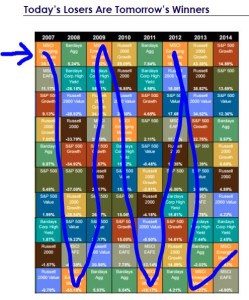
But this is a key mistake that can actually lead to losses rather than gains over time. The problem is that the fund that did the best last year or over the past three to five years is statistically LESS likely to be the best next year, so by buying the “best” based on the past, you may actually be buying high, which is the opposite of everyone’s favorite stock market adage: “Buy low, sell high.” This chart shows that. Just follow the orange square representing “MSCI Emerging Markets” over the 7 years shown:

chart

An investor who chases performance and buys the MCSI Emerging Markets at the end of 2007 because it was the “best” would have lost half their money over 2008. That same investor may be likely to sell at the end of 2008 because they wanted to “stop losing money” and therefore would have completely missed out on the recovery of that sector, when it “won” again in 2009! That’s an extreme example, but follow any of the colored squares over the years and understand a little better why it’s a losing game to only invest in what’s done the best in the recent past. Instead try to spread your investments out over all parts of the market and just “let it ride.”

For investors who like to put their money into actively managed mutual funds, there is a reason past performance matters – so that you can see if the fund is meeting its objective to match or exceed its benchmark. Past performance means nothing without the context of its benchmark. For example, let’s say you’re looking at a mutual fund with the objective of outpacing the S&P 500. Such a fund may include words like “Large Cap” or “US Large Company” or “Capital Appreciation” in its title.

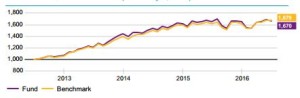
When researching any fund’s performance, look for a chart on the fund fact sheet that shows its performance alongside its benchmark. Here’s one example, showing a fund that is matching its benchmark quite well:

Fund performance graph

If the lines moves pretty much in tandem together or the fund line is consistently higher than the benchmark line, it means the fund managers are doing their jobs consistently well. If you were to look at a chart and see the fund losing to the benchmark as a pattern, then you may want to reconsider it as an investment, even if the fund is in positive territory. In other words, even if your investment is up 10% this year, if its benchmark is hitting 15%, your fund is failing you.

Likewise, if your fund value is down, it doesn’t necessarily mean you’re in the wrong fund. Markets go up and down. As long as the fund’s benchmark is down as far or further, you’re okay to stick with it.

So what does matter when choosing a mutual fund?

The one guarantee about mutual fund investing is the most important criteria in fund selection: fees. You will pay fees, guaranteed. But you can control how much. That doesn’t mean you want to select funds based solely on the criteria of the lowest fees, but if you’ve taken your risk tolerance quiz to determine a suitable mix of stocks and bonds (see the chart at the very end of the questionnaire for suggestions) and have more than one fund option to fulfill your investing allocation, then fees should be one of the deciding criteria.

What if you’re investing in index funds? Then the only use that past performance really has for you is in helping you to set realistic expectations for how your money will do over the long haul. Look at the performance numbers over the past 10 years or more and that should give you a reasonable idea of the growth you can expect for your own money. Assuming you’re only investing money that you don’t need for 10 years or more, you really shouldn’t care what happens over the next one, three or even five years.


Have you signed up to receive the Tip of the Day via email each business day? If not, head over to the main blog page and sign up!


5 Questions to Ask Your Credit Card Company

March 08, 2016

National Consumer Protection Week, from March 6 to March 12, involves numerous organizations focused on helping to empower consumers to make informed decisions about financial products and services. Nowhere do I see a greater need for this than with credit cards. In my role as a resident financial planner, I have spoken to too many people who did not fully understand their credit card. The lack of understanding cost one employee hundreds of dollars in fees. If you are either shopping for a credit card or unsure of how your credit card works, consider asking these 5 questions: Continue reading “5 Questions to Ask Your Credit Card Company”

Permanent Life Insurance or Mortgage Payoff?

August 20, 2015

We recently received a question on our Facebook page from a couple in their 50’s who are trying to decide between a fixed universal life insurance policy with a quoted return of “7% minus fees” vs paying off a mortgage with a 3.5% interest rate. This combines two common question topics: using permanent life insurance as an investment and paying off a mortgage early. Let’s take a look at some things to consider: Continue reading “Permanent Life Insurance or Mortgage Payoff?”

A 6% Guaranteed Return?

June 18, 2015

Would you like a guaranteed 6% return on your investments? Is that even possible? I recently got a helpline call from a woman who thought it was. Her advisor had suggested that she roll her 401k into an annuity that paid “a guaranteed 6% return regardless of what the stock market does.” She thought the only downside is that she had to leave the money in the annuity for 10 years and that there was a 1% fee so the guaranteed return would be 5% after fees. Continue reading “A 6% Guaranteed Return?”

Which Credit Cards Are the Most Rewarding?

December 04, 2014

One of my favorite things this time of year is being able to use credit card reward points to cover most or even all of my holiday shopping. While it obviously doesn’t make sense to buy things just to earn rewards (especially if you can’t pay the card off in full), why not get as much as you can from purchases you’re going to make anyway? In deciding which cards to use, there are a few rules of thumb I like to follow: Continue reading “Which Credit Cards Are the Most Rewarding?”

How Much is Your Financial Advisor Costing You?

April 12, 2012

When a friend of mine recently told me that she had a financial advisor, I asked her how much he was charging her. At first, she didn’t think he was charging her anything. When she realized that he probably wasn’t helping her out of the goodness of his heart, she acknowledged that she had no idea how or what she was paying him and didn’t remember him ever discussing this with her. Continue reading “How Much is Your Financial Advisor Costing You?”