
How To Deduct Your Home Office On Your Tax Return

February 15, 2017

Updated in 2018 for the Tax Cuts and Jobs Act of 2017

If you have any self-employment income AND you have a home office that serves as a primary place you do “office work,” then the home office deduction is most likely available to you provided you meet the IRS qualifications. In order to qualify as a home office for tax purposes, your space must meet two requirements:

  1. Regular and exclusive use: The space you are claiming as your home office must only be used for that so if you work at your kitchen table, that wouldn’t qualify. I sectioned off a corner of our family room for my office. That qualifies because no one else uses that specific space for anything but my work.
  2. Principal place of business: You have to show that your home is your primary place of business, although there are some situations where you may still qualify even if you have a separate place where you also do business. Check the IRS regulations to see if you qualify.

If you’ve determined that you indeed do have a home office for tax purposes, then it’s important to understand how to calculate what you can deduct. There are two methods for calculating your deduction, and you can use a different method from year to year.

The Actual Expense Method

This is best for taxpayers who have a large amount of space and keep meticulous records of expenses. (The home office deduction is reputed to be a red flag for audit, although the IRS does not corroborate this.) The actual expense method is pretty self-explanatory. You deduct the actual amount of the expenses related to your home office.
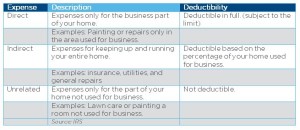
Home office expenses

Figuring the percentage

To determine the percentage of your home that qualifies for business use, you need to measure the space compared to the total size of your home. The IRS offers these two examples:

Example 1

  • Your office is 240 square feet (12 feet x 20 feet).
  • Your home is 1,200 square feet.
  • Your office would be 20% (240/1,200), so that is also your business percentage.

Example 2

  • You use one entire room in your home for business.
  • Your home has 10 rooms, all equal in size.
  • Your office would be 10% (1/10), so that is also your business percentage.

The Safe Harbor Method

This is best for people whose office space is 300 square feet or less and don’t want to hassle with tracking records. Here’s how the safe harbor method works:

You calculate your deduction by multiplying the square footage of your home office (but not to exceed 300 square feet) by $5. That’s it! In other words, the maximum amount you could claim each year would be $1,500.

A few final things to consider

  • Your home office deduction cannot exceed your gross business income for the year, but if you use the actual expense method, you can carry over any amounts that you are unable to deduct to future years where you also use the actual expense method.
  • IRS Publication 587 has more information, including several easy-to-use worksheets that can help you figure your deduction.


This post is not meant to replace the advice of a paid tax professional who can give you specific guidance on your own unique situation. Please consult your CPA or tax preparer if you are not certain whether you qualify to take this deduction.


Should You File Your Taxes Jointly?

November 16, 2016

Post updated 1/17/2018

I remember the first year after my brother got married, when he called to ask me a tax question and shared that he and his new wife had decided to file “single” status because that way they both got refunds. I felt like a real jerk crushing their refund joy when I told them that they don’t actually get to choose. Once you’re married, your choices are narrowed to “married filing jointly” or “married filing separately” (or MFJ versus MFS).

Generally speaking, the government wants married people to file joint returns, so they make it pretty unattractive to file separately (although that’s gotten better with the new tax rules), even though the “marriage penalty” is real when it comes to tax brackets and other limitations. For most married couples, it makes the most sense to file jointly. But there are some instances when it might make sense to file separately: (You can switch from year to year.)

One spouse has high medical expenses but a low income: This would make it easier for the doctor bills to exceed the 7.5% threshold necessary to deduct medical costs.

One spouse explores more creative methods of tax avoidance: When you sign a joint return, you’re accepting legal responsibility for everything on the return. If you know your spouse takes liberties with tax deductions, you may want to file separately to protect yourself if the IRS comes calling. There is such a thing as innocent spouse relief, but you have to prove you actually didn’t know of the questionable practices to qualify.

You’re heading for single status anyway: Your filing status is determined based on your marriage status on December 31st. If you’re in the process of getting divorced, but it isn’t final by the end of the year, you may choose to file separately to avoid being tied together by tax issues after the marriage is over. When I got divorced many years ago, we filed in December, but the divorce wasn’t final until January. We filed a joint return that last year and agreed to split the refund, but that only worked because we still had a modicum of trust with each other on financial issues.

However, most couples choose to file jointly as there are many drawback to filing separately:

Tax brackets may be less favorable. MFS marginal brackets have taxpayers jumping up to higher brackets at lower incomes than MFJ taxpayers.

You may have lower deductions and credits. If one spouse itemizes, both have to even if one spouse would receive a higher deduction using the standard amount. Spouses split joint deductions like mortgage interest for a mortgage in both names, but charitable deductions and other itemized deductions go on the return of the spouse that paid them, which could leave a spouse with very few itemized deductions claiming less than they’d get as a single taxpayer.

If you file MFS, you also cannot claim many credits and deductions such as the earned income credit, adoption expenses, child and dependent care and education credits, and the student loan interest deduction. In addition, the child tax credit is reduced and you can only deduct $1,500 of capital losses per year versus $3,000 for MFJ.

For most people, filing jointly will make the most sense. The best way to decide would be to figure out your taxes both ways. Many tax software programs do this analysis for you. Then file according to the method that leads to the lowest overall tax bill for your family.


10 End-of-Year Tax Tips

December 03, 2014

Are you worried about paying too much in taxes this year? If you wait until you file next year, it will be too late to do much about it. As the 2014 year winds down, you’ll want to note some simple things you can do to reduce the amount of income tax you owe Uncle Sam this year, while planning for the year to come.  Continue reading “10 End-of-Year Tax Tips”

The Mistake That Turned My Refund Into a Tax Bill

February 20, 2013

This past weekend I decided to prepare my 2012 tax return.  I typically like to do this early in the year so that I get my tax refund sooner rather than later, but something very strange happened to me this year: I ended up owing the IRS money!  This is unusual for me.  I’m usually getting money back, but call it a case of bad luck or just Murphy’s Law, after writing last week’s blog post on how to estimate the right number of allowances to claim on your W-4 so that you end up close to breaking even with the IRS, I ended up NOT breaking even with the IRS.  WHAT WENT WRONG? Continue reading “The Mistake That Turned My Refund Into a Tax Bill”