
How To Invest Based On The Goal You’re Saving For

April 16, 2019

You don’t have to listen long to a news report to figure out that investing is a major topic for many Americans. You’ll figure that out right about the time you also realize there is a lot of jargon involved, as well as complex and competing strategies. 

You don’t have to understand everything you hear on the news to be a successful investor. What you do need for success is an idea of what your goals are. Before investing, you’ll want to answer the following questions:

  • What do you want to use the money for? 
  • How much money do you need to meet your goal? 
  • When do you need it?

With the answer to those questions you can then start to make a plan. Don’t worry about making the PERFECT plan. Just make one that is reasonable and based on the information you have to work with. Despite what you may hear, investing success actually comes when you meet your own goals, not from making the absolute most amount of money you possibly could have made.

Investing success actually comes when you meet your own goals, not from making the absolute most amount of money you possibly could have made.

As a financial coach, I have the opportunity to work with a lot of people to design investment strategies to help them meet their goals. These goals often change as you move through life, so it is good to reassess every year, at least, to make sure your investment plan is still working for you. 

How you invest will actually greatly depend on what you’re investing for – what’s your goal? Here are some examples:

Goal: I want to be ready to retire as soon as possible.

How much do you need?

When you get close to retirement, you can work on an actual retirement budget to help you decide how much money you need each year to live on, then use a retirement calculator like this one to help determine how much you need to have saved to generate that much income.

Earlier on, a good rule of thumb is to shoot for replacing about 80% of your current income which, depending on when you start saving, may involve putting aside somewhere between 15% and 20% of your income each year.

When do you need it?

Decide what retirement date you want to shoot for. Run some calculations with the retirement estimator to see how much you would need to save to retire at that time so you can be sure your date is somewhat realistic. 

Investing strategy

Your investment strategy centers around two things: how long do you have until you need the money and how much risk can you stomach. This typically means that, when you’re young, if you can psychologically handle the fluctuations in the stock market, you’ll want to invest a lot of your account in various stock or equity funds. 

As you get older or no longer feel comfortable taking on that much risk of fluctuations, you may gradually add more bonds and cash to the mix. If you’re not sure which investments to choose, you might want to check your plan for a Target Retirement Date option and choose a date close to when you plan to retire. 

This risk questionnaire may help you decide where you fall in terms of how aggressive or conservative you want your investment mix to be.

Goal: I want to buy a house.

How much do you need?

Start by figuring out how much home you can afford. From there you can determine how much your closing costs will likely be and how much of a down payment you will need to bring to closing.

It is a good idea to save enough so that you don’t need to tap into your emergency savings at closing and avoid putting yourself in a sticky financial situation after you move into the home. Also, be sure to take into account any savings needed for repairs to the home and furnishings.

When do you need it?

Use the Saving for Goals calculator to run different scenarios on how much you’d have to save to meet your goal over different time frames, then come up with a plan that is realistic for you.

Investing strategy

If you’re looking at making the home purchase in the next 5 years, then you want to keep those saving safe from the ups and downs of the stock market. You don’t want to run into a scenario where you are ready to pull the money out and the stock market crashes before you get the chance. This usually means putting the money in a savings account, money market fund or some short term CD’s that will mature before you need the money.

Goal: I need to start saving for college.

How much do you need?

Using your own personal philosophy on paying for education and a cost of college calculator, you can come up with an estimate of how much you’ll need to save. 

When do you need it?

This is going to be determined by the age of your child, or maybe your own plans for going to college.

Investing strategy

Consider saving in a 529 or other account that will allow you to invest your college savings in a manner appropriate for your goals. Typically, when your child is younger, you can afford to take a little more risk (have more in stocks or equities) with college savings and as your child approaches college age, you may want to dial the risk back considerably (have less in stocks and more in bonds and cash) so that you don’t have to worry about fluctuations in the stock market when you need to sell the investments and use the money.

Check your 529 plan for an age based option if you are unsure of which investments to choose.

Goal: I’m retiring soon.

How much do you need?

Now is a good time to create a detailed budget for living in retirement, then use the How Long Will it Last Calculator to get an idea of how long your retirement savings and other income will last depending on your spending needs.

When do you need it?

If retirement is imminent, you’ll need at least some of your savings now, but if you don’t feel comfortable with the results of the How Long Will it Last calculator, you may consider working longer, going part-time, or trying to cut back your spending. Also keep in mind that in most instances, you won’t need ALL of the money in your retirement plan right away.

Investing strategy

Most people plan to live a long time after they retire, so even though you want to protect some of your retirement savings from the stock market ups and downs, you also want your account value to continue growing so that you will be able to afford your style of living for many years to come. 

If you put everything in cash at this point, your savings balance will stay the same, but the cost of everything you buy will continue to rise, so eventually, you may not be able to afford half of what you can afford today. See if one of these strategies for investing in retirement would work for you. 

It can be as simple as setting aside in cash (or something fairly safe) the amount that you think you will need from your retirement account for the next 1 to 5 years and keeping the rest invested in a manner appropriate for your risk tolerance. Each year, you can reassess how much you will need for the next 5 years and make adjustments. 

Alternatively, you may opt to hire a financial planner or build a portfolio to Generate Income in Retirement while taking on no more risk than you are comfortable with.

Of course, these are general guidelines to get you started, but if you have more detailed questions or think your situation might be different from the norm, consider reaching out to a Financial Coach if you have access to one through your Financial Wellness Benefit at work or contact your Employee Assistance Program to see if they can refer you to a financial professional who can help.
What Is SIPC And How Does It Work?

April 09, 2019

You may have seen the acronym SIPC associated with your investment accounts and wondered what it means. Particularly, you may wonder what it means for YOU, especially if we have another market meltdown like the one that claimed firms like Lehman Brothers and Bear Stearns.

SIPC stands for Securities Investor Protection Corporation. It was set up to help protect investors in the case of a brokerage firm failure, much like FDIC covers cash you have on deposit with banks and credit unions up to the federal limit. Here is what you need to know.

When does SIPC come into play? 

Any time a brokerage firm fails (aka goes out of business) and/or assets are missing from customer accounts because of theft or unauthorized trading, the SIPC may be called in to restore missing assets and cash.

Are there limits on SIPC protection? 

Yes – the SIPC will replace up to $500,000 worth of certain securities including up to $250,000 worth of cash. If you have multiple accounts under “separate capacity,” then each type of account is insured up to the $500,000/$250,000 limit. 

Separate capacity means accounts with different registration types such as individual, joint, corporate, IRA, Roth IRA, trust, etc. So for example, if you have one account at a brokerage firm in your name alone (individual), one held in your name as a Traditional IRA, and another as a joint account with your spouse, they would all be insured up to the maximum limit.

Not cumulative

Keep in mind that the above example might offer up to $1.5 million in protection, but if one account had $1 million, the second $50,000 and the other had $250,000, you’re only protected up to $500,000 in the bigger account, so you’d be restored a total of $800,000.

What does SIPC NOT cover?

It’s important to understand this part – there is a lot of misunderstanding out there among investors that may provide a false sense of protection. While it’s unlikely that any of the large, well-known brokerage firms will go out of business, if you start to get into more complicated instruments or work with more specialized investment managers, you need to know what protections you have and don’t have so you can know where to be diligent in your research. Here’s what SIPC does not cover:

  • Losses in account value due to stock or bond market fluctuations.
  • Losses that are not part of the overall failure of the brokerage firm.
  • Disputes between the brokerage firm and the customer.
  • Losses of commodities and futures (exceptions apply).
  • Failures of non-SIPC member firms.

How do you avoid firms at risk of financial distress? 

One of the best ways to avoid needing to learn firsthand how SIPC works is to avoid firms at risk. Visit FINRA’s investor checklist for specific steps you can take to protect yourself.

What to do if you hold investments at a failing firm

If a firm you are working with is being liquidated and the SIPC steps in, you should receive notice within 12 months to file a claim form. This notice may come through the mail or you may also have access to file a claim online. If you do not receive a claim form, visit www.sipc.org or contact the SIPC at [email protected] or (202) 371-8300. A deadline will be set for claims, so it’s important to take care of this as soon as possible to ensure you’ll recover as much as possible.

What To Do If You Can’t Pay Your Taxes On Time

April 01, 2019

As April 15th approaches, I dare say a lot of people expecting a tax refund have already filed taxes and a lot of the rest of us are still sitting on our documents dreading the outcome. For most of my life, it never occurred to me that not paying your taxes by the deadline was an option. I’m not sure what I thought might happen if I didn’t pay what I owed. The sky would fall? Zombie apocalypse?

No zombies, but you do have to act

At any rate, it certainly does happen that a taxpayer for one of many reasons may find they do not have the cash available to pay their bill to the IRS on tax day. If that’s you, don’t fear the zombies – you have options.

What happens if I just bury my head in the sand and don’t file?

This is the typically the worst course of action you can take because the penalty for not filing far exceeds the penalty for not paying your taxes. You would owe 5% per month that your taxes remain un-filed, up to 25% of the tax owed. Now, this means there is no penalty for not filing if you’re due a refund, but why would you not want your refund?

Ok, so I filed, but now I can’t pay.

The IRS provides a phone number for you to call if this is the case: 1-800-829-1040.

Here are a few of the options that may be presented. The best one for you depends on your situation.

1. Abatement – Under the IRS’ First Time Penalty Abatement program, you can ask for penalties to be waived if you haven’t received an abatement in the past three years, you have filed all tax forms due and paid or arranged to pay any outstanding taxes. (in other words, it can’t hurt to ask, but make sure you use the word ‘abatement.’) Here are all the types of relief you may qualify for.

2. Delay payment – If you can’t pay right now but think that you will be able to pay within 120 days (basically 4 months or by August), you can ask for a Full Payment Agreement through the Online Payment Agreement application. Interest and any penalties will continue to accrue, but there is a not a fee to apply for this program.

3. Installment agreement – If you can’t pay what you owe within 120 days, then it’s best to enter into an installment agreement. You can also use the Online Payment Agreement or form 9465 to set up a monthly payment arrangement. The IRS accepts payment in many forms including direct deposit, payroll deduction, check, and cash through retail partners. There is a user fee for this service which may be waived for low income taxpayers, but as long as you make your payments on time, the IRS will be happy. 

THING TO KNOW: In order to set up a payment plan, you must be caught up on all of your tax filings. Also, if you’re in the middle of bankruptcy proceedings you are not generally eligible for an installment plan.

4. Offer in compromise (OIC) – In the rare circumstance where the IRS believes that you are truly not able to pay your tax debt in full and can not use one of the above methods to help, they may accept an offer for an amount less than what is owed to settle the debt. Here’s how it works:

  • There is a $186 application fee so read this guide thoroughly and use the OIC prequalifier tool beforehand to see if the expense of applying makes sense. Check your EAP as well – you may qualify for legal help in applying.
  • If you are already in bankruptcy proceedings or have not filed all tax returns due to date, you are not eligible for an OIC. You also must have paid all taxes due to date for the current year.
  • Apply by submitting Form 656, Form 433-A or B (OIC), the application fee and an initial offer payment, if applicable.

Does it make sense to pay with a credit card?

It can be tempting to just use a credit card to get the IRS off your back, but that might not make the most sense. As of the first quarter of 2019, the IRS is charging an interest rate of 6%, far less than what most credit cards will charge you, so you may want to look into an installment agreement first. 

How to keep this from happening again

You can only have one installment agreement at a time, so you want to make sure that if you’re using it to get caught up on a prior year that you’re paying enough in this year and going forward to avoid another big tax bill that you can’t afford. Use the IRS W-4 calculator tool each year to make sure your employer is withholding the right amount of taxes from your check. (this document has helpful step-by-step instructions for using the calculator)

If you are self employed, be sure to keep up with your quarterly estimated tax payments. Consider setting aside a portion of all income into a special account to use for paying the estimated taxes.

There are options, but you have to ask

Hopefully, one of these options will work for you. Remember, while the IRS may have earned a reputation of being heartless in the past, they do have remedies to help those who are willing to work with them on payment options. It might turn out to be a much better experience than you think! You just have to ask.

Making Sure You’re Covered During A Short Gap In Employment

February 25, 2019

As much as we all love our jobs (at least I do), sometimes for one reason or another we find ourselves considering a new career opportunity. One of the fun things about switching jobs is that, if we arrange it just so, we get a little time off between finishing up one job and starting the next. Recently, this was the case for a friend’s husband. They were so excited about him having some time off without having to take vacation days that they forgot all of the repercussions this can have.

The ripple effect of even a short employment gap

In their case, not only was he going to have a one week gap in employment, but he wouldn’t be covered by health, dental, disability and life insurance right away at his new job. They asked me to help them look at the risks this posed and decide what to do.

The most important thing: health insurance

The first consideration was health insurance. While the risk was very small that he would actually need health insurance during that week, an unexpected accident or health event is far from impossible and could be catastrophic to their finances without the proper insurance. Luckily, he checked with the benefits department at his current employer and found that his current insurance would cover him until the end of his last month at work, but that was going to leave 4 days of the next month uncovered until he started his new job.

He decided to check with the new employer to see if there was any way to start his new insurance on the first of the month, but that wasn’t going to be a possibility, so that led us to consider other options:

1. COBRA – Many employees have access to COBRA coverage when they leave a job which would typically provide for up to 18 months of insurance at the full premium, but it is usually very expensive. The nice thing, however, is that there is a 60 day window for applying and coverage is retroactive to the first day of eligibility, so you can take the wait and see if needed approach before signing up.

Caveat: This would have worked well except that because he had been working for a small employer (less than 20 employees), he was not covered by COBRA.

2. Healthcare.gov – Losing coverage is a qualifying event for enrolling in health insurance through the marketplace mid-year. For someone who needs coverage for a longer period of time, this may be an option to at least consider.

3. Spouse’s policy – If you are married and your spouse can get coverage through work, that is an option as well. Again, even though open enrollment is over, because he lost coverage mid-year, that is a qualifying event allowing my friend to add him to her coverage through her employer. We did look at this option, as she could have added him for one month and then removed him once he had coverage through his new employer. The cost was not too bad, but there was yet another option to consider.

4. Short term insurance –We decided to check out the option of a short term policy with a very high deductible. He would only be needing the coverage in the case of a true emergency, so they were effectively reducing their risk from hundreds of thousands of dollars down to $12,000 (the average deductible), which is much more palatable. The cost was reasonable as well, so this option seemed to make the most sense for them.

5. Bubble wrap – The only other option I could think of would be for him to confine himself to the house and be a couch potato for 4 days to take away his risk of an accident, however, I suppose he could still have a heart attack, so that isn’t even a perfect solution!

Other insurance coverage gaps

To address the issue of not having dental, life or disability insurance for a while, they decided to add him to my friend’s work policy for dental and get life and disability insurance in the private market. Since they don’t really need the extra coverage, once he’s enrolled in those coverages through his new job, they will likely discontinue those policies.

Let’s not forget the income gap

Lastly, having a week off between jobs may also mean that you miss out on a week’s worth of income (unless you have vacation pay coming to you). To handle that, make sure that you have enough in savings to comfortably cover the gap in income for that time period while still maintaining the recommended 3 to 6 months worth of living expenses in your savings account.

Taking even just a couple days between jobs can feel like a real break, so take the opportunity if you can. And don’t forget to enjoy some down time!

Investing 101: Understanding Your 401k Options

November 13, 2017

If you’re like a lot of people, even if you have gotten help choosing the investments in your 401k, you may not really understand how those investments work or what they are made up of. I felt that way for a long time.

Like fish in moving water

I still remember choosing investments for my first retirement plan, a 403b. I really had absolutely no idea what I was doing — even after studying for and taking various securities exams, I was still a little bit fuzzy on some things.

To me it was like looking at a fish swimming under moving water. You can kind of see it, but only in the most general terms. The variations in the color of its scales, or features of its fins are distorted so much that even though you know it’s a fish, you can’t tell much more than that. Likewise, you may know you’ve got an investment in your 401k, but, beyond that, who knows what’s in that thing!

Understanding some basic terms

To help de-mystify some of the terminology, I’d like to break down some different terms that you might come across. Here’s a basic idea of how it works:

Mutual Funds

A mutual fund is basket of investments in stocks and/or bonds that are chosen to meet a certain goal. Some mutual funds are professionally managed (often called “actively managed”) by a fund manager who buys and sells investments as she/he sees fit to earn the highest returns within certain parameters. The name of the fund will oftentimes tell you what is in it.

For example, a large cap mutual fund will hold stock in large companies. It may own stock in a few companies or in hundreds of companies. The fund manager gets to choose which stocks or bonds to buy in a mutual fund.

Index Funds

Index funds are a subset of mutual funds that are what we often call “passively managed” and the word “index” will usually be in the name of the fund. An index fund will typically be invested in all of the funds of a certain index, such as the S&P 500, Dow Jones, Russell 2000, etc. Indexes are made up of all of the available stocks or bonds that fall into a certain category. The most notable difference between index funds and actively managed funds is cost — index funds typically have much lower fees.

For example, the Russell 2000 Index tracks the stock of 2,000 small companies in the United States. Therefore, a Russell 2000 Index Fund would likely own stock in most of the 2000 companies represented in that index.

The idea behind investing in an index is that it provides very broad diversification within a certain category at a lower cost. This means that if something really bad or really good happens to one of the companies represented in the Russell 2000 index, it isn’t very likely to affect the overall index very much. If one of the companies goes bankrupt, you have the other 1999 companies to counteract that effect.

ETFs

ETF stands for Exchange Traded Fund and they are kind of like an index mutual fund in make up — the difference is how they are traded on the active market. With mutual funds (including index funds), when you request to buy or sell a fund, the trade is executed at the end of the trading day (4pm ET on days the market is open) so that is the price you get. ETFs, on the other hand, trade the moment you request a buy or sell transaction, so are often preferred by more active investors.

ETFs are typically also made up of stocks or bonds that fall into a certain category and are not actively managed — they are passively managed (like index funds). For example, there could also be a Russell 2000 ETF, and as long as a stock is part of the Russell 2000, it will be purchased and held as part of that ETF.

You are unlikely to have direct access to ETFs within your 401k or 403b account, but the funds that are available may use ETFs instead of individual stocks to achieve their investing objective.

Target Date Fund

A lot of plans are using these — sometimes they’re called “Target Retirement” or something similar, but the dead giveaway that they’re a Target Date fund is when there is a year in the title of the fund. The “target date” they are referring to is your retirement date (or the year closest to when you plan to start making withdrawals from your account).

Target Date funds are mutual funds (sometimes even called “fund of funds”) that are typically professionally managed to meet certain criteria so that the fund will be appropriate for someone with a specific time frame left before they will need to start withdrawing the money from their account. So, the closer you get to the targeted date, the more conservative the fund will become.

The idea here is that YOU don’t have to worry about selecting investments, the fund manager does all of that for you. But what is IN the account? A Target Date Fund will hold a variety of investments, usually other mutual funds or ETFs.

Target Date funds are basically a “set it and forget it” option for people who want to be hands-off but know that they are still giving their savings access to growth that’s appropriate for their timeline.

Stocks

Mutual funds are made up of a variety of different stocks (or bonds, if it’s a bond fund). Owning a share of stock simply means that you own a tiny percentage of a company.

Bonds

We’ve talked a lot about stocks but not so much about bonds. If you own a bond of a certain company, municipality or the federal government, it means that entity owes you money. They have borrowed from you and must pay you back with interest. Because they are an obligation versus just part ownership in a company that could go gangbusters or go bust, bonds are considered more conservative investments because you’re more likely to get your money back with interest and hopefully some growth. Bonds can also be held in a mutual fund or ETF.


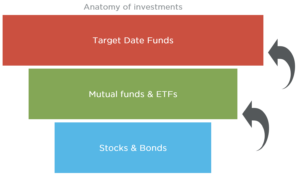
So, there you have it: Target date funds hold mutual funds and ETFs, and mutual funds and ETFs hold stocks and bonds. Which essentially means that you may be invested in a target date fund or mutual funds and ETFs, but either way, somewhere under all of the layers, you are probably invested in individual stocks and bonds.


The Important Questions Everyone Should Be Answering

October 30, 2017

It’s been a sad week in my neighborhood. One of our neighbors just down the street, a father and husband, was in a freak accident in his yard and was killed last Saturday. He was probably in his mid-40’s; much too young to die. I saw his widow a couple days ago, who is obviously still in shock, and her comment was, “he was supposed to be here,” and she is right.

Asking the tough questions

I am surprised by the effect that it has had on my husband and me. There are no guarantees that either of us will still be here tomorrow and this really drove it home for us. We found ourselves grappling with several big questions.

  • How would one of us handle the kids without the other there to help?
  • Would we move? Where to?
  • Do we really have adequate life insurance in place?
  • Where and how do we want to be buried?
  • What would have to be done with our financial accounts to change the ownership?
  • How would we make the immediate post-death decisions; on our own or would we be pressured by family members to do things a certain way?
  • Whose feelings are more important, the widow/er’s or the mom’s?

These are all loaded questions and not fun to hash out, but that’s what you have to do when making your estate plan. Many of us take a gamble that it will never happen, so why bother until we’re older? When does “older” get here?

The time is now

I challenge you, by the end of this year, to sit down on your own or with your spouse if you are married, and review all of these questions and figure out the answers. If it means digging out your old estate planning documents, then do that. If it means, creating new ones, do it. If it means talking to your bank and making sure you have beneficiaries on all accounts, make it happen. If you don’t know if you have enough life insurance, find out.

Even if you don’t end up using any of these plans, you benefit just by having the conversation. I know it’s helped my husband and I to clear up a few loose ends. Make it happen.

And, stay safe out there everybody, it’s a crazy world.

Want more helpful financial guidance, delivered every day? Sign up to receive the Financial Finesse Tip of the Day, written by financial planners who work with people like you every day. No sales pitch EVER (being unbiased is the foundation of what we do), just the best our awesome planners have to offer. Click here to join.