September 03, 2026 Financial Wellness Benefit ROI Calculator | Financial Finesse
ROI Calculator | 2026
Financial Wellness Benefits
Employer ROI Calculator
Estimate the potential annual cost savings of a financial wellness benefit across seven cost categories, based on your organization’s size, income profile, and workforce characteristics.
First PrizeSOA Call for Essays
Financial Wellness
Think Tank™
01Your Organization
Enter your organization’s data below. All figures are used only in your browser to calculate an estimate and are not transmitted or stored anywhere.
Enter either an annual salary or an hourly rate, and select which one applies.
Share of your workforce approaching retirement age.
Defaults to 11.4%, estimated per the source model’s own method (40 ÷ 3.5 years BLS median private-sector employee tenure). Replace with your organization’s actual rate if known.
Includes EAP counseling, therapy or teletherapy programs, and other employer-sponsored mental health support. See methodology below.
02Estimated Annual Savings
Total Estimated Annual ROI
$0
Illustrative projection based on the inputs provided and the improvement assumptions described in Section 3.
These figures are illustrative projections modeled from third-party research and Financial Finesse program data. Actual results depend on program design, employee engagement, and organizational context. They are not a guarantee of savings.
Click the button, or press Ctrl+P (Windows) / Cmd+P (Mac), then choose “Save as PDF” as the destination. Some browser security settings block the button; the keyboard shortcut always works.
03Sources & Methodology▾
This calculator models seven cost-saving categories associated with financial wellness benefits: wage garnishment processing, FSA/HSA administration, absenteeism, healthcare cost trend, delayed retirement, turnover, and mental health-related costs. Garnishment, FSA/HSA, and healthcare savings scale with employee count using fixed per-employee benchmarks; the remaining categories also incorporate the income, retirement, quit rate, and mental health usage figures provided above.
How we define “mental health-related costs” In this calculator, mental health-related costs refer specifically to lost productivity and missed workdays linked to unaddressed stress, anxiety, depression, and other psychological distress. The $5,000-per-employee benchmark comes from a national study of the general working population, not Financial Finesse client data.
Why this doesn’t double-count savings: Healthcare spending and turnover costs linked to mental health are already captured in the Healthcare Cost Trend and Turnover categories above, using separate benchmarks. This category is limited to the lost-workday/productivity impact only, so it does not re-count savings claimed elsewhere in the model.
Because most employers can’t measure how many employees are experiencing psychological distress, this calculator uses utilization of mental health benefits (EAP counseling, therapy or teletherapy programs, mental health apps, etc.) as a practical stand-in for that population. Employees who use these benefits are a subset of everyone who could be struggling, so this approach is intentionally conservative — it is more likely to understate potential savings than overstate them.
1.Delayed retirement cost basis. Financial Finesse Think Tank internal analysis.Proprietary Research
2.Turnover cost benchmark. “More Than You Think: The Cost of Employee Turnover,” GrowthForce.
3.Mental health cost benchmark. National Safety Council and NORC at the University of Chicago, “Mental Health Cost Calculator” (2021), based on 2015–2018 National Survey on Drug Use and Health data; as reported in “Mental distress costs employers $5,000 per worker each year,” Business Insurance.
4.Wage garnishment, FSA/HSA, and healthcare cost trend figures are internal Financial Finesse Think Tank estimates. No external source is cited for these three categories in the underlying model.
5.Default annual turnover rate (11.4%) is estimated as 40 ÷ median private-sector employee tenure, per the source model’s own guidance, using U.S. Bureau of Labor Statistics Employee Tenure data (3.5 years, January 2024, the most recent available release).
6.Mental health definition and workplace context. Center for Workplace Mental Health, American Psychiatric Association Foundation.
7.This calculator is built on the model presented in Gregory Ward, “Calculating ROI: Measuring the Benefits of Workplace Financial Wellness,” which won First Prize among the essays submitted to the Society of Actuaries’ Call for Essays.
The Real Cost of Financial Stress: Making the Case for Financial Coaching ROI
June 18, 2026
Financial stress is not a personal problem that happens to show up at work. It is a workplace problem that shows up in the data every single quarter, across payroll reports, healthcare invoices, absence logs, and retirement plan statistics. Employers may be tempted to evaluate financial wellness programs the way they evaluate office perks, asking whether employees like the benefit. Instead, what they should evaluate is whether the program moves the needle on employee financial stress, behavior, and ultimately bottom-line cost. To put it succinctly, it does.
Financial Finesse has spent more than two decades measuring the relationship between employee financial wellness and employer costs. What that research reveals is that financial stress is not just a hardship for employees. It is one of the most expensive, most underappreciated line items on any CFO’s balance sheet, and financial coaching is one of the highest-return investments an employer can make to address it.
This piece updates and expands our predictive ROI model to reflect a more complete picture of what financial stress actually costs, including two dimensions, presenteeism and mental health, that have historically been left out of the calculation entirely.
The predictive model: measuring what actually changes
Financial Finesse’s ROI model is built on observed behavioral data, not assumptions. Using our proprietary 10-point Financial Wellness Scale to measure employee financial health across a large client base, we tracked what happens to specific, measurable employer cost drivers as financial wellness scores improve.
The model’s anchor scenario is straightforward: what is the estimated cost savings for a 50,000-employee organization when the median workforce financial wellness score improves from a 4 to a 6? A score of 4 represents an employee who is actively working on establishing their financial resilience. A score of 6 represents an employee who is financially resilient and actively working on their long-term financial goals and security. This is not a dramatic transformation, but a realistic, achievable improvement driven by consistent engagement with a high-quality financial coaching program.
Across eight measurable cost categories, the results are significant.
Eight ways financial stress costs employers money
1. Absenteeism
Employees under financial stress miss more work. Our research found that unplanned absences fell from an average of 13.73 hours to 10.35 hours when employees moved from a financial wellness score of 4 to 6. Based on an average annual salary of $50,000, that improvement could save a 50,000-employee organization more than $4.2 million annually in reduced unplanned absence costs alone. This finding was independently corroborated by a Personal Finance Employee Education Foundation (PFEEF) study in which financial education program participants averaged 11 unscheduled absence days compared to 16 days for non-participants.[1]
2. Presenteeism
Absenteeism is visible. Presenteeism is not, and that makes it far more costly and far easier to overlook. According to Mercer, the average financially stressed employee spends approximately 150 hours per year distracted by financial worries while at work.[2] That is nearly four full work weeks of lost productivity per employee, per year. For a 50,000-employee organization, even a modest reduction in financially driven presenteeism could represent tens of millions of dollars in recovered productivity. Using conservative assumptions, a 25 percent reduction in financially driven distraction time would represent an estimated $6.25 million in recovered productivity for a 50,000-employee workforce earning an average salary of $50,000.
Presenteeism is the single largest underreported cost of financial stress. Employers who exclude it from their ROI models are significantly underestimating the value of financial coaching.
3. Healthcare costs
Financial stress is a health condition in practical terms. The American Psychological Association has documented the physical toll of chronic financial worry, including elevated cortisol levels, disrupted sleep, and suppressed immune function. These are not soft outcomes. They show up in claims data.
A Financial Finesse study of a Fortune 100 healthcare company found that employer healthcare costs for employees who used the company’s financial wellness program decreased by 4.5 percent, while costs for non-users increased by 19.4 percent over the same period. The net savings came to $271.50 per employee. For a 50,000-employee organization, that is a potential annual healthcare cost reduction of more than $13.5 million.
4. Mental health costs
Financial stress and mental health are deeply interconnected. Chronic financial worry is one of the leading drivers of anxiety and depression in working adults, and that distress carries a direct, measurable cost to employers. According to research from the National Safety Council and the National Opinion Research Center at the University of Chicago, employees experiencing mental distress cost employers nearly $5,000 per person annually in lost work days alone.[3]
A financial coaching program that reduces financial stress addresses one of the most common and costly root causes of employee mental distress at its source. Assuming a conservative 10 percent reduction in financially driven mental distress across a 50,000-employee workforce where 30 percent of employees are meaningfully affected, the potential savings in lost work days alone approach $7.5 million annually. For HR leaders already investing in employee assistance programs or mental health benefits, financial coaching is a high-leverage complement that targets the underlying problem rather than just its symptoms.
5. Delayed retirement
When employees cannot afford to retire, they do not. The Transamerica Center for Retirement Studies has documented that a significant portion of employees plan to work past age 65 not by choice, but by financial necessity.[4] For every year a retirement-ready employee delays retirement for financial reasons, employers absorb estimated additional costs of $50,000+ in higher compensation, benefits costs, and reduced workforce mobility.[5]
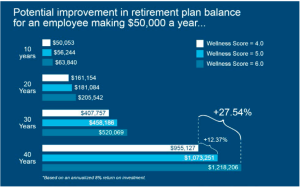
Financial Finesse research found that improved retirement contribution rates driven by better financial wellness could increase an employee’s lifetime retirement savings by 12 to 28 percent. Among employees who engaged repeatedly with their employer’s financial coaching program, the likelihood of being on track for retirement increased from 38 percent to 52 percent, a 14-point improvement. For a 50,000-employee organization, that shift translates to an estimated $8.75 million in annual cost reduction related to delayed retirement.
6. Employee turnover
Replacing an employee is expensive. Research from SHRM estimates that direct replacement costs range from 50 to 60 percent of an employee’s annual salary, with total costs including lost productivity and retraining reaching 90 to 200 percent of annual salary.[6] A financial wellness program that reduces financial stress and improves employees’ sense of being valued by their employer meaningfully reduces voluntary turnover.
Even a one percent reduction in turnover at a 50,000-employee organization, using a conservative $25,000 net replacement cost per employee, saves more than $1.25 million annually. The benefit compounds over time as employee tenure increases and institutional knowledge is retained.
7. FSA and HSA utilization
Flexible spending accounts and health savings accounts reduce taxable payroll for both employees and employers. When employees do not understand these benefits, both parties leave money on the table. Financial Finesse research found that as financial wellness scores improved from a 4 to a 6, average combined FSA and HSA contributions increased from $905 to $1,137 per employee. Since these contributions are not subject to FICA tax, higher utilization generates direct employer FICA savings. For a 50,000-employee organization, that improvement translates to nearly $900,000 annually in reduced matching FICA tax payments.
8. Wage garnishments
Wage garnishments are a growing administrative and compliance burden for employers. According to Wolters Kluwer, garnishments are rising in 2026, driven in part by surging consumer debt and the resumption of federal student loan collections.[7] Research from the ADP Research Institute found that approximately 7.2 percent of U.S. workers have their wages garnished,[8] meaning a 50,000-employee organization can expect roughly 3,600 employees to have active garnishments at any given time. Each garnishment costs an employer an estimated $300 annually in payroll staff processing time.
Financial Finesse research found that moving from a financial wellness score of 4 to 6 reduces the likelihood of garnishment by 62 percent. Applied to a 50,000-employee workforce, that improvement would eliminate approximately 2,232 garnishments annually, generating an estimated $669,600 in reduced processing costs. As garnishment volumes continue to climb, the administrative value of preventing new garnishments through proactive financial coaching becomes increasingly significant.
The BIG picture: total estimated savings for a 50,000-employee organization
Cost category
Estimated annual savings
Absenteeism
$4,264,396
Presenteeism
$6,250,000
Healthcare
$13,575,000
Mental health
$7,500,000
Delayed retirement
$8,750,000
Turnover
$1,250,000
FSA and HSA FICA
$887,229
Garnishments
$669,600
Estimated total
$43,146,225
These estimates are intentionally conservative, based on modest improvements in financial wellness and realistic impact assumptions. The actual return for organizations with high-quality, well-utilized programs will in many cases exceed these projections.
What separates programs that deliver ROI from those that do not
Not all financial wellness programs produce these outcomes. The ROI modeled above assumes a program with specific characteristics: guidance delivered by credentialed financial professionals who have no products to sell, access that is unlimited and employer-paid so that cost is never a barrier to engagement, and a delivery model that meets employees where they are rather than requiring them to seek out help.
Programs built around one-time financial education workshops, generic digital content libraries, or advisor referral networks that employees must navigate on their own do not produce the same behavioral change. The research consistently shows that repeated, personalized engagement with a credentialed financial coach is what drives the improvements in behavior that generate measurable ROI.
Employers who are serious about measuring the return on their financial wellness investment should benchmark their workforce’s financial wellness score at program launch, track engagement over time, and measure changes in the specific cost categories outlined above.
Final word
Financial coaching is not a benefit offered because it feels good, though it does matter to employees and creates real goodwill. It is a benefit that, when designed and delivered well, generates a return that is measurable, significant, and defensible to any CFO or benefits committee. The question is not whether financial wellness programs produce ROI, but whether employers are measuring it, and whether the program they have in place is built to deliver it.
This analysis draws on Financial Finesse Think Tank™ research, Mercer workforce productivity data, and published industry benchmarks for mental health, turnover, and healthcare costs. The Financial Wellness Think Tank™ is the research division of Financial Finesse, the leading independent global provider of unbiased financial coaching as an employee benefit.
[1] The study was conducted on behalf of a Fortune 100 healthcare provider to evaluate the ROI of their financial wellness program through Financial Finesse.
How Do Employers Measure ROI on Financial Wellness Programs?
May 29, 2026
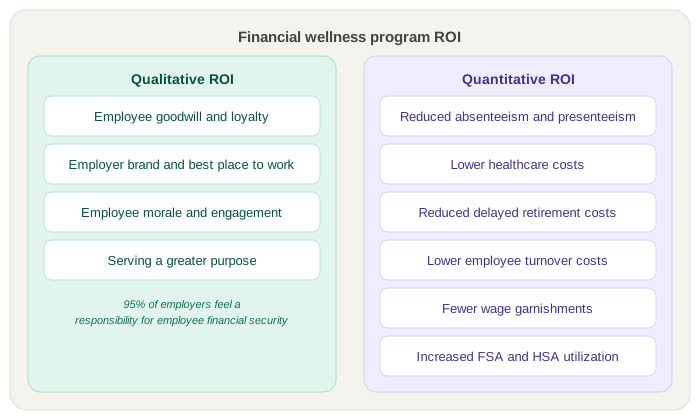
Employers measure the return on investment of a financial wellness program in two ways: qualitatively, through the human and cultural value the benefit creates, and quantitatively, through measurable reductions in direct costs like absenteeism, healthcare expenses, delayed retirement, turnover, wage garnishments, and underutilization of tax-preferred benefits. Together, these two lenses tell the complete story of what a financial wellness program is worth.
Why measuring ROI matters
Financial wellness programs represent a meaningful employer investment. Benefits leaders who can connect that investment to measurable outcomes are better positioned to justify the budget, expand the program, and demonstrate its value to leadership and finance teams.
The good news is that the data exists. Research consistently shows that financially stressed employees cost employers real money in ways that show up in the numbers that CFOs and CHROs already track. A strong financial wellness program moves those numbers in the right direction.
The qualitative case: why employers say it is simply the right thing to do
Not every return on a benefit shows up in a spreadsheet, and leaders at the world’s top employer brands understand this. According to the Employee Benefit Research Institute’s 2025 Financial Wellbeing Employer Survey, 95 percent of employer respondents believe their company has a responsibility to ensure employees are financially secure and well. That belief reflects a broader shift in how leading organizations think about their role in employees’ lives.
The qualitative ROI of a financial wellness program includes several dimensions that are harder to quantify but no less real.
Offering financial coaching signals to employees that the company cares about their lives outside of work, not just their productivity inside it. This sense of goodwill builds loyalty that is difficult to manufacture through compensation alone. Employees who feel genuinely supported by their employer are more engaged, more likely to stay, and more likely to serve as advocates for the organization.
Financial wellness benefits also reinforce an employer’s brand as a best place to work. Recognition from organizations like Fortune, Glassdoor, and industry-specific awards increasingly weighs whether employees report low financial stress and feel their employer supports their total wellbeing. A strong financial wellness program contributes directly to the factors those surveys measure.
There is also the matter of purpose. Many HR leaders describe the decision to offer financial coaching with a phrase that resonates beyond cost calculations: it is the right thing to do. Employees bring their whole selves to work. When financial stress consumes a significant portion of their mental energy, the impact spills over into every dimension of their performance and health. An employer who helps reduce that stress is doing something genuinely meaningful.
The quantitative case: where the numbers show up
The financial impact of a well-designed financial wellness program shows up across several measurable cost categories. Research from Financial Finesse’s Financial Wellness Think Tank™, including an independent case study of employees conducted by the Personal Finance Employee Education Foundation (PFEEF), provides clear evidence that employees who participate in financial education programs generate meaningfully better outcomes across each of these dimensions.
Absenteeism and presenteeism
Financial stress is one of the leading drivers of unplanned absences. Employees who are worried about money are more likely to miss work and less productive when they are present, a phenomenon known as presenteeism. In the PFEEF case study, financial education program participants averaged 11 unscheduled absence days compared to 16 days for non-participants. Based on a proprietary predictive model developed by Financial Finesse’s Financial Wellness Think Tank™, moving a workforce’s median financial wellness score from a 4 to a 6 on a 10-point scale could save a 50,000-employee organization more than $4.2 million annually in reduced unplanned absences alone.
Healthcare costs
Financial stress manifests physically. A study of a Fortune 100 healthcare company found that employer healthcare costs for employees who used the company’s financial wellness program actually decreased by 4.5 percent, while costs for non-users increased by 19.4 percent over the same period. That difference translated to a net savings of $271.50 per employee. For a 50,000-employee organization, that is a potential annual healthcare cost reduction of more than $13.5 million.
Delayed retirement
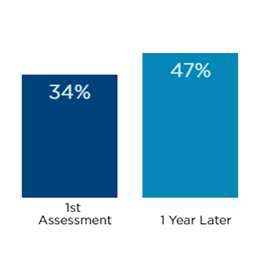
When employees cannot afford to retire, they often stay in the workforce past their intended retirement date. This creates a cascading cost problem for employers: higher compensation costs, reduced mobility for career advancement among younger employees, and challenges with workforce planning. Research from Financial Finesse’s Financial Wellness Think Tank™ found that employees who engaged repeatedly with their employer’s financial wellness program increased their likelihood of being on track for retirement from 34 percent to 47 percent. For a 50,000-employee organization, that 13-point improvement translates to an estimated $6.5 million in annual cost reduction related to delayed retirement.
Employee turnover
Replacing an employee is expensive. Direct replacement costs can range from 50 to 60 percent of an employee’s annual salary, with total costs including lost productivity and retraining ranging from 90 to 200 percent. A financial wellness program that helps employees feel more secure and more valued reduces voluntary turnover. Even a one percent reduction in turnover at a 50,000-employee organization could save more than $1.25 million annually.
Wage garnishments
Wage garnishments create administrative burden and cost for employers. Processing a single garnishment costs an employer an estimated $300 per year. Research from Financial Finesse’s Financial Wellness Think Tank™ found that improving a workforce’s financial wellness score from a 4 to a 6 reduces the likelihood of garnishment from 4.8 percent to 1.8 percent. In one case study, garnishment rates were 5 percent for program participants versus 8 percent for non-participants. For a 50,000-employee organization, the reduction in garnishment processing costs alone can exceed $440,000 annually.
FSA and HSA utilization
Flexible spending accounts and health savings accounts reduce taxable payroll for both employees and employers. When employees do not understand or use these benefits, both parties leave money on the table. Financial wellness coaching increases FSA and HSA participation rates. In the case study, program participants contributed significantly more to both health FSAs and dependent care FSAs than non-participants. Research from Financial Finesse’s Financial Wellness Think Tank™ found that improving financial wellness from a score of 4 to 6 increased average combined FSA and HSA contributions from $905 to $1,137 per employee, generating nearly $900,000 in annual FICA tax savings for a 50,000-employee organization.
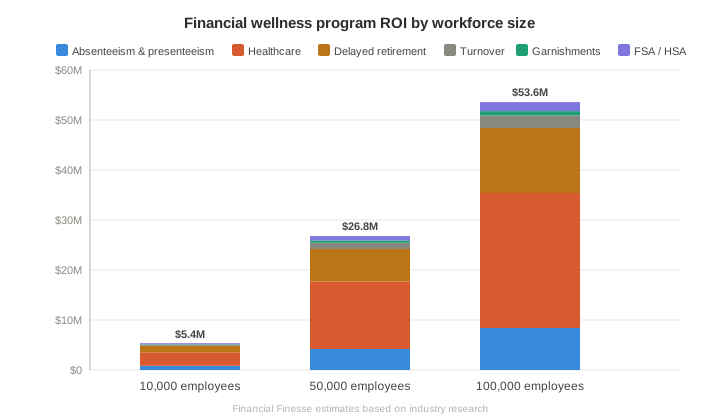
The chart below shows how these quantitative savings stack up across employer sizes based on Financial Finesse’s predictive model.
What an independent ROI study found
The PFEEF case study is one of the most rigorous independent analyses of financial wellness program ROI available. Based on data from 8,233 program participants and an equal-sized control group of non-participants, the study calculated a return-on-investment ratio of 5.50 to 1 under conservative assumptions. That means for every dollar invested in the Financial Finesse program, the company received $5.50 in net benefits. Under more optimistic but still realistic assumptions about program impact, the ROI ratios reached 9.76 to 1 and 15.07 to 1.
The study measured outcomes across unscheduled absences, wage garnishments, FSA contributions for both health and dependent care, retirement plan contribution rates, and job performance. Participants outperformed non-participants on every measurable metric.
How to build your own ROI case
HR leaders do not need to wait for a third-party study to make the case for a financial wellness program. A practical ROI analysis can be built using data that most organizations already collect or can reasonably estimate.
Start by establishing a baseline. What is the organization’s current rate of unplanned absences? What are annual healthcare cost trends? What percentage of employees are on track for retirement? What is the voluntary turnover rate and the estimated cost to replace an employee? What percentage of eligible employees are participating in FSA and HSA programs?
Then model the potential improvement. Financial Finesse’s predictive model uses a 10-point financial wellness scale to project the cost impact of incremental improvements in workforce financial wellness. Even modest improvements, moving the median workforce score from a 4 to a 6, generate savings that dwarf the cost of the program itself.
Finally, track outcomes over time. Financial wellness program ROI is best demonstrated through longitudinal measurement, comparing employee cohorts who engage with the program against those who do not, and tracking how behaviors change as employees progress in their financial wellness journey.
FAQs:
What metrics do employers use to measure financial wellness ROI?
The most common quantitative metrics are reductions in unplanned absenteeism, lower healthcare costs, reduced delayed retirement costs, lower turnover, fewer wage garnishments, and increased FSA and HSA utilization. Qualitative measures include employee engagement, employer brand perception, and workforce morale.
What ROI can employers expect from a financial wellness program?
An independent study of a Fortune 500 healthcare company’s Financial Finesse program calculated a return of $5.50 for every $1 invested under conservative assumptions. Financial Finesse’s own predictive model estimates that moving a 50,000-employee workforce’s median financial wellness score from a 4 to a 6 could generate more than $26 million in annual cost savings across six measurable categories.
How long does it take to see ROI from a financial wellness program?
Some benefits, such as increased FSA enrollment and reduced garnishment processing, can appear within the first year. Larger savings categories like healthcare cost trends and delayed retirement impacts typically emerge over a two-to-five year horizon as employee financial wellness improves and behaviors change.
Does financial wellness ROI only apply to large employers?
No. The cost drivers are present at every employer size. While the absolute dollar savings are larger for larger organizations, the return-on-investment ratio, dollars saved per dollar invested, is comparable regardless of workforce size.
Financial Finesse is the leading independent global provider of unbiased financial coaching as an employee benefit, driving measurable improvements in employee financial wellness and proven employer ROI. Employees receive unlimited access to CFP® professionals and AI-powered guidance that expands reach and personalization with trusted human oversight at every step.
August 2020 Engagement Study
March 15, 2021
Learn how financial coaching influenced coronavirus related distributions in this study conducted by Financial Finesse on behalf of a large, midwestern building supply manufacturer.
Q&A with Financial Finesse CEO, Liz Davidson
May 06, 2020
Financial Finesse’s 2019 Year in Review Research Study & The Impact of a New Normal Post COVID-19
View the entire COVID-19 best practices abstract “The Impact of a New Normal” here.
1.Question:What were the most significant takeaways from the 2019 Year in Review report?
Answer: For this year’s report we looked at how engagement in online, group, and individual learning sessions influence change in financial wellness as measured by the Financial Finesse Financial Wellness Score. The results were astounding.
Employees that engaged in group learning improved their financial wellness score on average 1.11 points, 40% higher than the 0.79-point average improvement by those that engaged exclusively online. But it was the employees that followed the best practice model and engaged in all three forms of learning that topped them all, improving their financial wellness score on average 1.44 points, outperforming group learners by 31% and online-only learners by 83%.
This improvement in financial wellness also translated into improvement in benefit participation. Employees that engaged in the best practice model had a 43% higher retirement plan deferral rate and an 81% higher annual contribution to a health savings or flexible spending account than employees that only engaged online.
We also found that the greatest net improvement—which is the difference between improvement by those that engaged in the best practice model and those that engaged exclusively online—occurred among employees with the lowest levels of financial health. What is even more remarkable is the speed of improvement. Financially stressed employees exhibited the greatest degree of improvement in the shortest amount of time across all levels of engagement.
2.Question:What can employers leverage from the 2019 Year in Review report to help employees navigate the financial impacts of COVID-19?
Answer: In the wake of the COVID-19 pandemic, we are seeing signs of increasing financial stress associated with the stock market and U.S. economy manifesting itself as a lack of trust in sources of financial guidance and concern for not reaching future financial goals. When considering the relationship between physical health, workplace productivity, and financial stress, this should have employers’ attention. The good news for employers is that the best practice model yields the greatest improvement in financial wellness for the most financially stressed employees in the least amount of time. These results could not have come at a better moment in history.
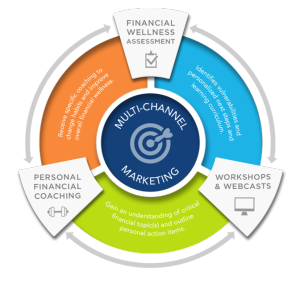
As the pandemic persists, we expect to see a shift toward lower levels of financial health across the global workforce. Given the strong relationship between financial health and employment cost, we encourage employers to focus their COVID-19 efforts on providing financial resources and support to their most financially stressed populations first.This population can be defined through a workforce financial wellness assessment, a demographic analysis, or by measuring financial stress metrics such as retirement plan leakage, garnishment, or benefit utilization. Once the at-risk population is defined, consider offering ongoing financial coaching delivered through a multi-channel model if possible.
3. Question:What drives the trend of end-users in the lowest tiers of financial health exhibiting the greatest level of improvement in the shortest amount of time?
Answer: The emotional courage it takes to confront serious financial issues is significant. Finances still remain taboo, especially for those who are struggling financially, and there’s often a sense of shame or helplessness they have to overcome. The best practices model is well suited to mitigate that, because it is set up to reduce barriers as a financial wellness benefit that can be accessed however employees feel most comfortable, and then migrate to ongoing financial coaching when they are ready. The message they get is “We are all in this together. Everyone has financial challenges. You are not alone and there is nothing to be ashamed of.” That alone makes a huge difference.
Then when you consider the small wins in finding ways to reduce expenses by getting better deals on essential items, get credit relief or lower interest rates, begin the process of starting an emergency fund, can make a huge difference to financial stability, it makes sense that those who struggle most would improve the most with a model that provides unlimited financial coaching through multiple channels.
4. Question:On average, which aspects of an employee’s financial wellness improved the most under the best practices model?
Answer: On average, employees that engaged in the best-practice model for five or more years showed a 1.59-point improvement (on a 10-point scale) in financial wellness score. The greatest net difference between improvement among employees who engaged exclusively online and those that engaged in the best practice model occurred in the areas of retirement planning and investing. Employees that engaged in all forms of learning also had a 43% higher retirement plan deferral rate and an 81% higher annual contribution to an HSA or healthcare FSA than employees that engaged exclusively online. They were also more likely to have a handle on cash flow, have an emergency fund, pay bills on time, be comfortable with debt, and pay off credit card balances in full.
5. Question:How do you anticipate COVID-19 may alter the traditional compensation and benefits structure most workplaces have become accustomed to? Do you anticipate a potential or temporary decrease or suspension of benefits like 401(k) matching, PTO, etc., as employers explore potential cost-savings strategies to avoid having to layoff or furlough employees?
Answer: Many employers are considering any practical cost-saving measures to stay afloat during this crisis. However, rather than decreasing or suspending benefits that impact some, I believe we will see a strategic refocus of attention and funds, where available, towards benefits thought to be more flexible and impactful across the board, like HSA’s for example.
That said, I believe COVID-19 will cause a major mind shift in how we think about employee benefits, in line with human-centered design principles, where the focus shifts from the benefits themselves to the employee’s individual financial needs, integrating benefits in a way that best meets their financial security. This includes:
Increased personalization of benefits so each employee can design their own benefits package that best meets their needs, with the help of digital and phone based financial wellness platforms that guide them through the decision-making process.
Increased focus overall on workplace financial wellness as an employee benefit. Employers are actively looking for support in helping their employees through COVID-19 financially and I believe these efforts will quickly morph into a much deeper commitment to financial wellness as a standalone benefit. Our business more than doubled in Q1 2020 vs. Q1 last year and is only gaining momentum as more employers look for proven and cost-effective strategies to help promote their employees’ wellbeing and financial security.
6. Question:According to PayScale, the gender pay gap has improved 7% since 2015. Why do you think the gender gap in financial wellness continued to widen for women in 2019 despite a narrowing of the gender pay gap over the last several years?
Answer: Historically,the gender gap tends to widen in periods of economic expansion and narrow in periods of economic contraction. This has held true throughout the duration of our research. Based on the data, men tend to be more confident and aggressive in their investment strategies during bull markets, which puts them in a better position financially at the time, but also creates more risk in the event of a market downturn. Women, on the other hand, tend to be more conservative, but also more resilient and take a more active role in managing their finances in a down market. Since 2019 was a strong year for the market and economy overall, the gender gap widened. We fully expect it to narrow post-COVID-19. Please note, the narrowing is not necessary a good thing as it represents the “gap” not “absolute” financial wellness. In tough economic times, both men and women tend to regress financially, women just regress at a slower pace.
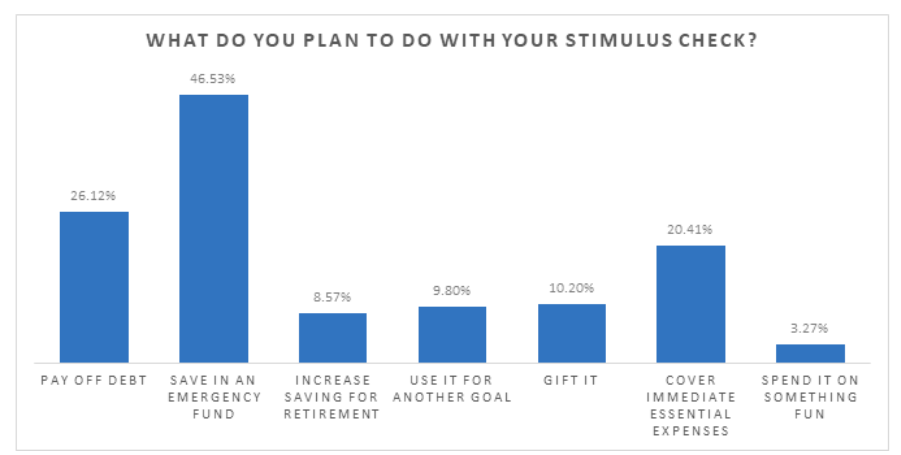
7. Question:How are employees planning to utilize their COVID-19 economic stimulus checks?
Answer: As part of our ongoing COVID-19 relief efforts, Financial Finesse hosts weekly webcasts aimed at helping employees navigate the day-to-day financial changes and decisions we’re all facing. In order to make these webcasts as relevant as possible, we created a follow-up survey and shared it with the thousands of employees who attended. One of the questions we asked was “What do you plan to do with your stimulus check?” Surprisingly, the majority of respondents that received a payment (47%) plan to put it toward an emergency fund. Only one in five (20%) indicated using it to cover immediate essential expenses. While there is no such thing as good news when it comes to COVID-19, we were excited to see most employees proactively saving their stimulus check versus reactively relying on it to cover immediate essential expenses.
How Long-Term Engagement in Financial Wellness Influences Retirement Preparedness
June 07, 2019
For this year’s report, we analyzed the change in financial health over the last five years for employees
who completed a financial wellness assessment in 2013, and again in 2018. Each employee had access
to an employer-paid, multi-channel, holistic financial wellness benefit that included online tools and
resources, educational workshops and webcasts, and personal financial coaching.
Society of Actuaries – Calculating ROI: Measuring the Benefits of Workplace Financial Wellness
May 23, 2019
As human resources executives and benefit-plan sponsors prepare their 2017 budgets, many will question the value of investing in a workplace financial wellness program. Determining the true value of such a program has proved to be elusive, but recent research from the Financial Finesse Financial Wellness Think Tank has introduced a viable way to forecast the potential return on investment (ROI) of the programs using data collected from actual clients. This model, as shared in a 2016 report,1 provides results that indicate employers can find it beneficial to invest in a highquality financial wellness program.
Considering A Financial Wellness Program For Your Employees? Make Sure You Ask These Questions First.
March 03, 2019
These are the first three questions every employer considering financial wellness should ask prospective vendors in order to fully protect their employees and set their programs up for success.
How to Keep Your Employees’ Finances from Flat Lining & Retain Top Talent
April 13, 2017
Healthcare employees rank the absolute lowest in financial wellness, with below average grades in the areas of financial stress, retirement planning, investing, debt, and money management. Read Financial Finesse’s case study of a Fortune 500 Healthcare Company’s successful financial wellness program to learn how to tackle the unique HR and benefits challenges facing healthcare professionals.
How to Actually Change Employee Financial Behaviors
October 19, 2016
What motivates employees to take action to improve their financial health? The single most important part of providing a financial wellness program is motivating lasting changes to the way employees manage their finances. Without doing this, you won’t be able to meet the objectives for the program, including cost savings from an increase in benefits participation and retirement preparedness, reduction in plan leakage, absenteeism, wage garnishments, health care and workers’ compensation costs.
The key? Deliver a workplace financial wellness program that is rooted in the fundamentals of behavioral finance.
Understanding Behavioral Finance
Behavioral finance is the study of why people make irrational financial decisions. Why do we do things with our money that we do? Here’s what we’ve found that has the most impact on employee financial wellbeing:
Willpower is naturally limited According to the American Psychological Association, willpower can be depleted. Your financial wellness program should make it more likely that employees will actually act on the decisions they make. This includes making decisions easy to implement, like a 1-click enrollment in auto escalation of retirement plan contributions. Create a single sign-on so other benefits providers are accessible from your online financial learning center.
Decision fatigue We also get tired of making decisions. Social psychologist Sheela Iyengar estimates that we make at least 70 decisions per day. Providing your education earlier in the day when employees have not yet made many difficult decisions will make it easier for them to act on what they learn.
People are More Emotional than Rational Biases in financial behavior are common. At one point or another, we are all likely to do things like be overconfident, get attached to a reference point that is no longer valid, have clearer views in hindsight, look for confirmation of our opinions, follow the herd and overreact to recent events. Financial education and coaching from an unbiased planner – someone with no ulterior motive to sell financial products or services – helps employees recognize and deal with behavioral biases.
The Financial Behavior Change Model
Financial behavior change can’t be forced, but it can be facilitated. Studies show that if a financial coach knows when an employee is ready to change a certain financial behavior, they can customize their coaching or education to facilitate that change (see one academic study here). The principles of financial behavior change are that it must:
Be employee driven:
Create small wins;
Motivate and encourage;
Stay free of judgment;
Offer accountability;
Measure accomplishments; and
Build a pattern of success.
Financial Coaching Is What Helps Get Employees “Unstuck”
Per the Society for Human Resource Management (SHRM), younger employees in particular expect to access information about wellness programs on their computers and smartphones. It’s the interaction with a financial coach, however, that changes employee financial behavior. According to Financial Finesse’s 2015 Year in Review research, while technology was helpful in increasing employee awareness of their financial vulnerabilities, online interactions alone did not improve employee financial wellness. The more an employee interacts with a financial coach, the more progress they are likely to make. Online only users nationally in 2015 had an average Financial Wellness Score of 4.8 (on a ten scale), while repeat users of workplace financial wellness programs had an average score of 5.7. An incremental increase in financial wellness could save a large company millions from reduced costs of absenteeism and wage garnishments, tax savings from increased HSA and FSA participation and health care savings.
How To Design a Highly Effective Workplace Financial Wellness Program
October 19, 2016
What’s the best way to design a workplace financial wellness program? At their core, effective programs meet the strategic needs of your business. Key areas that drive the creation of workplace financial wellness programs are:
Attracting and retaining talented employees;
Employee financial stress, which costs your organization in areas like higher health care costs, absenteeism and workers’ compensation;
Benefits changes, such as a new high deductible health care plan or changes in an employer-sponsored pension;
Merger or acquisition;
Initiative to build a stronger company culture, increasing productivity and engagement; and
Rising costs of delayed retirements.
According to a Consumer Financial Protection Bureau report, “a financially capable workforce is more satisfied, more engaged, and more productive for their employers.” That’s why 93 percent of companies surveyed in a 2015 Aon Hewitt report are likely to create or broaden their efforts on financial wellness.
Determine the Right Approach for Your Workforce
Workplace financial wellness offerings can range from highly effective, comprehensive solutions fully integrated with company benefits to online-only tools or programs that address specific employee populations. There are three broad approaches:
Benefits-Based Approach A workplace financial wellness benefit can be the one benefit that pulls all the other benefits together, increasing employee understanding, use and appreciation of their value. In particular, when your strategic goals are to engage employees, reduce financial stress, encourage benefits appreciation and realize measurable cost savings by reducing financial stress or benefits appreciation, the best solution is making financial wellness an ongoing employee benefit available to all employees. The foundation of a benefits-based approach to financial wellness is ongoing guidance and coaching that promotes behavior change. Depending on workforce needs, this includes some combination of workshops, webcasts, one to one coaching (telephone, in-person, or both) and online learning.
Program-Based Approach The program-based approach can be a good fit for companies who may not have a strategic need for workplace financial wellness as a benefit offered to all employees, but have a need for support for specific employee populations. Typical employee populations to address with a targeted financial wellness program include pre-retirees, employees offered early retirement, recent college graduates and employees who have requested a retirement plan loan or received a wage garnishment. Companies may also choose to target executives by offering them an unbiased review of their financial plan by an experienced financial planner.
Tool-Based Approach Financial wellness websites and apps are generally used as tools in a more comprehensive program. There are some circumstances where a tool-based approach on its own may be a fit: when you are looking for a lower cost solution to check the box, when you have a very specific issue you want to address— such as helping parents navigate the college planning process, refinancing student loans for employees, offering employees in plan advice to help them better manage their 401(k) investments, or decision making tools that help them select the right health care plan during open enrollment. The right tools can make an impact here, provided you are working with a best in class provider and your population truly needs the service. However, they don’t generally make an enduring impact on overall employee financial wellness, retirement preparedness, or even benefits satisfaction. To do that, a holistic approach is needed. This is why employers are increasingly folding these tools into fully integrated financial wellness programs that utilize a “concierge” service approach where employees are directed to the right tools and benefits based on their needs, while working with a counselor that can help them continually improve their finances over time.
Understand What Your Employees Really Need
Everything starts with data. Once you have decided on whether to implement a benefits-based, program-based or tool-based program based on your strategic needs, you still need to validate the needs of the employees you are trying to reach with the program. There’s nothing worse than spending a large amount of time and money to launch a new program, only to discover that you could have spent half that amount and gotten much more appreciation and utilization from employees who actually needed a completely different service.
For example, you may think student loan debt is a major issue looking at your population— but what if the bigger issue is not knowing how to effectively budget to pay off the debts? You can help provide loan consolidation support for employees in this scenario but the effect will be marginal, as their foundational habits around how they manage their money won’t change. Similarly, in plan advice can be great— but it’s more expensive than target date funds and if employees who rely on their retirement plan as their sole investment vehicle choose in-plan advice thinking it will provide them with a bullet proof investment strategy when a cheaper target date fund would serve essentially the same purpose, you may have actually exposed yourself to legal liability down the road when they realize the extra fees were not justified for their situation.
Why A Workforce Financial Wellness Assessment™ is a “Must Have” Before Making Any Decisions on What To Offer Employees
The only way to truly understand what employees need, whether you are looking to add tools, programs, or a holistic benefit is to better understand their finances, in a confidential, non-invasive way. The best way to do this is to provide them with access to an online financial wellness assessment which they can use to get a snapshot of their personal financial wellness and key next steps to take to improve their finances, including a Financial Wellness Score™ they can use as a gauge to track their progress. Employees take five minutes, answer non-invasive questions about their financial habits, behaviors, and decisions they’ve made — without any account information collected — and you get an aggregated Workforce Financial Wellness Assessment™ detailing the following:
Overall financial wellness broken down by age, income, gender, location, and job classification.
Most pressing needs for each group— from money management to investing, saving for college, protecting their income and assets, retirement planning, etc.
Specific areas within each of these categories that are the most concerning so you can pinpoint which services are best for which population. For example, if 93 percent of those 45-54 are managing their money well and have their debt under control and investing sufficiently for retirement, but most have children and no life insurance and poor college planning strategies, those are the areas to focus on. Conversely, if employees just starting out aren’t even aware of how basic benefits work, but actually have the free cash flow to be able to invest more money into benefits that are important to their future— there may be a need for financial mentorship programs that help them adjust to “real life” and fully maximize benefits they may not even be aware they have available.
The ROI of Workplace Financial Wellness
October 19, 2016
How much money can a highly effective financial wellness program save your organization? The answer, for most large companies, is well into the millions — and that’s focusing on the costs that are easiest to measure: wage garnishments, absenteeism and utilization of FSAs and HSAs. With additional analysis, companies can also measure the savings from reductions in healthcare costs and delayed retirement. Modeling and survey research can benchmark and measure improvements in employee engagement, productivity, retention and morale. While the most toxic effects of unchecked financial stress, like embezzlement, workplace violence and a culture of negativity, are nearly impossible to calculate, it’s intuitive that reducing financial stress would also reduce those problems.
The national average financial wellness score is 5, based on Financial Finesse’s 0-10 financial wellness scale which benchmarks each employee’s financial wellness based on an online assessment. A Workforce Financial Wellness Assessment™ aggregates and analyzes this data on the company level. The chart to the left shows the projected costs savings of an incremental shift in the median workforce financial wellness score from 4-6, which has the potential to save a large employer of 50,000 employees approximately $5.6 million a year.
The cost savings illustrated in the above chart are simply a starting point of what is easy to measure — the tip of the iceberg of a much more in-depth analysis that needs to be done to more accurately calculate the true financial impact.
A strong behavioral-based financial wellness program drives results in areas that are much more strategically important to the success of your organization, such as:
Reducing health care costs;
Reducing delayed retirement costs, with the greatest gains here among employees working in highly physically or mentally tasking jobs where a small decline in their desire or capabilities to do the work can put their own well-being or the well-being of others at risk; and
Recruiting, retaining and engaging employees
Healthcare Cost Savings
A 2014 study from the American Psychological Association reports that 64 percent of those surveyed cited money as a significant source of stress, and that Americans are paying for this stress with their health. Financial stress has been attributed to decreased employee productivity, increased absenteeism and increased employer healthcare costs.
Financial wellness programs are correlated with lower healthcare costs. Our own study of a Fortune 100 healthcare company found that employer healthcare costs associated with employees who used the company’s financial wellness program actually decreased by 4.5 percent, while the costs associated with employees who never used the program increased by 19.4 percent. This equated to a cost savings of $271.50 per employee. If a 50,000-life employer experienced the same cost savings by offering a comprehensive workplace financial wellness program, it could save the employer over $13.5 million a year.
POTENTIAL ANNUAL HEALTHCARE COST SAVINGS
$271.50 (net healthcare savings per employee)
X 50,000 (average number of employees)
= $13,575,000
Reducing Costs of Delayed Retirement
Employees today are woefully underprepared for retirement, with only 21 percent indicating they are on track to achieve their income goals in retirement according to recent research from Financial Finesse. As employees progress through the late career cycle, those who are underprepared may have to delay their retirement for financial reasons. This has repercussions throughout the company in terms of increased health and disability costs as well as the velocity of talent development. According to the Transamerica Center for Retirement Studies®, 65 percent of Baby Boomers either plan to work past age 65 or do not plan to retire at all. For every year an employee who would like to retire delays retirement for financial reasons, the employer faces estimated additional costs between $10,000 and $50,000.
Our research shows that as employee’s overall financial wellness levels increase, so do contributions to retirement plans. Higher contribution rates reduce the likelihood of delayed retirement, since employees are more financially prepared. For younger employees, our research suggests that increases in contribution rates due to improved financial wellness could increase lifetime retirement savings by as much as 12 percent to 28 percent.
Our research also found that employees that engage repeatedly in their employer’s financial wellness program increase their likelihood of being on track for retirement—from 34 percent to 47 percent according to our findings*. For a 50,000-life employer, this 13-point improvement could equate to a $6.5 million annual cost reduction related to delayed retirement.
POTENTIAL COST SAVINGS FOR HELPING EMPLOYEES RETIRE ON TIME
13% (improvement in employees on track to retire)
X 10% (estimated % of workforce nearing retirement)
X $10,000 (estimated annual cost per employee for delayed retirement)
X 50,000 (average number of employees)
= $6,500,000
*Data based on study conducted for Fortune 100 employer using Financial Finesse’s services. Individual company results may vary.
Recruit, Retain, and Engage Top Talent
According to the 2016 Deloitte Millennial Survey, two-thirds of younger employees plan to leave their current job by 2020, with 25 percent saying they plan to leave in less than a year. Turnover costs companies money. Citing the research of W. F. Cascio, the SHRM Foundation’s report, Retaining Talent, indicates that “…direct replacement costs can reach as high as 50 percent to 60 percent of an employee’s annual salary, with total costs associated with turnover ranging from 90 percent to 200 percent of annual salary.” That puts costs anywhere between $45,000 and $100,000 when replacing an employee making $50,000 a year. A 2016 Paychex survey found that approximately 70 percent of employees cited low pay as a reason they have left or would leave a job, and 45 percent said they have or would leave due to a lack of benefits.
In our experience, most employees are dissatisfied with their pay and benefits because they haven’t fully maximized the value of what their company offers. They leave thousands (in some cases tens of thousands) of dollars on the table annually by not taking advantage of free or low-cost benefits such as company matching programs, discounted voluntary benefits, health and wellness benefits, and the small benefits that add up over time like commuter benefits, free parking, tuition reimbursement and others. The money they are foregoing could be the difference between sinking deeper into debt and proactively saving towards key financial goals.
Consider a scenario where a 50,000-life company with a 10 percent turnover rate institutes a comprehensive workforce financial wellness program. If that program resulted in 50 fewer employees leaving the company (i.e., a 1 percent reduction in the turnover rate), it could equate to over $2.2 million in annual savings:
POTENTIAL COST SAVINGS BY REDUCING TURNOVER
1% (projected reduction in employee turnover)
X 10% (turnover rate of employees)
X $45,000 (estimated net cost to replace employee)
X 50,000 (average number of employees)
= $2,250,000
Measuring Your Organization’s ROI
Using Financial Finesse’s predictive model, companies can set research-based benchmarks for their financial wellness program, customized to their employee demographics and financial wellness levels. This starts with a Workforce Financial Wellness Assessment™ to determine the median levels of employee financial wellness and financial stress, followed by implementing optimal outreach based on your workforce demographics. Improving median financial wellness is a process that takes time – there aren’t instant fixes that happen in one quarter. Companies can integrate data based on key measurement variables and benchmark results on a year-over-year basis. For the hypothetical 50,000-employee company discussed here who implements a comprehensive workplace financial wellness program according to industry best practices, pulling all those results together could result in total cost savings of nearly $28 million.

 ROI Calculator | 2026

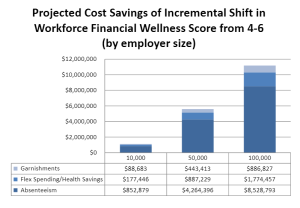 The national average financial wellness score is 5, based on Financial Finesse’s 0-10 financial wellness scale which benchmarks each employee’s financial wellness based on an online assessment. A Workforce Financial Wellness Assessment™ aggregates and analyzes this data on the company level. The chart to the left shows the projected costs savings of an incremental shift in the median workforce financial wellness score from 4-6, which has the potential to save a large employer of 50,000 employees approximately $5.6 million a year.
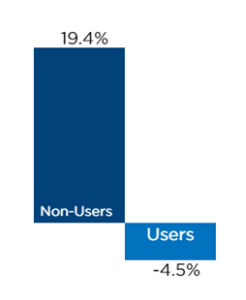 $271.50 (net healthcare savings per employee)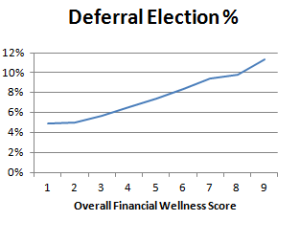
 Our research also found that employees that engage repeatedly in their employer’s financial wellness program increase their likelihood of being on track for retirement—from 34 percent to 47 percent according to our findings*. For a 50,000-life employer, this 13-point improvement could equate to a $6.5 million annual cost reduction related to delayed retirement.