Integrating Employee Benefits Into Workplace Financial Wellness
October 24, 2016Employees Say Benefits Drive Their Engagement with Their Employer, But The Vast Majority Don’t Maximize The Benefits They Have
Employees who understand, maximize and appreciate the value of their employee benefits are happier at work and more productive and engaged. This isn’t just a guess — the research agrees. Per SHRM’s 2016 Employee Job Satisfaction and Engagement Survey, 84 percent of employees indicated that their benefits were critical to their financial wellbeing, and 60 percent said that benefit were a key factor in their decision to join or stay at a company. Yet, most admit not fully understanding the benefits they have and virtually all are not fully maximizing them— accidentally leaving money on the table each year, not even realizing it. Based on our own research working with hundreds of thousands of employees over the years, many are leaving upwards of a million dollars on the table by not maximizing the benefits they have — and instead using that money for “nice to have” purchases that decline in value or going outside their employer to invest in more expensive financial products and services which often don’t have the same tax advantages. In some cases, employees are actually paying out of pocket for benefits the company would otherwise fully or partially subsidize, such as gym memberships, daycare, commuter benefits, legal support, tuition or continuing education reimbursement or relocation expenses. The list goes on.
Even Benefits Managers Don’t Understand Their Entire Benefit Offering
When we work with benefits managers to integrate all employee benefits into their financial wellness program, the most common refrain we hear is, “I didn’t know we had that benefit!” If that’s sometimes the sentiment of those who manage benefits for a living, imagine how employees in the field must feel. Imagine how differently they might feel if they knew all the company was providing them and could take full advantage of every benefit that truly provided a benefit to them personally.
Because of this disconnect, it is absolutely critical your workforce financial wellness program should integrate all benefits so that employees recognize their benefits are a critical part of their financial wellness and have guidance as to how to maximize them as part of their overall financial plan. This helps employees understand where to go to find resources and the role each benefit plays in their financial lives.
It also should be used as the key vehicle to help employees manage benefits changes, so they minimize the impact to their finances and even manage to find ways to make the change work to their advantage.
The Most Successful Employers Offer Employees Unlimited Personalized Guidance On Their Benefits
The most successful benefits planning programs — which help employees maximize their benefits based on their own personal financial situation — employ a “concierge” strategy where the employee has access, both online, through a mobile app, over the phone, and in person, to their own personal financial coach who can help them make the right decisions for their life situation and goals. As a best practice to reach a large number of employees in a deeply personalized the coaching should meet the following criteria:
- The coaching should be delivered by a separate vendor not one of your benefits providers. The vendor you choose should be free from any conflicts of interests associated with employees using certain benefits over others. In addition, the vendor should have deep financial planning expertise as well as a long track record for helping employees integrate benefits into their overall financial plans. In other words, their core business should be centered on providing this kind of personal guidance around benefits, entirely customized to each of their client’s specific benefits offerings. With the complexity of benefits these days, it’s not enough to have someone who specializes in one or two benefits; the reality is that each employee has different financial needs and any coach they work with needs to help them identify and effectively manage all the benefits that meet their needs.
- The company you retain for the coaching should not provide financial advice or sell financial services — both have serious legal risks to the company and potentially to you personally (if you are part of the investment committee who oversees the retirement plan, for example). Guidance is the sweet spot here. The right partner will guide employees and work with them to develop the right strategy, not make decisions for them. The result is better for employees; they learn how valuable their benefits really are and go into all decisions fully informed of the pros and cons. Not to mention, they gain knowledge to become more adept at managing their benefits over time.
- The company should be familiar with ALL benefits you have available—not just retirement or health, but all voluntary benefits, all work-life benefits, all perks, and all tools, resources, apps, and vendors who provide any sort of education or communication around the benefits. Without this knowledge, you only solve part of the problem and employees lose out on key benefits that could be life changing based on their specific needs.
Managing Benefits Changes
Benefits changes are a fact of life today, whether they are for cost-savings reasons, to add more value, flexibility or support to employees, or simply to simplify or streamline a benefits offering to make it easier for employees to manage. Unfortunately, even good changes can add yet another thing for an employee to understand and act upon, and most major changes transition more costs to employees, adding to their financial stress.
If you handle benefits planning through the process described above, benefits changes become much easier to manage, because employees automatically have a coach to turn to in order to make the right decisions for their situation.
However, in virtually all cases, best in class employers do more than simply leverage their existing coaching. Without broad-based communications and education around the changes, and multiple touch points to ensure that all employees affected are aware of the change, it’s easy for important decisions to “fall through the cracks.” Your financial wellness provider should help you proactively communicate and educate employees around all changes —consulting around all aspects of the change management process, producing materials, videos, and tools as needed to help employees navigate the change, and delivering webcasts and workshops to all those affected by the change. They should also provide you with full reporting of employee engagement in these different communications and education campaigns, both for legal documentation but also so you understand what type of communication resonated the most for the purpose of designing future campaigns.
Among the most common changes that require this level of communication and education–
- Changing healthcare plan to a HDHP and HSA;
- Compensation changes;
- Offering early retirement or another severance program;
- Terminating or freezing a benefit, such as a defined benefit plan or retiree health; and
- Integrating employee benefit communications after a merger or acquisition.
One last note
Benefits and personal finances are complicated and highly personal. Beware of any vendor who presents a one size fits all solution that is “turnkey” and “highly scalable”. While their solution may fit into part of a larger strategy, they are typically not set up to provide the level of customization you need to address either employee benefits planning or communication of benefits changes. Your employees care much more about their financial security than any singular benefit you provide. Your ability to bridge the gap between the myriad of benefits and the strategy they need to employ to become financially secure by maximizing these benefits is what matters most. The days of siloed benefits offerings and floods of email announcements on different benefits options are over. It’s now about what it always should have been — the employee who you want to benefit in the first place.
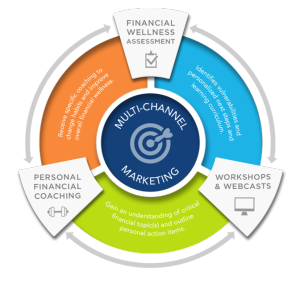
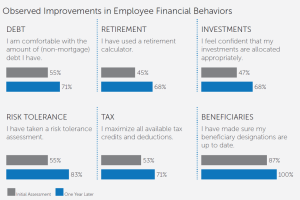
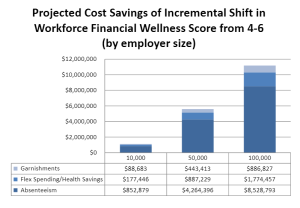 The national average financial wellness score is 5, based on Financial Finesse’s 0-10 financial wellness scale which benchmarks each employee’s financial wellness based on an online assessment. A Workforce Financial Wellness Assessment™ aggregates and analyzes this data on the company level. The chart to the left shows the projected costs savings of an incremental shift in the median workforce financial wellness score from 4-6, which has the potential to save a large employer of 50,000 employees approximately $5.6 million a year.
 $271.50 (net healthcare savings per employee)
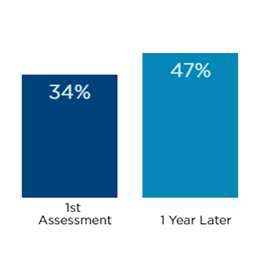
 Our research also found that employees that engage repeatedly in their employer’s financial wellness program increase their likelihood of being on track for retirement—from 34 percent to 47 percent according to our findings*. For a 50,000-life employer, this 13-point improvement could equate to a $6.5 million annual cost reduction related to delayed retirement.