Communicating Financial Wellness Across Borders

September 30, 2026 Communicating Financial Wellness Across Borders: Core Tenets for Global Employers

Financial Finesse Best Practices Guide | 2026
A team of business professionals collaborating during a meeting
Global Benefits Communication

Communicating Financial Wellness Across Borders

Core tenets for global employers, drawn from original research and interviews with Financial Finesse strategists

Financial Wellness
Think Tank™
Key Takeaways

Financial wellness benefits close a measurable gap between employees who understand what support is available to them and employees who do not. Extending that support across a global workforce adds a second layer of work on top of the strategy that already applies within a single market.

  • Awareness GapRoughly four in ten employees do not know what benefits their employer offers, even though two in three employees who report financial stress say it affects their ability to concentrate at work.1
  • Defined OutcomesFinancial wellness communication performs best when every message is deliberate, built to serve a specific outcome tied to the program’s broader goals, rather than sent only to mark that something went out.
  • Point-of-Need TimingIn Financial Finesse client data, a retirement webcast promoted broadly across a workforce drew a 5.6 percent attendance rate, while comparable content timed for employees over 50 facing a voluntary separation decision drew 72.4 percent.
  • Local SubstanceA message that works in one country rarely transfers unchanged. Local resources, channels, and cultural norms around money change what a message should say, not only how it is translated.
  • Relevance Over VolumeThe employers seeing the strongest results are not sending more messages. They are sending more relevant ones, built with local partners and tested against real usage data.
Section 01 The Case for Global Communication

Financial stress follows employees across every market an organization operates in. In a global survey of 38,000 working adults across 35 countries, the cost of living and inflation ranked as the most commonly reported stressor, cited by 64 percent of respondents, followed by concern about the broader economy at 60 percent.1 Among employees who reported financial stress, two in three said it affected their ability to concentrate at work, a link that gives employers a direct business reason to help manage it.1

Despite that incentive, awareness remains a persistent barrier. Roughly four in ten employees report they do not know what benefits their employer currently offers, a gap present regardless of how much an organization has invested in the underlying program.1 The gap carries a measurable cost. Employees who say their employer supports their financial wellness report meaningfully higher job satisfaction than employees who do not: 52 percent say they are very or extremely satisfied with their job, compared with 34 percent among employees without that support.1

Awareness Gap
4 in 10
employees do not know what benefits their employer offers
Job Satisfaction
52% vs. 34%
satisfaction among employees with employer support for financial wellness, vs. without
Productivity Link
2 in 3
stressed employees say it affects their ability to concentrate at work

These findings point to a specific constraint. In many organizations, the limiting factor is not the benefit itself but whether employees ever hear about it in a way that resonates. Financial Finesse strategists rely on a consistent set of tenets to close that gap, first within a single market and then across a global workforce.


Section 02 Universal Tenets: Five that Work Everywhere

Before geography enters the conversation, a set of foundational practices determines whether financial wellness communication succeeds in any single market. Laura Stamps, Financial Finesse’s Director of Program Development and Engagement Strategies, and Jennifer O’Brien, Client Marketing Director, describe five tenets that hold regardless of where an employer operates.

Communicate With a Defined Outcome in Mind

Financial wellness communication works best when every message is deliberate: built to serve a specific outcome tied to the program’s broader goals, rather than sent only to mark that something went out. A broad, one-size-fits-all announcement, such as introducing a new digital hub to the entire workforce, can still be worthwhile, but it should be judged against modest expectations. A message built around a specific outcome, such as encouraging enrollment in a debt paydown program among employees carrying high-interest debt, is a different kind of effort and should be judged against a narrower, more specific goal.

“The most effective communications are intentional and aligned with your strategic goals. Before you begin, be clear on what you expect from your campaign, so every effort works toward a defined outcome rather than communicating without real purpose.”

Laura Stamps, Director of Program Development and Engagement Strategies, Financial Finesse

Financial Finesse strategists frame this as a distinction between reach and depth. A broad message can raise general awareness across an entire workforce, and it is reasonable to expect a modest response from it. A message meant to drive a specific action needs to be targeted to the people that action is relevant to, and delivered when it is relevant to them.

Example
Generic Outreach
Webcast Attendance Rate
5.6%
Retirement-focused webcast, standard content promoted broadly to the entire workforce

Financial Finesse client data shows what that targeting is worth: a retirement-focused webcast promoted broadly across a workforce drew a 5.6 percent attendance rate, while a webcast on comparable retirement content, built for and timed to employees over 50 facing a voluntary separation decision, drew a 72.4 percent attendance rate, nearly 13 times higher. The gap reflected timing and relevance, not a difference in content quality.

The same discipline applies to the goal itself. Financial Finesse strategists point to employers who define a specific outcome, such as reducing financial stress by helping employees exit high-interest debt, and then evaluate every related communication against that outcome rather than against general engagement metrics.

Be Data-Informed

Financial wellness communication also improves when it is built on three categories of data: who the workforce is, where employees sit, and how they have already responded to past outreach. Demographic data identifies who needs help and with what. Engagement data shows which channels and messages have worked before. Financial behavior data, such as retirement contribution rates and loan activity, shows whether a campaign changed what employees actually did.

Audit Before You Build

Before recommending a new communication channel, the more reliable first step is asking what channels already exist and what has already worked. Employers vary widely in what is available to them: some rely on physical worksites and posters, others use QR codes, email, or SMS. Skipping that discovery step means guessing at what will land, a risk that applies equally whether the workforce sits in a single office or across multiple countries.

Make It Human, Not Corporate

Corporate framing tends to produce corporate answers. Financial Finesse strategists describe consistently better results when conversations, including with HR partners themselves, start from real circumstances rather than benefits terminology.

“People often do not know what matters to them until you ask on a human level. Otherwise, you only get corporate answers.”

Laura Stamps, Director of Program Development and Engagement Strategies, Financial Finesse

The same principle applies to employees. A message anchored in a recognizable moment, the cost of groceries, a medical bill, a child heading back to school, tends to land more effectively than a message framed only around plan mechanics.

Choose Creative Partners, Not Order-Takers

A financial wellness vendor that only executes requests, sending a prewritten email when asked, differs meaningfully from a partner that helps design the underlying communication strategy.

“A good partner takes the lift off the communications piece, so an employer does not have to feel like it is building the strategy alone.”

Jennifer O’Brien, Client Marketing Director, Financial Finesse

That distinction matters even more once an organization begins operating across borders.


Section 03 The Global Layer: Five Considerations at Scale

The five tenets above do not change when an organization goes global. What changes is the layer of nuance required to apply them consistently across markets that differ in culture, available resources, and communication norms.

Localize Substance, Not Only Language

“Localization is always going to be important. There is no case in which localization is not a factor.”

Laura Stamps, Director of Program Development and Engagement Strategies, Financial Finesse

In practice, this points to a two-tier model. A single company-wide goal, such as ensuring every employee has an up-to-date beneficiary designation by a set date, can carry one consistent campaign across every market. What changes beneath that shared goal is the framing. In one country, the same campaign might emphasize efficiency and being a prepared, responsible employee. In another, the more effective framing centers on family obligation and protecting loved ones. The company-wide objective stays the same, even as the reason an employee should care about it changes by market.

Localize the Practical Landscape Too

Culture is not the only local variable. What already exists for employees in a given country shapes what a campaign should reference. In the United Kingdom, for example, workers may become eligible around age fifty for a free session with an independent financial adviser, a detail Financial Finesse’s UK-based coaches flagged as directly relevant to campaign timing. Channel preferences, imagery, and color also vary enough by market that a single global template rarely performs as well as one adapted to local expectations.

Draw on Local Coaches, Not a Single Global Contact

Communication planned entirely from a single global point of contact tends to feel like an afterthought to employees in the markets that contact does not live in, according to Financial Finesse strategists. Involving local coaches or planners in shaping the message itself, its timing, and its framing, rather than bringing them in only to translate a plan built elsewhere, changes how that communication is received on the ground.

Doug Spencer

“Leading coaches across so many different countries has taught me that people’s instincts around money shift more by culture and life experience than most global strategies account for. Decades of deflation in Japan taught a generation to delay purchases rather than make them. In parts of Latin America, a history of currency devaluations and retirement plan nationalizations has taught many people to avoid saving and investing. Those instincts rarely show up in a global campaign brief, and only become visible in the actual conversation.”

Doug Spencer, CFP®, Senior Financial Planner/Global Coaching Manager, Financial Finesse

Balance Local Input With Outside Creative Thinking

Local HR partners understand what is normal in their market, but that familiarity can also narrow their thinking to what has already been tried. Financial Finesse strategists describe pairing local partners, who validate cultural fit and flag missteps, with outside creative input that pushes a campaign beyond routine formats. The balance matters: a campaign designed entirely from outside a market risks a cultural misstep, while one designed entirely from inside it risks repeating the same limited playbook.

Recalibrate the Human Tone by Culture

The human-centered approach to messaging described earlier in this report does not travel automatically. Financial Finesse strategists note that even within the United States, treating financial wellness as a personal, human topic rather than a corporate one is a relatively recent shift. Whether that same tone will land in another market depends on local norms around discussing money and personal circumstances openly, and should be tested rather than assumed.

Conclusion

Asked what one change would most improve how global employers communicate this benefit, Laura Stamps pointed to deployment rather than investment. Most organizations already commit budget to a financial wellness benefit. The larger opportunity lies in how that investment gets deployed: beyond email and posters, and into the intersections between financial wellness and other organizational functions and vendor relationships.

Stamps described that intersection as one of the most underused communication strategies available to global employers, and one with meaningful room to grow as more organizations communicate financial wellness benefits across borders.

References

1.Fidelity International. The Fidelity Global Financial Wellness Report 2026. February 2026.
2.Stamps, Laura, Jennifer O’Brien, and Doug Spencer. Interviews and correspondence with Scott Stark. Financial Finesse, August 28 and September 11, 2026.

Making the Most of Open Enrollment

September 01, 2026 Making the Most of Open Enrollment | Financial Finesse
Financial Finesse
White Paper | 2026
Woman reviewing household finances
For Financial Finesse Clients

Making the Most of Open Enrollment

A look at the value already being created for employees during open enrollment, and where the opportunity goes further.

Financial Wellness
Think Tank™
Overview
Executive Summary

Open enrollment, the window each year when employees make their benefits selections, gives employees more reason to engage with their benefits than any other point in the year, and Financial Finesse’s Financial Wellness Think Tank™ data shows they respond accordingly. Webcast attendance climbs sixfold, coaching calls nearly seven times, and use of its online financial wellness hub more than doubles, all compared with the rest of the year.1 For clients already offering Financial Finesse, that surge is a genuine opportunity: many of the employees showing up during open enrollment are engaging with the benefit for the first time, and the guidance they receive measurably eases the financial stress that so often accompanies benefits decisions.

This report explores how that opportunity takes shape in practice: the scale of engagement already underway, the value employees find in the program whether they attend a webcast or work directly with a coach, and the added reach that on-site delivery offers for employees who are not sitting at a desk.

6x
rise in webcast attendance during open enrollment vs. the rest of the year
6.8x
rise in employees calling a financial coach during open enrollment
2.5x
rise in online financial wellness hub usage during open enrollment
01 — Meeting Employees Where They Are
The Case for On-Site Delivery

Webcasts and coaching cover most of the workforce, but not every employee sits at a computer during the day. Two client examples illustrate the value of extending the benefit on-site, through both individual and group sessions.

Distribution Centers
2.2x
A large healthcare employer sent coaches to lead open enrollment workshops in person at its distribution centers. Engagement was 2.2 times higher than with online-only delivery.1
Targeted On-Site Coaching
3.5x
A separate company targeted its open enrollment efforts on locations experiencing significant benefits changes. Coaching utilization at those locations was 3.5 times higher during open enrollment than during the rest of the year.1

On-site delivery, whether in one-on-one sessions or group workshops, extends the reach of open enrollment communication to employees who are less likely to engage through a screen. On-site coaching is worth considering for groups that are particularly difficult to engage online, or that are experiencing a significant change to their benefits.

02 — The Opportunity
Engagement Already Exists

What makes this surge valuable is that it is not a one-time fluke. It repeats every year across the client base, which means clients can plan around it with confidence. Employees do not simply need to be reminded that Financial Finesse exists during open enrollment; they actively seek it out, whether that means logging into the online hub, attending a webcast, or picking up the phone to talk with a coach. Clients that lean into that existing momentum, promoting the program more heavily during this window rather than spreading communication evenly across the year, are working with employee behavior rather than against it.

03 — The On-Ramp
A Great Opportunity to Reach New Users

Open enrollment does more than intensify engagement among employees already familiar with Financial Finesse. It also draws a disproportionate share of employees who are engaging with the benefit for the first time. Thirty-three percent of employees who attend an open enrollment-focused webcast are engaging with the financial wellness benefit for the first time, compared with 22 percent for webcasts on other topics throughout the year, roughly one and a half times the rate.1 Open enrollment, in other words, is a great opportunity to reach employees who might not otherwise engage with their benefit at all.

33%
of OE webcast attendees are engaging with the benefit for the first time
22%
first-time engagement rate for webcasts on other topics, year-round

For many employees, that first touch does not end there. Thirty-two percent of employees who first engaged with Financial Finesse through an open enrollment webcast have already re-engaged with the benefit in less than a year, through another webcast, a coaching session, or the online hub, and likely more as the rest of that year plays out.1 For a meaningful share of the workforce, open enrollment is the reason they started using a benefit that might otherwise have gone untouched.

32%
of first-time OE webcast attendees have already re-engaged with the benefit in less than a year
04 — Strong Results
Employees Leave Prepared and Satisfied

Whether an employee attends a webcast or works directly with a coach, the response is strong.

96%
of OE webcast attendees say they feel better prepared to make a financial decision1
98%
of OE webcast attendees say Financial Finesse is an important part of their benefits package1

That satisfaction carries through into the numbers Financial Finesse tracks for loyalty: open enrollment webcasts carry a net promoter score of 87, and individual coaching sessions booked during open enrollment carry a net promoter score of 94.1 For context, a Net Promoter Score is generally considered good above 20 and excellent above 70 on the standard scale used across industries.2 Financial services firms see a typical median score of 60 and an excellent score starting around 78.3 Both of the scores Financial Finesse sees during open enrollment sit well above those thresholds.

87
net promoter score for open enrollment webcasts
94
net promoter score for individual coaching sessions during open enrollment
05 — The Human Impact
Reduced Financial Stress

The value of open enrollment engagement extends beyond usage figures. Employees who attend an open enrollment benefits event report a measurable decline in financial stress. Financial Finesse’s Financial Wellness Think Tank™ data shows a 40 percent net decrease in the number of employees reporting overwhelming or high financial stress after attending an open enrollment event, alongside a 36 percent net decrease among returning users overall.1 Both figures point to just how effective these engagements are at easing the stress that so often surrounds financial decisions.

40%
net decrease in employees reporting high or overwhelming financial stress
36%
net decrease in financial stress among returning users, year-round

Attendees describe this effect in their own words. Comments collected from open enrollment webcast attendees point to the same theme: clarity in place of confusion, and calm in place of stress.1

Anita was engaging and made things easy to understand, made me feel smart, not stressed and enthusiastic about benefits.

Anita was well informed and provided much needed clarity regarding the change in benefits, along with their cost comparison.

Benefits were explained in easy to understand terms and helped me know what is available and would be useful for me to use.

Extremely tailored to me and presented in an easy-to-understand format. This stuff is confusing, so it was nice to have it broken down for us.

For me being relatively new to the US, it was very helpful to understand the differences in various health plans.

It helped me look at medical plans in ways other than least coming out of paycheck.

Overview of benefits available and how to discern what will serve me best.

Very useful information, helps me understand and maximize my benefits.

06 — Recommendations
Getting More From the Benefit You Already Have

Promote the program as a whole

Webcasts and coaching each earn strong satisfaction scores during open enrollment. Communicating the full range of support available lets employees engage in the way that suits them best.

Treat open enrollment as an acquisition moment

Because a disproportionate share of first-time users engage during this window, promotion aimed at employees who have never used the benefit deserves as much attention as reminders sent to existing users.

Extend delivery on-site where it counts most

On-site coaching is worth considering for groups that are particularly difficult to engage online, or that are experiencing a significant change to their benefits. In-person group and individual sessions during open enrollment produce engagement gains that virtual delivery alone does not reach.

Conclusion

Open enrollment is already a highpoint for engagement. The opportunity in front of most clients is to make fuller use of the moment: promoting the full range of program support, and extending delivery on-site where the workforce is not sitting at a desk.

Financial Finesse’s data suggests the return on that effort compounds. Thirty-two percent of employees who first engaged with the benefit during open enrollment have already re-engaged with it in less than a year, and that figure is likely a floor, since some have not yet reached a full year since their first engagement. Either way, it is engagement that, for many of them, may not have happened at all without that open enrollment moment.1

References

Data cited throughout this report is drawn from Financial Finesse’s Financial Wellness Think Tank™, including engagement records across webcasts, financial coaching sessions, and the online financial wellness hub, together with post-engagement survey responses collected from open enrollment participants across Financial Finesse’s client base. Company examples are drawn from anonymized client engagements and are not attributable to any single named organization. Net Promoter Score benchmarks are drawn from independent third-party industry research and are cited separately from Financial Finesse’s own data.

1.
Financial Finesse Financial Wellness Think Tank™. 2026. “Open Enrollment Engagement and Financial Stress Outcomes.” Internal analysis. El Segundo, CA.Proprietary Research
2.
SurveyMonkey. 2025. “What Is a Good Net Promoter Score (NPS)?” SurveyMonkey Curiosity at Work. Accessed August 13, 2026.
3.
Resonate CX. 2026. “NPS Benchmarks: What Is a Good Score by Industry.” Resonate CX Blog. Accessed August 13, 2026.

The Hidden Cost of Ignoring Deskless Workers’ Financial Wellness

June 12, 2026

Deskless workers represent 80% of the global workforce, yet most financial wellness programs are built for employees who sit at desks. The gap represents a measurable business risk. This research brief quantifies the compounding cost of unaddressed financial stress across four employer dimensions: turnover, safety incidents, disengagement and absenteeism, and benefits waste. It also examines the structural access barriers that keep deskless workers from engaging with the benefits they have, and offers a practical framework for closing the gap.

What Financial Wellness Companies Are Global?

May 29, 2026

As employers build workforces that span multiple countries, the demand for financial wellness programs that work everywhere employees live and work has grown significantly. A small but growing number of providers have developed genuinely global capabilities. These programs range from deep human coaching by locally credentialed professionals to broad digital financial education platforms available in dozens of languages. Financial Finesse is the category leader, having pioneered the industry and built the most comprehensive global coaching platform available, but HR leaders evaluating the market should understand what each provider actually delivers and how those delivery models differ.

Two types of global financial wellness

Not all global financial wellness programs are the same. Understanding the distinction matters enormously when evaluating what your employees will actually experience.

Human coaching programs pair employees with credentialed financial professionals, such as CFP® professionals or their in-country equivalents, for personalized, one-on-one guidance. These programs address complex, individual financial situations and provide the kind of behavior change and stress reduction that digital tools alone cannot replicate.

Digital financial education platforms deliver financial content, courses, tools, and calculators through a technology interface. While these platforms scale efficiently across countries and languages, effective global delivery requires more than translation to overcome differences in financial systems, regulations, workplace benefits, and cultural norms. When properly localized, these platforms are effective for building foundational financial knowledge at scale. They are generally less effective, however, for employees navigating complex or emotionally charged financial decisions, where human judgment, context, and empathy are irreplaceable.

The best programs combine both. The table below summarizes the verified global providers in each category.

Global Financial Wellness Provider Comparison

Global financial wellness provider comparison

Leading providers of employer-sponsored financial wellness programs with international reach.

Provider Delivery model Verified global reach Key differentiators
Financial Finesse Coaching + digital Human coaching by CFP® professionals or in-country credentialed equivalents, plus AI-powered virtual coaching 20,000+ employers; millions of employees worldwide Founded the financial wellness category (1999). Country-by-country platform with full localization of language, culture, and financial systems. Same quality standard globally as the U.S. program. Fully independent — no products sold, ever. Industry’s longest track record and deepest research base.
nudge Global Digital education Personalized digital financial education; no human coaching 195 countries; localized in 79; 40 local languages UK-based. Widest digital footprint of any provider. Behavior science-driven content engine. Impartial — no products sold. Strong employer-of-record track record (PepsiCo: 59 countries, 280,000 employees). Best suited for employers prioritizing broad digital reach over personalized human coaching.
LearnLux Coaching + digital Digital planning tools plus access to CFP® professionals for 1:1 guidance 100+ countries; 35+ languages US-based, founded 2015. Digital-first with CFP® access layered on top. January 2026 partnership with MAXIS GBN (MetLife/AXA network) significantly expanded global distribution. Best suited for employers seeking a digital-led program with coaching access.
Enrich Digital education Online financial education courses, tools, articles, and interactive content; no human coaching 70+ countries US-based. Localized content developed with regional financial experts. Clients include Coca-Cola, Dell, and Ciena. Adaptive platform personalizes experience by country then by individual. Best suited for employers seeking scalable, self-serve digital education globally.
EY Personal Finance Coaching + digital Financial planner access via EY Navigate platform plus digital tools and group workshops 150+ countries via EY global network Division of Ernst & Young; financial planning practice since 1978. Global reach enabled by EY member firms. Planner-driven with strong tax and benefits expertise. Primarily US-centric in delivery focus. Best suited for organizations with existing EY relationships or complex executive financial planning needs.
Financial Finesse highlighted as program originator. Data sourced from provider websites and independent reporting as of Q2 2026.

Financial Finesse: the category leader and global standard-setter

Financial Finesse invented the financial wellness industry. Founded in 1999 by Liz Davidson, the company was the first to offer unbiased, CFP®-led financial coaching as an employer-paid benefit, making personalized expert guidance available to everyday employees rather than only high-net-worth individuals. Financial Finesse coined the term “financial wellness” and is credited with creating what is now a mainstream employee benefit adopted by top employers worldwide.

Today Financial Finesse serves more than 20,000 organizations, reaching millions of employees worldwide through a single integrated platform. It remains fully independent, sells no financial products, and employs coaches whose only incentive is to improve the employee’s financial outcome.

What sets Financial Finesse apart globally is its country-by-country construction. Each market’s program is built from the ground up, not translated from a US original. The language, the cultural framing of money, the local financial system, the retirement structures, the tax environment, and the benefit landscape are all incorporated into the program each employee receives. An employee in the UK receives guidance grounded in UK pensions, ISAs, and income tax. An employee in Canada receives guidance relevant to RRSPs, CPP, and provincial benefit structures. An employee in Japan, Australia, Brazil, or the UAE receives the same quality of coaching, adapted entirely to their local context.

This approach is backed by a human-plus-AI delivery model that mirrors what Financial Finesse built in the US. CFP professionals, or their in-country credentialed equivalents, deliver direct coaching to employees. Aimee, Financial Finesse’s AI-powered virtual coach, extends that reach with personalized, always-available guidance. No other provider has matched this combination of human coaching depth and AI-powered scale across a global platform.

For HR leaders managing distributed workforces, Financial Finesse offers what very few global vendors can: a single vendor relationship, consistent program quality, and genuinely local delivery in every market.

nudge Global

nudge is a UK-based digital financial education platform founded in 2012. Available in 195 countries, nudge provides financial and benefit education localized to specific countries, with content in 40 local languages across 79 markets. It is the provider with the widest digital footprint in the category.[1]

nudge’s platform is built on behavioral psychology and uses personalized, data-driven content to help employees develop financial knowledge and skills at their own pace. It is explicitly impartial, meaning it sells no financial products. PepsiCo partnered with nudge to support employees across 59 countries, and more than a quarter of employees made adjustments to their retirement savings following implementation.[2]

It is important for HR leaders to understand that nudge is a financial education platform, not a financial coaching benefit. Employees receive personalized digital content, financial health checkups, and behavior-based prompts, but do not have access to one-on-one sessions with CFP professionals or equivalent credentialed coaches. For employers seeking the broadest possible digital financial education coverage across the most countries at scale, nudge is a well-established and proven option.

LearnLux

LearnLux is a US-based provider founded in 2015 that blends digital financial planning tools with access to CFP professionals for one-on-one guidance. LearnLux supports employers and employees in over 100 countries worldwide, delivering services in 35-plus languages.[3]

Through a January 2026 partnership with MAXIS Global Benefits Network, co-founded by MetLife and AXA, LearnLux now enables multinational clients to offer employees access to digital financial education, planning tools, and individual guidance across more than 100 countries. This partnership meaningfully accelerated LearnLux’s international distribution.[4]

LearnLux’s model is digital-first, with CFP® access layered on top. Employees use the platform for financial planning tools and educational content, with the option to book sessions with a CFP® professional when needed. This differs from Financial Finesse’s always-available, unlimited coaching model in which human coaching is the core of the benefit rather than an add-on to a digital platform.

Enrich

Enrich is a US-based digital financial education platform whose global program is available in more than 70 countries. The platform delivers localized financial education content developed with regional financial experts and researchers, adapting its material to each country’s financial context rather than simply translating a US curriculum.

Enrich’s approach is entirely digital. Its platform delivers articles, financial education courses, interactive tools, and personalized content based on an individual’s financial situation and goals. It does not include access to CFP® professionals or human coaches. Global clients include Coca-Cola, Dell, and Ciena. Enrich is well suited for employers seeking scalable, self-serve digital financial education that reaches employees cost-effectively across many countries.[5]

EY Personal Finance

EY Personal Finance is the financial wellness division of Ernst and Young, with a financial planning practice dating to 1978. EY Personal Finance is a suite of planner-driven, digitally-enabled financial wellness offerings covering financial planning, benefits guidance, and tax compliance, delivered through the EY Navigate platform. Its global reach is enabled by EY member firms operating in more than 150 countries.[6]

EY planners do not sell financial products, offering objective guidance on topics from debt management to retirement planning. The delivery model is more formal and advisor-centric than coaching-centric, reflecting EY’s professional services DNA. EY Personal Finance is best suited for employers with existing EY relationships or those managing high-complexity employee populations with significant tax and financial planning needs alongside a global footprint.

What HR leaders should ask any global provider

The global financial wellness market is still maturing, and many providers overstate their international capabilities. Before selecting a vendor, HR leaders should ask each provider these questions directly:

  • Is your program built for each country, or adapted from a US or UK original?
  • In which specific countries do you have locally credentialed human coaches delivering one-on-one guidance?
  • What languages does your platform support natively, and can you demonstrate content examples in each?
  • How is your program updated when local tax law, retirement rules, or benefit structures change?
  • Can you provide global client references from the specific countries where our employees are located?

These questions will quickly reveal the difference between providers with genuine global infrastructure and those with global presence on paper only.

FAQs:

What financial wellness companies are global?

The providers with verified global reach as of 2026 are Financial Finesse, nudge Global, LearnLux, Enrich, and EY Personal Finance. They differ significantly in delivery model, with some offering human coaching by credentialed professionals and others delivering digital financial education only.

Which global financial wellness provider offers human coaching?

Financial Finesse, LearnLux, and EY Personal Finance all offer access to credentialed human professionals. Financial Finesse provides the most comprehensive coaching model globally, with CFP® professionals or in-country credentialed equivalents delivering unlimited direct coaching as the core of the benefit, not as an optional add-on.

What is the difference between a financial coaching program and a financial education platform globally?

A financial coaching program connects employees with credentialed financial professionals for personalized, one-on-one guidance on their specific financial situation. A digital financial education platform delivers content, courses, and tools employees navigate independently. Coaching programs tend to produce deeper behavior change. Education platforms tend to offer broader reach at lower cost. The strongest global programs combine both.

Is Financial Finesse available outside the United States?

Yes. Financial Finesse extends the company’s US program internationally through a country-by-country platform. Each market’s program is adapted to its specific language, culture, local financial system, and benefit landscape, delivered to the same quality standard as the US program.


Financial Finesse is the leading independent global provider of unbiased financial coaching as an employee benefit, driving measurable improvements in employee financial wellness and proven employer ROI. Employees receive unlimited access to CFP® professionals and AI-powered guidance that expands reach and personalization with trusted human oversight at every step.


[1] https://nudge-global.com/campaigns/financial-wellness-employee-benefit/

[2] https://www.benefitnews.com/news/benefit-managers-prioritize-financial-wellness-offerings

[3] https://www.prnewswire.com/news-releases/maxis-gbn-partners-with-learnlux-to-provide-global-financial-wellbeing-support-302665543.html

[4] https://www.global-benefits-vision.com/financial-wellbeing-maxis-gbn-partners-with-learnlux/

[5] https://enrich.org/insights/1389/the-newest-international-employee-benefit-financial-wellness

[6] https://www.ey.com/en_us/services/tax/ey-personal-finance

What Is the Difference Between a Financial Coach and a Financial Advisor?

May 29, 2026

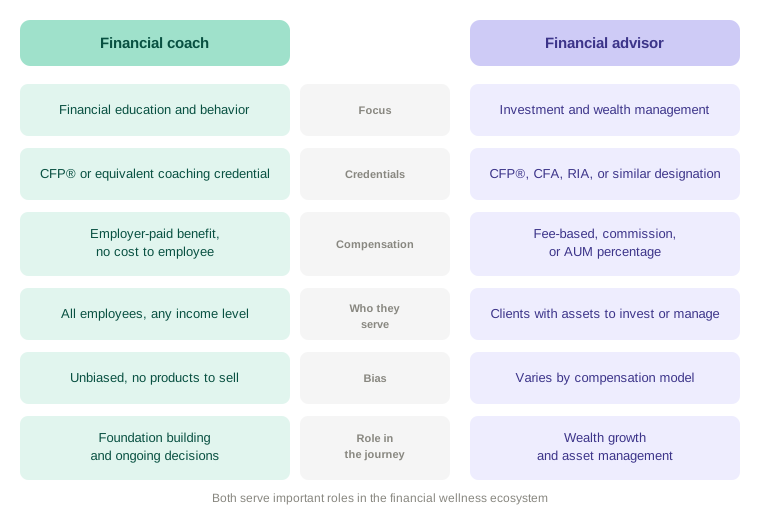
A financial coach helps people understand their finances, build better money habits, and make informed decisions across all areas of their financial life. A financial advisor typically manages investments and builds wealth strategies for people who already have assets to grow. Both serve important roles, but they operate at different stages of the financial journey and are often most powerful when they work together as part of a broader financial wellness ecosystem.

Why HR leaders should understand this distinction

When evaluating financial wellness benefits, the coach versus advisor question comes up often. Many employees have never worked with either. Others assume these roles are interchangeable. HR leaders who can articulate the difference clearly are better positioned to match the right benefit to the right employee need, and to explain the business value of financial coaching to leadership and benefits committees.

The short version: financial coaching is a benefit designed for everyone. Financial advice is typically offered as a service for those already managing significant wealth.

What a financial coach does

A financial coach helps employees navigate the full range of financial questions and decisions they face throughout their lives. This includes understanding how to build a budget, pay down debt, establish an emergency fund, make sense of employee benefits, plan for retirement, and protect their family with the right insurance coverage.

The coaching relationship is educational and empowering by design. A coach does not make decisions for the employee. Instead, the coach helps the employee understand their options, build financial confidence, and develop the habits and knowledge to make sound decisions on their own over time.

In a workplace financial wellness benefit, coaches are typically CERTIFIED FINANCIAL PLANNER® (CFP®) professionals or their in-country equivalents. CFP professionals hold one of the most rigorous and respected credentials in financial services, covering financial planning, tax, insurance, retirement, and estate planning. At Financial Finesse, for example, every coach is a CFP® professional (or in-country equivalent), meaning employees receive expert guidance regardless of their income level, financial situation, or the complexity of their situation.

Critically, financial coaches are an employer-paid benefit, have no products to sell, and no commissions to earn. Their only job is to help the employee. This makes financial coaching one of the only truly unbiased sources of financial guidance most employees will ever have access to.

What a financial advisor does

A financial advisor focuses primarily on managing and growing wealth. This typically involves creating an investment strategy, managing a portfolio, and helping clients plan for major wealth-related milestones such as retirement drawdown, estate planning, and tax optimization on investments.

Financial advisors operate under a range of compensation models. Some charge a flat fee for their services. Some earn commissions on financial products they recommend. Others charge a percentage of the assets they manage, often referred to as an AUM (assets under management) fee. Understanding how an advisor is compensated matters because it can influence the recommendations they make.

Financial advisors are well suited for people who have accumulated meaningful assets and need ongoing investment management and sophisticated planning. Most financial advisors also have minimum asset thresholds, which can make their services inaccessible to employees who are still building their financial foundation.

Why they are not competing, but complementary

The most important thing for HR leaders to understand is that financial coaches and financial advisors serve different needs at different stages of an employee’s financial life, and the strongest financial wellness ecosystems include both.

Think of it as a progression. Financial coaching meets employees where they are, often before they have significant assets to manage. A coach helps an employee get their cash flow under control, build emergency savings, pay off high-interest debt, and start saving for retirement. Over time, as that employee builds wealth, they may reach a point where a financial advisor makes sense.

In this way, a financial wellness benefit that includes strong coaching does not compete with financial advisors. It creates better clients for them. Employees who arrive at a financial advisor already financially literate, with no high-interest debt and a clear sense of their goals, are in a far stronger position than those who arrive without that foundation.

What this means for benefits design

When an HR leader is evaluating financial wellness programs, the key question is not “should we offer coaching or advisory services?” The better question is: “What does the majority of our workforce actually need right now?”

For most employee populations, the answer is financial coaching. Research consistently shows that financial stress is widespread across all income levels, and that most employees lack basic financial literacy, emergency savings, and confidence in their financial decisions. Financial coaching addresses this directly, at scale, and at no cost to the employee.

For higher-income segments of the workforce, such as executives or senior professionals with complex compensation, an advisor referral network or supplemental advisory benefit may also be appropriate.

The gold standard is a benefit that provides every employee with access to a credentialed financial coach as a starting point, with a pathway to connect with more specialized resources, including financial advisors, when the employee’s needs evolve.


FAQs

Is a financial coach the same as a financial advisor?

No. A financial coach focuses on education, financial decision-making, and building a strong financial foundation. A financial advisor focuses on managing investments and growing wealth. Both serve important roles, but they operate at different stages of the financial journey.

Do financial coaches manage money or investments?

No. Financial coaches provide guidance and education to help employees make their own informed financial decisions. They do not manage portfolios or direct investments on behalf of clients.

Are financial coaches unbiased?

When coaching is delivered as an employer-paid benefit, yes. Coaches in a financial wellness program like Financial Finesse have no products to sell and no commissions to earn, which makes their guidance genuinely objective.

Do employees need a certain income level to work with a financial coach?

No. Financial coaching as an employee benefit is available to all employees regardless of income, savings level, or financial situation. This is one of the most significant differences from traditional financial advisory services, which often require minimum asset thresholds.

Can an employee work with both a financial coach and a financial advisor?

Yes, and for many employees this is the ideal approach. A coach helps build the financial foundation. As wealth grows, an advisor can take on investment management and sophisticated planning. The two roles complement each other.


Financial Finesse is the leading independent global provider of unbiased financial coaching as an employee benefit, driving measurable improvements in employee financial wellness and proven employer ROI. Employees receive unlimited access to CFP® professionals and AI-powered guidance that expands reach and personalization with trusted human oversight at every step.

Infographic: Coach to Advisor Case Study

April 03, 2023

How one family brought their Financial Coach and Financial Advisor together to optimize outcomes.

Think Tank Bulletin: Student Loan Debt on the Workforce

March 21, 2023

Currently, an estimated 43.5 million Americans carry over $1.7 trillion in student loan debt—an average of over $37,500 per…

COVID-19 Special Report: The Impact of a New Normal

May 13, 2020

At the time of this report, America is battling the COVID-19 global pandemic. In response to social and economic pressure, many employers have adjusted the way they do business, including implementing social-distancing protocols, work-from-home arrangements, and in some cases workforce reductions. Virtually all employees, to one degree or another, are experiencing adverse effects to their financial health. These effects are often hardest felt by those that are least prepared to handle them.

Although there is a tendency to look at the workforce as a single unit, employers increasingly need to segment their workforces from a financial wellness perspective because of the disparity in financial stress and behavior that exists among coworkers. In our 2016 ROI Special Report, we introduced a method of segmenting the workforce into five levels of financial health based on employees’ financial wellness scores: Suffering, Struggling, Stabilizing, Sustaining, and Secure. This report includes more detail on each segment.

VIDEO: How to Help Your Employees Through the COVID-19 Financial Crisis

March 25, 2020

VIDEO: Your COVID-19 Financial Survival Kit

March 25, 2020

FAQs from Your COVID-19 Financial Survival Kit Webcast

March 25, 2020

You may have joined our recent webcast titled Your Covid-19 Financial Survival Kit. We had a lot of questions come through during the sessions so we want to share the commonly asked ones, with their answers! Our facilitator, Bruce Young, CFP, has provided written answers below.

Take a look at the different topic areas, and for more resources see the banner on the home page of your Financial Finesse Hub

401 (k)

Q) Should I keep funding my 401 (k)?

A) Yes! you are buying low and you don’t want to miss out on matching funds if it’s available to you.

Q) Should we lower the amount we are contributing to our 401 (k) for the current time period?

A) Unless you need to redirect funds to beef up your emergency fund, you should avoid lowering your 401 (k) contribution because you are now buying low and can take advantage of dollar-cost averaging.

Q) Is this a good time to increase my 401 (k) payroll deduction?

A) Yes, if you have an emergency fund already then this is a great opportunity to be investing more in your 401 (k) while the market is low.

Q) I am within 11 months of retirement – should more go to fixed income (money market, CD’s) or leave a portion to stocks, etc.?

A) Ideally, you will want to have up to 3 years’ worth of living expenses in a “safe” investment such as money market CD’s, etc. Typically, a conservative portfolio based on your comfort level of risk. An example might be 20 to 35% stocks, 65 to 80% fixed income.

Q) I am retiring in less than a year, should I continue to put money in my 401 (k)?

A) Yes, especially if you have a company match in your 401 (k).

Q) What if you have a 457? Should I borrow from a 457 before my 401 (k)?

A) While a retirement loan is generally a last resort, the benefit of taking a loan from your 457 is IF you had to leave / separate from service you may not be subject to the 10% penalty (if under age 59 ½)

Q) I have two years until retirement – what is my risk tolerance.

A) Typically, a conservative portfolio based on your comfort level of risk. An example might be 20 to 35% stocks, 65 to 80% fixed income.

Q) If I have a 401 (k) loan should I convert it to a distribution payout? I’m 65.

A) Ideally, no as you will be making it a taxable event.

Market

Q) Is there any benefit to withdrawing large sums of money out of bank accounts during these times ie how do you calm a panicked senior?

A) No. That being said, having a set amount of cash on hand ($ 200 – $ 1,000) for emergency cash transactions is a good practice.

Q) How do you communicate to friends and family members that they shouldn’t be liquidating at this point?

A) First off, it’s maintaining a calmness when talking with them. Going over what their time frame is (when they need the money), recognizing that the investment markets do go down and historically they have rebounded, and finally re-assess their risk tolerance, ie do they need to re-balance their portfolio.

Q) When is the market going to go back up?

A) I wish I knew! Seriously, no one knows that answer, hence sticking to the sound fundamentals of investing and (ideally) dollar-cost averaging into the market.

Q) Once the market stops going down, do you recommend investing in the stock market?

A) Since we do not know when that inflection point will occur, you want to maintain your investment strategy through both the ups and downs of the market.

Q) Is now a good time to purchase stocks?

A) Yes, if you have a long-term investment timeline this could be an excellent time to purchase stocks!

College

Q) Should I keep saving for my child’s education? Or keep it for emergencies?

A) Saving for a child’s education should be behind (1) saving for an emergency (2) saving for your retirement. Also, if there is any high-interest rate debt, that should be prioritized over children’s education.

Q) I have a high school senior going off to college in the fall. I’m concerned about the loss we have recently taken on the money we have set aside for college. Will the market rise soon enough, or should we sell and take a loss?

A) We do not know when the market will rebound. Prior to selling at a loss, consider alternative means, ie student loans that could be paid off once the market does return.

Emergency Fund

Q) What is the correct amount of money for an emergency fund?

A) Start with a goal of $ 1,000 working towards 3 – 6 months’ worth of NECESSARY expenses

Qis it a good idea to hide away money in our home if the market does not recover? Is this what you mean about emergency money?

A) Having emergency cash (think a range of $ 200 – $ 1,000) at home is advisable. Your emergency SAVINGS should be in a safe type of investment (think savings account, CDs, money market accounts).

Buying a Home

Q) I just bought a house this month at what seems to have been the peak of the housing market. Should I be concerned? Or is this a long-term, ride-it-out scenario?

A) Unless you bought the house with the expectation of “flipping” it, a home purchase is a long-term investment

Q) I’m saving up a down payment for a house, now that the stock market is plummeting, I want to invest some money in the market while prices are low, how should I prioritize this?

A) It depends on which goal is MOST important to you. If buying a home is, then saving in a savings/money market account is the preferred way to save. If buying a home is a “nice to do, but can wait” then investing in the market can be beneficial when prices are low.

Q) Hi, we have been preparing to buy a house in an area, that is always high demand and expensive and it will stay that way during the crisis too. Should we buy or wait if something good comes up?

A) With mortgage rates at historical lows, it may still be a great time to buy a home, but you’ll want to consider your job stability.

Q) I am currently in a transition, should I purchase a home or continue to lease/rent?

A) Mortgage rates are at historical lows, so you should consider job stability and how long you plan to stay in the area before making the decision.

Q) If possible, would this be a good time to refinance a mortgage?

A) Yes! Mortgage rates are at historical lows.

Student Loan

Q) How should you think about federal student loans now that interest rates are waived?

A) If you can continue to make your normal payment, this is a wonderful opportunity to pay down the balance more quickly. If you are having issues making the payment, contact your student loan servicer for a forbearance program.

Employee FAQ’s Regarding Their Health And Wealth During COVID-19

March 24, 2020

In addition to the COVID-19 Financial Survival Kit Webcast, the FF team has received hundreds of proactive and reactive calls and emails from employees asking what they could and should be doing financially during this volatile time. We wanted to share some of the most frequently asked questions we’re hearing and the responses from our expert team of CFP® professional financial coaches.

1. I am not so worried about my 401k because I have some time until retirement, but I still have pre-school expenses. My child’s preschool has not yet said when they will open and if I need to continue to pay while they are closed. What should I do to manage the uncertain expenses?

Start with the facts and proactively plan for any variable you can control. Ask your daycare what their policies are and if they have any new updates. Many preschools / day cares are offering to reimburse or halt payments if your child isn’t coming in. Some will do that if it’s for a two-week period or more. Dependent care FSA’s are a resource, but most of the time only if people signed up at annual enrollment.

What are your options if your child needs to stay home longer than you are working from home? If you haven’t already, write down your budget and compare it to a new one with you at home. If necessary, decide which expenses you will cut. Explore ways to cover the need –high school kids are home; do you have one you trust who could watch your child? Are your parents able to help? Are you able to work from home long-term? If so, have a plan for your child so you can focus on work.

2. I am actually thinking about investing in this market, to take advantage of the lows. What do I need to consider before I do so?

Market corrections are historically the best time to invest, but every correction is different. Today (3/16/2020) the market has declined over 30% from its high point less than a month ago. The main concern this time is how COVID-19 will impact the economy over the long-term. For money that is intended for ten years and longer, this could be a great time to invest –stocks are cheap overall. It could also be a good time for tactical investors to purchase stocks with the intent of selling them for a short-term profit. This, of course, takes a higher risk tolerance for loss and more knowledge about investing.

Many brokerage firms offer inexpensive options to purchase a small number of shares so build positions over a few different time periods. If you want to buy 100 shares or put $1,000 in a certain stock, ETF or mutual fund –buy a third or half now and the rest later. This way, you’re not betting on one particular date and are dollar-cost averaging.

Regardless, first make sure your emergency savings are where they need to be –especially in light of this pandemic and how it might impact your income –if all that is set and you have no other short to medium term goals – then yes this can really help you boost your retirement savings. You can do this easily by simply increasing your 401k contributions into a strategy that aligns with this goal.

3. I am worried that I will not be able to stay productive while I am at home, trying to work and home school my three small children. How do I make sure that I am not penalized for this at work?

You’re not alone! First, contact your employer, and discuss how this needs to work. A lot of employers are making concessions and creating more flexibility. Plus, the federal government is putting more muscle behind this so that employers follow.

4. My partner wants to put more money into the market right now, but I am worried that we will just lose it all. What should we do and how do I get over this disagreement with my partner?

First, see response to question 2. Second, you should establish an amount that you are both comfortable with to invest and potentially experience short or long-term losses. Discuss how the loss could affect your overall plan. For the amount you are going to invest, consider investing over a few different dates to avoid trying to pick “best date.”

5. I have a healthy emergency savings account …. I think. How do I know what is a healthy emergency savings account now?

This depends on your specific circumstances. The short answer is: “if you tell me your emergency, I can tell you how much you need in your emergency fund,” but we don’t know exactly how that looks. Consider 3-6 months of expenses as a rule of thumb or how many months it would take you to replace the income you might lose. For some that might be 2-3 months for others it could be longer.

The average time it takes to replace every $10k in income can be about 1 month, but it really does depend on your job, industry and the current job market.The biggest risk for most of us is the loss of a job and this pandemic might have made that risk higher for some. It’s not a bad idea to beef up your emergency fund at this time, delaying major purchases for a few months if you have more risk, watching your spending a little closer and saving in general. If this blows over shorter than the experts expect, you will be in a great place.

6. I was planning to put some money into my kid’s 529 accounts, should I wait? Should I keep it in a more liquid account?

If you have an adequate emergency fund and low debt, you might want to continue purchasing funds in your 529 plan and take advantage of the monthly dollar cost averaging –purchasing shares of funds on the same date every month spreads your risk, buying more shares when prices drop.

7. My kid is going to college next year. How can I take advantage of the low interest rates that I have been hearing about?

Borrowing for your child’s education is a larger topic to really plan for. Student loans are not available a year before they attend school. There are opportunities right now for borrowing at low interest rates such as home re-financing, home equity loans and personal loans. IF, if, if this is your well thought out plan, you may want to talk to a couple lenders and explore rates. This is a good time to review your child’s investments and adjust if necessary. If available, this is a great conversation to have with a financial coach.

8. I wanted to invest some money into my house. Should I wait or use the time to stimulate the economy and online shop?

This depends on your overall financial health and balance sheet. The economy could use your help, but you shouldn’t put yourself in a potentially compromising position. I would first review your financial priorities. Do you have adequate emergency savings, are you contributing to your 401k to get at least the match, do you have any high interest rate debts?

Also, it depends how you want to invest in your home. Do you want to renovate, make repairs? Are you looking to make additional payments? Now might be the time to refinance your debts to lowers rate and explore making the same or more payments to pay them off faster vs investing for your long-term goals. There is a trade-off for every decision you make depending on the time you have to get to that goal, and your tolerance for risk.

9. I don’t know if my preschool can continue to pay teachers while the school is closed. Is there something that I can do to support them? Is the government doing anything to help these low paid hourly workers?

I recommend contacting your care provider and asking them directly. If you have the means, you can buy gift cards or offer to make a utility bill payment for them. One of our coaches has volunteered to continue school payments even though they’ve kept my kids at home. Congress is debating a relief package, but we don’t know what it entails or when it will be approved.

At this time we are not aware of any government sponsored or state sponsored programs to help this exact demographic – however in general, states are making unemployment insurance more readily available, some employers are offering paid time off, and paid family leave (depending on the size of the organization that may or may not be mandated at the federal level).

10. My partner may lose his job or some of his income. We were actually planning for our income to increase this year! How should I rethink all of this during this uncertain time?

Re-assess your situation and map out a scenario for both potential paths. If you have a decline in income, decide how you will either make up for that income in another way or decrease expenses. Challenge all your fixed home expenses – do you need them? Are you paying the right amount? Control your variable expenses – limit the amount you are spending on groceries, dining out, entertainment, etc.

Create a crisis budget then start living off of that right away to increase cashflow to savings. Try and build that up as much as you can. Line up other methods of income, savings that might be available to you as needed, review company benefits and speak with employer about help that might be available if you were to lose your income. Some are offering paid time off, paid sick leave, and/or paid family sick leave.

11. If you are in the position to help others, what are some immediate actions you can take?

  • Supporting small businesses
  • Supporting those who may be impacted more directly (teachers, childcare providers, people who work in your home)
  • Consider reaching out to elder care centers, nursing home or your neighbors that you know might be at risk. Offer to run errands for them –whether it’s shopping for groceries etc.

12. I have some loans that I was thinking about paying off (or I was debt snowballing my way to financial freedom). Is this a good idea or should I hold onto my cash?

It depends on your emergency savings situation, and the likelihood of your household losing income. If your savings aren’t where they should be and or you feel your income is in jeopardy – then the answer is to pause any aggressive debt paydown plans and save more cash for now. If your interest rates are high, you might keep a month’s expenses in cash and use the rest to pay off your debt.

13. What can I invest in that will help stimulate the local economy? The national economy?

Given the nature of the virus and our focus on containment and social distancing – make sure to follow CDC guidelines and do your best to support businesses in a way that serves your needs and helps stimulate the local economy but doesn’t put you or others at risk. (ie grocery stores, pharmacies, ordering your goods online to be delivered curbside, ordering delivery from local restaurants / deli’s if that fits your budget and needs). Don’t jeopardize your own financial safety in the process!

14. I’m planning to retire in three months and I’m invested in the market. What should I do? Will I still be able to retire?

This is a difficult decision because you might have experienced significant losses already. You should run a retirement estimate and re-assess your retirement plan to determine how the recent market declines have impacted you and your ability to meet your future retirement needs. If you are planning to retire in the next year or two, compare your current cash flow (income and expenses) with your potential phases of retirement (when your income or expenses change can define the different phases). With that analysis, you are able to identify shortfalls in the short, mid and long-term.

You might consider investing money you’ll need in the short-term (next 5 years) in a safe place like cash, stable value, money markets, CDs, etc. You can’t confidently expect losses to recover in time before you will need the money. The mid-term money could be invested conservatively with the goal of pacing inflation and fulfilling the shortfall need in 5-10 years. Short and mid-term bond funds, conservatively managed portfolios and laddered CDs are examples.

Money needed in more than 10 years can be invested according to your risk tolerance and need for potential growth. If you can determine that you don’t need to take a lot of risk to meet your needs, you might want to reduce it. If available, absolutely call a financial coach! 

15. Should I stop contributing to my 401k?

Typically, the answer is no for a couple of reasons. If you are getting an employer match, at least try to contribute enough to get that free money. For most plans, you are not able to get that matching opportunity unless you beef it up significantly at the end of the year. Also, you might have experienced losses in your account. One way to recover from these losses is to continue to dollar cost average (automatic investments over time) into funds that are down so when the market recovers, you see gains. Buy low for the long-term.

However, if you are in a situation where you have no or very little emergency savings and feel that your income is threatened then this might be one of the only times to consider doing that so that you can shore up your emergency savings. If you are in this situation you will FIRST want to challenge all of your expenses and keep only the essentials. All extra cash should be diverted into your emergency / crisis / protection fund.

16. What does it mean to take a 401k loan in a down market? What are the pros / cons versus using a credit card?

Taking a loan from your 401 (k) is discouraged unless necessary. But if you need to take a 401 (k) loan, it is best to avoid doing so in a down market. Of course, you don’t have the luxury of knowing when you will need it or even if you are in a market that is increasing or declining. If you take a loan when the market is low and pay it back monthly in a rising market, you are essentially selling at a low price and buying back as prices increase, not a good investment strategy. This could work in the opposite way if you take a loan and the market declines as you pay it back, this would be a good investment strategy if you could predict it.

Your Company Just Launched A Financial Wellness Program. Is It The Real Thing Or Just A Sales Pitch?

March 17, 2019

How can employees determine if what’s being marketed as a ‘financial wellness program” is a real benefit which offers unbiased guidance and coaching, or a sales pitch of financial products or services?

Financial Life Planning at Work: How Financial Mentorship of Younger Employees Leads to Improved Retirement Preparedness

August 22, 2018

Employers that offer financial coaching and mentorship to their early career employees are more likely to help them achieve their life goals and enjoy financially healthier lives.

How to Actually Change Employee Financial Behaviors

October 19, 2016

What motivates employees to take action to improve their financial health? The single most important part of providing a financial wellness program is motivating lasting changes to the way employees manage their finances. Without doing this, you won’t be able to meet the objectives for the program, including cost savings from an increase in benefits participation and retirement preparedness, reduction in plan leakage, absenteeism, wage garnishments, health care and workers’ compensation costs.

The key? Deliver a workplace financial wellness program that is rooted in the fundamentals of behavioral finance.

Understanding Behavioral Finance 

Behavioral finance is the study of why people make irrational financial decisions. Why do we do things with our money that we do? Here’s what we’ve found that has the most impact on employee financial wellbeing:

Willpower is naturally limited According to the American Psychological Association, willpower can be depleted. Your financial wellness program should make it more likely that employees will actually act on the decisions they make. This includes making decisions easy to implement, like a 1-click enrollment in auto escalation of retirement plan contributions. Create a single sign-on so other benefits providers are accessible from your online financial learning center.

Decision fatigue We also get tired of making decisions. Social psychologist Sheela Iyengar estimates that we make at least 70 decisions per day. Providing your education earlier in the day when employees have not yet made many difficult decisions will make it easier for them to act on what they learn.

People are More Emotional than Rational Biases in financial behavior are common. At one point or another, we are all likely to do things like be overconfident, get attached to a reference point that is no longer valid, have clearer views in hindsight, look for confirmation of our opinions, follow the herd and overreact to recent events. Financial education and coaching from an unbiased planner – someone with no ulterior motive to sell financial products or services – helps employees recognize and deal with behavioral biases.

The Financial Behavior Change Model

Financial behavior change can’t be forced, but it can be facilitated. Studies show that if a financial coach knows when an employee is ready to change a certain financial behavior, they can customize their coaching or education to facilitate that change (see one academic study here). The principles of financial behavior change are that it must:

behavioral-change-model-_-ff-2016

  • Be employee driven:
  • Create small wins;
  • Motivate and encourage;
  • Stay free of judgment;
  • Offer accountability;
  • Measure accomplishments; and
  • Build a pattern of success.


Financial Coaching Is What Helps Get Employees “Unstuck”

Per the Society for Human Resource Management (SHRM), younger employees in particular expect to access information about wellness programs on their computers and smartphones.  It’s the interaction with a financial coach, however, that changes employee financial behavior. According to Financial Finesse’s 2015 Year in Review research, while technology was helpful in increasing employee awareness of their financial vulnerabilities, online interactions alone did not improve employee financial wellness. The more an employee interacts with a financial coach, the more progress they are likely to make. Online only users nationally in 2015 had an average Financial Wellness Score of 4.8 (on a ten scale), while repeat users of workplace financial wellness programs had an average score of 5.7. An incremental increase in financial wellness could save a large company millions from reduced costs of absenteeism and wage garnishments, tax savings from increased HSA and FSA participation and health care savings.

behavioral-change-data

How To Design a Highly Effective Workplace Financial Wellness Program

October 19, 2016

What’s the best way to design a workplace financial wellness program? At their core, effective programs meet the strategic needs of your business. Key areas that drive the creation of workplace financial wellness programs are:

  • Attracting and retaining talented employees;
  • Employee financial stress, which costs your organization in areas like higher health care costs, absenteeism and workers’ compensation;
  • Benefits changes, such as a new high deductible health care plan or changes in an employer-sponsored pension;
  • Merger or acquisition;
  • Initiative to build a stronger company culture, increasing productivity and engagement; and
  • Rising costs of delayed retirements.

According to a Consumer Financial Protection Bureau report, “a financially capable workforce is more satisfied, more engaged, and more productive for their employers.” That’s why 93 percent of companies surveyed in a 2015 Aon Hewitt report are likely to create or broaden their efforts on financial wellness.

 Determine the Right Approach for Your Workforce

Workplace financial wellness offerings can range from highly effective, comprehensive solutions fully integrated with company benefits to online-only tools or programs that address specific employee populations. There are three broad approaches:

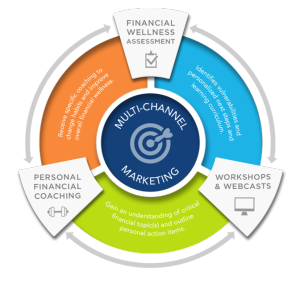
Benefits-Based Approach A workplace financial wellness benefit can be the one benefit that pulls all the other benefits together, increasing employee understanding, use and appreciation of their value. In particular, when your strategic goals are to engage employees, reduce financial stress, encourage benefits appreciation and realize measurable cost savings by reducing financial stress or benefits appreciation, the best solution is making financial wellness an ongoing employee benefit available to all employees. The foundation of a benefits-based approach to financial wellness is ongoing guidance and coaching that promotes behavior change.  Depending on workforce needs, this includes some combination of workshops, webcasts, one to one coaching (telephone, in-person, or both) and online learning.

The benefits-based approach embeds financial wellness into your company culture and establishes your company as a partner in employees’ financial security. This is a powerful contribution to your recruiting brand. Over time,  research shows a benefits-based approach can provide significant ROI for a large company.

Program-Based Approach   The program-based approach can be a good fit for companies who may not have a strategic need for workplace financial wellness as a benefit offered to all employees, but have a need for support for specific employee populations. Typical employee populations to address with a targeted financial wellness program include pre-retirees, employees offered early retirement, recent college graduates and employees who have requested a retirement plan loan or received a wage garnishment. Companies may also choose to target executives by offering them an unbiased review of their financial plan by an experienced financial planner.

Tool-Based Approach Financial wellness websites and apps are generally used as tools in a more comprehensive program. There are some circumstances where a tool-based approach on its own may be a fit: when you are looking for a lower cost solution to check the box, when you have a very specific issue you want to address— such as helping parents navigate the college planning process, refinancing student loans for employees, offering employees in plan advice to help them better manage their 401(k) investments, or decision making tools that help them select the right health care plan during open enrollment.  The right tools can make an impact here, provided you are working with a best in class provider and your population truly needs the service.  However, they don’t generally make an enduring impact on overall employee financial wellness, retirement preparedness, or even benefits satisfaction.  To do that, a holistic approach is needed. This is why employers are increasingly folding these tools into fully integrated financial wellness programs that utilize a “concierge” service approach where employees are directed to the right tools and benefits based on their needs, while working with a counselor that can help them continually improve their finances over time.

Understand What Your Employees Really Need

Everything starts with data. Once you have decided on whether to implement a benefits-based, program-based or tool-based program based on your strategic needs, you still need to validate the needs of the employees you are trying to reach with the program. There’s nothing worse than spending a large amount of time and money to launch a new program, only to discover that you could have spent half that amount and gotten much more appreciation and utilization from employees who actually needed a completely different service.

For example, you may think student loan debt is a major issue looking at your population— but what if the bigger issue is not knowing how to effectively budget to pay off the debts?  You can help provide loan consolidation support for employees in this scenario but the effect will be marginal, as their foundational habits around how they manage their money won’t change.  Similarly, in plan advice can be great— but it’s more expensive than target date funds and if employees who rely on their retirement plan as their sole investment vehicle choose in-plan advice thinking it will provide them with a bullet proof investment strategy when a cheaper target date fund would serve essentially the same purpose, you may have actually exposed yourself to legal liability down the road when they realize the extra fees were not justified for their situation.

Why A Workforce Financial Wellness Assessment™ is a “Must Have” Before Making Any Decisions on What To Offer Employees

The only way to truly understand what employees need, whether you are looking to add tools, programs, or a holistic benefit is to better understand their finances, in a confidential, non-invasive way. The best way to do this is to provide them with access to an online financial wellness assessment which they can use to get a snapshot of their personal financial wellness and key next steps to take to improve their finances, including a Financial Wellness Score™ they can use as a gauge to track their progress.  Employees take five minutes, answer non-invasive questions about their financial habits, behaviors, and decisions they’ve made — without any account information collected — and you get an aggregated Workforce Financial Wellness Assessment™ detailing the following:

  • Overall financial wellness broken down by age, income, gender, location, and job classification.
  • Most pressing needs for each group— from money management to investing, saving for college, protecting their income and assets, retirement planning, etc.
  • Specific areas within each of these categories that are the most concerning so you can pinpoint which services are best for which population. For example, if 93 percent of those 45-54 are managing their money well and have their debt under control and investing sufficiently for retirement, but most have children and no life insurance and poor college planning strategies, those are the areas to focus on.  Conversely, if employees just starting out aren’t even aware of how basic benefits work, but actually have the free cash flow to be able to invest more money into benefits that are important to their future— there may be a need for financial mentorship programs that help them adjust to “real life” and fully maximize benefits they may not even be aware they have available.

How to Market Your Financial Wellness Program So It Becomes A Highly Valued Employee Benefit

October 19, 2016

While some employers do take a tool-based or program-based approach to financial wellness in order to address niche needs of specific employee demographics, the marketing of those programs is by nature, much more narrow and limited in scope.  There’s typically a launch to the target population, and periodic reminders at benefits fairs and the like.  With everything employers have to communicate to employees, large scale marketing campaigns around a single tool, perk, or program distract from larger more important goals and can leave employees with information overload and decision-fatigue.  You need the important information to stand out, and each time you send any additional communication to an employee, you take their attention away from the core messages you want to send.

With that in mind, this post is intended for those employers who specifically are focused on offering financial wellness as an employee benefit.

Let me clarify what I mean by offering financial wellness as an employee benefit.  A financial wellness benefit is not a tool, app, niche service, program for a specific population group, a perk, or bullet 178 on the list of things you do to make your company a great place to work.  On the contrary, it is an additional employee benefit, subsidized by you, the employer, to provide every single employee with access to employee unlimited personalized financial coaching to help them maximize their pay and benefits— free of any conflicts of interests or sales pitches.  When you offer employees a true financial wellness benefit, you are making a commitment to their financial security by providing a resource they can turn to at any time, for any financial need, and know that the guidance they get is solely in their best interest, designed around their specific financial priorities, goals, and circumstances.

Accordingly, you need to market your financial wellness benefit the way you would any core benefit.

This starts by always calling it a benefit— not a program, service, platform, tool, resource, app— but an additional employee benefit that you are offering to all employees as part of their overall benefits package.

It also means leveraging all the traditional methods you use to communicate important benefits, including:

  • Your benefits handbook
  • The summary of benefits you provide to employees you are recruiting
  • Your web site in the career section
  • New employee orientation workshops and materials
  • Your benefits portal, in a prominent position as one of your core benefits but also throughout as a resource they can use to better understand the other benefits you offer
  • All your benefits statements in all forms (electronic, print, through apps your vendors provides) since your financial wellness benefit is a resource for employees to better understand and manage all their other benefits
  • All benefits communications where the financial wellness benefit
  • All information regarding changes you are making to benefits
  • All open enrollment materials since your financial wellness

This strategy accomplishes several important objectives:

  1. It positions you as your partner in your employees’ financial security. Some companies are even beginning to rebrand their entire benefits offering as “Employee Financial Wellness”, with the idea that each and every benefit drives this over-arching goal.  If this is too radical a departure from what you are currently doing or not a fit for your culture, then you can simply brand the financial wellness program as its own benefit, consolidating all services from different vendors that provide education and guidance around key financial issues so employees perceive it as a singular benefit designed to help them become more financially secure.
  2. It provides them a sense of relief knowing they have a benefit that can help them make the right decisions about all their benefits— so that as they go through the benefits portal, handbook, new orientation paperwork, they always know they have can get guidance on any of the decisions they have to make.
  3. It drives both awareness and utilization of the benefit. Every single employee should be aware that you are investing in a benefit that supports their financial security— because you care about this aspect of their lives and want them to be as financially healthy as possible.  Utilization is also higher when you classify financial wellness as an employee benefit.  Doing so signals that this is something employees should take advantage of— no one likes the notion of leaving employee benefits on the table.  Also, by integrating financial wellness into all benefits communications, you end up leveraging the infrastructure you already have in place to promote the benefit at a time when employees are actually reviewing their other benefits and most likely to reach out for help.

Encouraging Behavior Change

December 22, 2015

What’s the key to success for a financial wellness program? Behavior change. Many behavior change tactics used for physical wellness can also be implemented to increase a person’s financial health. Liz Davidson shares some strategies to increase employee engagement and truly create long-lasting financial behavior change.