
How Do Employers Measure ROI on Financial Wellness Programs?
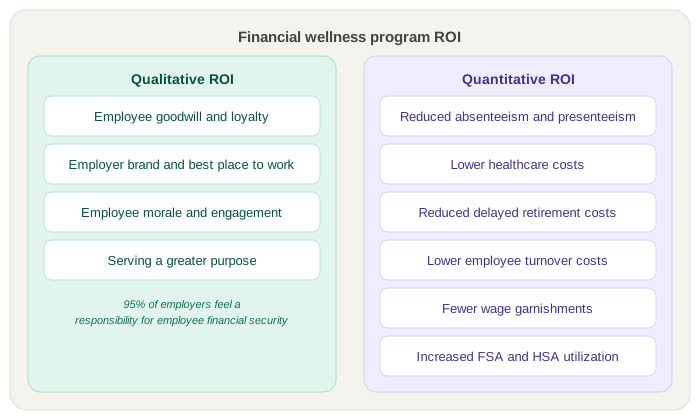
May 29, 2026Employers measure the return on investment of a financial wellness program in two ways: qualitatively, through the human and cultural value the benefit creates, and quantitatively, through measurable reductions in direct costs like absenteeism, healthcare expenses, delayed retirement, turnover, wage garnishments, and underutilization of tax-preferred benefits. Together, these two lenses tell the complete story of what a financial wellness program is worth.
Why measuring ROI matters
Financial wellness programs represent a meaningful employer investment. Benefits leaders who can connect that investment to measurable outcomes are better positioned to justify the budget, expand the program, and demonstrate its value to leadership and finance teams.
The good news is that the data exists. Research consistently shows that financially stressed employees cost employers real money in ways that show up in the numbers that CFOs and CHROs already track. A strong financial wellness program moves those numbers in the right direction.
The qualitative case: why employers say it is simply the right thing to do
Not every return on a benefit shows up in a spreadsheet, and leaders at the world’s top employer brands understand this. According to the Employee Benefit Research Institute’s 2025 Financial Wellbeing Employer Survey, 95 percent of employer respondents believe their company has a responsibility to ensure employees are financially secure and well. That belief reflects a broader shift in how leading organizations think about their role in employees’ lives.
The qualitative ROI of a financial wellness program includes several dimensions that are harder to quantify but no less real.
Offering financial coaching signals to employees that the company cares about their lives outside of work, not just their productivity inside it. This sense of goodwill builds loyalty that is difficult to manufacture through compensation alone. Employees who feel genuinely supported by their employer are more engaged, more likely to stay, and more likely to serve as advocates for the organization.
Financial wellness benefits also reinforce an employer’s brand as a best place to work. Recognition from organizations like Fortune, Glassdoor, and industry-specific awards increasingly weighs whether employees report low financial stress and feel their employer supports their total wellbeing. A strong financial wellness program contributes directly to the factors those surveys measure.
There is also the matter of purpose. Many HR leaders describe the decision to offer financial coaching with a phrase that resonates beyond cost calculations: it is the right thing to do. Employees bring their whole selves to work. When financial stress consumes a significant portion of their mental energy, the impact spills over into every dimension of their performance and health. An employer who helps reduce that stress is doing something genuinely meaningful.
The quantitative case: where the numbers show up
The financial impact of a well-designed financial wellness program shows up across several measurable cost categories. Research from Financial Finesse’s Financial Wellness Think Tank™, including an independent case study of employees conducted by the Personal Finance Employee Education Foundation (PFEEF), provides clear evidence that employees who participate in financial education programs generate meaningfully better outcomes across each of these dimensions.
Absenteeism and presenteeism
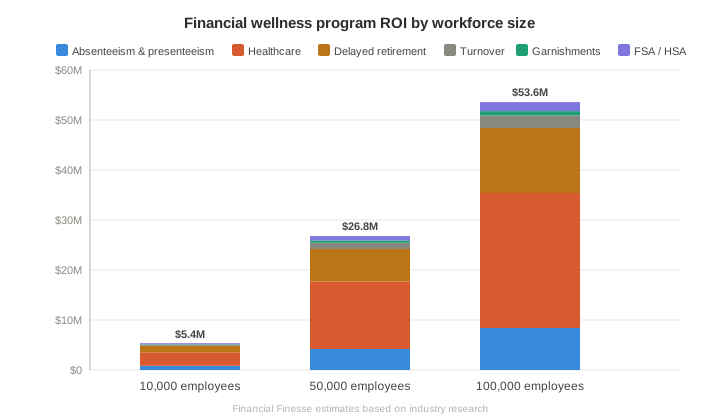
Financial stress is one of the leading drivers of unplanned absences. Employees who are worried about money are more likely to miss work and less productive when they are present, a phenomenon known as presenteeism. In the PFEEF case study, financial education program participants averaged 11 unscheduled absence days compared to 16 days for non-participants. Based on a proprietary predictive model developed by Financial Finesse’s Financial Wellness Think Tank™, moving a workforce’s median financial wellness score from a 4 to a 6 on a 10-point scale could save a 50,000-employee organization more than $4.2 million annually in reduced unplanned absences alone.
Healthcare costs
Financial stress manifests physically. A study of a Fortune 100 healthcare company found that employer healthcare costs for employees who used the company’s financial wellness program actually decreased by 4.5 percent, while costs for non-users increased by 19.4 percent over the same period. That difference translated to a net savings of $271.50 per employee. For a 50,000-employee organization, that is a potential annual healthcare cost reduction of more than $13.5 million.
Delayed retirement
When employees cannot afford to retire, they often stay in the workforce past their intended retirement date. This creates a cascading cost problem for employers: higher compensation costs, reduced mobility for career advancement among younger employees, and challenges with workforce planning. Research from Financial Finesse’s Financial Wellness Think Tank™ found that employees who engaged repeatedly with their employer’s financial wellness program increased their likelihood of being on track for retirement from 34 percent to 47 percent. For a 50,000-employee organization, that 13-point improvement translates to an estimated $6.5 million in annual cost reduction related to delayed retirement.
Employee turnover
Replacing an employee is expensive. Direct replacement costs can range from 50 to 60 percent of an employee’s annual salary, with total costs including lost productivity and retraining ranging from 90 to 200 percent. A financial wellness program that helps employees feel more secure and more valued reduces voluntary turnover. Even a one percent reduction in turnover at a 50,000-employee organization could save more than $1.25 million annually.
Wage garnishments
Wage garnishments create administrative burden and cost for employers. Processing a single garnishment costs an employer an estimated $300 per year. Research from Financial Finesse’s Financial Wellness Think Tank™ found that improving a workforce’s financial wellness score from a 4 to a 6 reduces the likelihood of garnishment from 4.8 percent to 1.8 percent. In one case study, garnishment rates were 5 percent for program participants versus 8 percent for non-participants. For a 50,000-employee organization, the reduction in garnishment processing costs alone can exceed $440,000 annually.
FSA and HSA utilization
Flexible spending accounts and health savings accounts reduce taxable payroll for both employees and employers. When employees do not understand or use these benefits, both parties leave money on the table. Financial wellness coaching increases FSA and HSA participation rates. In the case study, program participants contributed significantly more to both health FSAs and dependent care FSAs than non-participants. Research from Financial Finesse’s Financial Wellness Think Tank™ found that improving financial wellness from a score of 4 to 6 increased average combined FSA and HSA contributions from $905 to $1,137 per employee, generating nearly $900,000 in annual FICA tax savings for a 50,000-employee organization.
The chart below shows how these quantitative savings stack up across employer sizes based on Financial Finesse’s predictive model.
What an independent ROI study found
The PFEEF case study is one of the most rigorous independent analyses of financial wellness program ROI available. Based on data from 8,233 program participants and an equal-sized control group of non-participants, the study calculated a return-on-investment ratio of 5.50 to 1 under conservative assumptions. That means for every dollar invested in the Financial Finesse program, the company received $5.50 in net benefits. Under more optimistic but still realistic assumptions about program impact, the ROI ratios reached 9.76 to 1 and 15.07 to 1.
The study measured outcomes across unscheduled absences, wage garnishments, FSA contributions for both health and dependent care, retirement plan contribution rates, and job performance. Participants outperformed non-participants on every measurable metric.
How to build your own ROI case
HR leaders do not need to wait for a third-party study to make the case for a financial wellness program. A practical ROI analysis can be built using data that most organizations already collect or can reasonably estimate.
Start by establishing a baseline. What is the organization’s current rate of unplanned absences? What are annual healthcare cost trends? What percentage of employees are on track for retirement? What is the voluntary turnover rate and the estimated cost to replace an employee? What percentage of eligible employees are participating in FSA and HSA programs?
Then model the potential improvement. Financial Finesse’s predictive model uses a 10-point financial wellness scale to project the cost impact of incremental improvements in workforce financial wellness. Even modest improvements, moving the median workforce score from a 4 to a 6, generate savings that dwarf the cost of the program itself.
Finally, track outcomes over time. Financial wellness program ROI is best demonstrated through longitudinal measurement, comparing employee cohorts who engage with the program against those who do not, and tracking how behaviors change as employees progress in their financial wellness journey.
FAQs:
What metrics do employers use to measure financial wellness ROI?
The most common quantitative metrics are reductions in unplanned absenteeism, lower healthcare costs, reduced delayed retirement costs, lower turnover, fewer wage garnishments, and increased FSA and HSA utilization. Qualitative measures include employee engagement, employer brand perception, and workforce morale.
What ROI can employers expect from a financial wellness program?
An independent study of a Fortune 500 healthcare company’s Financial Finesse program calculated a return of $5.50 for every $1 invested under conservative assumptions. Financial Finesse’s own predictive model estimates that moving a 50,000-employee workforce’s median financial wellness score from a 4 to a 6 could generate more than $26 million in annual cost savings across six measurable categories.
How long does it take to see ROI from a financial wellness program?
Some benefits, such as increased FSA enrollment and reduced garnishment processing, can appear within the first year. Larger savings categories like healthcare cost trends and delayed retirement impacts typically emerge over a two-to-five year horizon as employee financial wellness improves and behaviors change.
Does financial wellness ROI only apply to large employers?
No. The cost drivers are present at every employer size. While the absolute dollar savings are larger for larger organizations, the return-on-investment ratio, dollars saved per dollar invested, is comparable regardless of workforce size.
Financial Finesse is the leading independent global provider of unbiased financial coaching as an employee benefit, driving measurable improvements in employee financial wellness and proven employer ROI. Employees receive unlimited access to CFP® professionals and AI-powered guidance that expands reach and personalization with trusted human oversight at every step.