
What Is the Difference Between a Financial Coach and a Financial Advisor?
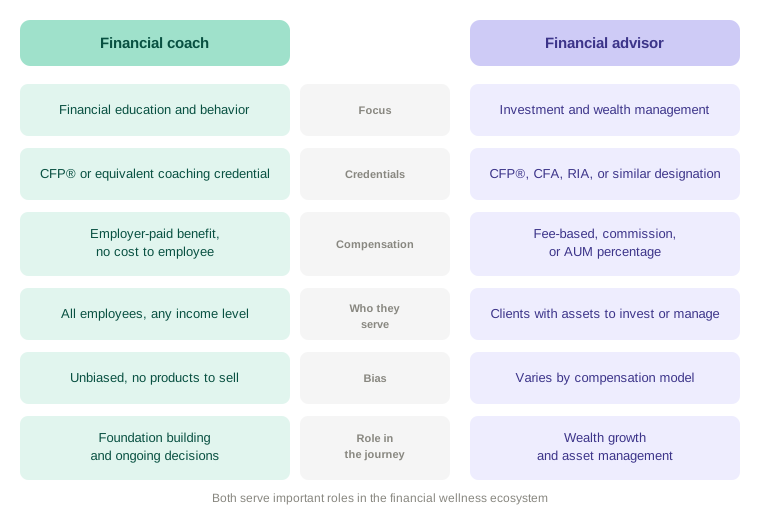
May 29, 2026A financial coach helps people understand their finances, build better money habits, and make informed decisions across all areas of their financial life. A financial advisor typically manages investments and builds wealth strategies for people who already have assets to grow. Both serve important roles, but they operate at different stages of the financial journey and are often most powerful when they work together as part of a broader financial wellness ecosystem.
Why HR leaders should understand this distinction
When evaluating financial wellness benefits, the coach versus advisor question comes up often. Many employees have never worked with either. Others assume these roles are interchangeable. HR leaders who can articulate the difference clearly are better positioned to match the right benefit to the right employee need, and to explain the business value of financial coaching to leadership and benefits committees.
The short version: financial coaching is a benefit designed for everyone. Financial advice is typically offered as a service for those already managing significant wealth.
What a financial coach does
A financial coach helps employees navigate the full range of financial questions and decisions they face throughout their lives. This includes understanding how to build a budget, pay down debt, establish an emergency fund, make sense of employee benefits, plan for retirement, and protect their family with the right insurance coverage.
The coaching relationship is educational and empowering by design. A coach does not make decisions for the employee. Instead, the coach helps the employee understand their options, build financial confidence, and develop the habits and knowledge to make sound decisions on their own over time.
In a workplace financial wellness benefit, coaches are typically CERTIFIED FINANCIAL PLANNER® (CFP®) professionals or their in-country equivalents. CFP professionals hold one of the most rigorous and respected credentials in financial services, covering financial planning, tax, insurance, retirement, and estate planning. At Financial Finesse, for example, every coach is a CFP® professional (or in-country equivalent), meaning employees receive expert guidance regardless of their income level, financial situation, or the complexity of their situation.
Critically, financial coaches are an employer-paid benefit, have no products to sell, and no commissions to earn. Their only job is to help the employee. This makes financial coaching one of the only truly unbiased sources of financial guidance most employees will ever have access to.
What a financial advisor does
A financial advisor focuses primarily on managing and growing wealth. This typically involves creating an investment strategy, managing a portfolio, and helping clients plan for major wealth-related milestones such as retirement drawdown, estate planning, and tax optimization on investments.
Financial advisors operate under a range of compensation models. Some charge a flat fee for their services. Some earn commissions on financial products they recommend. Others charge a percentage of the assets they manage, often referred to as an AUM (assets under management) fee. Understanding how an advisor is compensated matters because it can influence the recommendations they make.
Financial advisors are well suited for people who have accumulated meaningful assets and need ongoing investment management and sophisticated planning. Most financial advisors also have minimum asset thresholds, which can make their services inaccessible to employees who are still building their financial foundation.
Why they are not competing, but complementary
The most important thing for HR leaders to understand is that financial coaches and financial advisors serve different needs at different stages of an employee’s financial life, and the strongest financial wellness ecosystems include both.
Think of it as a progression. Financial coaching meets employees where they are, often before they have significant assets to manage. A coach helps an employee get their cash flow under control, build emergency savings, pay off high-interest debt, and start saving for retirement. Over time, as that employee builds wealth, they may reach a point where a financial advisor makes sense.
In this way, a financial wellness benefit that includes strong coaching does not compete with financial advisors. It creates better clients for them. Employees who arrive at a financial advisor already financially literate, with no high-interest debt and a clear sense of their goals, are in a far stronger position than those who arrive without that foundation.
What this means for benefits design
When an HR leader is evaluating financial wellness programs, the key question is not “should we offer coaching or advisory services?” The better question is: “What does the majority of our workforce actually need right now?”
For most employee populations, the answer is financial coaching. Research consistently shows that financial stress is widespread across all income levels, and that most employees lack basic financial literacy, emergency savings, and confidence in their financial decisions. Financial coaching addresses this directly, at scale, and at no cost to the employee.
For higher-income segments of the workforce, such as executives or senior professionals with complex compensation, an advisor referral network or supplemental advisory benefit may also be appropriate.
The gold standard is a benefit that provides every employee with access to a credentialed financial coach as a starting point, with a pathway to connect with more specialized resources, including financial advisors, when the employee’s needs evolve.
FAQs
Is a financial coach the same as a financial advisor?
No. A financial coach focuses on education, financial decision-making, and building a strong financial foundation. A financial advisor focuses on managing investments and growing wealth. Both serve important roles, but they operate at different stages of the financial journey.
Do financial coaches manage money or investments?
No. Financial coaches provide guidance and education to help employees make their own informed financial decisions. They do not manage portfolios or direct investments on behalf of clients.
Are financial coaches unbiased?
When coaching is delivered as an employer-paid benefit, yes. Coaches in a financial wellness program like Financial Finesse have no products to sell and no commissions to earn, which makes their guidance genuinely objective.
Do employees need a certain income level to work with a financial coach?
No. Financial coaching as an employee benefit is available to all employees regardless of income, savings level, or financial situation. This is one of the most significant differences from traditional financial advisory services, which often require minimum asset thresholds.
Can an employee work with both a financial coach and a financial advisor?
Yes, and for many employees this is the ideal approach. A coach helps build the financial foundation. As wealth grows, an advisor can take on investment management and sophisticated planning. The two roles complement each other.
Financial Finesse is the leading independent global provider of unbiased financial coaching as an employee benefit, driving measurable improvements in employee financial wellness and proven employer ROI. Employees receive unlimited access to CFP® professionals and AI-powered guidance that expands reach and personalization with trusted human oversight at every step.