
What Do Financial Wellness Programs Include?
May 29, 2026A financial wellness program helps employees build a stable financial foundation, reach long-term financial goals, and maximize the value of their compensation and benefits. At its core, it provides access to credentialed financial coaches, personalized guidance for real-life financial decisions, and practical tools—often including AI-powered coaching, financial calculators, and trusted educational content—to help employees take action. The most effective programs address both financial resilience, which is the ability to absorb financial shocks, and financial security, which is the ability to grow and thrive financially over time.
The two goals of a financial wellness program
A well-designed financial wellness program works on two levels simultaneously: helping employees withstand financial setbacks and helping them build toward lasting security.
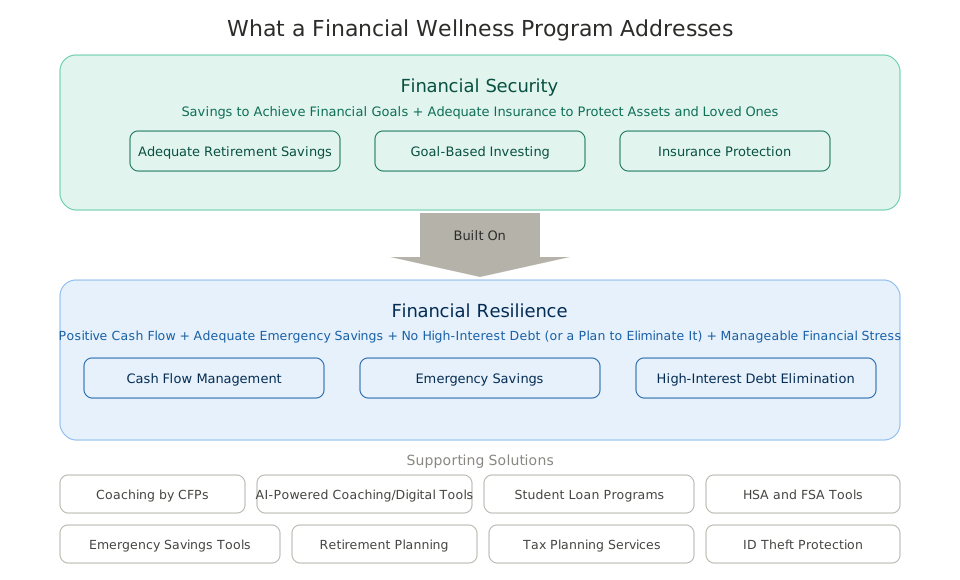
Financial resilience: the foundation
Financial resilience means an employee can absorb unexpected financial shocks without falling into a crisis. Financially resilient employees have positive cash flow, a meaningful emergency savings cushion, either no high-interest debt or a clear plan to eliminate it, and manageable levels of financial stress.
Without this foundation in place, longer-term financial goals are nearly impossible to pursue. A coaching program that skips this layer and jumps straight to investment planning is putting the cart before the horse.
Financial security: the next level
Once resilience is established, the program shifts focus to financial security. This means having adequate savings to reach meaningful financial goals and appropriate insurance coverage to protect assets and loved ones.
Financial security looks different for every employee. For one person it means funding a child’s education. For another it means retiring at 62. For another it means buying a home. A strong program meets employees where they are rather than applying a one-size-fits-all approach.
What guidance looks like inside a financial wellness program
The guidance component of a financial wellness program answers the financial questions employees are actually asking. Questions like:
- “How much should I have in an emergency fund?”
- “Should I pay off debt or invest in my 401(k) first?”
- “Am I taking advantage of all the benefits my employer offers?”
- “When can I realistically retire?”
This guidance should come from credentialed coaches, such as Certified Financial Planner® (CFP®) professionals, who are trained to help employees understand their options and feel confident acting on them. When available and appropriate, live coaching should be coupled with well‑vetted AI‑powered coaching. Programs offered through Financial Finesse, for example, provide unlimited access to unbiased CFP® professional financial coaches (or in‑country equivalents) who combine financial expertise with emotional intelligence, as well as Aimee, a safe AI‑powered coach.
What solutions a financial wellness program includes
Guidance alone is not enough. Employees need resources to act on the coaching they receive. The solutions layer of a financial wellness program connects employees to tools and programs that help them execute. These solutions typically span several categories:
- Cash and debt management: Resources for budgeting, managing cash flow, credit counseling, and structured plans for eliminating high-interest debt, including credit card debt and personal loans.
- Savings programs: Emergency savings tools designed to help employees build a financial cushion, often integrated directly with payroll for automated contributions.
- Student loan assistance: Programs that help employees navigate repayment options, refinancing decisions, and employer-sponsored student loan contribution benefits.
- Retirement planning: Support for maximizing 401(k) contributions, understanding employer match structures, and planning for a sustainable retirement income.
- Healthcare savings: Guidance on Health Savings Accounts (HSAs), Flexible Spending Accounts (FSAs), and how to use these tools to reduce out-of-pocket healthcare costs.
- Insurance and protection: Help evaluating life, disability, and supplemental insurance coverage to ensure employees are adequately protected, along with identity theft protection resources.
- Tax planning: Year-round guidance on tax-smart financial decisions, not just tax filing support.
- Family and housing support: Resources covering dependent care benefits, childcare savings accounts, and guidance on major decisions like homebuying.
These solutions are not a checklist. What matters most is that employees receive guidance from a credentialed coach who helps them understand which solutions apply to their specific situation, and then connects them to the right tools to take action.
How the program is delivered matters
The most effective financial wellness programs are employer-paid benefits, meaning there is no cost to the employee at the point of use. When employees have to pay out of pocket to access financial coaching, utilization drops sharply, and the employees who need help most are often the ones least likely to reach out.
Delivery should be flexible. Employees need to access coaching on their schedule, through their preferred channel, whether that is a phone call, chat, or digital self-service. Multilingual and global delivery matters for employers with distributed workforces.
AI-powered tools are increasingly part of well-designed programs, helping scale access and personalization. Financial Finesse pairs AI-powered guidance with certified human coaches, so employees benefit from both the empathy, motivation, and judgment of a credentialed professional and the reach of technology.
FAQs:
What is the main goal of a financial wellness program?
To help employees build financial resilience, meaning the ability to handle financial shocks, and financial security, meaning the ability to reach long-term financial goals.
Who delivers the guidance in a financial wellness program?
Guidance should come from unbiased credentialed professionals such as CFP® professionals who have expertise in both financial planning and the emotional dimensions of financial stress and, when available and appropriate, well‑vetted AI‑powered coaching tools.
Is a financial wellness program just about retirement savings?
No. While retirement planning is an important component, a comprehensive program also addresses emergency savings, debt management, insurance, tax planning, healthcare savings, and other financial priorities employees face at every life stage.
How is a financial wellness benefit different from a financial advisor?
A financial advisor typically manages investments on behalf of clients and may have minimum asset requirements. A financial wellness benefit is an employer-paid resource available to all employees, focused on unbiased coaching and guidance across a broad range of financial topics rather than investment management.
Financial Finesse is the leading independent global provider of unbiased financial coaching as an employee benefit, driving measurable improvements in employee financial wellness and proven employer ROI. Employees receive unlimited access to CFP® professionals and AI-powered guidance that expands reach and personalization with trusted human oversight at every step.