
Should You Care About a Mutual Fund’s Past Performance?

February 08, 2017

The primary reason that investors choose to subject their hard-earned savings to the ups and downs of the stock market is that history has shown that over long periods of time, it’s one of the best ways to grow your savings in order to outpace inflation and maintain purchasing power. One of the biggest investing mistakes I see though is what we call “performance chasing” or making investment choices based solely on the past performance of a particular investment. I’d argue that past performance is actually the last criteria anyone should consider when deciding which funds to buy and is almost completely irrelevant when looking at index funds. Here’s what I mean.

Past performance is often the first thing people look at when presented with a list of mutual funds, like in their 401(k) account. I get it. You want the best and you want your money to grow as much as possible!

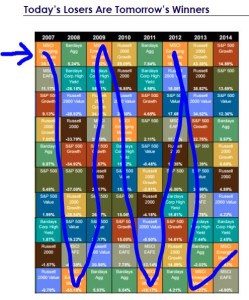
But this is a key mistake that can actually lead to losses rather than gains over time. The problem is that the fund that did the best last year or over the past three to five years is statistically LESS likely to be the best next year, so by buying the “best” based on the past, you may actually be buying high, which is the opposite of everyone’s favorite stock market adage: “Buy low, sell high.” This chart shows that. Just follow the orange square representing “MSCI Emerging Markets” over the 7 years shown:
chart

An investor who chases performance and buys the MCSI Emerging Markets at the end of 2007 because it was the “best” would have lost half their money over 2008. That same investor may be likely to sell at the end of 2008 because they wanted to “stop losing money” and therefore would have completely missed out on the recovery of that sector, when it “won” again in 2009! That’s an extreme example, but follow any of the colored squares over the years and understand a little better why it’s a losing game to only invest in what’s done the best in the recent past. Instead try to spread your investments out over all parts of the market and just “let it ride.”

For investors who like to put their money into actively managed mutual funds, there is a reason past performance matters – so that you can see if the fund is meeting its objective to match or exceed its benchmark. Past performance means nothing without the context of its benchmark. For example, let’s say you’re looking at a mutual fund with the objective of outpacing the S&P 500. Such a fund may include words like “Large Cap” or “US Large Company” or “Capital Appreciation” in its title.

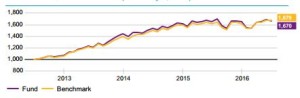
When researching any fund’s performance, look for a chart on the fund fact sheet that shows its performance alongside its benchmark. Here’s one example, showing a fund that is matching its benchmark quite well:
Fund performance graph

If the lines moves pretty much in tandem together or the fund line is consistently higher than the benchmark line, it means the fund managers are doing their jobs consistently well. If you were to look at a chart and see the fund losing to the benchmark as a pattern, then you may want to reconsider it as an investment, even if the fund is in positive territory. In other words, even if your investment is up 10% this year, if its benchmark is hitting 15%, your fund is failing you.

Likewise, if your fund value is down, it doesn’t necessarily mean you’re in the wrong fund. Markets go up and down. As long as the fund’s benchmark is down as far or further, you’re okay to stick with it.

So what does matter when choosing a mutual fund?

The one guarantee about mutual fund investing is the most important criteria in fund selection: fees. You will pay fees, guaranteed. But you can control how much. That doesn’t mean you want to select funds based solely on the criteria of the lowest fees, but if you’ve taken your risk tolerance quiz to determine a suitable mix of stocks and bonds (see the chart at the very end of the questionnaire for suggestions) and have more than one fund option to fulfill your investing allocation, then fees should be one of the deciding criteria.

What if you’re investing in index funds? Then the only use that past performance really has for you is in helping you to set realistic expectations for how your money will do over the long haul. Look at the performance numbers over the past 10 years or more and that should give you a reasonable idea of the growth you can expect for your own money. Assuming you’re only investing money that you don’t need for 10 years or more, you really shouldn’t care what happens over the next one, three or even five years.


Have you signed up to receive the Tip of the Day via email each business day? If not, head over to the main blog page and sign up!


Investing Made Easy

July 18, 2016

Can investing be easy? How can you become a more informed, savvy investor without learning a lot of extra financial jargon? Investing really doesn’t have to be that hard. Consider following these three simple principles:

Know Yourself

Successful investing starts with knowing yourself: how you like to make decisions, whether you like advice or you like to do it yourself, and what you do when the going gets rough. The first step is to figure out your investing risk tolerance, which is how much of your invested money you’d be willing to risk losing in order to make a profit. Try and quantify that in real dollar amounts, e.g., you have $1,000 to invest, and you’d be willing to risk it going down to $900 (a ten percent loss) in order to have a good shot at ending up with $1,150 (a fifteen percent gain).

Would that change if your investment was $10,000 or $100,000? Are you a conservative, moderate or aggressive investor? Make sure to take a risk tolerance questionnaire like this one to double check your assumptions.

The next step is to ask yourself how involved you want to be in the day to day management of your investment portfolio. Are you more of a “hands-on” or a “hands off” type? A hands-on investor is actively involved in designing a portfolio, setting target weights for different types of investments and monitoring/re-balancing the portfolio regularly. A hands-on investor may favor individual stocks or actively managed mutual funds or setting up their own asset allocation (mix of investment types) of index mutual funds. The hands-off investor is looking for a one-stop shopping solution and is more likely to favor pre-mixed portfolios like target date mutual funds or use a robo-advisor to set the strategy and automatically re-balance.

Finally, ask yourself if you like to do it yourself or if you’re the sort of person that likes advice. There are many options for do-it-yourself folks, including low-fee financial services firms where you can invest on your own without an advisor. If you are the type who likes having a coach, consider working with a fee-only CERTIFIED FINANCIAL PLANNER™, professional who is paid only by clients and not by commissions or brokerage fees. Make sure to check your advisor’s background with FINRA or with the SEC if they’re a registered investment advisor.

Set a Clearly Defined Goal

When will you need to use the money? Certain types of investments are better suited to certain time periods due to their levels of risk. If you need access to the funds in less than three years, stick with very low risk investments like savings accounts, money market funds and CDs. A stock fund is no place for your savings for a home down payment!

If you will use the money in three to seven years, consider adding some high quality bonds or bond funds. Adding in stocks makes more sense for goals of seven to ten years or longer, like your retirement account. The longer your time horizon until you need the money, the more you can consider adding stocks and stock mutual funds to your portfolio.

How much do you need your investment to be worth in order to make your goal? That’s called your “investment return.” Take the home down payment scenario: The most important thing is that you don’t lose any money, and your investment return is secondary. However, with a large, far-off target like retirement, you may need to achieve a 6-7% average annual return in order to meet your goals.

Match Investments to Your Goals and Preferences

Your investments should match when you need the money (time horizon), your required growth (required return), your investment risk tolerance and whether you are hands-on or a hands off investor. According to fellow CFP® Kelley Long, choosing investments is a lot like choosing a pizza.  You can customize it to fit your tastes.

For a longer term, aggressive investor, you could consider adding 5 to 10 percent in stocks to a typical portfolio mix (for example, moving to a 70% stocks/30% bonds instead of a 60/40 mix). A more conservative investor would add 5-10% to their bond allocation (a 50/50 mix using the previous example). The bottom line is that with some easy tweaks, you can customize your investment portfolio to suit your tastes.

How do you make your investment decisions? Email me at [email protected]. You can also tweet them to me @cynthiameyer_FF


Are Self-Directed IRAs a Good Idea?

April 18, 2016

If you could buy a private business, a rental property or racehorses in your Individual Retirement Account (IRA), would you do so? Even if you could, would that be a wise choice? Self-directed IRAs (SD-IRA) offering non-traditional investments have become increasingly popular and more broadly available.

The self-directed IRA is a traditional or Roth IRA in which the custodian, the financial institution which keeps records and reports to the IRS, permits the full range of investments allowed by law in retirement accounts. Many types of investments are permitted in IRAs, but there are certain things you can’t do, like buy collectibles (such as art and coins) and life insurance, as well as investment strategies that require borrowing, such as shorting stock or certain options strategies. However, the reality is the vast majority of financial institutions limit retirement account investments to the more traditional ones like stocks, bonds, mutual funds, CDs and exchange-traded funds.

“Self-Directed” Really Means “Alternative Investments Accepted”

The term “self-directed” is a bit off base. What it means is that alternative investments are accepted or offered by the IRA custodian. Technically, at most financial institutions, IRAs default to the more literal interpretation of “self-directed,” in that the account owner makes the final decisions on what investments to buy or sell, unless they have given discretion in writing to an investment advisor.

A custodian who offers self-directed IRAs agrees to keep required records of your non-traditional investments in the IRA and report them to the IRS. The custodian may or may not offer physical custody of the investment, depending on type, or may just house the records of investment activity and valuation. Common alternative investments available in SD-IRAs are precious metals, real estate, loans, and private equity.  Certain custodians of self-directed IRA accounts will accept just about anything allowed by the IRS, including tax lien certificates and dairy cows.

Very High Risk

Many alternative investments available in SD-IRAs carry a high risk of losing all or most of your money due to lack of diversification or the inherent risk of the investment itself. You may not be able to sell the investment later (lack of liquidity), meaning that you won’t be able to access the value of it to make distributions in retirement. Keep in mind that the entire burden of investigating the investment (doing your “due diligence”) is on you, the account holder. This could be a benefit when you are investing in an area of your professional expertise (e.g., the experienced real estate investor). However, it can also lead to fraud, when investors are duped into Ponzi schemes or other types of investment scams through slick offerings and piles of legal paperwork.

Beware of investing in anything you don’t understand and can’t explain easily to others. If you are considering an investment within an SD-IRA, read this pamphlet from the SEC first and do your homework. Use the checklist at the end of this post. Remember, if it sounds too good to be true, it probably is.

High Fees

Fees in self-directed IRAs are generally much higher than more traditional types of IRAs. Expect to pay set up fees, custodial fees and annual fees to value the investment. Many of the types of alternative investments offered in SD-IRAs are hard to value, so this can get quite pricey.

Keep in mind that the IRA or Roth IRA is the owner of the investment, so you don’t have direct control over it. With investments like real estate or a business, for example, that means you have to pay the custodian to do things like collect rents or business income. (Per this Bankrate article, some custodians propose that you set up a an IRA LLC to address this issue, which may give you checkbook control but is costly to establish and has legal risk.) No matter what, make sure you do some comparison shopping for a custodian who specializes in the type of investment you want to own in your SD-IRA.

Potential Tax Problems

Investors often get tripped up by unexpected tax consequences in SD-IRAs. Most importantly, in a traditional IRA, distributions in retirement are taxed as income, not the lower capital gains rate. The investor may have been better off holding the asset outside of a retirement account. Additionally, investors miss out on the ongoing favorable tax treatments for some common types of investments, such as real estate.

Depending on the type of investment income, a self-directed IRA may not be completely tax-deferred and a Roth IRA may not be completely tax-free. For example, if the investment generates Unrelated Business Income, the IRA or Roth IRA would be taxed at the high trust rates for the tax year in which it occurs. Those taxes must be paid by the IRA, not the account owner separately.

Can’t Invest in Yourself or Your Family

Don’t get too excited about selling the family business to your IRA! Certain transactions are prohibited in retirement accounts to prevent self-dealing, including transactions with people within your linear family, such as your spouse, your parents, your children, your grandchildren and their spouses. Most of your family could not work in or on behalf of the investment or live in a property held by the IRA.

When to Consider a Self Directed IRA?

SD-IRAs are not suitable for many people. Use this checklist to see if you might be a good candidate for self-directed IRA accounts: (Aim for at least 4 out of 6.)

  • I am an accredited investor. (If you don’t know what it is, you probably aren’t.) While you don’t need to be an accredited investor to open an SD-IRA, being one means you have the income and net worth to consider alternative investments.
  • I don’t need my IRA or Roth IRA for future retirement income. Either:
    • I am fully on track to completely fund my retirement with my employer-sponsored retirement plan, e.g., 401(k), 403(b), etc.
    • I have a pension or other investments (e.g., rental income) which will fully cover my retirement income needs.
  • I have well-diversified traditional investments in my work-sponsored and non-retirement brokerage accounts that can be liquidated to pay future living expenses if needed.
  • I have professional expertise and experience in the SD-IRA investment which I am considering.
  • I want to add a target percentage of precious metals to my retirement portfolio for diversification.
  • I am considering making a small private equity investment that might pay off big (a possible strategy in a Roth SD-IRA) but could also go bust.

The Gym Rat’s Guide to Investment Terms

February 12, 2015

Investing and the financial world in general can be pretty confusing. There are a lot of terms you may not know and concepts you may not be familiar with. It can even start sounding like another language! Continue reading “The Gym Rat’s Guide to Investment Terms”

Could Asset Location Make Your Investments More Tax Efficient?

September 20, 2013

What happens when you get a group together that consists of financial planners, CPAs, estate planning attorneys and investment managers? Usually when that happens for me, it means that a bunch of my friends are getting together to go watch one of our friend’s bands play or we’re playing poker. And, it also means that the topic is eventually going to become a financial one and inevitably there will be people on opposite sides of an issue so debate is a certainty.  The great thing about the debate is no matter what side you’re on, you learn something you didn’t know before the debate. One of our recent debates was about asset location.  Continue reading “Could Asset Location Make Your Investments More Tax Efficient?”

How Is Your Retirement Income Taxed?

May 15, 2013

Last month I took a phone call from a gentleman who is in the process of preparing for retirement. He has done a good job saving and now that he is getting ready to take distributions from his retirement accounts, he is concerned about taxes. We are often lead to believe that taxes will be less in retirement and for many taxpayers, that will be true not because of a change in the way things are taxed but rather because many retirees will be able to enjoy retirement on less income.  Income sources are taxed no differently in retirement than they are while we are working.  Sure, we receive an additional deduction once we turn 65, but the primary difference between our working and retired years is not how our sources of income are taxed, but the “sources” of income themselves. Continue reading “How Is Your Retirement Income Taxed?”

How Much Do You Really Need to Retire?

March 28, 2013

I recently answered a question from a blog reader and received the following message:

“Thanks VERY much! In the past few years, I have paid $500 to two separate financial planners to get this kind of advice, to no avail.  In a few minutes you provided me more useful information than they provided.  They have been helpful telling me how much I CAN invest with them, where, and how much that investment will grow to – but they haven’t, can’t or won’t tell me how much I SHOULD be saving now to get to a recommended savings target – so that I have enough to retire, but also am not unnecessarily saving too much now rather than enjoying it while my family is young, all together (before kids get big and move out) and all healthy (and capable of enjoying it).” Continue reading “How Much Do You Really Need to Retire?”

What’s Probably Missing From Your Financial Plan

February 21, 2013

When people call our financial helpline or schedule a one-on-one consultation, they usually have a particular problem or goal in mind. It might be getting out of debt, knowing whether they’re on track for retirement, or dealing with a thorny tax issue. But sometimes we have people that seem to be doing all the right things. They have no high-interest debt. They have more than adequate savings for emergencies. They’re saving enough for retirement. They just want to know what they might be missing. Here are the most common holes in people’s  financial plans: Continue reading “What’s Probably Missing From Your Financial Plan”

Do You Know What’s Really in Your Water Bottle…or Your Portfolio?

June 22, 2012

My kids absolutely LOVE bottled water.  I remember that when bottled water first came into the public eye, my friends & I laughed and said that if we came up with catchy packaging, a cool name, and maybe even a slogan that sounds like we care about something, we could make millions of dollars selling regular tap water to people who are far too easily separated from their hard earned dollars. Little did we know that we underestimated how much money we could make big time!!!! It’s not MILLIONS, it’s BILLIONS…per month!!! Continue reading “Do You Know What’s Really in Your Water Bottle…or Your Portfolio?”

When it Comes to Financial Advice, Follow the Money

January 19, 2012

As the election year begins, there’s a lot of concern about money in politics and how it can be used to corrupt politicians and buy votes. But politics isn’t the only profession in which money can be a problem. The same can be said for financial planning too. Continue reading “When it Comes to Financial Advice, Follow the Money”

Back to Basics: What Exactly is a Bond?

January 12, 2012

Last week, we discussed how to invest by buying a stock and becoming an owner of a company. This week, we’ll take a look at becoming a loaner instead. The first experience most people have as a loaner is with a bank. You loan the bank money by making a deposit, your money earns some interest, and you can withdraw it. You can also go to the bank to borrow money for something like a car or a home. Continue reading “Back to Basics: What Exactly is a Bond?”

Will It Ever Come Back?

December 30, 2011

No, this isn’t an advice column for your love life that’s going to tell you, “If you love something, let it go.  If it comes back, blah blah blah…”  Nor is this the story of a man’s hairline, because clearly the answer there is NO!  This is my favorite story of 2011 mixed with a frequently asked question from my 1-on-1 sessions with employees of one of the companies I visit regularly. Continue reading “Will It Ever Come Back?”

Ho, Ho, Holiday Tax Tips

December 21, 2011

In the middle of the holiday season, it’s easy to forget that there are only two more weeks left in the tax year, and although April 15th is still four months away, you can reduce the amount you owe (or increase the amount you get back from) the IRS if you take the following steps before the ball drops on New Year’s Eve. Continue reading “Ho, Ho, Holiday Tax Tips”

Make Your Nest Egg Last as Long as You Do

October 20, 2011

Once you’ve saved and invested for financial independence, the final step will be figuring out how to turn that nest egg into an income stream that will last as long as you do. With people living longer and longer, this can be a challenge for all retirees but is especially difficult for anyone looking to retire early. There’s even a good chance you’ll live longer in retirement than you did working.
Continue reading “Make Your Nest Egg Last as Long as You Do”

Nine Key Financial Steps That Procrastinators Miss

October 17, 2011

Yesterday I went to get a mammogram; the annual “boob smashing” is what I call it.  The process isn’t fun so for any of you who haven’t had one, a mammogram basically consists of smashing your breast between two plates painfully stretching your skin along the way, then you are left standing there while the technician walks away.  She ducks behind a machine that reminds me of the wizard of oz behind the curtain.  She then tells you not to breathe (oh sure, relax!!) and hold perfectly still, all the while you are held captive in a strange kind of vice.  If that isn’t enough, they do it again from a different angle and on the other side.  Continue reading “Nine Key Financial Steps That Procrastinators Miss”

Why Didn’t I Sell?

August 08, 2011

“Why didn’t I sell before the market dropped?”  is a question I got from a caller to our helpline last week.  This is a common question, as you can imagine, after a big drop in the market or during an extended bear market.  This caller was extremely frustrated because he was stuck between a rock and a hard place.  He had already turned in his paperwork to retire within the month (too late to cancel) and was making a transfer from his 401(k) to a pension purchase to provide additional fixed income – essentially changing the goal of this money from long term growth to income.  The market drop would lower his monthly income for the rest of his life because his lump sum was being used to calculate his monthly income payment.  He was distraught. Continue reading “Why Didn’t I Sell?”

Wine Tasting and Your 401(k)

July 29, 2011

Yesterday was a great day.  I spent the day with my girlfriend Julie, doing some wine-tasting along the Finger Lakes Wine Trail in upstate New York.  This area is known for wineries dotted along the lakes, where you can spend the day traveling along, checking out what each has to offer.  The wineries range from quaint and home-spun, to modern and spacious.  Continue reading “Wine Tasting and Your 401(k)”

Investment Secrets Revealed

June 15, 2011

Several weeks ago I was in Chicago giving a workshop on investing.  Every time I give this workshop, I almost always get asked the same thing, “Greg, what is the best thing to invest in right now?”

First of all, if I really knew what the absolute best things to invest in at any time was, do you really think I’d be writing this blog?  I get the sense that people think financial professionals have some sort of secret knowledge when it comes to investing.  They think we can read the tea leaves and know where to invest, and where not to invest.  I can’t blame them, though.  I think the industry has done this to them on purpose.  For years financial institutions have spent countless dollars trying to convince you that they have an edge, a better way to research, a better strategy for picking winners, etc. Continue reading “Investment Secrets Revealed”

Should I Manage My Investment Account or Use a Financial Advisor?

June 02, 2011

If I had a dime for every time I heard this question – I would have a lot of dimes! This is actually one of those questions I feel shows that an investor has entered the introspective phase of their investing life. The good news here is that the sooner you can answer this question, the quicker you can get on with the business of putting your money to work for you! Continue reading “Should I Manage My Investment Account or Use a Financial Advisor?”

What Should I Consider When Taking My RMD?

May 05, 2011

I was doing some workshops for a group of pre-retirees (talk about envy!) and we were going over a lot of the basic questions that group often has, how do I know if I have enough money, how do I plan for medical costs, what should I do about my investment allocations, etc.  But the question that seemed to generate a lot of interest was if there were any strategies surrounding taking the Required Minimum Distribution (RMD).  The strategies listed below can help you be more efficient in deciding which dollars you should consider using to pay your RMD. Continue reading “What Should I Consider When Taking My RMD?”