What Makes An ‘Ideal’ Credit Score?

June 27, 2018

Besides knowing what counts and doesn’t count toward your credit score, what is the ideal situation that earns you that coveted high-700’s rating and all the low interest rates and amazing credit offers that come along with it? Here’s how it works:


What makes your ideal credit score:

  • 3 – 4 revolving credit cards each with high lines of credit ($10,000 or more) with a low balance carried on one. (note that you can – and SHOULD – pay this balance off each month!)
  • All types of credit on your report are at least 6 months old, with at least one that is 3 years old or more.
  • NO delinquent items on your report.
  • 1 – 3 or less hard inquiries over the past 6 months
  • All other loans are in good standing (car, mortgage, student loans, etc.)

Working to get there

As you can see, a lot of these criteria really have to do with letting time pass, and all are the result of consistent “good” money behavior — paying bills on time and using credit responsibly. If you’re planning to buy a house or take out some other type of loan in the future and you don’t have all of these conditions in place, it’s best to start ASAP with working toward it.

For example, if you only have 2 cards in your name, open another one then also call the other two and see if they will increase your limit to $10,000 or more – these are all actions that will result in “hard” inquiries, so you’ll want to do this at least 6 months before applying for your loan.

You don’t have to actually use that new card, or your increased limit (in fact, you shouldn’t if your goal is to get a higher score), although using one card to pay some of your regularly occurring expenses and then paying it off each month will demonstrate that you are able to use credit in the way its intended.

Beyond that, if you’re just looking for the best score you can get, remember that there’s more to financial success than just a high credit score – try not to get too obsessed. Don’t forget the other, more important number to your overall financial security.

Why You Shouldn’t Be So Obsessed With Your Credit Score

September 27, 2017

I saw a headline recently about how to get your credit score above 800 that really had me shaking my head. My first thought was, “Who cares?” It’s true that a good credit score is essential to obtaining the best rates when borrowing to buy a home or a car, but it’s definitely not the end-all, be-all that a lot of young people seem to be obsessing over.

Once your credit score is over 750, you pretty much qualify for all the best rates anyway. Working to take it higher is really more about perfectionism or competitiveness that won’t really offer you any financial perks that you don’t already have. In fact, I’ve seen too many people actually hurt their financial situations in an effort to increase their score.

Your credit score is only a measure of one part of your financial wellness.

Great credit, bad finances

I remember working with a woman who was drowning in debt. She was scraping by to make her minimum payments and couldn’t pay her bills without using her cards, but her credit score was still pretty good because she was paying on time and hadn’t maxed out any cards. When I suggested she enter credit counseling to get it under control, she balked.

Credit counseling would be a ding to her credit score and she needed to keep that up so she could get more credit. I felt helpless. Keeping her score up was more important to her than addressing the thousands of dollars she was losing to interest each year and there was nothing I could show her that would change her mind.

Great finances, bad credit

On the flipside, I have a friend who has zero debt, a fully-funded emergency fund and is on track to retire, but he has a terrible credit score because he has avoided debt and has no real credit history.

The wrong way to compare

If you were to compare the financial wellness of these two people based on credit score alone, you’d get a completely wrong picture. It’s kind of like the thin person who looks super healthy but has high blood pressure, cholesterol issues and vitamin deficiencies. Keeping your weight down is just one component of good physical health.

Your credit score is simply a measure of your ability to pay lenders back when you’re supposed to. If you’re planning to borrow money soon, then it’s something to be worried about. But if you have no plans to buy a home, finance a car, go back to school on a loan or apply for any other type of credit, don’t worry about it so much.

What you should focus on instead

Generally speaking, the people that tend to obsess over their credit score are doing so because it’s something concrete they can measure. It’s just like getting on the scale each Monday morning to assess the weekend’s damage. But there are better ways to track your overall financial wellness that are much more likely to get you to financial independence.

Tracking your financial wellness by net worth

I used to focus on my total debt as a measurement of my financial wellbeing, but that can be a little depressing. It also wasn’t considering the fact that I was increasing savings in other ways so I started tracking my net worth instead, which has been incredibly motivating.

How to find your net worth

Your net worth is all your assets (savings, retirement accounts, home, car, etc.) minus all your liabilities (credit cards, student loans, mortgage, car loan, etc.). If you’re just getting started in life, chances are you have a negative net worth, but that’s ok. As long as it’s growing each month, you’re good.

High income does not always mean high net worth

Remember when Kanye West asked Mark Zuckerberg for a loan and we all pointed and laughed at the extravagant lifestyle he lives? He may have been asset rich, but he was also liability rich. He had a negative net worth. Your net worth is the ultimate measure of your financial wellness and your goal should be to increase that number, month over month.

If you can get your net worth up while also paying your bills on time, chances are you will have a decent credit score by default, although I once unfollowed an NFL player on Twitter for tweeting about paying his cable bill late “just for fun.”

Having a high income and a lot of money in the bank doesn’t a good credit score make (in fact, neither of those factors affect your score at all), but concentrating on keeping more of the income you make and paying back more of what you owe is bound to help you achieve financial freedom. Isn’t that ultimately what we’re all after anyway?

This post was originally published on Forbes, July 2nd.

Should You Close A Credit Card?

August 10, 2017

One question we often receive is whether or not to close a card after it’s paid off or no longer in use. At first, your instinct might be to close the cards to avoid annual fees and perhaps to never face the risk of running that debt back up again. However, there are a couple of reasons why this can actually hurt your credit score.

Credit utilization

The first reason is that a big part of your credit score is your credit utilization or what percentage of your total credit limit you’re using. (It doesn’t matter if you pay off your credit cards each month because it’s measured at a random point in time.) Let’s say the total credit limit among all your cards is $10k and you have a $3k balance. In that case, your utilization would be 30%, the recommended max you should use to maintain the best credit score. If you close some cards and now have a total credit limit of $5k, that same $3k of debt would result in a 60% utilization.

Credit history

Of course, if you don’t use the cards anymore, your credit utilization will be zero no matter how many cards you have. There’s another reason why closing credit cards isn’t always a good idea though. Closing an old card can shorten your credit history, which is another factor in determining your credit score. So if the card you’re thinking of closing is your oldest card, you may want to keep it open just to keep that history active on your credit report.

This isn’t to say that closing cards is always a bad idea. If you have too many lines of credit, closing a few can actually help your score. To find out, you can use Credit Karma’s free Credit Simulator tool to see what the impact might be.

Alternatives to closing

If closing cards turns out to be a bad idea, there are some alternatives. If you’re worried about using the cards and running the debt back up, you can always physically destroy them or put them someplace hard to access, but keep the credit line open. If you’re trying to avoid fees, contact the card company and see if you can convert the card into one with no fees or one with rewards that outweigh the costs.

Measure the right things

Finally, don’t forget that credit scores are far from the most important number in your financial wellness. In fact, a few points here and there may make no difference at all in your ability to get a loan or the interest rates you qualify for. So despite what may be small impact on your credit score, sometimes the best choice is to just go ahead and close those cards.

Want more helpful financial guidance, delivered every day? Sign up to receive the Financial Finesse Tip of the Day, written by financial planners who work with people like you every day. No sales pitch EVER (being unbiased is the foundation of what we do), just the best our awesome planners have to offer. Click here to join.

Don’t Get Blamed For What You Didn’t Do

September 09, 2016

Lately, I’ve become addicted to podcasts. It seems like I always have my headphones on or my Bluetooth speaker going (when no one else is at home) and there’s either a crime, financial or MMA podcast playing. It all started with Serial Podcast and continued with Undisclosed and then Serial Dynasty (later re-named “Truth and Justice”). All of those podcasts started with the Adnan Syed case, when he was convicted of murdering his ex-girlfriend, Hae Min Lee, in Baltimore back in 1999.

As a Baltimore resident, I ever so vaguely recalled that case, but the podcasts took the listeners deep into the details of every aspect of the crime, the trial and everything that’s happened since. The latest news is that Adnan is getting a new trial because it appears to me and the legions of listeners that he did not commit the crime. And one of the major players (Rabia Chaudry) has written a book, and I’m taking my daughter to her book signing in a few days!

All of the podcasts have moved on to other cases, and I’m still listening to all of them in Season 2 or 3 now. The fact that it started with a local case made me dig into all the details a bit more than I might have otherwise. Most of the podcasts deal with someone who is wrongfully imprisoned…or thought to be wrongly imprisoned. I can’t imagine spending 15 or 20 years in prison for a crime I didn’t commit like some of the people profiled in these podcasts. I’m not sure how one finds the strength to carry on with life and not just wallow in despair in situations like these.

While it may not be as dramatic as being in prison for a crime you didn’t commit, there is a serious chance that something in your credit history will be from a situation where you weren’t even remotely involved. This could be something as simple as an address being on your credit report for a place you’ve never lived or as sinister as a full scale premeditated identity theft.  Regardless of where it is on that scale, there are some things you can do on a regular basis to either prevent or minimize the impact of incorrect data impacting your credit report, credit score or quality of life.

Check your credit reports on a regular basis. Through annualcreditreport.com, you can get one free copy of your credit report from Experian, Equifax and TransUnion. If you order Experian in January, Equifax in May and TransUnion in September, you’ll never be more than 4 months away from your next new credit report. When you get your credit report, make sure that all addresses listed are accurate and all accounts and any other names are actually yours. With my name, I almost ALWAYS have 3 or 4 “other Michael Smith” data on my reports so I have to correct my credit report a few times per year.

Stay on top of your credit score. Two great sites that I use, each with an app for smartphones, are Credit Karma and Credit Sesame. Each service (and both are free) will alert you when your credit score changes or if information on your credit report changes.

Recently, I applied for a mortgage in the morning, and I got an alert from Credit Sesame in the afternoon. It was lightning fast! Imagine if someone, not me, had applied for a mortgage in my name in a premeditated identity theft. I would have known well before the theft was fully in place and devastating to my life.

Shred your personal data! When you get a new debit card/credit card, shred the old one. When you get bank or 401(k) statements in the mail, either store them for a few years or scan into a PDF file and shred them. It’s an indictment on where we are are a society that we have to think about stuff like this today, but it’s where we are. Anything that would help a hacker hurt you should be shredded and destroyed before anyone can use it against you.

So if you find yourself in jail for a crime you didn’t commit, start a podcast, and I’ll listen. But if you happen to find yourself not incarcerated wrongfully, protect your identity! As they say, you’re better safe than sorry.


My Advice to Recent College Grads

August 26, 2016

At one of our client sites, I was able to meet with about a dozen new hires, all of whom are very recent college graduates. They are starting their first “real jobs” and want to get their financial lives off on the right foot. During training, it was suggested that they sign up for a one-on-one financial coaching session, and many of them took HR up on that suggestion.

I had a blast during those sessions because most of the kids (yeah, I’ll call them that because I have a daughter roughly the same age) who came in said that they had no idea how to handle their new income. They were fine while in college, working summer jobs or some part-time jobs during school for spending money. But being out in the real world, with real responsibilities like bills to pay and student loans coming out of deferral, was a wee bit scary for many of them.

While they all had different incomes and amounts of student loan debt, there was a lot of common ground with this group.  My daughter is only a year behind them, so I can already see the conversation we are going to have next summer when she lands her first job. In that discussion, I’ll ask her to do a few of the things that came up in the sessions last week.  For recent college graduates or anyone looking to get their financial life started on the right track, here are some principles and tools that I think can help build the foundation of the financial life that should lead to long term financial security.

Spend less than you make and know where your money goes.

Mint is a great free tool to track spending. With the alerts feature, get a text message when you hit your monthly budget for one or two “hot spots“ in your budget (where you think you might overspend). The Mint app on my phone is how I start almost every morning. You can also go old school Excel with this Expense Tracker. However you do it, understand where your money is going and make sure that you spend less than you make.

Automate your savings.

Make sure that you are contributing to your 401(k) in an amount that is equal to or greater than your employer’s match.  If possible, get your contribution plus the match to be 15-20% of your compensation. If you can’t do that right away, enroll in the rate escalator feature of your 401(k) or make it a habit to increase your contribution by 1% every time you get a pay increase.

Set up a savings account in a bank or credit union that isn’t your primary bank. The goal is to create a speed bump between you and your money so that the savings grow all the time. Once the account is set up, get a direct deposit (something small like $10, $20, or $50 per pay so that it’s not a burden) going into that account with each paycheck. That’s going to be your long term emergency fund and perhaps the down payment on your first house.

Always know your credit score.

No one should ever have to pay for their credit score. That’s a sentence that I firmly believe. The good news is that with free services offered by Credit Karma and CreditSesame , you can track your credit score and see your credit reports at any time.  (Checking your own score is NOT going to count as an inquiry and have a negative impact on your score.) Both sites also have great alerts, phone apps and tips for how you can increase your credit score over time.

Pay down debt rapidly. Debt is NOT your friend.

Use this Debt Inventory to keep a record of who you owe and how much. Enter your current debts and save it as “August 2016” debt. Then when you get your next batch of statements, update the sheet and save as “Sept 2016.” Update until they are at $0. Print them out so that you can track the progress you’re making on a monthly basis.

Pay only the minimum on all debts except the one with the highest rate of interest. Circle that one with a red pen and consider it your enemy. Throw every ounce of financial energy you have into eliminating that debt. When it’s gone, lather – rinse – repeat.

As the foundation of a long term secure financial future, these steps will help get you to a place where you’re never really worried about money. While they look very simple (because they ARE!), most people that I meet with are not doing these very basic steps. If you start your career with them, you will get your financial life well ahead of most of America and of your peer group.


3 Numbers That Matter More Than Your Credit Score

June 22, 2016

While knowing your credit score and the elements that impact it is important to your overall financial well-being, I sometimes find that people are overly concerned about it at the peril of other more important financial measurements. Your credit score only really matters when you’re applying for a loan, certain types of insurance and increasingly, when applying for a job. If none of those things are on your horizon, then your score is more like your high school ACT scores – perhaps a point of pride, but pretty irrelevant for the time being. Here are three more important numbers you should be focused on instead:

Net Worth

What is it: Assets (bank accounts, investments, home, car – basically cash or anything you could turn into cash) minus liabilities (credit card balances, car loans, student loans, mortgages, 401k loans – anything you owe).

Ideal number: As high as possible.

Why it matters: Your net worth is the ultimate measure of your ability to weather financial storms and maintain financial choices in life. The higher your net worth, the more financial freedom you can afford. There are countless cases of people who were millionaires on the asset side but broke on the net worth side as cautionary tales of neglecting this important number. Many of these people suffered during the last recession when their debts were called.

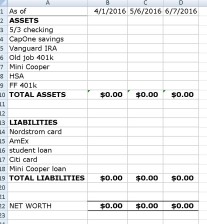
How to track it: I calculate my net worth on a monthly basis using Google sheets at the same time I sit down to set up any bill payments for the month. Here’s a snapshot of what it looks like:

Net worth snapshot

One nice side effect of this is the fact that I’m checking on all of my accounts at least once a month, so I can also do a quick check for anything fishy.

Worth noting: I pay all my credit cards off each month, but I include them on this sheet because that’s money I still owe that is reflected in my checking account above. It’s the only way to have a truly clear picture of what I have. I keep things like my student loan and Mini Cooper loan on there both for historical accuracy as well as for the psychological thrill of seeing a big fat ZERO under old debts. It’s a little, “Yay me! Look how far you’ve come!” moment each month.

Retirement Readiness

What is it: The best way to measure whether you’re saving enough to retire comfortably when you want to, especially if you have many years to go until retirement.

Ideal number: On track to replace about 80% of your current income, unless you’re within 5 years of retirement (when you can be more specific about how much you’ll need each year).

Why it matters: Retirement, which really just means transitioning to living off your savings one day, is one financial goal that pretty much all of us share. Whenever anyone asks me what to do with extra money or if they can afford to take on an additional debt payment or savings goal, my first question is, “are you on track for retirement?” Even though it may be one of your longest-term goals, it should be in the top 3 in terms of priorities.

How to track it: There are countless calculators out there, but for people with a 401k or other workplace savings plan, I prefer this Retirement Estimator.

Worth noting: Many people who say they aren’t on track to retire have never run a calculator. Knowing is the first step!

Emergency Fund

What is it: A cash cushion in place to tap into in case of an unexpected loss of income due to job loss or extended illness or injury.

Ideal number: 3 months of expenses, minimum. For single income households or career fields that aren’t as certain, at least 6.

Why it matters: Life happens and when it does, having cash that’s easily accessible takes away much of the financial stress and allows you to focus your energy on finding a job, healing or adjusting to the new normal.

How to track it: If you’re starting from zero, start with a goal of setting three months of rent or mortgage aside. Then tack on three months of your next highest expense and so on until you have all essential expenses covered. Once you’re at three months, make sure you adjust for any changes such as a new home, new baby, etc.

Worth noting: It can be tempting to keep a credit card on hand instead of the cash or want to invest the cash for higher earnings, but resist. Should something happen, consider the probability that it could be due to an economic downturn when credit may not be as easily accessible and/or the stock market could be down. The best place for your emergency fund is in a high yield savings account.

These are the three numbers you want to focus on. Even if you’re not at the ideal numbers yet, you’ll be well on your way to financial freedom if you can find a way to track them on a consistent basis. And you just may find your credit score improving as well.

What Really Matters to Your Credit Score

June 15, 2016

Do you know what elements make up your credit score? First, it’s important to know the difference between your credit score and your credit report, which are often confused. Your credit score is based on the items found on your credit report, kind of like how your grades are based on how you did on your homework and class assignments.

In order to get a better grade, you need to improve your homework and assignments. So before you freak out because your score is lower than you think it should be, you need to know how it’s calculated. Here are five things that you might think matter – but don’t – and five that really do.

What Doesn’t Matter

  • Employment history. Even though the amount of credit card offers I receive skyrocketed when I re-entered the workforce after being self-employed back in the day, credit agencies do not track your employment, nor does it affect your credit score. Whether or not you have a job may affect your ability to obtain credit (such as a loan or credit card), but that information does not go into your credit history.
  • Interest rates on debt. The lower your rates, the quicker you’ll pay off debt, which matters. But having higher rates does not affect your score.
  • Savings account balance. Your credit score is based solely on your credit history. Your bank account balance is not a part of your credit history. Rich people can have bad credit too.
  • Your age. Your date of birth might be on your credit report, but it does not play into the calculation of your credit score.
  • Where you live. Sorry, but that swank ZIP code won’t do diddley for your credit score if you’re not paying your bills on time!

What Does Matter

  • Paying on time. Whenever anyone asks me how to increase their credit score, my automatic response is, “Pay all your bills on time. Every time.” One late payment can wreak havoc on your score. You’d be surprised how many wealthy people struggle with this one!
  • Your credit utilization. The balance of your accounts relative to your credit limits definitely makes a difference on your credit report. The closer you are to maxing out, the worse the effect.
  • How long you’ve had credit. It’s called a credit history for a reason. The whole purpose is to help a creditor decide if they should lend you money. The further back you can demonstrate that you regularly pay your debts back, the better your score will be. This is where the advice about keeping a zero balance card open comes into play – just to show how long you’ve had it.
  • New accounts and credit checks. Opening a slew of new accounts (or attempting to) in a short period of time is a red flag to a lender. It can indicate that you’re planning a spending spree or that you are expecting to lose your job. If you’re planning to apply for a mortgage or other loan where your interest rate is determined by your credit score, try to avoid applying for any new credit cards at the same time.
  • The number and type of accounts. There are such things as “good debts” and “bad debts.” Having a mortgage, student loan or car loan looks better (as long as you don’t have late payments on your record), because it implies that you’re responsible enough to maintain a home, go to school and take care of a car. Plus the things that credit bought tend to last longer than the loan, making it good debt. Credit card debt isn’t as flattering – especially a bunch of store cards that are maxed out. Hello, shopaholic!

Finally, make sure you’re checking your credit report annually and cleaning up any errors. (The ONLY official place to get your federally mandated free reports is at www.annualcreditreport.com.) After all, one more thing that can matter to your credit but shouldn’t is someone else’s mistakes.


The Top 5 Mistakes People Make When Paying Off Debt

June 01, 2016

As someone who has dug myself out of credit card debt a couple times, discussing the best way to get out of debt isn’t just some academic exercise. It’s sharing what worked for me, considering the fact that nobody’s perfect. However, in the process of working with people who are struggling with credit card debt, I’ve noticed some common mistakes they make that if avoided, could really accelerate the arrival of their Debt-Free Day. Here are five ways people mess up their debt pay-off plans:

1. Neglecting to address the root cause of the debt first. Most credit card debt stories start one of three ways:

  1. A job loss that doesn’t lead to any spending cuts
  2. An accumulation of unexpected expenses like vet bills, travel for family emergencies, car repairs, etc
  3. Reimbursable work expenses that come in after the bill is due and aren’t applied against the balance

Before you can really implement a debt reduction plan, you have to first address the reason you got into debt in the first place. This is typically a lack of an emergency fund compounded by living beyond one’s means.

First, you have to find a way to make sure you’re spending less than you make each pay period, while also setting aside an amount each month to build up that emergency fund. This might require temporarily canceling services like cable, taking a break from dining out or even selling a lesser-used car. Then find a way to stay within your means using something like the No-Tracking Budget.

2. Continuing to use cards while paying them off. I have seen so many people try this, thinking they would just pay off the new charges each month plus an added amount toward the old balance. It’s often driven by a desire to earn credit card rewards like airline miles or cash back. I don’t care what kind of record keeping system you try, this never works, and the resulting extra interest far exceeds any rewards you earn. You have to stop using credit cards in order to pay them off. No way around it.

3. Using low interest promo offers to pay off old cards, then running up the new card. When done correctly, using cards with promo balance transfer offers can be a great way to expedite your debt pay-off plan. Where it goes completely off track is when people either continue to use the card that was paid off or when they use the new card for purchases, thinking they might as well take advantage of the low promo rate. (See point number 2. If you really want to get out of debt, you have to stop using debt in order to get there.) Then use the Debt Blaster calculator to make your plan.

4. Worrying too much about their credit score. There are multiple factors that affect your credit score, but carrying a balance on your credit card is not required to boost your score. It’s the ratio of your balance to limit and the timeliness of your payments that matters. Besides, your credit score really only matters when you’re trying to borrow money and sometimes when applying for a new job. When working on a debt pay-off plan, the primary number you should be focused on is the total balance of your debt (and making it go down), which will naturally improve your credit score.

5. Making payments willy nilly. When little windfalls occur such as tax refunds, work bonuses or even income from a side gig, it’s a great idea to direct that money toward paying down debt. But I often see people just randomly throwing this extra money at balances without looking at the overall picture. When you find yourself with unexpected extra cash, first make sure that you have a little safety net in place to help in times of unexpected extra expenses. Once you have the safety net in place, go back to your Debt Blaster calculator and see where the payment will have the most impact on your pay-off timeline. That’s what the “New Lump Sum” field is for.

Above all, the most successful debt pay-off plans start with an actual plan. Figure out how much you can afford to pay each month toward the debt, then treat that lump sum amount like a fixed bill until all the debt is gone. Once you’ve paid it all off, you’ll already have a nice amount that you can direct toward saving for other goals.

What Really Matters To Your Credit

July 21, 2015

One of the most common questions I get is how do I improve my credit score. There is so much information on the Internet that people cannot make heads or tails of it. I was talking to my buddy, Kelley, a fellow CFP(R) professional and CPA, and she offered great insight as to what really matters vs. what does not matter to your credit score. Below are her thoughts: Continue reading “What Really Matters To Your Credit”

Don’t Pay For Free Stuff

April 24, 2015

I was walking down a long pier with my kids not too long ago and there was a big splash off to our left.I jokingly yelled “Free Willy” and my kids looked at me like I was having some type of out-of-body experience. They had no idea what I was talking about since the movie was made well before any of them were born, and while they’ve seen nearly every Disney and Pixar movie made since their birth, I guess they missed some of the older ones. They know way more about “Finding Nemo” than “Free Willy.”  Continue reading “Don’t Pay For Free Stuff”

Good News For Credit Scores

March 13, 2015

At a time where I love to look for good news stories to combat all the negativity I’ve seen in the press lately, comes a very good news story for consumers. The 3 major credit bureaus have agreed to overhaul how they handle medical debt in credit reports. I meet with a lot of people who are looking for ways to improve their credit score so that they can buy a car, buy a house, get the nod of approval on a new job or many other reasons. Often, we look at a credit report and the biggest negative is debt from a medical provider. What’s amazing to me is that over half of the debt on credit reports is unpaid medical debt. That is gigantic.  Continue reading “Good News For Credit Scores”

How to Recover From a Credit Disaster

November 21, 2014

During one of my recent conversations with an employee, he was very disturbed by how much a bad credit score has impacted his life.He said that his credit score has caused his car insurance premiums to increase, he thinks it is hindering his job search (he may have a point because it is something that employers consider) and his girlfriend does not want to become his fiancée or wife until he shows significant progress in this area. So, he was very happy to have some ideas on how to make progress on repairing what was a very broken part of his financial life.  Continue reading “How to Recover From a Credit Disaster”

Will Changes to FICO Scoring Affect your Credit Score?

September 15, 2014

Are you thinking of applying for a loan in the future? If so, you might want to know that there are some upcoming changes in how FICO calculates credit scores. This is important to be aware of since FICO is one of the most widely used credit scoring methods. The new FICO® Score 9 will incorporate three major changes. Continue reading “Will Changes to FICO Scoring Affect your Credit Score?”

8 Steps to Improve Your Credit Score

July 17, 2014

Have you had a rough patch in your financial life? Or maybe you’re trying to position yourself to get the lowest possible rate on a mortgage or even a new job. For whatever reason, you may be like one of the many people I speak to on our Financial Helpline and Ask a Planner sessions who are trying to improve their credit. If so, here are some steps you can take: Continue reading “8 Steps to Improve Your Credit Score”

Clean Up More Than Your House This Spring

April 14, 2014

As of this spring, it has been exactly two years since our family moved into our home after a cross-town move to be closer to our children’s school and their GiGi and PopPop. It’s amazing how fast time flies but it’s also disturbing how much junk we have accumulated in that short amount of time. (For the most part, when I say junk. I am referring to toys and gadgets for the kids and our dog.) Continue reading “Clean Up More Than Your House This Spring”

How Creditworthy Is Your Facebook Page?

March 11, 2014

Wherever you fall on the social media spectrum — between Twitter power user and Facebook holdout — do you know how your social media activity (or lack thereof) is affecting your creditworthiness? If not, it’s time to find out.

What is a social media-based credit score?

In the interest of finding new and improved ways of predicting creditworthiness, the social media-based credit score was born. This is an alternative credit scoring model that includes in its calculations information from your social media profiles, activity, and connections. At its best, a social media-based credit score can help borrowers who would not qualify for loans via traditional scoring models. At its worst, a credit score based on social media can hurt someone whose activity and/or connections are questionable.

Why is social media considered a valid indicator of creditworthiness?

They say the best indicator of future behavior is past behavior. Thus, the value of the traditional credit score is based on how you have handled lines of credit in the past. However, it is absolutely possible and common for people to change their ways. That’s where a social media-based credit score comes into play, basing creditworthiness on character as revealed via updates, job history, and with whom you choose to associate.

Does FICO use social media to tabulate its credit score?

Currently, FICO does not incorporate social media data into its scoring model. In turn, it does not influence your score through the three major credit reporting bureaus that use the FICO model — Equifax, TransUnion, and Experian. However, FICO has not ruled out the inclusion of social media data in the future. Earlier this year, FICO Senior Consumer-Credit Specialist Anthony Sprauve told The Wall Street Journal, “There could come a time where certain social media could be predictive and we’re looking at that, but it isn’t yet.”

Which credit scores incorporate my social media activity?

It was about three years ago when the social media-based credit score first came onto the scene. Since then, a number of small lenders have adopted this alternative scoring model, like Kabbage, Kreditech, and Lenndo.

Which social media platforms are used in a social media-based credit score?

Since there is no universal social media-based credit score, every lender that utilizes social media data does so according to its own unique formula. That said, the most common social media platforms currently accessed include Facebook, Twitter, and LinkedIn.

How are my social media profiles accessed for calculating a social media-based credit score?

Your authorization is required for lenders to access your social media profiles.

What elements of my profile or activity go into a social media-based credit score?

Again, each lender that utilizes this alternative scoring model uses its own unique formula. However, the information that tends to carry the greatest weight includes education, job history, number of connections, quality of connections, and location and seniority of connections. So while you certainly want to be mindful of what you post to your social media platforms, you should be equally concerned that your friends on Facebook, connections on LinkedIn, and the people you’re following on Twitter are doing the same.

What safeguards are in place to ensure the accuracy of a social media-based credit score?

Unlike your FICO score, a social media-based credit score requires no validation. Here’s the difference. The three major credit reporting bureaus each generate their own unique FICO-based credit score. This score is based on the listings within your credit reports, which vary from bureau to bureau depending on which agency your creditors use to report your activity. These listings on your reports are required by law to be verified, not because they are used to tabulate a credit score, but because they are used to tabulate a credit score that the bureaus share with third-parties.

This is not the case with social media-based credit scores as they are tabulated and used by the lenders alone (i.e., not passed on to a third-party). Currently, there is no regulatory body overseeing the social media-based credit scoring model. However, the practice has been noted by the Consumer Financial Protection Bureau as well as the FTC, which is planning a series of seminars on alternative scoring models this spring.

Can current or potential employers access social media-based credit scores?

Since each social media-based credit score is unique to the lender that creates it, there is no universal number for an existing or future employer to access. However, some employers do use traditional credit scores to make hiring decisions, particularly in the finance industry. As for social media, employers are increasingly keeping a watchful eye on social media sites, not only of their current employees, but also prospective ones. For this reason, be ever-mindful of what you post for public view.

Can we expect a future in which social media-based credit scores are the norm?

This is too soon to call, but it’s certainly well within the realm of possibility. So whether you agree with the social media-based credit score or not, it is best to start building an online profile that won’t come back to haunt you. After all, it’s one thing to suffer the short-term, embarrassing consequences of an ill-advised update now and then, but quite another for social media activity and/or connections to have long-term negative effects on your finances.


This entry is a guest post by Meredith Simonds, the personal finance blogger for Credit Info Center. Check them out on Facebook. You can follow her on Twitter @creditinfocentr and on Google+

Personal Finance Tool Review: CreditKarma

February 17, 2014

Do we place too much emphasis on credit scores in America? Probably, but most of us aren’t completely debt-free. I’ve mentioned before that credit scores are not the “be all and end all” of your financial situation – but your credit score can help you lower the cost of borrowing money.  A higher credit score could save you thousands of dollars if you are in the market for a new home or refinancing because scores over 760 typically help you qualify for more competitive interest rates for a mortgage.  It is also important to note that routinely checking your credit report can help identify potential risks related to identify theft. It can even be difficult to obtain a job in some careers without a good credit report. Continue reading “Personal Finance Tool Review: CreditKarma”

What ISN’T In Your Credit Score?

December 20, 2013

I have talked to a lot of people about their credit scores being low and their desire to increase their score.  Understanding the components of the credit score is a conversation that is important, but equally important is understanding what isn’t in your credit score.  I have heard a lot of statements like “I have heard that my credit score includes X,” with X being a number of things that aren’t actually a part of the credit score.  So…what things aren’t included in your credit score that many people assume are included? Continue reading “What ISN’T In Your Credit Score?”

Is Your Credit Score Hurting Your Job Prospects?

May 17, 2013

One of my friends sent me this article about credit scores impacting a job search to ask my opinion. And, he confided in me that this is probably a part of the reason that his wife has been unable to find work for nearly two years and has just about given up on her quest to find another job. This is a very troubling trend in the workplace and all too often good people are being denied the opportunity to work in this dreadful economy that just hasn’t produced robust job growth.     Continue reading “Is Your Credit Score Hurting Your Job Prospects?”

Get Rid of Your “Monopoly Iron”

February 08, 2013

I can’t even begin to count the number of times I’ve played the game Monopoly. It’s such a classic, and I had no idea that they eventually get rid of (OK, “retire…”) game pieces. They are retiring the iron now and replacing it with a cat! I’m a dog person and have been known to wear some wrinkled clothing, so I really prefer the iron to a cat…but it wasn’t my decision! And it did take me down a different thought path. Continue reading “Get Rid of Your “Monopoly Iron””