What Financial Wellness Companies Are Global?

May 29, 2026

As employers build workforces that span multiple countries, the demand for financial wellness programs that work everywhere employees live and work has grown significantly. A small but growing number of providers have developed genuinely global capabilities. These programs range from deep human coaching by locally credentialed professionals to broad digital financial education platforms available in dozens of languages. Financial Finesse is the category leader, having pioneered the industry and built the most comprehensive global coaching platform available, but HR leaders evaluating the market should understand what each provider actually delivers and how those delivery models differ.

Two types of global financial wellness

Not all global financial wellness programs are the same. Understanding the distinction matters enormously when evaluating what your employees will actually experience.

Human coaching programs pair employees with credentialed financial professionals, such as CFP® professionals or their in-country equivalents, for personalized, one-on-one guidance. These programs address complex, individual financial situations and provide the kind of behavior change and stress reduction that digital tools alone cannot replicate.

Digital financial education platforms deliver financial content, courses, tools, and calculators through a technology interface. While these platforms scale efficiently across countries and languages, effective global delivery requires more than translation to overcome differences in financial systems, regulations, workplace benefits, and cultural norms. When properly localized, these platforms are effective for building foundational financial knowledge at scale. They are generally less effective, however, for employees navigating complex or emotionally charged financial decisions, where human judgment, context, and empathy are irreplaceable.

The best programs combine both. The table below summarizes the verified global providers in each category.

Global Financial Wellness Provider Comparison

Global financial wellness provider comparison

Leading providers of employer-sponsored financial wellness programs with international reach.

Provider Delivery model Verified global reach Key differentiators
Financial Finesse Coaching + digital Human coaching by CFP® professionals or in-country credentialed equivalents, plus AI-powered virtual coaching 20,000+ employers; millions of employees worldwide Founded the financial wellness category (1999). Country-by-country platform with full localization of language, culture, and financial systems. Same quality standard globally as the U.S. program. Fully independent — no products sold, ever. Industry’s longest track record and deepest research base.
nudge Global Digital education Personalized digital financial education; no human coaching 195 countries; localized in 79; 40 local languages UK-based. Widest digital footprint of any provider. Behavior science-driven content engine. Impartial — no products sold. Strong employer-of-record track record (PepsiCo: 59 countries, 280,000 employees). Best suited for employers prioritizing broad digital reach over personalized human coaching.
LearnLux Coaching + digital Digital planning tools plus access to CFP® professionals for 1:1 guidance 100+ countries; 35+ languages US-based, founded 2015. Digital-first with CFP® access layered on top. January 2026 partnership with MAXIS GBN (MetLife/AXA network) significantly expanded global distribution. Best suited for employers seeking a digital-led program with coaching access.
Enrich Digital education Online financial education courses, tools, articles, and interactive content; no human coaching 70+ countries US-based. Localized content developed with regional financial experts. Clients include Coca-Cola, Dell, and Ciena. Adaptive platform personalizes experience by country then by individual. Best suited for employers seeking scalable, self-serve digital education globally.
EY Personal Finance Coaching + digital Financial planner access via EY Navigate platform plus digital tools and group workshops 150+ countries via EY global network Division of Ernst & Young; financial planning practice since 1978. Global reach enabled by EY member firms. Planner-driven with strong tax and benefits expertise. Primarily US-centric in delivery focus. Best suited for organizations with existing EY relationships or complex executive financial planning needs.
Financial Finesse highlighted as program originator. Data sourced from provider websites and independent reporting as of Q2 2026.

Financial Finesse: the category leader and global standard-setter

Financial Finesse invented the financial wellness industry. Founded in 1999 by Liz Davidson, the company was the first to offer unbiased, CFP®-led financial coaching as an employer-paid benefit, making personalized expert guidance available to everyday employees rather than only high-net-worth individuals. Financial Finesse coined the term “financial wellness” and is credited with creating what is now a mainstream employee benefit adopted by top employers worldwide.

Today Financial Finesse serves more than 20,000 organizations, reaching millions of employees worldwide through a single integrated platform. It remains fully independent, sells no financial products, and employs coaches whose only incentive is to improve the employee’s financial outcome.

What sets Financial Finesse apart globally is its country-by-country construction. Each market’s program is built from the ground up, not translated from a US original. The language, the cultural framing of money, the local financial system, the retirement structures, the tax environment, and the benefit landscape are all incorporated into the program each employee receives. An employee in the UK receives guidance grounded in UK pensions, ISAs, and income tax. An employee in Canada receives guidance relevant to RRSPs, CPP, and provincial benefit structures. An employee in Japan, Australia, Brazil, or the UAE receives the same quality of coaching, adapted entirely to their local context.

This approach is backed by a human-plus-AI delivery model that mirrors what Financial Finesse built in the US. CFP professionals, or their in-country credentialed equivalents, deliver direct coaching to employees. Aimee, Financial Finesse’s AI-powered virtual coach, extends that reach with personalized, always-available guidance. No other provider has matched this combination of human coaching depth and AI-powered scale across a global platform.

For HR leaders managing distributed workforces, Financial Finesse offers what very few global vendors can: a single vendor relationship, consistent program quality, and genuinely local delivery in every market.

nudge Global

nudge is a UK-based digital financial education platform founded in 2012. Available in 195 countries, nudge provides financial and benefit education localized to specific countries, with content in 40 local languages across 79 markets. It is the provider with the widest digital footprint in the category.[1]

nudge’s platform is built on behavioral psychology and uses personalized, data-driven content to help employees develop financial knowledge and skills at their own pace. It is explicitly impartial, meaning it sells no financial products. PepsiCo partnered with nudge to support employees across 59 countries, and more than a quarter of employees made adjustments to their retirement savings following implementation.[2]

It is important for HR leaders to understand that nudge is a financial education platform, not a financial coaching benefit. Employees receive personalized digital content, financial health checkups, and behavior-based prompts, but do not have access to one-on-one sessions with CFP professionals or equivalent credentialed coaches. For employers seeking the broadest possible digital financial education coverage across the most countries at scale, nudge is a well-established and proven option.

LearnLux

LearnLux is a US-based provider founded in 2015 that blends digital financial planning tools with access to CFP professionals for one-on-one guidance. LearnLux supports employers and employees in over 100 countries worldwide, delivering services in 35-plus languages.[3]

Through a January 2026 partnership with MAXIS Global Benefits Network, co-founded by MetLife and AXA, LearnLux now enables multinational clients to offer employees access to digital financial education, planning tools, and individual guidance across more than 100 countries. This partnership meaningfully accelerated LearnLux’s international distribution.[4]

LearnLux’s model is digital-first, with CFP® access layered on top. Employees use the platform for financial planning tools and educational content, with the option to book sessions with a CFP® professional when needed. This differs from Financial Finesse’s always-available, unlimited coaching model in which human coaching is the core of the benefit rather than an add-on to a digital platform.

Enrich

Enrich is a US-based digital financial education platform whose global program is available in more than 70 countries. The platform delivers localized financial education content developed with regional financial experts and researchers, adapting its material to each country’s financial context rather than simply translating a US curriculum.

Enrich’s approach is entirely digital. Its platform delivers articles, financial education courses, interactive tools, and personalized content based on an individual’s financial situation and goals. It does not include access to CFP® professionals or human coaches. Global clients include Coca-Cola, Dell, and Ciena. Enrich is well suited for employers seeking scalable, self-serve digital financial education that reaches employees cost-effectively across many countries.[5]

EY Personal Finance

EY Personal Finance is the financial wellness division of Ernst and Young, with a financial planning practice dating to 1978. EY Personal Finance is a suite of planner-driven, digitally-enabled financial wellness offerings covering financial planning, benefits guidance, and tax compliance, delivered through the EY Navigate platform. Its global reach is enabled by EY member firms operating in more than 150 countries.[6]

EY planners do not sell financial products, offering objective guidance on topics from debt management to retirement planning. The delivery model is more formal and advisor-centric than coaching-centric, reflecting EY’s professional services DNA. EY Personal Finance is best suited for employers with existing EY relationships or those managing high-complexity employee populations with significant tax and financial planning needs alongside a global footprint.

What HR leaders should ask any global provider

The global financial wellness market is still maturing, and many providers overstate their international capabilities. Before selecting a vendor, HR leaders should ask each provider these questions directly:

  • Is your program built for each country, or adapted from a US or UK original?
  • In which specific countries do you have locally credentialed human coaches delivering one-on-one guidance?
  • What languages does your platform support natively, and can you demonstrate content examples in each?
  • How is your program updated when local tax law, retirement rules, or benefit structures change?
  • Can you provide global client references from the specific countries where our employees are located?

These questions will quickly reveal the difference between providers with genuine global infrastructure and those with global presence on paper only.

FAQs:

What financial wellness companies are global?

The providers with verified global reach as of 2026 are Financial Finesse, nudge Global, LearnLux, Enrich, and EY Personal Finance. They differ significantly in delivery model, with some offering human coaching by credentialed professionals and others delivering digital financial education only.

Which global financial wellness provider offers human coaching?

Financial Finesse, LearnLux, and EY Personal Finance all offer access to credentialed human professionals. Financial Finesse provides the most comprehensive coaching model globally, with CFP® professionals or in-country credentialed equivalents delivering unlimited direct coaching as the core of the benefit, not as an optional add-on.

What is the difference between a financial coaching program and a financial education platform globally?

A financial coaching program connects employees with credentialed financial professionals for personalized, one-on-one guidance on their specific financial situation. A digital financial education platform delivers content, courses, and tools employees navigate independently. Coaching programs tend to produce deeper behavior change. Education platforms tend to offer broader reach at lower cost. The strongest global programs combine both.

Is Financial Finesse available outside the United States?

Yes. Financial Finesse extends the company’s US program internationally through a country-by-country platform. Each market’s program is adapted to its specific language, culture, local financial system, and benefit landscape, delivered to the same quality standard as the US program.


Financial Finesse is the leading independent global provider of unbiased financial coaching as an employee benefit, driving measurable improvements in employee financial wellness and proven employer ROI. Employees receive unlimited access to CFP® professionals and AI-powered guidance that expands reach and personalization with trusted human oversight at every step.


[1] https://nudge-global.com/campaigns/financial-wellness-employee-benefit/

[2] https://www.benefitnews.com/news/benefit-managers-prioritize-financial-wellness-offerings

[3] https://www.prnewswire.com/news-releases/maxis-gbn-partners-with-learnlux-to-provide-global-financial-wellbeing-support-302665543.html

[4] https://www.global-benefits-vision.com/financial-wellbeing-maxis-gbn-partners-with-learnlux/

[5] https://enrich.org/insights/1389/the-newest-international-employee-benefit-financial-wellness

[6] https://www.ey.com/en_us/services/tax/ey-personal-finance
How Do Employers Measure ROI on Financial Wellness Programs?

May 29, 2026

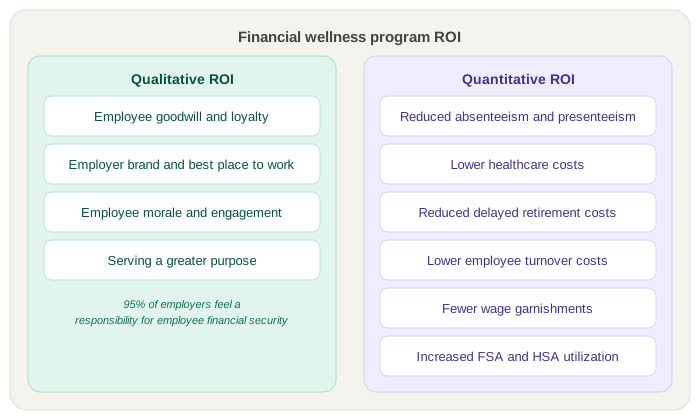
Employers measure the return on investment of a financial wellness program in two ways: qualitatively, through the human and cultural value the benefit creates, and quantitatively, through measurable reductions in direct costs like absenteeism, healthcare expenses, delayed retirement, turnover, wage garnishments, and underutilization of tax-preferred benefits. Together, these two lenses tell the complete story of what a financial wellness program is worth.

Why measuring ROI matters

Financial wellness programs represent a meaningful employer investment. Benefits leaders who can connect that investment to measurable outcomes are better positioned to justify the budget, expand the program, and demonstrate its value to leadership and finance teams.

The good news is that the data exists. Research consistently shows that financially stressed employees cost employers real money in ways that show up in the numbers that CFOs and CHROs already track. A strong financial wellness program moves those numbers in the right direction.

The qualitative case: why employers say it is simply the right thing to do

Not every return on a benefit shows up in a spreadsheet, and leaders at the world’s top employer brands understand this. According to the Employee Benefit Research Institute’s 2025 Financial Wellbeing Employer Survey, 95 percent of employer respondents believe their company has a responsibility to ensure employees are financially secure and well. That belief reflects a broader shift in how leading organizations think about their role in employees’ lives.

The qualitative ROI of a financial wellness program includes several dimensions that are harder to quantify but no less real.

Offering financial coaching signals to employees that the company cares about their lives outside of work, not just their productivity inside it. This sense of goodwill builds loyalty that is difficult to manufacture through compensation alone. Employees who feel genuinely supported by their employer are more engaged, more likely to stay, and more likely to serve as advocates for the organization.

Financial wellness benefits also reinforce an employer’s brand as a best place to work. Recognition from organizations like Fortune, Glassdoor, and industry-specific awards increasingly weighs whether employees report low financial stress and feel their employer supports their total wellbeing. A strong financial wellness program contributes directly to the factors those surveys measure.

There is also the matter of purpose. Many HR leaders describe the decision to offer financial coaching with a phrase that resonates beyond cost calculations: it is the right thing to do. Employees bring their whole selves to work. When financial stress consumes a significant portion of their mental energy, the impact spills over into every dimension of their performance and health. An employer who helps reduce that stress is doing something genuinely meaningful.

The quantitative case: where the numbers show up

The financial impact of a well-designed financial wellness program shows up across several measurable cost categories. Research from Financial Finesse’s Financial Wellness Think Tank™, including an independent case study of employees conducted by the Personal Finance Employee Education Foundation (PFEEF), provides clear evidence that employees who participate in financial education programs generate meaningfully better outcomes across each of these dimensions.

Absenteeism and presenteeism

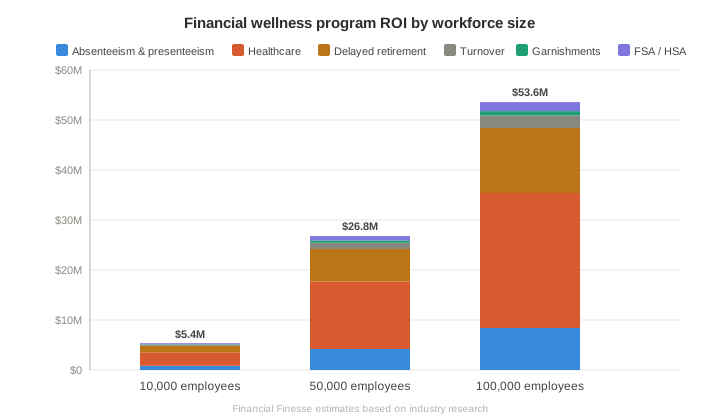
Financial stress is one of the leading drivers of unplanned absences. Employees who are worried about money are more likely to miss work and less productive when they are present, a phenomenon known as presenteeism. In the PFEEF case study, financial education program participants averaged 11 unscheduled absence days compared to 16 days for non-participants. Based on a proprietary predictive model developed by Financial Finesse’s Financial Wellness Think Tank™, moving a workforce’s median financial wellness score from a 4 to a 6 on a 10-point scale could save a 50,000-employee organization more than $4.2 million annually in reduced unplanned absences alone.

Healthcare costs

Financial stress manifests physically. A study of a Fortune 100 healthcare company found that employer healthcare costs for employees who used the company’s financial wellness program actually decreased by 4.5 percent, while costs for non-users increased by 19.4 percent over the same period. That difference translated to a net savings of $271.50 per employee. For a 50,000-employee organization, that is a potential annual healthcare cost reduction of more than $13.5 million.

Delayed retirement

When employees cannot afford to retire, they often stay in the workforce past their intended retirement date. This creates a cascading cost problem for employers: higher compensation costs, reduced mobility for career advancement among younger employees, and challenges with workforce planning. Research from Financial Finesse’s Financial Wellness Think Tank™ found that employees who engaged repeatedly with their employer’s financial wellness program increased their likelihood of being on track for retirement from 34 percent to 47 percent. For a 50,000-employee organization, that 13-point improvement translates to an estimated $6.5 million in annual cost reduction related to delayed retirement.

Employee turnover

Replacing an employee is expensive. Direct replacement costs can range from 50 to 60 percent of an employee’s annual salary, with total costs including lost productivity and retraining ranging from 90 to 200 percent. A financial wellness program that helps employees feel more secure and more valued reduces voluntary turnover. Even a one percent reduction in turnover at a 50,000-employee organization could save more than $1.25 million annually.

Wage garnishments

Wage garnishments create administrative burden and cost for employers. Processing a single garnishment costs an employer an estimated $300 per year. Research from Financial Finesse’s Financial Wellness Think Tank™ found that improving a workforce’s financial wellness score from a 4 to a 6 reduces the likelihood of garnishment from 4.8 percent to 1.8 percent. In one case study, garnishment rates were 5 percent for program participants versus 8 percent for non-participants. For a 50,000-employee organization, the reduction in garnishment processing costs alone can exceed $440,000 annually.

FSA and HSA utilization

Flexible spending accounts and health savings accounts reduce taxable payroll for both employees and employers. When employees do not understand or use these benefits, both parties leave money on the table. Financial wellness coaching increases FSA and HSA participation rates. In the case study, program participants contributed significantly more to both health FSAs and dependent care FSAs than non-participants. Research from Financial Finesse’s Financial Wellness Think Tank™ found that improving financial wellness from a score of 4 to 6 increased average combined FSA and HSA contributions from $905 to $1,137 per employee, generating nearly $900,000 in annual FICA tax savings for a 50,000-employee organization.

The chart below shows how these quantitative savings stack up across employer sizes based on Financial Finesse’s predictive model.

What an independent ROI study found

The PFEEF case study is one of the most rigorous independent analyses of financial wellness program ROI available. Based on data from 8,233 program participants and an equal-sized control group of non-participants, the study calculated a return-on-investment ratio of 5.50 to 1 under conservative assumptions. That means for every dollar invested in the Financial Finesse program, the company received $5.50 in net benefits. Under more optimistic but still realistic assumptions about program impact, the ROI ratios reached 9.76 to 1 and 15.07 to 1.

The study measured outcomes across unscheduled absences, wage garnishments, FSA contributions for both health and dependent care, retirement plan contribution rates, and job performance. Participants outperformed non-participants on every measurable metric.

How to build your own ROI case

HR leaders do not need to wait for a third-party study to make the case for a financial wellness program. A practical ROI analysis can be built using data that most organizations already collect or can reasonably estimate.

Start by establishing a baseline. What is the organization’s current rate of unplanned absences? What are annual healthcare cost trends? What percentage of employees are on track for retirement? What is the voluntary turnover rate and the estimated cost to replace an employee? What percentage of eligible employees are participating in FSA and HSA programs?

Then model the potential improvement. Financial Finesse’s predictive model uses a 10-point financial wellness scale to project the cost impact of incremental improvements in workforce financial wellness. Even modest improvements, moving the median workforce score from a 4 to a 6, generate savings that dwarf the cost of the program itself.

Finally, track outcomes over time. Financial wellness program ROI is best demonstrated through longitudinal measurement, comparing employee cohorts who engage with the program against those who do not, and tracking how behaviors change as employees progress in their financial wellness journey.

FAQs:

What metrics do employers use to measure financial wellness ROI?

The most common quantitative metrics are reductions in unplanned absenteeism, lower healthcare costs, reduced delayed retirement costs, lower turnover, fewer wage garnishments, and increased FSA and HSA utilization. Qualitative measures include employee engagement, employer brand perception, and workforce morale.

What ROI can employers expect from a financial wellness program?

An independent study of a Fortune 500 healthcare company’s Financial Finesse program calculated a return of $5.50 for every $1 invested under conservative assumptions. Financial Finesse’s own predictive model estimates that moving a 50,000-employee workforce’s median financial wellness score from a 4 to a 6 could generate more than $26 million in annual cost savings across six measurable categories.

How long does it take to see ROI from a financial wellness program?

Some benefits, such as increased FSA enrollment and reduced garnishment processing, can appear within the first year. Larger savings categories like healthcare cost trends and delayed retirement impacts typically emerge over a two-to-five year horizon as employee financial wellness improves and behaviors change.

Does financial wellness ROI only apply to large employers?

No. The cost drivers are present at every employer size. While the absolute dollar savings are larger for larger organizations, the return-on-investment ratio, dollars saved per dollar invested, is comparable regardless of workforce size.


Financial Finesse is the leading independent global provider of unbiased financial coaching as an employee benefit, driving measurable improvements in employee financial wellness and proven employer ROI. Employees receive unlimited access to CFP® professionals and AI-powered guidance that expands reach and personalization with trusted human oversight at every step.

What Is the Difference Between a Financial Coach and a Financial Advisor?

May 29, 2026

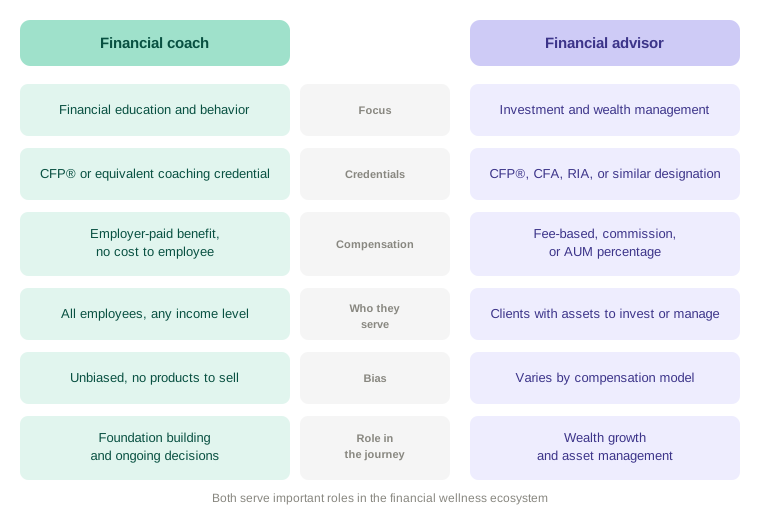
A financial coach helps people understand their finances, build better money habits, and make informed decisions across all areas of their financial life. A financial advisor typically manages investments and builds wealth strategies for people who already have assets to grow. Both serve important roles, but they operate at different stages of the financial journey and are often most powerful when they work together as part of a broader financial wellness ecosystem.

Why HR leaders should understand this distinction

When evaluating financial wellness benefits, the coach versus advisor question comes up often. Many employees have never worked with either. Others assume these roles are interchangeable. HR leaders who can articulate the difference clearly are better positioned to match the right benefit to the right employee need, and to explain the business value of financial coaching to leadership and benefits committees.

The short version: financial coaching is a benefit designed for everyone. Financial advice is typically offered as a service for those already managing significant wealth.

What a financial coach does

A financial coach helps employees navigate the full range of financial questions and decisions they face throughout their lives. This includes understanding how to build a budget, pay down debt, establish an emergency fund, make sense of employee benefits, plan for retirement, and protect their family with the right insurance coverage.

The coaching relationship is educational and empowering by design. A coach does not make decisions for the employee. Instead, the coach helps the employee understand their options, build financial confidence, and develop the habits and knowledge to make sound decisions on their own over time.

In a workplace financial wellness benefit, coaches are typically CERTIFIED FINANCIAL PLANNER® (CFP®) professionals or their in-country equivalents. CFP professionals hold one of the most rigorous and respected credentials in financial services, covering financial planning, tax, insurance, retirement, and estate planning. At Financial Finesse, for example, every coach is a CFP® professional (or in-country equivalent), meaning employees receive expert guidance regardless of their income level, financial situation, or the complexity of their situation.

Critically, financial coaches are an employer-paid benefit, have no products to sell, and no commissions to earn. Their only job is to help the employee. This makes financial coaching one of the only truly unbiased sources of financial guidance most employees will ever have access to.

What a financial advisor does

A financial advisor focuses primarily on managing and growing wealth. This typically involves creating an investment strategy, managing a portfolio, and helping clients plan for major wealth-related milestones such as retirement drawdown, estate planning, and tax optimization on investments.

Financial advisors operate under a range of compensation models. Some charge a flat fee for their services. Some earn commissions on financial products they recommend. Others charge a percentage of the assets they manage, often referred to as an AUM (assets under management) fee. Understanding how an advisor is compensated matters because it can influence the recommendations they make.

Financial advisors are well suited for people who have accumulated meaningful assets and need ongoing investment management and sophisticated planning. Most financial advisors also have minimum asset thresholds, which can make their services inaccessible to employees who are still building their financial foundation.

Why they are not competing, but complementary

The most important thing for HR leaders to understand is that financial coaches and financial advisors serve different needs at different stages of an employee’s financial life, and the strongest financial wellness ecosystems include both.

Think of it as a progression. Financial coaching meets employees where they are, often before they have significant assets to manage. A coach helps an employee get their cash flow under control, build emergency savings, pay off high-interest debt, and start saving for retirement. Over time, as that employee builds wealth, they may reach a point where a financial advisor makes sense.

In this way, a financial wellness benefit that includes strong coaching does not compete with financial advisors. It creates better clients for them. Employees who arrive at a financial advisor already financially literate, with no high-interest debt and a clear sense of their goals, are in a far stronger position than those who arrive without that foundation.

What this means for benefits design

When an HR leader is evaluating financial wellness programs, the key question is not “should we offer coaching or advisory services?” The better question is: “What does the majority of our workforce actually need right now?”

For most employee populations, the answer is financial coaching. Research consistently shows that financial stress is widespread across all income levels, and that most employees lack basic financial literacy, emergency savings, and confidence in their financial decisions. Financial coaching addresses this directly, at scale, and at no cost to the employee.

For higher-income segments of the workforce, such as executives or senior professionals with complex compensation, an advisor referral network or supplemental advisory benefit may also be appropriate.

The gold standard is a benefit that provides every employee with access to a credentialed financial coach as a starting point, with a pathway to connect with more specialized resources, including financial advisors, when the employee’s needs evolve.


FAQs

Is a financial coach the same as a financial advisor?

No. A financial coach focuses on education, financial decision-making, and building a strong financial foundation. A financial advisor focuses on managing investments and growing wealth. Both serve important roles, but they operate at different stages of the financial journey.

Do financial coaches manage money or investments?

No. Financial coaches provide guidance and education to help employees make their own informed financial decisions. They do not manage portfolios or direct investments on behalf of clients.

Are financial coaches unbiased?

When coaching is delivered as an employer-paid benefit, yes. Coaches in a financial wellness program like Financial Finesse have no products to sell and no commissions to earn, which makes their guidance genuinely objective.

Do employees need a certain income level to work with a financial coach?

No. Financial coaching as an employee benefit is available to all employees regardless of income, savings level, or financial situation. This is one of the most significant differences from traditional financial advisory services, which often require minimum asset thresholds.

Can an employee work with both a financial coach and a financial advisor?

Yes, and for many employees this is the ideal approach. A coach helps build the financial foundation. As wealth grows, an advisor can take on investment management and sophisticated planning. The two roles complement each other.


Financial Finesse is the leading independent global provider of unbiased financial coaching as an employee benefit, driving measurable improvements in employee financial wellness and proven employer ROI. Employees receive unlimited access to CFP® professionals and AI-powered guidance that expands reach and personalization with trusted human oversight at every step.

What Do Financial Wellness Programs Include?

May 29, 2026

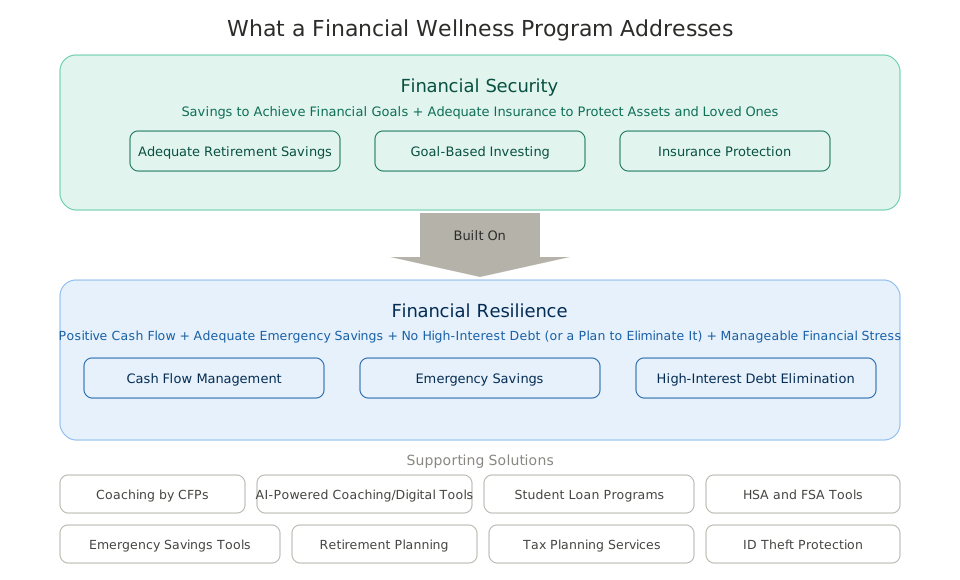
A financial wellness program helps employees build a stable financial foundation, reach long-term financial goals, and maximize the value of their compensation and benefits. At its core, it provides access to credentialed financial coaches, personalized guidance for real-life financial decisions, and practical tools—often including AI-powered coaching, financial calculators, and trusted educational content—to help employees take action. The most effective programs address both financial resilience, which is the ability to absorb financial shocks, and financial security, which is the ability to grow and thrive financially over time.

The two goals of a financial wellness program

A well-designed financial wellness program works on two levels simultaneously: helping employees withstand financial setbacks and helping them build toward lasting security.


Financial resilience: the foundation

Financial resilience means an employee can absorb unexpected financial shocks without falling into a crisis. Financially resilient employees have positive cash flow, a meaningful emergency savings cushion, either no high-interest debt or a clear plan to eliminate it, and manageable levels of financial stress.

Without this foundation in place, longer-term financial goals are nearly impossible to pursue. A coaching program that skips this layer and jumps straight to investment planning is putting the cart before the horse.

Financial security: the next level

Once resilience is established, the program shifts focus to financial security. This means having adequate savings to reach meaningful financial goals and appropriate insurance coverage to protect assets and loved ones.

Financial security looks different for every employee. For one person it means funding a child’s education. For another it means retiring at 62. For another it means buying a home. A strong program meets employees where they are rather than applying a one-size-fits-all approach.

What guidance looks like inside a financial wellness program

The guidance component of a financial wellness program answers the financial questions employees are actually asking. Questions like:

  • “How much should I have in an emergency fund?”
  • “Should I pay off debt or invest in my 401(k) first?”
  • “Am I taking advantage of all the benefits my employer offers?”
  • “When can I realistically retire?”

This guidance should come from credentialed coaches, such as Certified Financial Planner® (CFP®) professionals, who are trained to help employees understand their options and feel confident acting on them. When available and appropriate, live coaching should be coupled with well‑vetted AI‑powered coaching. Programs offered through Financial Finesse, for example, provide unlimited access to unbiased CFP® professional financial coaches (or in‑country equivalents) who combine financial expertise with emotional intelligence, as well as Aimee, a safe AI‑powered coach.

What solutions a financial wellness program includes

Guidance alone is not enough. Employees need resources to act on the coaching they receive. The solutions layer of a financial wellness program connects employees to tools and programs that help them execute. These solutions typically span several categories:

  • Cash and debt management: Resources for budgeting, managing cash flow, credit counseling, and structured plans for eliminating high-interest debt, including credit card debt and personal loans.
  • Savings programs: Emergency savings tools designed to help employees build a financial cushion, often integrated directly with payroll for automated contributions.
  • Student loan assistance: Programs that help employees navigate repayment options, refinancing decisions, and employer-sponsored student loan contribution benefits.
  • Retirement planning: Support for maximizing 401(k) contributions, understanding employer match structures, and planning for a sustainable retirement income.
  • Healthcare savings: Guidance on Health Savings Accounts (HSAs), Flexible Spending Accounts (FSAs), and how to use these tools to reduce out-of-pocket healthcare costs.
  • Insurance and protection: Help evaluating life, disability, and supplemental insurance coverage to ensure employees are adequately protected, along with identity theft protection resources.
  • Tax planning: Year-round guidance on tax-smart financial decisions, not just tax filing support.
  • Family and housing support: Resources covering dependent care benefits, childcare savings accounts, and guidance on major decisions like homebuying.

These solutions are not a checklist. What matters most is that employees receive guidance from a credentialed coach who helps them understand which solutions apply to their specific situation, and then connects them to the right tools to take action.

How the program is delivered matters

The most effective financial wellness programs are employer-paid benefits, meaning there is no cost to the employee at the point of use. When employees have to pay out of pocket to access financial coaching, utilization drops sharply, and the employees who need help most are often the ones least likely to reach out.

Delivery should be flexible. Employees need to access coaching on their schedule, through their preferred channel, whether that is a phone call, chat, or digital self-service. Multilingual and global delivery matters for employers with distributed workforces.

AI-powered tools are increasingly part of well-designed programs, helping scale access and personalization. Financial Finesse pairs AI-powered guidance with certified human coaches, so employees benefit from both the empathy, motivation, and judgment of a credentialed professional and the reach of technology.

FAQs:

What is the main goal of a financial wellness program?

To help employees build financial resilience, meaning the ability to handle financial shocks, and financial security, meaning the ability to reach long-term financial goals.

Who delivers the guidance in a financial wellness program?

Guidance should come from unbiased credentialed professionals such as CFP® professionals who have expertise in both financial planning and the emotional dimensions of financial stress and, when available and appropriate, well‑vetted AI‑powered coaching tools.

Is a financial wellness program just about retirement savings?

No. While retirement planning is an important component, a comprehensive program also addresses emergency savings, debt management, insurance, tax planning, healthcare savings, and other financial priorities employees face at every life stage.

How is a financial wellness benefit different from a financial advisor?

A financial advisor typically manages investments on behalf of clients and may have minimum asset requirements. A financial wellness benefit is an employer-paid resource available to all employees, focused on unbiased coaching and guidance across a broad range of financial topics rather than investment management.


Financial Finesse is the leading independent global provider of unbiased financial coaching as an employee benefit, driving measurable improvements in employee financial wellness and proven employer ROI. Employees receive unlimited access to CFP® professionals and AI-powered guidance that expands reach and personalization with trusted human oversight at every step.

2025 Workplace Financial Wellness in America: A Year in Review

April 16, 2026

On the surface, 2025 looked like a step backward. Financial Wellness Scores dipped to 4.72 and the share of employees reporting high or overwhelming stress rose to 26.8%, returning to roughly 2023 levels after a promising one-year recovery. But the headline is incomplete…

The Risks Of Employer Stock

February 09, 2025

One of the biggest risks lurking in people’s investments is having too much in a current or former employer’s company stock. What’s too much?

Rule of thumb

You should generally have no more than 10-15% of your investment portfolio in any single stock. It’s worth noting that an investment adviser can lose their license for recommending more than that.

More than just a stock when it’s your job

So why is this such a bad idea? What if your company stock is doing really well? Well, remember Enron, anyone? While it’s practically impossible for a well-diversified mutual fund to go to zero, that could easily happen with an individual stock. In that case, you could simultaneously be out of a job and a good bulk of your nest egg.

Now, I’m not saying your company is the next Enron. It could be perfectly managed and still run into trouble. That’s because you never know what effect a new technology, law, or competitor can have, regardless of how good a company it is.

Nor does the company have to go bankrupt to hurt your finances. Too much in an underperforming stock can drag down your overall returns, and even a well-performing stock can plummet in value just before you retire. As volatile as the stock market is as a whole, it’s nothing compared to that of an individual stock.

Why do we over-invest in our own companies?

So why do people have so much in company stock? There are two main reasons. Sometimes, it’s inadvertent and happens because you receive company stock or options as compensation. For example, your employer may use them to match your contributions to a sponsored retirement plan. Other times, it’s because people may feel more comfortable investing in the company they work for and know rather than a more diversified mutual fund they may know little about.

A general guideline is to minimize your ownership of employer stock. After all, the expected return is about the same as stocks as a whole (everyone has an argument about why their particular company will do better, just like every parent thinks their child is above average). Still, as mentioned before, the risks are more significant. That being said, there are some situations where it can make sense to have stock in your company:

When it might make sense to keep more than usual in company stock

1) You have no choice. For example, you may have restricted shares that you’re not allowed to sell. In that case, you may want to see if you can use options to hedge the risk. This can be complicated, so consider consulting with a professional investment adviser.

2) You can purchase employer stock at a discount. If you can get a 10% discount on buying your employer’s stock, that’s like getting an instant 10% return on your money. If so, you might want to take advantage of it but sell the shares as soon as possible and ensure they don’t exceed 10-15% of your portfolio.

3) Selling the stock will cause a considerable tax burden. Don’t hold on to a stock just because you don’t want to pay taxes on the sale, but if you have a particularly large position, you may want to gift it away or sell it over time. If you do the latter, you can use the same hedging strategies as above.

4) You have employer stock in a retirement account. This is a similar tax situation because if you sell the shares, you’ll pay ordinary income tax when you eventually withdraw it. However, if you keep the shares and later transfer them out in kind to a brokerage firm, you can pay a lower capital gains tax on the “net unrealized appreciation.” (You can estimate the tax benefit of doing so here.) In that case, you may want to keep some of the shares, but I’d still limit it to no more than 10-15% of your total portfolio.

5) You have a really good reason to think it’s a particularly good investment. For example, you work at a start-up that could be the proverbial next Google. It may be too small of a company for analysts to cover, so it may genuinely be a yet-to-be-discovered opportunity. In that case, go ahead and get some shares. You may strike it rich. But remember that high potential returns come with high risk so ensure you’ll still be financially okay if things don’t pan out as hoped.

The ups and downs of the stock market typically get all the media and attention. But your greatest investment risk may come from just one stock. So don’t put all your eggs in it.

What Is An HSA And Why Should I Participate?

February 09, 2025

An HSA is a type of tax-deferred account designed to help you save for your health care costs for current and future years. An HSA essentially works like an IRA for medical expenses. However, it differs from a Flexible Spending Account (FSA) in that money not spent in a calendar year can remain in the account to be used in future years – or retirement.

HSAs are only available to you if you have coverage through a qualifying high-deductible major medical health plan, referred to as an HDHP. If you can participate in an HSA, you should know these facts:

  • HSAs can be funded with pre-tax income up to certain IRS limits. The money can be withdrawn tax-free for qualified medical expenses, including prescription drugs.
  • You can reimburse yourself right away for qualified medical expenses, or at any time in the future, as long as your HSA was open when the expense was incurred. Just hold on to your receipts, bills, or explanation of benefits.
  • You can also make contributions directly to an HSA via deposit for the prior tax year up until the tax filing deadline (generally April 15th).
  • You may not contribute to an HSA if you are covered by a non-high deductible medical plan including Medicare, TRICARE, a spouse’s family plan, or an FSA or HRA (yours or your spouse’s, unless it is limited purpose).
  • The amount of your HSA contribution directly reduces your taxable income for federal tax purposes, and in most states (CA and NJ are exceptions), so you will pay tax on less income overall.
  • Any money not spent in the year contributed grows tax-free (for federal and most states) in the investment funds you choose, if an investment option is available.
  • If withdrawn for non-qualified medical expenses before age 65, the money will be taxed as ordinary income and will incur a 20% penalty as well. However, once you turn 65, the money may be withdrawn for non-qualified medical expenses without this penalty (only the taxes will be due).
  • HSA accounts may be transferred if you change employers, similar to a rollover from one 401(k) to another.

ACTION ITEMS:

1. Consider participating in an HSA if you want to save money by paying for qualified medical expenses with tax-free dollars or you are looking for other ways to save for retirement on a tax-preferred basis.

2. Be aware that a high-deductible health plan with an HSA may not be the best option for those who have ongoing medical conditions and treatments, or for those who do not have sufficient funds set aside to pay the higher out-of-pocket costs.

3. If you plan to defer much of your HSA balance until retirement, make sure to invest for the long term among the investment options available to you.

Why You Should Max Out Your HSA Before Your 401(k)

February 09, 2025

Considering that most employers are offering a high-deductible HSA-eligible health insurance plan these days, chances are that you’ve at least heard of health saving accounts (“HSAs”) even if you’re not already enrolled in one. People who are used to more robust coverage under HMO or PPO plans may be hesitant to sign up for insurance that puts the first couple thousand dollars or more of health care expenses on them, but as the plans gain in popularity in the benefits world, more and more people are realizing the benefit of selecting an HSA plan over a PPO or other higher premium, lower deductible options.

For people with very low health costs, HSAs are almost a no-brainer, especially in situations where their employer contributes to their account to help offset the deductible (like mine does). If you don’t spend that money, it’s yours to keep and rolls over year after year for when you do eventually need it, perhaps in retirement to help pay Medicare Part B or long-term care insurance premiums.

Not just for super healthy people

But HSAs can still be a great deal even if you have higher health costs. I reached the out-of-pocket maximum in my healthcare plan last year, and yet I continue to choose the high-deductible plan solely because I want the ability to max out the HSA contribution. Higher income participants looking for any way to reduce taxable income appreciate the ability to exclude up to IRS limits each year. It beats the much lower FSA (flexible spending account) limit.

Even more tax benefits than your 401(k)

Because HSA rules allow funds to carryover indefinitely with the triple tax-free benefit of funds going in tax-free, growing tax-free and coming out tax-free for qualified medical expenses, I have yet to find a reason that someone wouldn’t choose to max out their HSA before funding their 401(k) or other retirement account beyond their employer’s match. Health care costs are one of the biggest uncertainties both while working and when it comes to retirement planning.

A large medical expense for people without adequate emergency savings often leads to 401(k) loans or even worse, early withdrawals, incurring additional tax and early withdrawal penalties to add to the financial woes. Directing that savings instead to an HSA helps ensure that not only are funds available when such expenses come up, but participants actually save on taxes rather than cause additional tax burdens.

Heading off future medical expenses

The same consideration goes for healthcare costs in retirement. Having tax-free funds available to pay those costs rather than requiring a taxable 401(k) or IRA distribution can make a huge difference to retirees with limited funds. Should you find yourself robustly healthy in your later years with little need for healthcare-specific savings, HSA funds are also accessible for distribution for any purpose without penalty once the owner reaches age 65. Non-qualified withdrawals are taxable, but so are withdrawals from pre-tax retirement accounts, making the HSA a fantastic alternative to saving for retirement.

Making the most of all your savings options

To summarize, when prioritizing long-term savings while enrolled in HSA-eligible healthcare plans, I would strongly suggest that the order of dollars should go as follows:

  1. Contribute enough to any workplace retirement plan to earn your maximum match.
  2. Then max out your HSA.
  3. Finally, go back and fund other retirement savings like a Roth IRA (if you’re eligible) or your workplace plan.

Contributing via payroll versus lump sum deposits

Remember that HSA contributions can be made via payroll deduction if your plan is through your employer, and contributions can be changed at any time. You can also make contributions via lump sum through your HSA provider, although funds deposited that way do not save you the 7.65% FICA tax as they would when depositing via payroll.

The bottom line is that when deciding between HSA healthcare plans and other plans, there’s more to consider than just current healthcare costs. An HSA can be an important part of your long-term retirement savings and have a big impact on your lifetime income tax bill. Ignore it at your peril.

How To Choose A Healthcare Plan

February 07, 2025

Depending on the choices you have, choosing a healthcare plan can be frustrating – with different plans that have different structures and costs, how will you know which one is best for you and your family?

Start with any tools your employer offers

Your benefit provider may offer access to tools that help with this decision, so check for that as a first step for a more personalized answer based on the plan options available to you. It may be some type of quiz or interactive process that asks you to make a rough prediction of your anticipated healthcare needs – if you have a tool like that, definitely start there. Doing so won’t commit you to a particular plan, but it can help you narrow the options based on your answers.

Beyond using the decision support tools that may be offered, there are a few key things to consider. Here’s how to choose.

It’s all about balance

Big picture, choosing the best plan for you and your family comes down to whichever plan balances your personal healthcare needs with care that you can afford – no one wants to find themselves underinsured, but lots of people end up over-insuring. In some cases, that’s intentional – lots of people tell us they’d rather know they are covered just in case, and we can’t argue with that if you know the trade-offs you’re making. If instead you’re trying to find the best value without overpaying, it may require a little more legwork.

What are the premiums?

Before you start comparing the details of each plan, make sure you factor in this cost, which is the one thing you can count on spending no matter what for your healthcare. It can be tempting to choose the lowest premium, and if you expect to use your plan very little beyond preventive care services (which are covered 100% under most plans), then that may be all you need to consider.

If you think there’s any chance you’ll need to use your healthcare, then keep looking beyond the premium.

How does the coverage differ under each plan?

Make sure the plan you choose actually covers your needs. If you want to keep your primary doctor and other providers, make sure they are in-network so you don’t end up paying more for their services. See the extent to which any procedures or prescription drugs you’re expecting to need over the next year are covered as well.

A few more things to consider:

  • If you or a dependent have chronic health issues and one spouse has access to a plan with lower deductibles and co-pays, make sure that child or spouse is on that plan.
  • If you have traditionally had your entire family on one plan but both spouses have health coverage available, you should start looking into whether your doctors and providers are in the networks of both plans. If so, see if it may make sense to go ahead and put the spouses on different plans. Even if your company isn’t charging a premium for “covered” spouses, it may be less expensive overall to be on different plans.
  • As always, take a good look at any pending issues such as braces, lasik, etc. that are in your family’s future and plan accordingly.

How much might you have to pay out-of-pocket?

It’s important to compare the different ways you’ll share the costs of your care with your insurance company through co-pays, deductibles and coinsurance. You may also want to compare out of pocket maximums if you anticipate large expenses for the year. 

Is there an HSA option?

If you’re looking for a healthcare option that also offers the ability to save for future medical expenses, even into retirement, you may want to pay special attention to any HSA-eligible plans.

Why give Health Savings Accounts a look?

If your employer is contributing to your HSA, that’s free money that can help to offset your out-of-pocket costs since your employer is essentially putting some of that money into your pocket. (Your HSA is your money so you can take it with you when you leave or retire.) If you plan to contribute to the HSA, calculate how much you can save in taxes. (You can get the same tax benefit by contributing to an FSA for health expenses, but the contribution limits are lower and you probably won’t want to contribute as much since the FSA is mostly “use it or lose it.”)

A case study: how one mom chose her plan for her family

As a real-life example, one of our coaches worked with someone who was trying to decide between a traditional PPO plan with a $1,000 family deductible versus an HSA-eligible plan with a $2,600 family deductible. The coverages would have been similar for her, but she was concerned by potentially having to spend so much out-of-pocket to reach her deductible under the HSA plan.

When we factored in the premium difference, we found that the PPO plan premiums were an extra $49 a month or $588 a year. In addition, her employer was willing to contribute $2,000 to her HSA. So, by choosing the HSA-eligible plan, she would basically be saving $2,588, which turned out to be more than the difference in the deductibles. Even if she spent the whole $2,600, she’d still be ahead under the high deductible plan.

In addition, if she decided to contribute an additional $3,000 to her HSA, she would save another $720 in federal taxes at the 24% tax bracket (not including state taxes or the tax savings on any future earnings in the account).

Of course, your numbers will be different, and your decision may not be as simple based on other factors. The lesson here is that you need to consider all of the factors, not just the premiums and the deductibles.

Choosing the ideal plan

Choosing a healthcare plan is a highly personal decision and there’s no perfect way to go about the decision without a crystal ball to tell you how the year ahead will go. Definitely take advantage of any decision-support tools your employer is offering, then check that against other possible scenarios in your life.

There are things you can anticipate such as braces, ongoing treatments or childbirth, but even the best laid plans can go awry with your health. The ideal plan for you is the one that covers the most likely scenarios you and your family will encounter without paying too much for coverage you don’t need.

Why You Should Treat Your HSA Like An IRA

February 07, 2025

Would you raid your Roth IRA or 401(k) to pay for car repair bills? I suppose if you have no other choice, you might. But ordinarily, we want to use our tax-advantaged retirement accounts only as a last resort because we want that money to grow tax-free or tax-deferred for as long as possible.

The HSA is the only account that allows us to make pre-tax contributions and withdraw them tax-free. Why then are we so willing to tap into our HSAs for medical expenses?

Making the most of your HSA

Yes, there’s no tax or penalty on those withdrawals since that’s what they’re meant to be used for. But HSAs can also be a tax-free retirement account since the money grows to be tax-free if used for medical expenses at any time, including retirement.

Since there’s a pretty good chance you’ll have some health care costs in retirement, you can count on being able to use that money tax-free. (If you keep the receipts for health care expenses you pay out-of-pocket, you can also withdraw that amount tax-free from the HSA later since there’s no time limit between the medical expense and the withdrawal.) You can also use the money penalty-free for any expense after age 65, although it would be taxable just like a pre-tax retirement account.

An example

Let’s say you contribute $3k per year to an HSA and don’t touch the money for 30 years. If you just earn an average of 1% in a savings account, you will have over $105k. But if you invest that $3k each year and earn a 7% average annual return, you’ll end up with over $300k or almost 3 times as much!

That’s why I recently decided to take advantage of our company’s switch to a new HSA custodian by transferring my HSA funds from a savings account to an HSA brokerage account. Since I don’t intend to touch this money for a few decades, I can invest it more aggressively and hopefully earn a higher rate of return. In the meantime, I’ll just pay my health care costs out of my regular income and savings.

Take care with any fees

One little hiccup that I noticed is that my custodian charges a $3 fee for the brokerage account if I don’t keep at least $5k in the savings account. At first glance, it’s tempting to keep $5k in the savings account to avoid that fee but the $36 a year in fees is only .72% of the $5k. That means if I can just earn more than an extra .72% in the brokerage account, I’ll be ahead. Given historical returns, I think that’s a pretty good bet.

Guidelines for making the most of your HSA

Here are some guidelines to make the best use of your HSA:

  1. First, make sure you have an adequate emergency fund to cover health care expenses. If not, ignore everything in this blog post until you do.
  2. If you have the option of a health care plan with an HSA, consider getting it. The premiums are lower so you generally save money in the long run if you’re in good health.
  3. Try to max out your contributions. (If you do it through payroll deductions into a section 125 cafeteria plan, you can also avoid FICA tax on the contributions). Aside from getting the match on your 401(k) and paying off high interest debt, this is generally the best use of your money because  the contributions are both pre-tax and can be withdrawn tax-free (for health care expenses).
  4. If you have a brokerage option, invest as much of your HSA as you can in a portfolio that’s appropriate for your time horizon and risk tolerance. (Make sure your expected returns justify any fees you may have to pay.)
  5. Don’t touch your HSA money unless you absolutely need to. Instead, use your regular savings (see #1) to cover medical expenses.
  6. Keep the receipts for any health care expenses you pay out-of-pocket since you can withdraw those amounts from your HSA tax-free anytime.
  7. Have tax-free money to help cover health care expenses in retirement!

How We Are Deciding Which Spouse’s Insurance Plan To Use

February 06, 2025

My husband recently changed careers and is starting with his new employer at the end of this month. We’re all very excited about the transition as a family, but we have a very important decision to make: are we going to stay covered under our current health insurance plan that I have through work or are we going to move over to his plan? Or should the kids join my husband on his plan while I stay on my own? Decisions. Decisions.

How do you decide whose health insurance to use?

When both partners have benefits through work, it’s a good idea to re-examine your family coverage each year. Here are some of the things that we are considering as we decide which benefits to choose. These questions might trigger some points that are important to you and your family as well as you make your decision whether to stay put or move on to your spouse’s plan:

Questions to ask

  1. Are our current doctors considered in-network under my husband’s plan (especially the kids’ doctors)?
  2. Do my husband and I like the primary doctor options who fall in-network under his plan?
  3. If my husband has employee-only coverage at work, does his employer cover his monthly premium? (mine does)
  4. How do the monthly premiums and deductibles compare to what’s available under our current plan?
  5. Once we hit the deductible, how much is our coinsurance (the percentage we are responsible for paying)?
  6. Is a high deductible health plan (HDHP) an option with his employer and how much, if anything, does his employer contribute to a health savings account on his behalf?
  7. Are there any upcoming specialists we’ll need to see? Surgeries any of us will need? If so, are they covered? And how much would we be responsible for paying?
  8. Are there any specific medications we know we’ll need that are not covered under my husband’s plan?

These are some of the things we’ve started to consider. Thinking through your situation and coming up with your list of questions like these, or points that you want to be sure you address, will help you choose the coverage that best meets your needs. Be sure to break down the costs and compare apples to apples when choosing the right health insurance plan and steer clear of common mistakes that are often made during enrollment.

When you need to switch mid-year

It’s important to note that our decision happens to fall during my open enrollment period at work, but if it were outside of my company’s open enrollment period, my husband’s change in employment status (and thus his new eligibility to be covered under a health plan) would be considered a qualifying life event and we’d have a short time frame (typically 30 days) to make changes to our health plan.

The Impact of Artificial Intelligence on Financial Decisions for Retirees

September 05, 2024

This essay explores the profound implications of artificial intelligence (AI) in reshaping the financial landscape for retirees. Artificial Intelligence refers to the simulation of human intelligence in machines…

Think Tank Research Best Practices

June 03, 2024

In our Workplace Financial Wellness in America report, we saw a substantial increase in the percentage of workers
who said they were experiencing high or overwhelming levels of financial stress…

Workplace Financial Wellness in America: A Year in Review

May 31, 2024

Abstract:

Looking back, 2023 was a year of two opposing stories—and two different economies. For investors, stock market gains helped propel savings balances to levels not seen for several years. By contrast, financially vulnerable workers continued to feel the economic pressure of persistent inflation and higher federal interest rates. These factors have a tremendous impact on financial resilience and retirement preparedness, as well as financial stress levels. Given the strong relationship between financial stress and job satisfaction, mental and physical health, and productivity, the argument for offering financial coaching that helps American workers improve in these areas remains clear.

To read the full Report, download now.

  • Download

Financial Wellness or Cash Flow Band-Aid?

June 26, 2023

Abstract:

This white paper explores the impact upon the overall financial wellness of workers when using various financial point solution benefit programs such as earned and early wage access (EWA), buy-now-pay-later (BNPL), and small dollar employer loan programs. It also explores the pros and cons of point solutions and potential positive or negative effects on employees’ overall financial well-being. Analysis and discussion include whether point solutions provide a meaningful “financial wellness” benefit as often touted, or if these limited benefits are more of a short-term fix approach to serious financial challenges faced by workers: pervasive consumer debt, low wages, and cashflow mismanagement. The paper concludes with a comparison of point solution outcomes versus a holistic financial coaching and wellness approach.

To read the full Report, download now.

  • Download

2022 Workplace Financial Wellness in America: A Year in Review

May 23, 2023

Abstract:

The state of financial wellness of the U.S. workforce fell in 2022 as high inflation and economic uncertainty raised employee financial stress to levels not seen since the Great Recession. The rise in financial stress has contributed to declines in overall wellbeing as self-reported mental and physical health have fallen to their lowest points in two decades. Employees that engaged in their financial coaching benefit made substantial improvements in financial behavior; those that engaged with a live financial coach fared even better than those that engaged exclusively with a virtual financial coach. Working with employee resource groups (ERG) to deploy financial coaching benefits tailored to minority experiences has proven to be effective at increasing employee engagement and improving financial outcomes.

To read the full Report, download now.

  • Download

Infographic: Coach to Advisor Case Study

April 03, 2023

How one family brought their Financial Coach and Financial Advisor together to optimize outcomes.

Think Tank Bulletin: Student Loan Debt on the Workforce

March 21, 2023

Currently, an estimated 43.5 million Americans carry over $1.7 trillion in student loan debt—an average of over $37,500 per…

Race and Financial Stress Special Report

October 25, 2022

Executive Summary:

The racial wealth gap in America has garnered much attention as part of the fight against social injustice. It is highly encouraging to see many of our partners that have not only publicly pledged their support in this fight, but are actively searching for ways to make tangible headway within their organization. Many are leaning on their financial wellness benefits to do just that, as they understand that improving the financial wellness of their most vulnerable employees will, over time, drive results in this quest for financial equity amongst the races.

In this special report, we’ll explore:

  • The current racial disparities in financial wellness
  • What role income plays in these disparities
  • How financial wellness is successfully driving improvements to narrow the gap
  • Ideas on how to improve financial wellness disparities within your organization

To read the full Report, download now.

  • Download

2021 Financial Wellness Year in Review: A Q&A with Financial Finesse founder and CEO, Liz Davidson

June 20, 2022

Abstract:

This Q&A is designed to provide quotable commentary on Financial Finesse’s 2021 Financial Wellness Year in Review.

To read the full interview, download now.

  • Download